

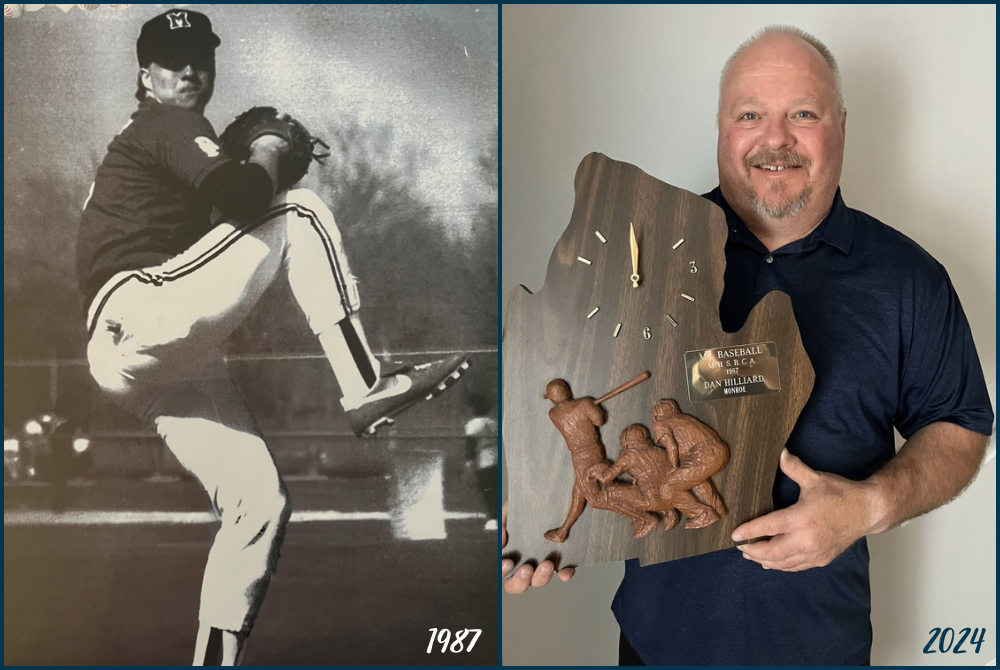
Monroe High Memories Remain Rich for Michigan's 1987 Mr. Baseball
By
Doug Donnelly
Special for MHSAA.com
July 22, 2024
WHITE LAKE – Dan Hilliard’s time came before Twitter, before computers were part of everyday life and almost before there was such a thing as Mr. Baseball.
 But he fit the bill perfectly.
As legendary Monroe Evening News sportswriter Bill Brenton once wrote about Hilliard’s Monroe High School baseball career, “a complete list of accomplishments would overload this word processor.”
Hilliard was an outstanding pitcher at Monroe High School during the late 1980s. He never lost a game his junior and senior seasons on the mound. He was an all-state choice and after his senior year was named Mr. Baseball, the second recipient of the award that has been handed out by the Michigan High School Baseball Coaches Association since 1986.
Scott Salow, the head coach at Homer High School when the Trojans won 75 straight games and his sport’s national coach of the year in 2005 by the National High School Coaches Association, was a high school teammate of Hilliard.
“He was absolutely dominant,” Salow recalls. “Our best overall player. He could hit and run as well.”
Hilliard was as surprised as anyone to learn he was Michigan’s Mr. Baseball after his senior season.
“I didn’t know there was any such thing as Mr. Baseball,” Hilliard said.
After going 9-0 with a 1.42 ERA and a .506 batting average in 1987, Hillard was invited to play in the MHSBCA All-Star Game at Tiger Stadium in Detroit. At a pregame dinner, one of the board members pulled him aside and told him they were going to call him up to the podium and introduce him as Mr. Baseball.
“I just thought, ‘Wow, OK,’” Hilliard said. “I didn’t really think baseball had that award. I didn’t really think of it.”
Hillard was a pitcher-outfielder for Monroe. For his career, he went 27-2 as a pitcher and had 57 stolen bases in 60 attempts.
“To me, I didn’t think I did anything super crazy,” he said. “I was part of a really good team. We put together a lot of wins. To me, I was just a part of the team. I didn’t think I stood out more than anyone else. It’s humbling to think back on those times.”
Longtime Blissfield coach Larry Tuttle – who has the most wins of any high school baseball coach in Michigan history – coached Hilliard in American Legion ball. Tuttle’s Blissfield team won the prestigious Monroe Auto Equipment Co. Baseball Tournament during Hilliard’s senior season, but Hilliard received the Most Valuable Player Award.
“He was very deserving of that honor,” Tuttle said. “He was a great pitcher, the best around. We recruited him to play summer ball with us.”
Tuttle was on the Mr. Baseball selection committee when the award began.
“We met and talked about it and decided we needed to do something to honor the best player in the state,” Tuttle said. “Dan was no doubt deserving after the season and career he had.”
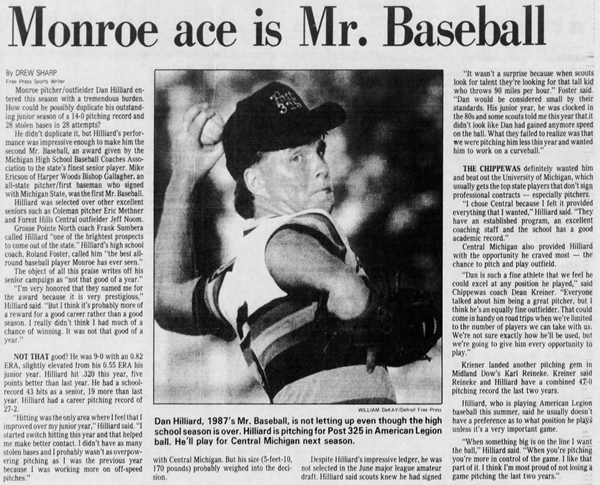 Hilliard grew up in Monroe, near the shores of Lake Erie, playing recreation baseball during the week and on a travelling “all-star” team that a few parents would organize on the weekends. As a youngster he played in the famed Monroe County Fair All-Star Tournament, which dates back to the early 1960s and is still going strong.
At Monroe, he couldn’t play high school baseball until his sophomore season.
“Back then, the high school was only sophomores through seniors,” he said. “I wasn’t at the high school as a freshman.
“I was a little intimidated at first,” he added. “It didn’t take long for me to realize I did belong up there on the varsity. I was the youngest guy on the team, so a few guys took me under their wing. I had a great time.”
Hilliard went 4-2 as a sophomore hurler for Butch Foster’s Trojans. His junior year is when he shined the brightest, going 14-0 on the mound with a 0.69 ERA and 155 strikeouts. He easily was picked as the player of the year by the local newspaper. He followed that up with another undefeated senior season and then joined Tuttle’s Blissfield-based American Legion team for the summer.
“I put together three pretty good years,” he said. “That was that.”
He made the short drive to Blissfield one afternoon for a game.
“It was my night to be on the mound, so I was in the bullpen warming up and Coach Tuttle came up to me and said, ‘Hey, I need to talk to you.’ That’s when he told me I was picked for the East-West All-Star game. I thought, well, that’s pretty cool,” Hilliard recalled.
Once in Detroit, the all-star players got together for a workout, then went to a banquet where Hilliard was announced as the statewide player of the year.
“A lot of the guys there were guys I had never heard of or never played against,” he said. “They were from different parts of the state.”
Hilliard went to Central Michigan University to play baseball, but never donned the Chippewas uniform. When his sophomore season rolled around, he transferred to Spring Arbor University near Jackson, where his older brother and Salow were playing baseball.
“I thought it was a better fit for me,” Hilliard said. “It ended up being great. I loved playing college baseball.”
It was at Spring Arbor where a teammate introduced him to his future wife, Elizabeth. They moved to White Lake soon after where they still live and have raised three children, ranging in age from 20-28. Sports remained a big part of Hilliard’s life. His two daughters both played volleyball in college, and his oldest daughter is now a coach at a university in Illinois. His youngest daughter plays college beach volleyball in North Carolina. His son was a three-sport athlete in high school who studied turf management at Michigan State University.
Hilliard works for an electrical supply house in Waterford.
“Things are going good,” he said. “It is a very nice place to live. There are a lot of lakes around here.”
His Mr. Baseball plaque hangs on the wall in his basement, right next to a photo of him at Tiger Stadium with the rest of the East-West all-stars.
“It pops into my head every so often,” he said of his high school days. “I pay attention to the local high schools up here and see who’s playing well. I think about those times a lot. I don’t talk about them often, but I think about it.”
He doesn’t have video clips of games he pitched, but the memories are strong.
“In this day and age with internet and YouTube and all these videos, you see a lot of great players in the state,” he said. “I wonder what it would have been like if I would have been in this modern day.”
2024 Made In Michigan
July 17: Record-Setting Viney Gained Lifelong Confidence at Marine City - Read
July 11: High School 'Hoop Squad' Close to Heart as Hughes Continues Coaching Climb - Read
July 10: Nightingale Embarking on 1st Season as College Football Head Coach - Read
June 28: E-TC's Witt Bulldozing Path from Small Town to Football's Biggest Stage - Read
PHOTOS (Top) At left, Dan Hilliard pitches for Monroe High as a senior in 1987; at right, he holds up his Mr. Baseball Award that continues to hang on a basement wall. (Middle) Hilliard headlines in the Detroit Free Press on June 18, 1987. (Top photos courtesy of Dan Hilliard. Clipping courtesy of the Detroit Free Press.)
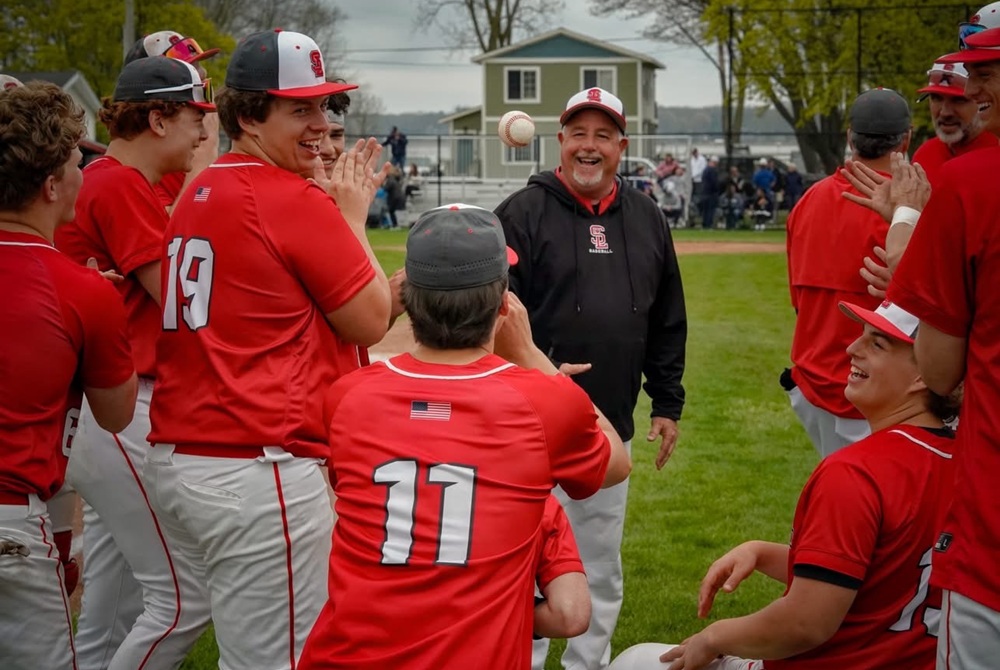
Senior-Powered Spring Lake Answering Anticipation, Pursuing High Expectations
By
Dean Holzwarth
Special for MHSAA.com
April 29, 2026
SPRING LAKE – The time is now for the Spring Lake baseball team.
 With the return of 11 veteran seniors, the Lakers entered this spring with lofty expectations and an eye on an extended postseason run.
Anticipation has come to fruition in the form of a state ranking and a nearly perfect start.
“Our motto is we are going to worry about next year next year, and we are going to do all we can this year,” Lakers fourth-year coach Bill Core said. “We knew we were going to have a big experienced group coming back, and that's just how the roster folded out. We have a lot of experience, a lot of returners and pretty high expectations.”
Spring Lake, which finished as Division 2 runner-up in 2024 and won a conference title last year for the first time since 2014, is off to an impressive 13-1 start (9-0 in the Ottawa-Kent Conference Black) and has climbed to No. 7 in the latest coaches poll.
Core said the vast number of returners, which includes five players who will play in college next year, has paid early dividends.
“I think that’s been a big difference,” he said. “We’ve played some younger teams that were breaking in sophomores or juniors or new kids, and our guys were ready to go right from the start. It’s been an advantage early on.”
Senior starting pitchers Oliver Smies and Maddux Kipling believe the strong bond among the senior class has been a major factor in the torrid start.
 “I think something that’s really important about this team is our team chemistry and the amount of seniors we have on the team,” Smies said. “That alone allows us to have a ton of experience, and I think that's a big reason why we are off to such a hot start. We have been playing good team baseball and complementary baseball with good defense and good offense.”
Added Kipling: “We genuinely like being around each other, and every day we show up ready to get a little better. Our team has a real gritty and energetic identity, and I think that shows in how we compete and support each other.”
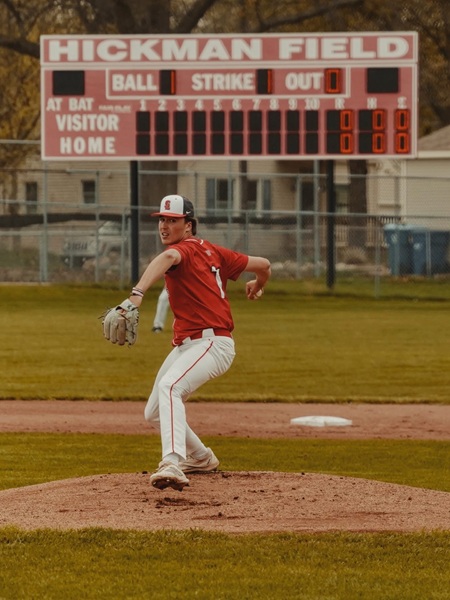
Kipling and Smies have been dominant on the mound this season. They haven’t allowed an earned run while combining for 80 strikeouts. Kipling earned a second-team all-state accolade as a junior and is headed to Michigan State next year. Smies will play at Calvin University.
“It starts with our pitching,” Core said. “Any time you are going to make a run, it starts with your pitching and we are pretty lucky, especially with our top two.”
Offensively, the Lakers possess a balanced lineup and boast a .330 batting average.
Senior Owen Smies, who will join his twin brother at Calvin, is hitting a team-best .432 with 13 RBIs. Seniors Alex Strauss (Adrian College) and Max Feltner (Muskegon Community College) are both batting .333 and have combined to score 25 runs.
As a team, Spring Lake has produced eight shutouts and nine wins by run differential.
“We got off to a good start, but we are going to play a lot better competition,” Core said. “This is a good week for us because we play Northview and state-ranked East Grand Rapids. We just picked them up, so we were excited to fill in the week with those two schools.”
Spring Lake is 62-6 over its last 68 games and trying to remain focused on each game as it attempts to erase the disappointment of last year’s early exit from the postseason.
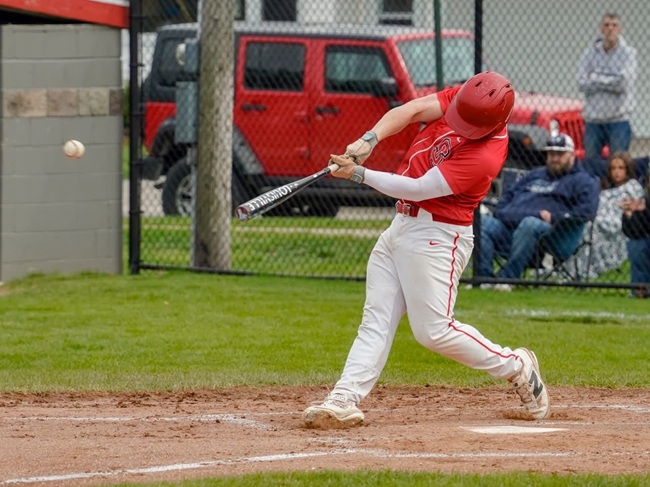 Despite winning 30 games, the Lakers suffered a 3-2 loss to Grand Rapids West Catholic in District play.
“I think there is some motivation there from that loss,” Oliver Smies said. “And I think that loss last year taught us that any team can beat any team, so you have to play your best baseball every single game no matter the opponent.”
Core said last year hasn’t been discussed, but believes it still sits in the back of his players’ minds.
“I think they think about that, but we've had quite a few mercies to start the season, and I said to them that when we get to the tournament it's going to be a one-run game and we are going to have to do the little things to make a difference because we are not going to win 14-0 all the time,” he explained. “We try to keep everyone in the moment.”
Kipling isn’t dwelling on the past – or looking too far ahead.
“As a group we’ve done a great job staying focused on the present and not getting caught up in the past or worrying too much about the future,” Kipling said. “My dad has always told me to focus on what you can control because putting energy into things you can’t control is a waste.
"That mindset has stuck with me, especially on the field. I try to live by ‘one pitch at a time,’ and because of that I haven’t really spent time thinking about last year’s loss. That’s behind us, and we’re just focused on what we can do right now.”
 Dean Holzwarth has covered primarily high school sports for Grand Rapids-based WOOD-TV for five years after serving at the Grand Rapids Press and MLive for 16 years along with shorter stints at the Ionia Sentinel and WZZM. Contact him at [email protected] with story ideas for Allegan, Kent and Ottawa counties.
PHOTOS (Top) Spring Lake baseball coach Bill Core tosses Maddux Kipling his home run ball after a win over Fruitport. (Middle) Kipling pitching at Spring Lake's Hickman Field. (Below) Senior Oliver Smies connects with a pitch. (Photos by Trevor McCue/Grand Haven Tribune.)