

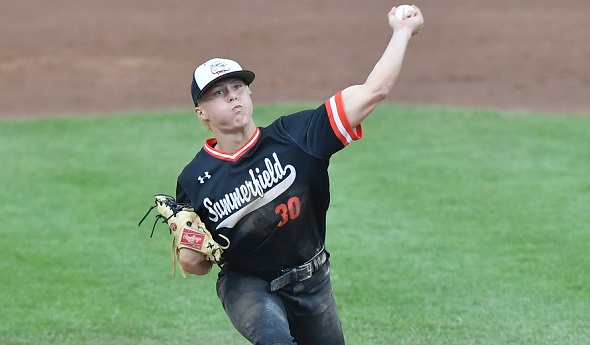
Performance: Summerfield's Derek Clark
June 20, 2019
 Derek Clark
Petersburg Summerfield junior – Baseball
The Bulldogs closed one of the most dominating runs in MHSAA Baseball Tournament history with their first championship Saturday, and Clark turned in a performance to match. The pitcher/centerfielder threw a four-hit shutout in the 9-0 Division 4 Final win over Saginaw Nouvel, capping a run of 44 straight scoreless innings pitched to close his junior season as he earned the MHSAA “Performance of the Week.”
Clark’s pitching statistics this spring were jaw-dropping. He finished 13-0 with a 0.20 ERA – good for seventh lowest in MHSAA history. He had 116 strikeouts in 70 innings pitched, with 11 strikeouts in the championship game including for the season’s final out. He was 4-for-7 from the plate over the Semifinal and championship games to push his average to .500 for this spring, and he also finished with 48 runs scored and 52 stolen bases (tied for 19th most) on 54 attempts over 32 games. Summerfield defeated Gaylord St. Mary 5-0 in the Semifinal on the way to meeting Nouvel on Saturday, and finished with a combined scoring margin of 89-2 over eight postseason games. The championship was the school’s first at the Finals level in any boys sport. The Bulldogs also won the Tri-County Conference and finished 28-4 overall, capping a complete program turnaround – more on that below.
A three-sport athlete as a junior, Clark doesn’t plan to play football as a senior but will return as the point guard for a basketball team that won the league this past winter for the first time since 2011-12. He’s also a 3.6 student, part of National Honor Society and student council, and is leaning toward studying business or sports marketing when high school is done. He should have some interesting options to continue on the diamond as well – the left-hander made the Division 4 all-state first team this spring as a pitcher after earning the same as an outfielder in 2018.
Coach Travis Pant said: “He’s an ultra competitor. He hates to lose, and it shows in the way he plays the game. Derek’s energy and leadership fueled this historic weekend that we had as a program. He’s a humble leader who brings an enthusiasm to the field every single day that is unmatched. What people saw this weekend in the Finals is what I have watched for the past three seasons. He plays the game the right way and is very fun to watch. … He has been the face of the rebuild we had at Summerfield. When he was an eighth grader, we went 6-28. In his freshman year he quickly became the ace and a leader in the dugout. We have won at least 21 games in every year since. Derek has pitched us to two District championships, two Regional championships and a state championship. He wants the ball in big games and the team fuels off his confidence. … Derek’s junior season was nothing short of amazing. He broke the county record for ERA with a 0.20 and was within three of the county stolen base record with 52. To do what he does on the mound and at the plate for us at such a consistent rate is amazing. Derek never had a bad day on the mound. No matter what the situation, he showed up with his best stuff.”
Performance Point: “The community's been really great about it. I can't go anywhere without having somebody say congratulations. I've had people I've never seen in my life say ‘Congrats,’” Clark said. “It's really nice to have that back-up, so to say, with our community. … With the weekend, it was just so good. All of our hard work, it finally paid off, finally got (us) to our number one goal. It's really nice to accomplish something this big. … The last out, to strike him out for the game, I was telling my catcher, ‘If we get to two outs, we've got to strike him out.’ I think that was probably the best moment. I just felt like it was more ecstatic, had us all pumped up. Because we had the confidence, I don't think it was shocking, so to say. We were really confident in ourselves and in our play because we were playing really well at the time. I think it was just more of a relief.”
Talking turnaround: “I think it’s just having guys that can play. The junior class this year was really big. We started five freshmen my freshman year. So just having that, and having guys come out. Also just having confidence in each other and trusting in each other, because team chemistry is huge. If you don’t have that, talent doesn’t really mean anything. … We’ve always been a baseball group. There’s been football and basketball, but we’ve been more of a baseball grade. I think we’ve been all right coming up, and we’ve just hit a stride the last couple of years and (we’re) just getting better.”
 Taking the lead: “I just try to be a leader of everything, every sport I play. When it comes to basketball, I'm the point guard so you've gotta communicate, you've gotta use your words, you can't be quiet. You're the general of the floor – you've got to know what to do, what's going on at all times. That's kinda how I am with baseball. I just try to keep everybody engaged and try to get everybody looks and help everybody as much as I can.”
Title time: “It's just great to finally get it done. Our baseball program, Coach (Darrell) Polter built it up (before retiring in 2014 after nearly 40 seasons). He has 17 league titles at Summerfield, and just to finally get that state title meant a lot to us. Nobody's really ever been there to do that, in any sport, so (the community) made a really big deal. We came home after we won, and there was a big parade in town and it was just really surreal and awesome to be a part of.”
Never stop competing: “I think we're all just so competitive. We'll be in math class, doing something that's competitive, and if you lose it's hectic. Nobody wants to lose. I think that's got something to do with (our success). When we grew up, we didn't want to lose ever. That's how we've been since we were little. Some kids take it even into school, like ‘Ha ha, I have better grades than you.’ It gets wild. I’m not bad (academically), but our shortstop Brendan Dafoe has a 4-point, and Brayden Jewell has a 3.8 or 3.9 or something like that. We’re all in advanced class, so we get after each other in there.”
- Geoff Kimmerly, Second Half editor
Past 2018-19 honorees
June 13: Audrey Whiteside, East Grand Rapids lacrosse - Read
June 6: Kari Miller, Ann Arbor Pioneer tennis - Read
May 23: Keshaun Harris, Lansing Waverly track & field - Read
May 16: Gabbie Sherman, Millington softball - Read
May 9: Nathan Taylor, Muskegon Mona Shores golf - Read
May 2: Ally Gaunt, New Baltimore Anchor Bay soccer - Read
April 25: Kali Heivilin, Three Rivers softball - Read
March 28: Rickea Jackson, Detroit Edison basketball - Read
March 21: Noah Wiswary, Hudsonville Unity Christian basketball - Read
March 14: Cam Peel, Spring Lake swimming - Read
March 7: Jordan Hamdan, Hudson wrestling - Read
February 28: Kevon Davenport, Detroit Catholic Central wrestling - Read
February 21: Reagan Olli, Gaylord skiing - Read
February 14: Jake Stevenson, Traverse City Bay Reps hockey - Read
February 7: Molly Davis, Midland Dow basketball - Read
January 31: Chris DeRocher, Alpena basketball - Read
January 24: Imari Blond, Flint Kearsley bowling - Read
January 17: William Dunn, Quincy basketball - Read
November 29: Dequan Finn, Detroit Martin Luther King football - Read
November 22: Paige Briggs, Lake Orion volleyball - Read
November 15: Hunter Nowak, Morrice football - Read
November 8: Jon Dougherty, Detroit Country Day soccer - Read
November 1: Jordan Stump, Camden-Frontier volleyball - Read
October 25: Danielle Staskowski, Pontiac Notre Dame Prep golf - Read
October 18: Adam Bruce, Gladstone cross country - Read
October 11: Ericka VanderLende, Rockford cross country - Read
October 4: Kobe Clark, Schoolcraft football - Read
September 27: Jonathan Kliewer, Grand Rapids Forest Hills Northern soccer - Read
September 20: Kiera Lasky, Bronson volleyball - Read
September 13: Judy Rector, Hanover-Horton cross country - Read
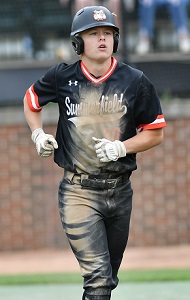
PHOTOS: (Top) Petersburg Summerfield's Derek Clark unloads a pitch during Saturday's Division 4 championship game win at McLane Stadium. (Middle) Clark heads back to his dugout after sliding in head-first to score in Friday's Semifinal.
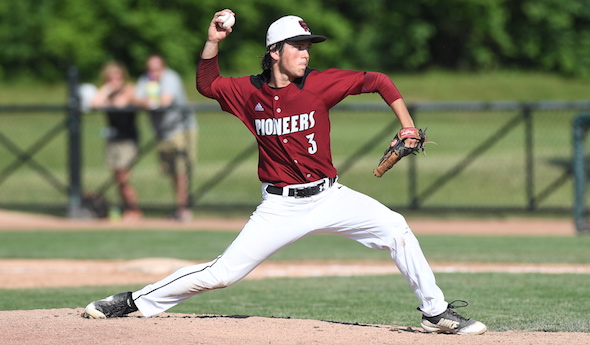
Ace Paces Richard's Championship Triumph
June 16, 2018
By Jason Schmitt
Special for Second Half
EAST LANSING – He’d seen a dropped third strike 100 times before Saturday’s championship game.
Excuse Riverview Gabriel Richard’s Matthew Silka for getting caught up in the moment.
With two outs in the seventh inning, the junior got a swinging third strike to seemingly clinch his team’s first MHSAA baseball title. But his biting breaking ball ended up in the dirt – so he looked at the catcher, then glanced at first. Finally, he turned and looked at his second baseman, who was charging toward him to celebrate.
At that moment, he figured it out. His team had just won the Division 3 championship, defeating reigning champ Madison Heights Bishop Foley, 3-0.
“I was so confused,” said Silka, smiling with a championship medal hanging from his neck. “That’s not an ideal way to end the game, because I’m not sure if we won or not. I was looking at the first base ump to see if he was going to call him out or not. We were all waiting for someone to say something.”
The game-ending strikeout was his seventh of the game, one he dominated from start to finish. Silka, a junior, allowed just one hit, that coming in the seventh inning. Prior to that single, he was on his way to becoming the first pitcher to toss a complete-game no hitter in MHSAA Finals history.
Instead, he became just the fifth pitcher in Finals history to allow just one hit in a complete game.
“I was trying to keep (the ball) to the corners, and not make too many mistakes and leave the ball over the heart of the plate,” Silka said. “I was just trying to throw strikes and help my teammates out.”
His teammates helped him out early on, scoring a run in the second, third and fourth innings to stake him to a 3-0 advantage.
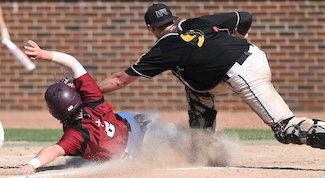 The Pioneers scored their first run unconventionally. Leadoff batter Hayden Burke reached on a dropped third strike. The junior then moved over to second base on a walk to fellow junior Frank Klamerus. Those two advanced to second and third thanks to a pair of wild pitches. Burke then scored on a fielder’s choice by junior Hayden Flynn to make it 1-0.
In the third inning, Richard pieced together three singles – the last by Flynn plated junior Niko Maloney. In the fourth inning, the Pioneers used a walk, sacrifice bunt and an RBI-single by sophomore David Zubor to cap off their scoring, giving Silka more than he needed to get the job done.
“I think momentum is one of the biggest parts of the game,” Silka said. “That was really huge for us to get out in front. I knew once we had a lead and we got rolling, it was going to be a lot easier to pitch.”
Richard coach Mike Magier said Silka’s success was due to his ability to keep the Ventures off balance.
“He went through the lineup one time and he gained a little confidence, and he could use his secondary pitches a little bit more,” Magier said. “(Silka) has been a workhorse for us. He’s really been a competitor.
“He’s been our ace. He’s pitched against all our tough teams.”
Bishop Foley (19-18-1) could muster just one hit – from sophomore Liam Pollock to lead off the seventh inning.
“That’s baseball,” Foley coach Tim McEvoy said. “We ran into a stud pitcher who threw strikes. He kept us off balance, and we weren’t able to get out in front of his fastball. That was the main issue.
“I want to congratulate their coaching staff. They have a great staff and a great pitcher.”
For Richard (29-3), this could be just a taste of what’s to come next year. There are no seniors on the roster, so everyone should be back for another title run in 2019.
“I guess it’s kind of unusual,” said Magier, talking about a lack of seniors on his roster. “That (junior) class, as soon as they came in in ninth grade, we had three or four guys come up on varsity and we knew we had a pretty good class there.
“It takes a lot to win a state championship, so we won’t take it for granted. We’re going to enjoy this one, and hopefully next year we can do the same.”
VIDEO: Gabriel Richard pitcher Matthew Silka finishes his seventh strikeout, which wrapped up the 3-0 win over the Ventures.
PHOTOS: (Top) Gabriel Richard ace Matthew Silka makes his move toward the plate Saturday. (Middle) A Pioneers runner tries to slide in under the tag of Bishop Foley catcher Mason Minzey.