

Preview: First-Time Winner Guaranteed
June 15, 2016
By Geoff Kimmerly
Second Half editor
Reigning MHSAA champions Hartland and Jackson Lumen Christi will return to Michigan State University's McLane Stadium this weekend hoping to enjoy another celebration on the final weekend of the 2015-16 school year.
But nine of 16 contenders at this season's Semifinals are seeking their first MHSAA title in baseball, and three are hoping to play in a championship game for the first time. It's guaranteed the Division 4 champion will be a first-time winner, as none of the four contenders have claimed an MHSAA title before.
See below for a schedule of this weekend’s games, plus glances at all 16 teams that will take the field beginning Thursday.
Semifinals – Thursday
Division 1
Traverse City West vs. Warren DeLaSalle, 2:30 p.m.
Saline vs. Hartland, 5 p.m.
Division 2
Holland Christian vs. DeWitt, 9 a.m.
Linden vs. Dearborn Divine Child, 11:30 a.m.
Semifinals – Friday
Division 3
New Lothrop vs. Jackson Lumen Christi, 2:30 p.m.
Grosse Pointe Woods University Liggett vs. Scottville Mason County Central, 5 p.m.
Division 4
Centreville vs. Sterling Heights Parkway Christian, 9 a.m.
Gaylord St. Mary vs. Portland St. Patrick, 11:30 a.m.
Finals – Saturday
Division 1: 11:30 a.m.
Division 2: 9 a.m.
Division 3: 5 p.m.
Division 4: 2:30 p.m.
Tickets cost $8 per round and include admission to softball and girls soccer games those days also at MSU’s Old College Field. Radio broadcasts of all games can be heard online at MHSAAnetwork.com. All games will be streamed live online at MHSAA.TV and viewable on subscription basis. Click to order tickets in advance and for a parking map.
All statistics below are through Regionals. (Click for links to brackets and scores.)
Division 1
HARTLAND
Record/rank: 36-5-1, No. 10
Coach: Brian Morrison, 15th season (397-158-4)
League finish: Second in Kensington Lakes Activities Association West
Championship history: Division 1 champion 2015.
Players to watch: John Baker, sr. 1B/P (.405, 4 HR, 43 RBI; 10-1, 0.83 ERA, 105 K pitching); Hunter DeLanoy, jr. 2B (.403, 26 RBI, 38 R); Nathan Lohmeier, sr. P (8-0, 0.54 ERA, 96 K pitching).
Outlook: Hartland is already eight wins better than the team that won last season’s championship. Baker – who has signed with Ball State University – starred in throwing 10 innings of one-run ball in the Final against Portage Northern, and seven hitters from last season’s lineup are back this weekend. The Eagles have given up only seven runs total in five postseason games during this run.
SALINE
Record/rank: 34-6, No. 2
Coach: Scott Theisen, 24th season (636-239-8)
League finish: First in Southeastern Conference Red
Championship history: Four runner-up finishes (most recent 2010).
Players to watch: Josh Nelson, sr. P (10-0, 0.63 ERA, 67 K pitching); Jake Finkbeiner, jr. 3B (.409, 4 HR, 38 RBI); Cole Daniels, soph. P/1B (.424, 29 RBI; 8-1, 1.55 ERA, 45 K pitching).
Outlook: Saline has won at least 30 games four of the six seasons since its most recent trip to an MHSAA championship game, and is back in the Semifinals for the first time since 2012. The Hornets have scored 49 runs over five tournament games the last three weeks, and all nine in the lineup hit at least .333 – with Ryan Foley (.412) adding a third over .400.
TRAVERSE CITY WEST
Record/rank: 41-2, No. 9
Coach: Matt Bocian, eighth season
League finish: First in the Big North Conference
Championship history: Has never played in an MHSAA Final.
Players to watch: Nick Brzezinski, sr. CF (.504, 14 2B, 8 3B, 52 RBI, 67 R, 16 SB); Alex Strickland, sr. C (.496, 10 2B, 73 RBI); Jake Newhouse, sr. 3B/C/P (.417, 39 RBI; 5-0, 0.56 ERA pitching).
Outlook: West has built on its first Regional title with this trip to the Semifinals, eliminating No. 3 Bay City Western, No. 4 Rockford and honorable mention Saginaw Heritage during the tournament run. A roster loaded with nine seniors boasts a one-two pitching combination of Keegan Kenny (10-1, 1.40 ERA) and sophomore Ryan Hayes (10-0, 0.64 ERA) and a 2.01 team ERA.
WARREN DELASALLE
Record/rank: 26-13, unranked
Coach: Matt Cook, sixth season (122-101-3)
League finish: Fourth in Detroit Catholic League Central
Championship history: Three MHSAA titles (most recent 2009), runner-up 2012.
Players to watch: Rob Zurawski, sr. 3B/OF (.389, 11 2B, 30 RBI); Mac Graybill, soph. C/IF (.344); Easton Sikorski, soph. P/IF (7-2, 1.84 ERA pitching).
Outlook: The Pilots have won 10 of their last 11 with victories over honorable mention Grosse Pointe North and Division 2 No. 10 Detroit Country Day during the streak after emerging from the always-tough Catholic League Central. DeLaSalle went a combined 4-5 against Division 1 No. 1 Birmingham Brother Rice and Division 2 No. 2 Orchard Lake St. Mary’s during the regular season. These are the most wins under Cook, who led a team with a sub-.500 record to the Division 1 Final in his second season, 2012.
Division 2
DEARBORN DIVINE CHILD
Record/rank: 26-15, unranked
Coach: Tony DeMare, 17th season (453-199)
League finish: Third in Detroit Catholic League Central
Championship history: Five MHSAA titles (most recent 2010).
Players to watch: Frankie Lucska, sr. 2B (.384, 17 2B, 37 RBI); Nick Gurney, jr. P/OF (.357, 22 RBI; 6-1, 1.55 ERA, 53 K pitching); Torey DeMare, sr. 1B (.328, 20 2B, 34 RBI).
Outlook: Divine Child is riding a 10-game winning streak and beat No. 10 Detroit Country Day in the Quarterfinal to advance. The Falcons prepared against the treacherous Catholic League Central, earning wins against ranked Brother Rice, Orchard Lake St. Mary’s and Division 1 semifinalist Warren DeLaSalle. Senior left fielder Danny Blade (.315) made the all-state second team last season and leads off, and junior Daniel Bullard (6-2, 1.45 ERA) provides another proven arm.
DEWITT
Record/rank: 30-9-1, honorable mention
Coach: Alan Shankel, seventh season (164-80-2)
League finish: Second in Capital Area Activities Conference Red
Championship history: Two MHSAA titles (most recent 1993), two runner-up finishes.
Players to watch: Michael Stygles, jr. OF/P (.508, 12 2B, 4 HR, 45 RBI; 1.26 ERA, 37 K pitching); Donovan Tarn, sr. 3B/P (.429, 13 2B, 5 HR, 39 RBI; 2.30 ERA, 79 K pitching); Will Nagel, jr. SS/P (.354, 14 2B, 6 HR, 45 RBI; 2.33 ERA 33 K pitching).
Outlook: DeWitt won its third straight Regional title and will return to the Semifinals after reaching in 2014 but missing last season. The Panthers’ 30 wins are their most under Shankel and came with nine sophomores but only three seniors on the roster. DeWitt picked things up quickly this spring, splitting with No. 6 Haslett midway through and taking a win over No. 10 Marshall before the postseason began. Sophomores Mark Connelly (.366), Nolan Knauf (.417) and Josh Robinson (.408) fill out the top six in the lineup along with Stygles, Tarn and Nagel.
HOLLAND CHRISTIAN
Record/rank: 34-6, No. 3
Coach: Jim Caserta, third season (78-24)
League finish: First in Ottawa-Kent Conference Green
Championship history: Has never played in an MHSAA Final.
Players to watch: Mike Mokma, sr. P/1B (.441, 4 HR, 32 RBI, 15 HBP); Brandon Riemersma, sr. CF (.319, 34 R); David Williams, sr. C (.354, 6 HR, 32 RBI).
Outlook: Holland Christian is making its first Semifinal appearance after winning its second Regional title ever, and with an all-state catcher and arguably the best pitcher in Michigan. Although his stats on the mound were unavailable, Mokma has thrown multiple perfect games (the second one shortened) this season and will play collegiately at MSU. Holland Christian beat honorable mentions Grand Rapids Kenowa Hills and Ada Forest Hills Eastern along the tournament path.
LINDEN
Record/rank: 28-9-1, No. 5
Coach: Steve Buerkel, sixth season (140-73-1)
League finish: First in Flint Metro League
Championship history: Division 2 runner-up 2004.
Players to watch: Chris Kitch, sr. 1B (.336); Kevin Bates, sr. SS (.316, 11 SB); Jack Shore, jr. P (12-1, 0.31 ERA, 111 K pitching).
Outlook: Linden is making its second run to the Semifinals ever after winning its fourth straight District title. The Eagles entered the postseason having lost six of their last nine (and closing with Division 1 semifinalist Hartland), but have given up only one run in five tournament games, outscoring those opponents by a combined 18-1. Junior center fielder Ryker Rivera adds another spark to the lineup hitting .319 with 23 stolen bases.
Division 3
GROSSE POINTE WOODS UNIVERSITY LIGGETT
Record/rank: 29-4, No. 1
Coach: Dan Cimini, 13th season (355-79)
League finish: First in Michigan Independent Athletic Conference Blue
Championship history: Four MHSAA titles (most recent 2014), two runner-up finishes.
Players to watch: William Morrison, soph. CF (.400, 12 2B, 51 RBI, 12 SB); Connor McCarron, jr. SS (.505, 17 2B, 64 R, 21 SB); Sean Fannon, sr. OF (.351, 15 2B, 27 RBI); Matthew Gushee, sr. P/OF (.325, 12 2B, 31 RBI; 9-1, 0.74 ERA, 83 K pitching).
Outlook: All four players mentioned above earned all-state recognition last season as the team won the sixth of what are now seven straight District titles – and the Knights also won Division 3 in 2014 and Division 4 in 2013. Liggett opened this season 23-1 and edged No. 6 Madison Heights Bishop Foley during the Regional; it also owns victories over Division 2 No. 10 Detroit Country Day and Warren DeLaSalle.
JACKSON LUMEN CHRISTI
Record/rank: 25-13, honorable mention
Coach: Phil Clifford, sixth season (133-85-1)
League finish: Tied for first in Interstate-8 Athletic Conference
Championship history: Two MHSAA titles (most recent 2015).
Players to watch: Zach Mehelich, sr. P/IF; John Fleming, sr. C/F; Connor Mogle, jr. C/OF. (Statistics not submitted.)
Outlook: The reigning champ eliminated No. 5 Schoolcraft, No. 7 Parchment and honorable mention Bronson on the way to MSU and during a current nine-game winning streak. Mehelich was an all-stater last season and Fleming the winning pitcher with a shutout in the MHSAA Final. Those two were joined by Mogle in the starting lineup for that championship game.
NEW LOTHROP
Record/rank: 40-3, No. 4
Coach: Benjamin Almasy, first season (40-3)
League finish: First in Genesee Area Conference Blue
Championship history: Division 4 champion 2014.
Players to watch: Cam Pope, sr. P (.485, 58 R, 13 2B, 44 RBI; 12-2, 0.42 ERA, 121 K pitching); Quentin Taylor, sr. CF (.575, 63 R, 16 2B, 10 HR, 67 RBI, 20 SB); Zac Besant, soph. C/P (.422, 11 2B, 39 RBI; 10-0, 0.89 ERA 68 K pitching).
Outlook: New Lothrop exited during the Regional a year ago but is back in the Semifinals under Almasy, who also has coached at Mount Morris, Flint Southwestern and Flint Hamady. The Hornets trailed 5-0 in the seventh inning of their Quarterfinal before rallying for a 6-5 win over Standish-Sterling. Six regulars bat at least .400; in addition to the three mentioned above, sophomore second baseman Nic Johnson comes in at .467, freshman right fielder Nathaniel Lane at .440 and senior shortstop Steve Garza at .417.
SCOTTVILLE MASON COUNTY CENTRAL
Record/rank: 28-8, unranked
Coach: Don Thomas, 10th season (216-144)
League finish: Second in West Michigan Conference.
Championship history: Has never played in an MHSAA Final.
Players to watch: Blake Bladzik, sr. CF (.452, 51 RBI, 12 SB); Mitchell Lange, sr. SS (.451, 20 SB, 39 RBI); Spencer Knizacky, sr. C (.447, 51 R, 25 RBI, 25 SB).
Outlook: Mason County Central will play in its first Semifinal after winning its first Regional since 1998. A strong group of seniors fill the middle of the lineup and the top two pitching spots – Trevor Carrier (9-1, 1.92 ERA) and Nolan Asiala (9-1, 2.63 ERA) have seen most of the innings. Junior designated hitter Austin Tyndall (.451) and junior left fielder Cody Soberalski (.444) give the team two more big hitters as they try to add to a 15-game victory streak.
Division 4
CENTREVILLE
Record/rank: 28-3, No. 1
Coach: Mike Webster, fifth season (105-49-1)
League finish: First in Berrien-Cass-St. Joseph Conference East
Championship history: Division 4 runner-up 2015.
Players to watch: Coletin Gascho, jr. P/3B (.388, 13 SB, 37 R; 12-0, 0.99, 60 K pitching); Jalen Brown, sr. 1B (.424, 30 RBI); Michael Kool, sr. P/3B (.295, 25 R; 11-1, 0.52 ERA, 106 K pitching).
Outlook: The reigning runner-up did its work to get back to MSU with wins over No. 2 Kalamazoo Hackett and No. 5 St. Joseph Lake Michigan Catholic during the earlier rounds and a nine-inning nail-biter against Concord in the Quarterfinal. Kool was the Semifinal winning pitcher a year ago; seven of the team’s top eight hitters from the 2015 championship game are back in the lineup.
GAYLORD ST. MARY
Record/rank: 31-5, No. 8
Coach: Matt Nowicki, 12th season (186-152)
League finish: First in Ski Valley Conference
Championship history: Class D runner-up 1988 and 1989.
Players to watch: Adam Nowicki, sr. SS; Nicholas Torsky, jr. P/IF; Drew Long, soph. P/2B. (Statistics not submitted.)
Outlook: St. Mary is on its longest run since those runner-up finishes at the end of the 1980s, and with only four seniors on the roster. The Snowbirds got past No. 9 Norway in the Quarterfinal and have won 16 straight. The six runs scored Tuesday were their fewest of the tournament; St. Mary had scored 10 or more in eight straight games.
PORTLAND ST. PATRICK
Record/rank: 33-7, unranked
Coach: Bryan Scheurer, 12th season (279-101)
League finish: Second in Central Michigan Athletic Conference
Championship history: Three MHSAA runner-up finishes (most recent 1993).
Players to watch: Travis Moyer, sr. P/3B (.372, 32 RBI; 13-2, 0.60 ERA, 111 K pitching); Brendan Schrauben, jr. C (.425, 7 HR, 50 R, 42 RBI); Garrett Pline, sr. CF (.362, 30 RBI, 22 SB).
Outlook: Portland St. Patrick made its first Semifinals since 2010 with a Quarterfinal win over No. 3-ranked and reigning champion Muskegon Catholic Central, and also beat Fowler 1-0 to open the postseason after losing to the eventual CMAC champ Eagles twice during the regular season. Moyer leads a solid pitching staff that has given up only eight runs over five playoff games and paced the Shamrocks to a school record for wins.
STERLING HEIGHTS PARKWAY CHRISTIAN
Record/rank: 21-11-1, unranked
Coach: Rich Koch, sixth season (101-60-1)
League finish: Second in Michigan Independent Athletic Conference Red
Championship history: Division 4 runner-up 2009
Players to watch: Riley McManus, sr. P/1B/3B; Andrew Manier, sr. P/1B/OF; Pierce Banks, sr. P/SS. (Statistics not submitted.)
Outlook: Parkway prepared for the tournament against a number of bigger schools during the regular season and has outscored its playoff opponents by a combined 49-5 over five games. The team’s top six hitters in the lineup are all seniors, and McManus was an all-stater in 2015 when the team won its second of three straight District titles.
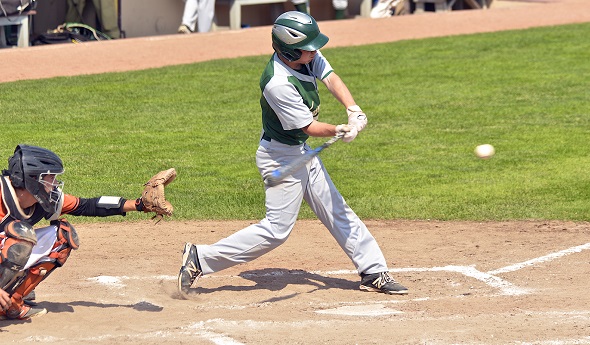
PHOTO: A Traverse City West batter takes a swing during Tuesday's win over Rockford in their Division 1 Quarterfinal. (Click to see more from HighSchoolSportsScene.com.)
Longtime Chelsea High School Administrator, Coach Bush to Join MHSAA Staff as Assistant Director
By
Geoff Kimmerly
MHSAA.com senior editor
December 21, 2022
Brad Bush, a highly-respected educator, administrator and coach over the last three decades, has been selected to serve in the position of assistant director for the Michigan High School Athletic Association, beginning Jan. 17.
 Bush, 52, taught and coached at East Kentwood High School for four years before beginning a tenure at Chelsea High School in 1997 that has included teaching, then serving as athletic director and later also assistant principal and leading the football program as varsity coach from 1997-2002 and again from 2004-18.
He also has served as a statewide delegate on the MHSAA Representative Council during the last year and provided leadership in multiple roles, including president, for the Michigan High School Football Coaches Association (MHSFCA) since 2005.
Bush will serve as the MHSAA’s lead administrator for baseball and also among lead administrators for the officials program, which includes more than 8,000 registered officials in all sports. Bush also will be assigned additional duties in other sports based on his vast experiences. He was selected from a pool of 34 applicants.
“I’m incredibly excited to have Brad join our team,” MHSAA Executive Director Mark Uyl said. "He’s been an outstanding athletic director and coach who is highly-respected by those who know him.”
As Chelsea athletic director, Bush annually has supervised a staff of 110 coaches across 31 programs, with nearly 70 percent of the high school’s 800 students participating in athletics. As a teacher and assistant principal, he has served on Chelsea’s School Improvement Team and on multiple committees that provided instructional leadership including in the development of the district’s new trimester schedule. In his roles with the MHSFCA, Bush helped direct an organization with more than 2,200 members and also served as the association’s treasurer and liaison to the MHSAA.
Bush is perhaps best known, however, for his coaching success. Over 22 seasons, he led Chelsea’s varsity football team to a 169-60 record, 13 league championships, 18 playoff appearances, seven District titles and a Division 3 runner-up finish in 2015. During his break in tenure as Chelsea coach, Bush served as an assistant football coach and recruiting coordinator for Eastern Michigan University during the 2003-04 school year, and he has served as an assistant coach at Albion College the last four seasons contributing to the team’s two league titles and appearance in the 2021 NCAA Division III Playoffs.
“I feel like joining the team at the MHSAA is an opportunity I couldn’t pass up,” Bush said. “The 26 years I spent at Chelsea were some of the best times of my life. It’s a professional transition that in the back of my mind, if this opportunity came, was something I needed to do.
“Over time, I’ve grown to care about the bigger picture of athletics and appreciate the role of the MHSAA in protecting high school athletics in Michigan.”
Bush is a 1988 graduate of Ypsilanti High School. He studied and played quarterback at Cornell University before returning and graduating from EMU after majoring in history and minoring in social studies. He earned his physical education endorsement from EMU in 2000 and his master’s in physical education and sports management from EMU in 2002. He has earned continuing education credits in sports management from Drake University and completed the Path to Leadership program from the Michigan Association of Secondary School Principals (MASSP).
Bush was inducted into MHSFCA Hall of Fame and Ypsilanti High School Hall of Fame both in 2019. He and his wife Laura have three adult children, two daughters and a son.
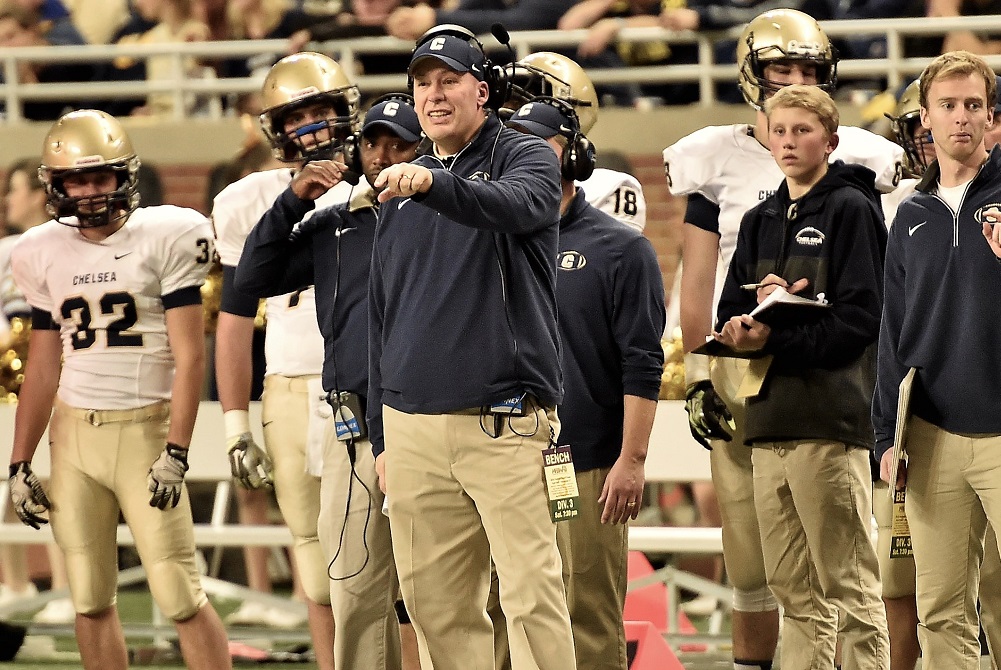
PHOTO Chelsea coach Brad Bush directs his team during the 2015 Division 3 Final at Ford Field.