

Pro Stars Cherishing St Clair Roots, Support
By
Paul Costanzo
Special for MHSAA.com
November 11, 2020
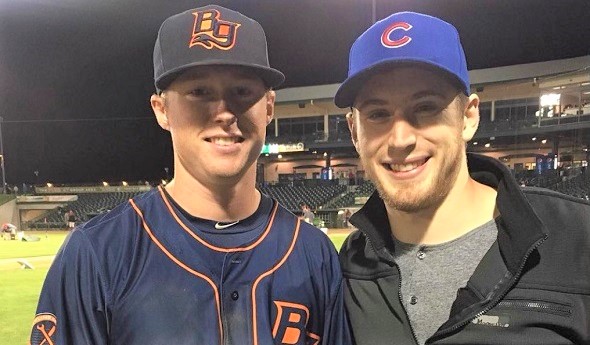
It’s been nearly 10 years since Jacob Cronenworth and Tyler Motte were teammates at St. Clair High School, but the pair still managed to energize their hometown in 2020.
 Cronenworth tied for second in the official National League Rookie of the Year voting, which was announced Monday – and won several Rookie of the Year honors from other organizations, including his fellow players – after a standout first season with the San Diego Padres.
Motte was a key cog for the Canucks as they made a run to the Western Conference semifinals, scoring four goals and adding an assist in 17 playoff games, and earning himself a two-year contract extension in October.
And as the folks back home were reveling in that success, both were happy to have the support.
“The support of our town has been crazy throughout my career, even back when I was at Michigan,” Motte said. “When you have the support of not just your friends, family and loved ones, to have it go to an even bigger population where you grew up, that’s cool to see.”
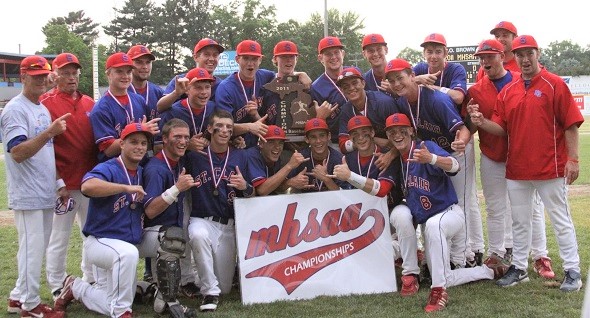
 Motte and Cronenworth provided plenty of great memories while students in St. Clair, most notably helping the Saints win the 2011 MHSAA Division 2 baseball championship. Cronenworth was the winning pitcher in the title game, while Motte had two hits and scored what turned out to be the winning run against Grand Rapids Christian.
“Obviously, that was an incredible team,” said Cronenworth, who was a junior that season. “We only lost one game the whole year. It was just a special group of guys. We were all friends, we all played little league together. We’d all play street hockey and basketball together in the summers. It was a great way to cap off our childhood.”
That team featured 10 players who would go on to play college athletics. Two – Joel Seddon and Jared Tobey – joined Cronenworth and Motte as professional draft picks, as they were both selected in the MLB Draft. Another, Jeremy Carrell, is now the Detroit Tigers bullpen catcher.
Most of the players on the title team had been playing together since Little League, where they also had plenty of success, taking second in the state in 2006 before a handful of them came back and took third the next year. As they stayed together, the wins kept coming.
“I think at the time (2011), with that group of people, our eyes were on a state championship,” Motte said. “I was in more of a supporting role, because we had a lot of good baseball players. Just looking back, it was kind of crazy.
“Going through with those guys and how much fun we had in Little League really made the camaraderie we had in high school so much stronger. We had guys that really cared about each other, and that’s what made it really fun.”
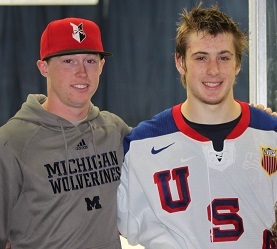 The 2011 Division 2 Final was Motte’s final competitive baseball game, as after his sophomore year he joined the USA Hockey National Team Development Program in Ann Arbor. He had planned to continue playing baseball while going to school at Ann Arbor Pioneer, but said that it didn’t work out.
“If there was a way to go out, that’s the way to do it,” he said.
Baseball was a big part of Motte’s athletic upbringing, just like hockey was a big part of Cronenworth’s. The two had played travel hockey together locally in Port Huron, and Cronenworth continued to play the sport through high school. By that time, baseball had started to look like his path forward, but he was still a star on the ice, winning the Macomb Area Conference Red MVP.
“It was one of those things, I think Tyler wanted to play both in college, but it was a decision that we kind of had to make – I always wanted to play hockey,” Cronenworth said. “I think probably my sophomore year of high school, maybe freshman year when I got called up to the varsity in baseball, that was the turning point. But (hockey season) was huge. It just gave me a rest from baseball. When we were younger, yeah, you’re playing street hockey in the summer, but when it was baseball season, we played baseball, and when it was hockey season, we played hockey.”
Both went to University of Michigan to continue their academic and athletic careers and took winding professional paths before getting the opportunities they’re currently enjoying.
Both already have been part of multiple pro organizations. Cronenworth was dealt to San Diego after beginning his career as a Tampa Bay Rays draft pick. Motte was a Chicago Blackhawks draft selection and after his first season was traded to the Columbus Blue Jackets, who later sent him to Vancouver.
But while they may both be out west now, their biggest fans remain in St. Clair – unless you count each other.
“I got to watch him play basically every single game besides,” Cronenworth said. “He had that game where he scored two short-handed goals, and I’m in my living room at 10:30 in the morning screaming at the TV. We have a group chat with the guys we played with in high school. We’re like one big family. We grew up together.”
 Paul Costanzo served as a sportswriter at The Port Huron Times Herald from 2006-15, including three years as lead sportswriter, and prior to that as sports editor at the Hillsdale Daily News from 2005-06. He can be reached at [email protected] with story ideas for Genesee, Lapeer, St. Clair, Sanilac, Huron, Tuscola, Saginaw, Bay, Arenac, Midland and Gladwin counties.
PHOTOS: (Top) Former high school teammates Jacob Cronenworth (left) and Tyler Motte meet up while Cronenworth plays minor league baseball for the Bowling Green Hot Rods in 2016. (Middle) Cronenworth shows his support for Motte during the latter’s time suiting up for USA Hockey. (Below) Cronenworth holds the trophy and Motte is bottom row, second from right, as St. Clair celebrates its 2011 Division 2 baseball championship. (Photos of Cronenworth and Motte together courtesy of Tyler Motte; head shots courtesy of MLB.com and NHL.com, respectively.)
Brother Rice Baseball, Lacrosse Standouts Live Out National Team Dreams
By
Steve Vedder
Special for MHSAA.com
October 23, 2026
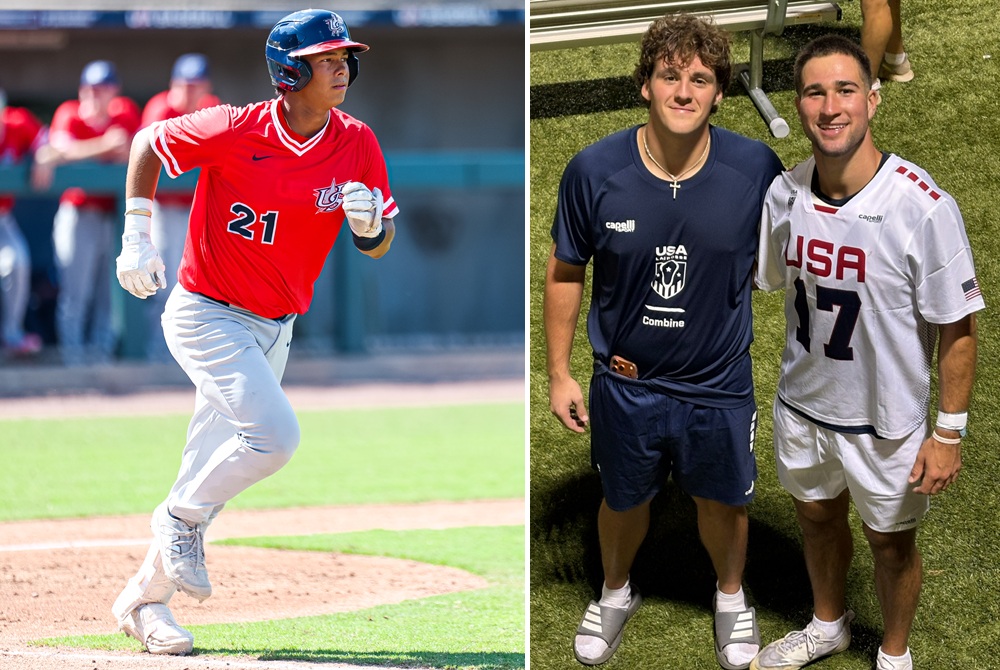
Broder Katke sees it as a once-in-a-lifetime opportunity, a stepping stone and also a chance to showcase himself not only on a national level, but eventually an international one.
Not least of all, however, is the chance to represent his country.
When the Bloomfield Hills Brother Rice senior and Vanderbilt University commit found out he'd made the USA Baseball U-18 team for the recently commenced WBSC Americas U-18 Pan Am Championships in the Dominican Republic, he didn't dwell on the pressure and long odds he overcame, but instead on what a tremendous opportunity the selection offers.
"There are definitely a lot of ways to look at it," said Katke, one of three Brother Rice athletes selected to compete in select United States national competitions this fall. "I just looked at it like, don't press, don't make the situation bigger than it is. You just go about it like any other game, any other at-bat.
"It was super cool to make the team a cold-weather state. Putting that "USA" across your chest and representing your country is a big thing."
A senior catcher for Brother Rice, Katke made the U-18 team following tryouts at the USA Baseball facility in Cary, N.C., in late August. Eighty-eight players were invited including other catchers from California, Florida, Georgia, Tennessee, Indiana, Minnesota and Puerto Rico. Katke impressed a coaching staff comprised of predominantly former major leaguers by going 5-for-17 with two RBIs in eight games.
The Pan Am Championships are a qualifier for the 2027 U-18 World Cup in China. Katke is the first Michigan native to make the U-18 roster since Billy Killian of Remus Chippewa Hills in 2003. Just 10 Michigan high schoolers have made that team since its founding in 1981.
Recent graduates of the U-18 program include current major leaguers Pete Crow-Armstrong, Bobby Witt Jr., Riley Greene, C.J. Abrams, Corbin Carroll, Nolan McLean, Jackson Holiday and Dylan Crews. Among USA Baseball coaches at the tryouts were former big leaguers Brian Schneider, Rick Ankiel, Ryan Zimmerman, Ian Desmond and Brad Wilkerson.
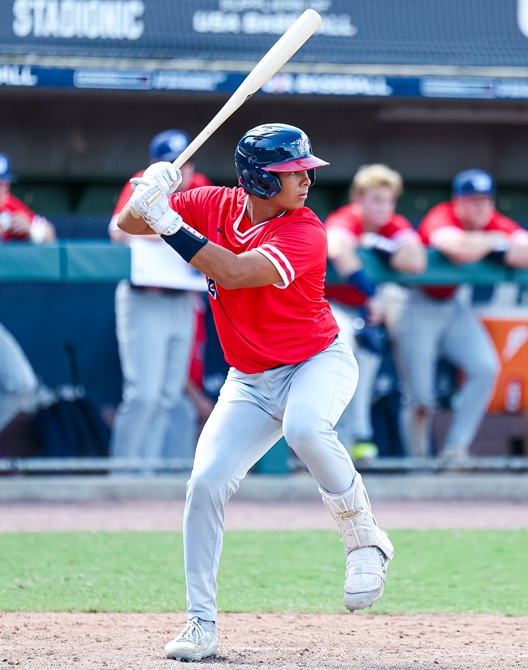
Katke made Michigan's all-state Dream Team at Brother Rice last spring after batting .410 with 21 RBIs and 34 runs. In three seasons at Brother Rice, Katke has hit .371 with 78 RBI, 31 doubles and eight homers in 275 at-bats.
He knows the rarity of making a national team when 14 of the 20 players come from baseball-popular, warm-weather states California, Florida, Texas and Georgia.
"Michigan is a cold-weather state, but it doesn't get enough credit in baseball," said Katke, rated as the nation's 37th-best player by Perfect Game and 31st by Prep Baseball. "But (cold-weather) teams haven't faced some of the pitching we have. I was never stressed out at the tryout; I just wanted to compete and give myself the best shot at making the team. I thought of it as a chance to express myself rather than trying to impress.
"There are bigger and faster players than me, but I was there to do the best I could. It was nice to go there knowing you were representing your school, our coaches, community and state. If you go there thinking anything else, you're playing the wrong game."
Katke said one of his strengths as an athlete is the ability to put pressure aside. Katke followed up his performance at the tryouts by playing for the West team last month at the 2026 Dick's Perfect Game All-American Classic at Citizens Bank Park in Philadelphia. He was the first Michigan player to make that game since Northville's Dante Nori in 2023.
"Pressure is a privilege," Katke said. "You feel intensity and you're excited, and there's a thin line between the two. You're going to have anxiety, but the preparation I had leading up to the event was some of the best I've ever had."
Katke is one of three Brother Rice athletes who have recently donned USA national team jerseys. Senior Ben Waechter made the USA Lacrosse U-19 team while junior Michael Burkhart made the U-17 team. The Brother Rice lacrosse players were the only Michigan players to make either team, both of which competed in the Sept. 27-29 Brogden Cup held at the USA Lacrosse headquarters in Sparks, Md.
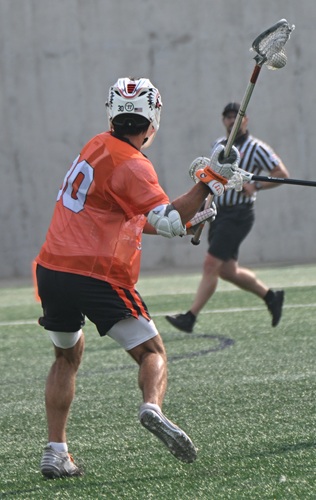
Committed to continue at Duke, Waechter was all-state and All-American last season and scored the game-winning goal in overtime in the 2025 Division 1 championship game against Detroit Catholic Central. He was one of 85 players invited to the original tryouts who later were cut down to the final 25.
"Everyone dreams of having "USA" stitched across your chest," he said. "That's awesome. You're playing with some of the best lacrosse players in the country, which is always a goal you have in mind. Getting to the highest step you can make is great, something awesome to be part of."
While Katke competed against well-known southern and western baseball players, many of lacrosse's top high school-age players come from the East. The talent level at the tryouts was an eye-opening experience, Waechter said.
"It was definitely hard because the East has so many players, but I've always had good coaches who do the same things that coaches in the East do," he said. "It just comes down to how much you want to put into it."
The USA U-19 team defeated Canada 8-7 in the final to go undefeated in three games.
Burkart lettered for Brother Rice as a junior last season. He went through a Regional qualifier and then 100-player combine to make the U-17 roster.
"It was an amazing experience," he said. "You have to go out there level-headed and not wanting to get out of yourself and play badly. I felt I was pretty composed and not overconfident, and that worked for me."
Like Katke and Waechter, Burkhart was aware there are limited chances to impress coaches at tryouts. He credits the national team coaches, however, for giving all players an equal shot at making the roster.
"I thought we had a lot of chances to make plays," he said. "Things move pretty fast. You do drills and technical stuff, but there is an opportunity to be seen. That's what you want."
The U-17 team beat Canada 16-3 in the final to earn a gold medal.
PHOTOS (Top) At left, Broder Katke heads to first base while playing for his national baseball team. At right, Michael Burkhart and Ben Waechter pose for a photo together. (Middle) Katke waits on a pitch during an at bat for USA Baseball. (Below) Waechter launches what would become the game-winning shot for Brother Rice in the 2025 Division 1 Final. (Katke photos courtesy of USA Baseball.)