

Semifinal Comebacks Set Up Decider Between 1st-Time Title Hopefuls
By
Keith Dunlap
Special for MHSAA.com
June 15, 2023
EAST LANSING – Clutch pitching, squandered chances and plenty of extra baseball was the theme of Thursday’s second Division 1 Semifinal between Novi and Mattawan.
In a battle of two teams both seeking a first championship, it was Novi that ultimately prevailed in 10 innings, 4-1, at Michigan State’s McLane Stadium.
Novi was down to its last strike in the seventh inning, but finally broke through against Mattawan junior starter Brendan Garza to advance to the season’s final day for the first time since 1973.
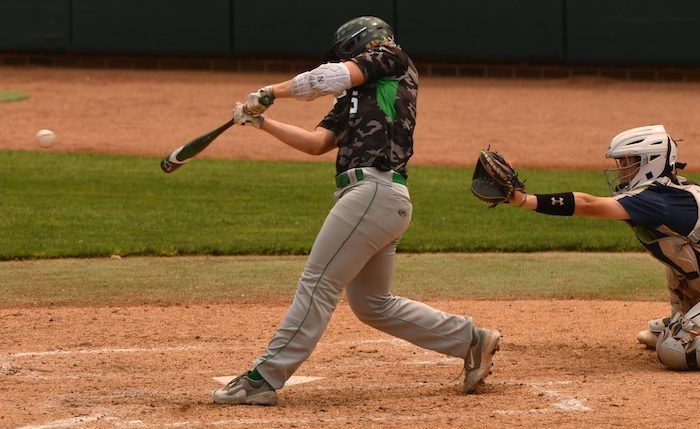
With runners on first and second and two outs following a walk and hit batter, Novi senior Alex Czapski lined a single up the middle with two strikes to tie the game at 1-1, just as Garza was on the verge of tossing a one-hit shutout.
“Earlier in the game I was thinking off-speed,” Czapski said. “He was giving it to me, and I wasn’t hitting it. Overall, I wasn’t hitting it great, but I got a lucky poke on that. He was a great pitcher.”
Each team had a chance in the ninth inning, starting when Novi put runners at first and second base with nobody out. But the rally fizzled after an unsuccessful sacrifice bunt attempt and two strikeouts.
In the bottom of the ninth, Mattawan put a runner on third with one out following a leadoff double by sophomore Tyson Stratton and a sacrifice bunt, but couldn’t get the winning run across after a short flyout and strikeout. The flyout was a soft line drive to right, but the baserunner was partially up the line when the ball was caught and didn’t have enough time to go back to the base, tag up and try to run home.
 In the top of the 10th inning, Novi took a 2-1 lead on a Mattawan throwing error. Novi put runners on first and second with nobody out after a hit and a walk, and on a sacrifice bunt attempt a throw went into left field allowing a run to score. With two outs, junior Andrew Kummer hit a ball that got past the shortstop and into left field, scoring two runs to give Novi a 4-1 lead.
Novi sophomore reliever Uli Fernsler capped off three scoreless innings by pitching a 1-2-3 ninth to finish the game.
Now, Novi will go for its first Finals title in head coach Rick Green’s 23rd year at the helm.
“It’s an incredible feeling,” Green said. “I’m so thrilled and happy for these guys. It’s all about these guys and the guys in the past as well.”
Novi on the mound started senior Andrew Abler, who allowed five hits and a run over seven innings.
Up until Czapki’s tying single in the seventh, the story of the game was Garza, who was dominant throughout until the walk and hit batter in the seventh opened the door.
Garza also accounted for Mattawan’s lone run, singling it home in the first inning.
Mattawan, which stranded runners on second and third base in both the fifth and sixth innings, finished 25-12-1.
“We had two or three chances to win the game and didn’t capitalize,” Mattawan head coach Brett Vaughn said. “It was exactly what I thought it was going to be. I thought it was going to be a pitcher’s duel, and that’s exactly what it was right until the end.”
Brownstown Woodhaven 6, Macomb Dakota 4
Woodhaven has been following a pattern of clutch two-out hitting and improbable comebacks of late.
In a Division 1 Quarterfinal win over Grosse Pointe South, the Warriors rallied from a 7-3 deficit in the bottom of the sixth inning, scoring six runs with two outs en route to a 9-7 victory.
It was more of the same for Woodhaven in its Semifinal win over Dakota.
The Warriors trailed 4-0 in the fourth inning, but rallied for six runs — all with two outs — to earn a 6-4 victory and their second appearance in a Division 1 championship game since 2018.
Woodhaven (32-11) has won 21 of its last 23 games.
 “We’ve been through a lot this season,” Woodhaven head coach Corey Farner said. “Almost every single situation you can think of, we’ve been through it. We were down big in the Quarterfinal. We just don’t quit. They don’t have that in them.”
A bulk of the rally for Woodhaven came in the bottom of the fourth inning, when the Warriors mounted a five-run rally with two outs.
With runners on second and third base, senior Tyler Harris doubled to left-center to cut the deficit to 4-2 Dakota.
Senior Michael Budai, junior Jacob Wright and senior Nick Phillips each added RBI singles with two outs to give the Warriors a 5-4 lead.
Woodhaven then added another run in the fifth inning when an RBI single with two outs by Budai gave the Warriors a 6-4 advantage.
Once given a lead, Woodhaven ace Evan Langlois settled in and didn’t give Dakota any great opportunities to get back into the game, allowing just one runner to get into scoring position over the last three innings after Dakota scored four runs in the top of the third to go up 4-0.
“I felt I was dialed in pretty much the whole entire time,” said Langlois, a senior who struck out five, walked one and allowed five hits in a complete-game win. “That rally will affect anybody. I just tried to stay focused the whole entire time and do my thing.”
Three of the four Dakota runs scored in the third inning were unearned. After loading the bases with one out, the Cougars took a 1-0 lead on an RBI groundout by senior Brendan Borowicz before forming a two-out rally. Dakota took a 2-0 lead following a throwing error, and then the Cougars grabbed a 4-0 lead when a single to right by senior Will DeMasse plated two runs.
But that would be all the offense for Dakota (26-13-2), which also ended its 2019 season at the Semifinals.
DeMasse had three hits to lead the way for the Cougars.
“One bad inning,” Dakota head coach Angelo Plouffe said. “It sucks, but that’s baseball. You’ve got to make three outs in an inning. That’s what it takes. I’m proud of my kids.”
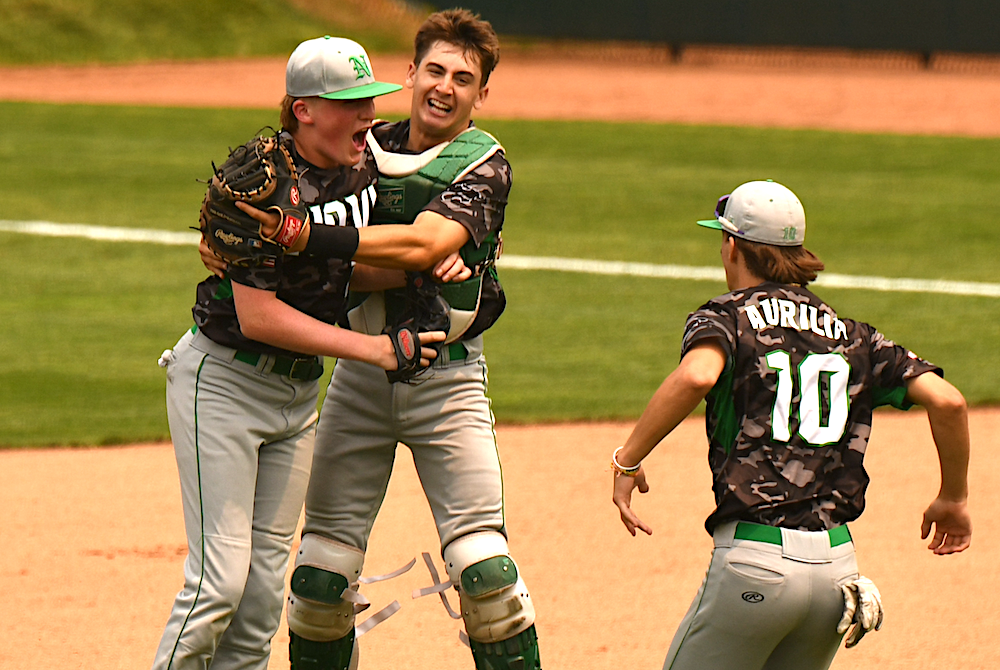
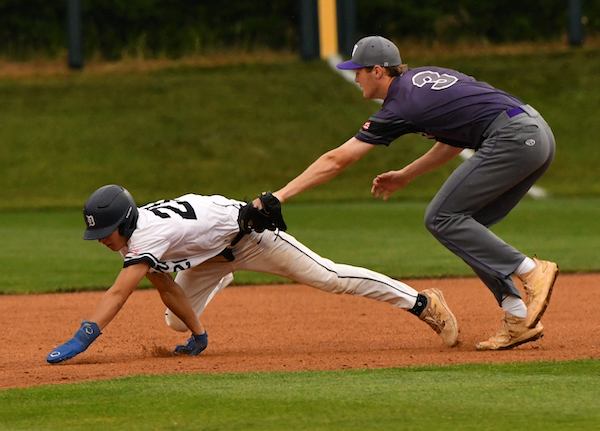
PHOTOS (Top) Novi players, from left, Uli Fernsler, Brett Reed and Jonathan Aurilia celebrate their team’s Semifinal win Thursday at McLane Stadium. (Middle) Novi’s Alex Czapski drives a pitch against Mattawan. (Below) Woodhaven’s Evan Langlois (3) applies a tag during his team’s Semifinal win over Macomb Dakota.
Be the Referee: Injured Runner
By
Paige Winne
MHSAA Director of Brand Management
April 21, 2026
Be The Referee is a series of short messages designed to help educate people on the rules of different sports, to help them better understand the art of officiating, and to recruit officials.
Below is this week's segment – Injured Runner - Listen
We have a baseball scenario for you today:
Your team is down one in the ninth and you are standing on second base when your teammate hits a mammoth game-winning home run.
You are understandably excited. But – in your excitement of rounding the bases – you trip on third base and tear your Achilles tendon. You are unable to get up and continue to home plate.
The home run hitter stops at second base – unsure of where to go.
Because you are entitled to the next base on a home run, your team is able to bring in a pinch runner for the injured runner, and that person can finish running the bases and cross home plate.
The home run hitter can then continue rounding the bases and score the winning run.
Previous 2025-26 editions
April 14: Officiate Michigan Day - Listen
March 11: Basketball Replay - Listen
March 3: Over the Back - Listen
Feb. 24: Wrestling Out-of-Bounds - Listen
Feb. 17: Backwards Skiing - Listen
Feb. 10: Faking Being Fouled - Listen
Feb. 3: Bowling Pins - Listen
Jan. 27: Ski Gates - Listen
Jan. 20: Cheer Judges - Listen
Jan. 13: Basketball Over the Back - Listen
Jan. 6: Bowling Ball Bounces Out of Gutter - Listen
Dec. 9: Puck on Goal Netting - Listen
Dec. 2: Goaltending vs. Basket Interference - Listen
Nov. 25: Football Finals Instant Replay - Listen
Nov. 18: Volleyball Libero Uniforms - Listen
Nov. 11: Illegal Substitution/Participation - Listen
Nov. 4: Losing a Shoe - Listen
Oct. 28: Unusual Soccer Goals - Listen
Oct. 21: Field Hockey Penalty Stroke - Listen
Oct. 14: Tennis Double Hit - Listen
Oct. 7: Safety in Football - Listen
Sept. 30: Field Hockey Substitution - Listen
Sept 23: Multiple Contacts in Volleyball - Listen
Sept. 16: Soccer Penalty Kick - Listen
Sept. 9: Forward Fumble - Listen
Sept. 2: Field Hockey Basics - Listen
Aug. 26: Golf Ball Bounces Out - Listen