

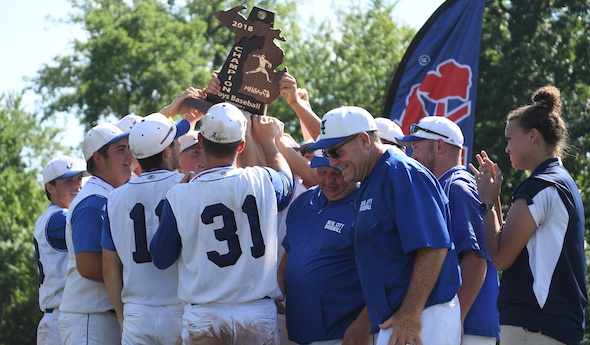
Upton Hoists Beal City Back to Top of D4
June 16, 2018
By Jason Schmitt
Special for Second Half
EAST LANSING – Don’t get Beal City senior Brett Upton wrong. He wants all the attention on himself – in the biggest of moments.
But he’s the first to deflect the credit to his teammates.
Take for example Saturday afternoon at Michigan State’s McLane Stadium. Upton pitched a gem, completely dominating Unionville-Sebewaing during a 10-0, six-inning victory in the MHSAA Division 4 championship game.
He deserved the lion’s share of the credit. No one could dispute that.
“It’s awesome. I embraced it. I feed off stuff like that,” said Upton, who struck out eight while walking just a pair. “I love big games, I love being the guy in situations like that. All the credit to my teammates, though, making me look a lot better than I really am. That’s for sure.”
The championship is the fourth in Beal City baseball history. The Aggies also won titles in 1993, 2009 and 2010. They were runners-up in 2013-14.
“I’m so happy for these kids,” Beal City coach Steve Pickens said. “This is what baseball is all about. When I see my kids do well, it’s like you put a dollar in and two dollars come out.
“They’ve been dedicated all year, and they work hard and that’s paid off.”
Beal City scored the game’s first run in the bottom of the fourth inning. Senior Kollin Sharrar reached on a bunt single and scored on an RBI double by junior Keegan Haynes. The Aggies added another run in the fifth inning on an RBI single by junior Colby Berryhill, scoring Lucas Schumacher.
But the Aggies broke the game open – and closed it out – with eight runs in the bottom of the sixth inning. Haynes and freshman Cameron Lynch each singled to center to get things rolling for their team. After junior Nate Wilson was intentionally walked to load the bases, senior Aaron Schafer drove in a pair to make it 4-0.
That was just the beginning for Beal City. One batter later, with the bases loaded, Berryhill drove in two more with a double. Upton then had a double of his own, scoring senior Lucas Schumacher to give his team a 7-0 lead. Haynes’ RBI single made it 9-0, and Wilson closed things out with an RBI single.
 “I can’t even describe it right now. Four years, four years it took us to get here,” Upton said. “To finally finish it, oh my God. All the hours we’ve put in all winter, this senior corps as a group. It’s all paid off. We won our last high school game ever, can’t ask for anything more than that.”
Haynes finished 3 for 4 scoring twice and driving in a pair for Beal City (23-8). Schumacher also had three hits, scoring twice, while Berryhill finished with two hits and three RBI.
Pickens, in just his second year as head coach of the Aggies, spoke about the state of the baseball program in Beal City.
“The kids want to play baseball out there. That’s half the battle, getting them to play,” Pickens said. “I don’t have to do that, so now I can start at 202 instead of 101. By the time we get to the state tournament, here we are.”
Beal City beat Gaylord St. Mary, 7-3, in their Semifinal matchup Friday.
Unionville-Sebewaing (22-16) bested St. Joseph Lake Michigan Catholic, 5-1, to advance to Saturday’s championship game.
“When you get beat, you get beat. At the end of the day, it’s going to sting but you can live with that knowing you got beat by a good team. They’re a great team,” USA coach Tyler Bader said. “They pitched well, they defended well, they bunted well. I think we could have done some other things that would have made it a little tougher (for them). Anytime you get just one hit, it’s tough to win a game.”
Despite the loss, Bader said he was proud of his team.
“When you get this far into the tournament, you know the team in that other dugout is no slouch. We just couldn’t take advantage of our opportunities when we had guys in scoring position, to put a little pressure on them,” Bader said. “I told them before we went up on stage (to receive the runner-up trophy), ‘I know we’re bummed, we’re mad, but try and enjoy this because in a couple days we’re going to look back on this moment.’
“I know there are a lot of other schools and players out there that would love to swap places with us and be the loser in the state championship game.”
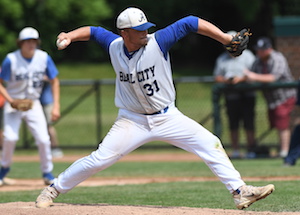
PHOTOS: (Top) Beal City raises its championship trophy Saturday. (Middle) Brett Upton delivers a pitch for the Aggies.
Fish's Powerful Record Pursuit Helped Set Stage for College, Pro Achievements
By
Steve Vedder
Special for MHSAA.com
August 27, 2026
Many of the home runs were prodigious, some of the balls landing on the tops of schools, crashing onto car roofs, into clumps of trees, empty parking lots and neighboring practice fields.
 Two of Zach Fish's record-setting clouts, in fact, landed on the I-94 expressway and in the middle of a cemetery.
But it wasn't the variety of locations that made his homers remarkable. It was their number.
As a senior at Richland Gull Lake in 2011, Fish set the state single-season home run record with 24. The total not only broke the record of 23 set by Morley-Stanwood's Jim Willison in 1998 and Drew Henson of Brighton in 1997, but no hitter since has even made a serious run at breaking Fish's mark. The closest has been 15 homers by Zach MacDonald of Portage Central in 2021.
"There were some fun ones," Fish said of the homers.
Fifteen years later, Fish, now a corporal for the Granbury, Texas, police force, said he looks at his record-setting season much the same as he did during the final three months of his high school career. He remembers feeling a sense of accomplishment, but also relief as the Blue Devils, which would finish 38-2, could now switch focus from Fish's record to the drive of winning a state title.
Fish said when he thinks back over his career, it's not only the home run chase he remembers but also cherishing a leadership role on a young Blue Devils club. Fish also remembers the 5 a.m. offseason workouts designed to strengthen his 6-foot, 200-pound frame, and always seeking new ways to hone his special talent for recognizing and adjusting to how high school pitchers were trying to get him out.
As for the record, Fish also recalls the torrid late-season stretch it took to surpass Henson and Willison. Just when it looked like he could fall short, Fish slammed 16 homers over his final 17 games, including his last three in the Regional tournament to break the record.
Fish said an overlooked part of the 24 homers – and something which was probably a benefit – was that aside from local media, no one was clamoring for stories each step of the way. There was minimal distraction outside of the Gull Lake community as Fish approached breaking one of the most sought-after state records.
 "There wasn't any social media back then. Not much hype or noise around it," he said. "And I got a lot of positive reinforcement from the people around me. No one said anything if I came back to the bench without hitting a homer or getting a hit. The important thing was we were winning as a team. I think my success was a product of how successful the team was.
"I stayed within the mindset of the team. With all the people around me, I never got too high or too low. That helped me focus.”
The 24 homers closed out a remarkable career for Fish, who after his senior season was taken by the Texas Rangers in the 24th round of the 2011 MLB draft. Fish, who hit .561 with 82 RBIs as a senior, was named to the Rawlings, Baseball America and MaxPreps All-America teams. He would be recruited by Michigan, Clemson, Vanderbilt, Louisville, Washington and Georgia Tech before signing with Oklahoma State, where he would become the Big 12 Player of the Year as a junior.
Fish's story from growing up playing in a Kalamazoo recreation league as a grade schooler to being taken by the Chicago White Sox in the 11th round (318th overall) of the 2014 draft and spending two years in pro ball includes, by his own admission, an extraordinary drive to succeed.
"Bordering on obsession," he said. "Baseball was more than a passion with me. I loved baseball and what it stood for. It's America's pastime for a reason."
Growing up, Fish actually showed minimal signs of becoming a nationally elite-level player. He played rec ball in Kalamazoo and later hooked up with the Midland Braves travel team for three seasons as a 16, 17 and 18-year-old. He played two seasons at Kalamazoo Central where he batted .291 with five homers as a freshman and then .423 with six homers as a sophomore.
Family obligations led him to transfer to Gull Lake as a junior, where he quickly blossomed. He hit .473 with 12 homers, 57 RBIs and 27 stolen bases.
"Coaches would help me," Fish said of his power. "They said just swing hard in case you hit it. I truly believed that. The first two years in high school I was kind of sporadic in terms of hard contact. A lot of that was in my approach."
Fish's junior season set the stage for his sensational final year. He barely had double digits in homers by midseason before catching fire in the second half. But with 21 homers heading into the Regional, he was still two short of tying the record. He climbed to within one when he homered during a 12-2 Regional opener win against Sturgis, then slammed two more in a 13-2 Regional Final victory over Hamilton to set the record.
 With the achievement accomplished, Fish said he remembers returning to the bench after the second homer against Hamilton with mixed emotions.
"At first I came back like it was just another homer," he said. "I was in the dugout, put my (catching) gear back on and I had this moment of what I did. But at the same time, I was glad it was out of the way and now we could focus on the team and winning a state title.
"The last three weeks was a good stretch, but I was able to swing the bat because the guys in front of me were getting on base and pitchers had nowhere to put me."
In a 6-5 Quarterfinal win over Grand Rapids Catholic Central, Cougars pitchers virtually refused to pitch to Fish. Amid a flurry of intentional walks, Fish saw only one strike, which he smashed for a bases-loaded triple. The team concluded its season with a 6-1 Semifinal loss to eventual Division 2 champ St. Clair as Fish flew out twice and was safe on an error in his final high school at-bats.
According to MaxPreps, the 24 homers ties Fish for 27th place nationally, just six behind the all-time record of 30. His 82 RBIs as a senior ties him for 26th place. Fish finished his prep career with 47 home runs, 23 behind the state record of 70 hit by Henson from 1995-98. Fish's 203 career RBIs are second behind Henson's 290. The 24 homers in 116 at-bats means Fish hit a homer an incredible once every 4.8 at-bats.
Former Gull Lake coach Bill Blakely said Fish was always striving for perfection as a hitter. He recalls Fish would often come back to the bench following a home run lamenting his swing could have been better. As for the record, Blakely said he would occasionally move Fish around on defense, including making use of his 90-mph fastball on the mound, to keep his mind off hitting. Blakely reasoned Fish could get a break from the pressure of the home run chase if he had to focus on defense.
"Externally, he didn't show that it bothered him," Blakely said of the chase. "We had lots of kids who could keep him loose. It was a light atmosphere. We would count the homers as they came along, but he didn't go into any slumps as he got close.
"As for the record, it wasn't if he was going to set it, but when, barring an injury."
2026 Made In Michigan
Aug. 18: Glen Lake Grad Adds Pacific Ocean to Life's Journey in Completing World's Toughest Row - Report
Aug. 13: Basketball Takes 'The Judge' Worldwide, Home Again as Love of Game Lives On - Report
Aug. 11: Nearly 25 Years After Leading Unexpected Run, Morton Directing Life-Changing Mission - Report
Aug. 7: Significance of Historic Run, Relationships Formed Live On for 1973 Unity Champs - Report
Aug. 4: Work Ethic Continues to Drive Van Dyk's Endeavors as Co-Owner of Family Farm - Report
July 24: Hackett Mentor's Care Sparked Lifetime in Hoops for BCAM President White - Report
July 24: Mackey Leaving Court with 500+ College Hoops Wins, Many More Lessons Shared - Report
July 16: Country Day Two-Time Champ Moore Building Perennial Winner at Harvard - Report
July 9: Multi-Sport Career at TC West Helps Gillis Thrive as Pro in Game She Once Left Behind - Report
July 2: Inspired by Home, Eager to Give Back, Spencer Hosts Hoop City Alumni Games - Report
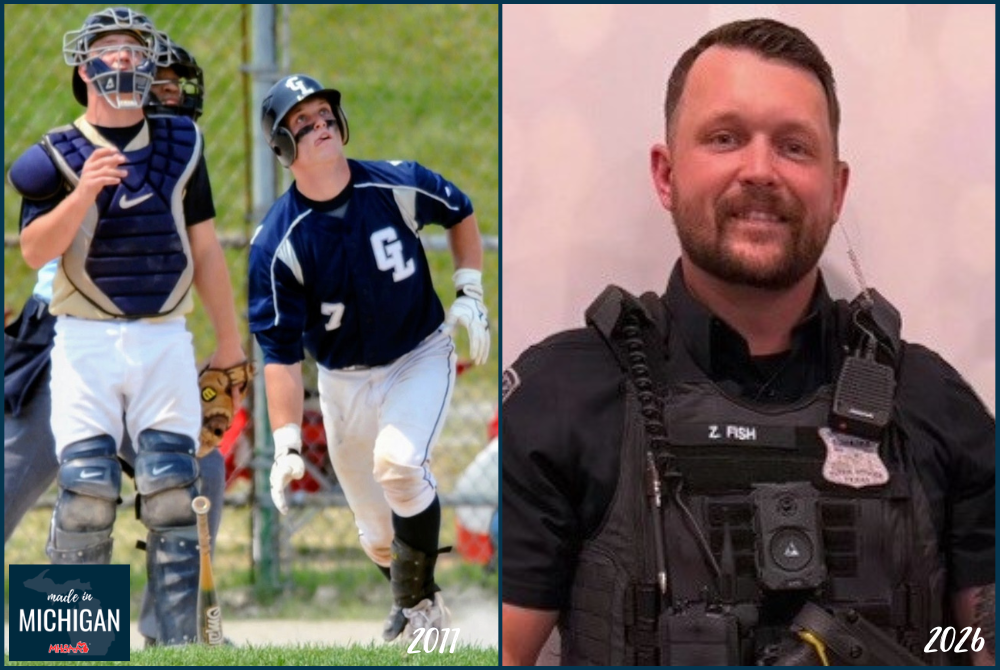
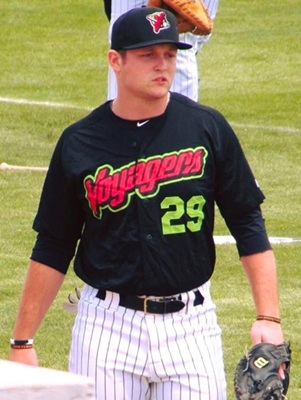
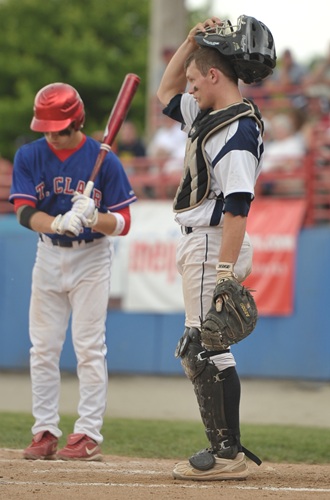
PHOTOS (Top) At left, Gull Lake's Zach Fish follows a drive during his senior season in 2011, and at right Fish is now an officer in Granbury, Texas. (Middle) Fish takes the field as part of the Rookie-level Great Falls Voyagers. (Below) Fish mans the catcher position for Gull Lake during a Division 2 Semifinal against St. Clair in 2011. (Granbury and Great Falls photos courtesy of the Fish family. Hitting photo by Gary Shook. Catching photo from MHSAA archives.)