

Vast Experience Shapes Retired MLB-er Gates Into 3-Time Finals-Winning Coach
By
Steve Vedder
Special for MHSAA.com
August 1, 2023
If there is anything that Brent Gates knows for sure, it's that there is no single explanation for three MHSAA Finals baseball championships.
 For starters, the Grand Rapids Christian coach credits the superior coaching he had as a youngster, especially for helping him make the Michigan High School Baseball Coaches Association Dream Team in 1988.
From there, Gates points to the experience gained as a former Big 10 Baseball Player of the Year, a seven-year major league playing career that saw him rubbing shoulders with such notables as Hall-of-Famer Tony LaRussa and Minnesota Twins manager Tom Kelly, and then landing at a high school where the critical support he received from players, community and administration was priceless.
Put it all together and that, at least in part, explains Gates becoming the first Grand Rapids-area baseball coach with three state titles on his resume.
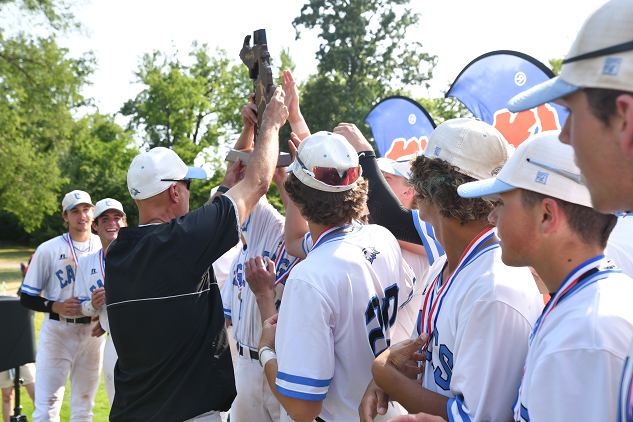
The Eagles' 2-1 win over Grosse Pointe Woods University Liggett in the June 17 Division 2 Final marked Gates' third title as a coach. His Grand Rapids Christian clubs had previously won back-to-back titles in 2012-13.
Gates passed former Grandville Calvin Christian coach Jay Milkamp as the Grand Rapids-area coach with the most state titles. Milkamp won in 1994 (Class C) and 1996 (Class B).
Gates, a member of three Halls of Fame, is quick to deflect the credit for three championships and two other championship game appearances. What he treasures most is being mentioned in the same breath as other legendary west-side coaches such as Jenison's Gary Cook, Ron Engels of Wyoming Park, Hudsonville's Dave Van Nord, East Grand Rapids' Chris LaMange, formerly Rockford and now Ada Forest Hills Eastern's Ian Hearn and Milkamp, most of whom Gates either played against while an all-stater at Grandville or through coaching at Grand Rapids Christian.
"I'm just a small piece of what has transpired in 11 years," he said. "Just to be mentioned with them and their success is an honor. (Three titles) is not an individual thing, but because of many people and what they can do working day in and day out together.
"I've always said the west side doesn't get the recognition it should in baseball. There are some great coaches here with great baseball talent, and I think you see that in the postseason."
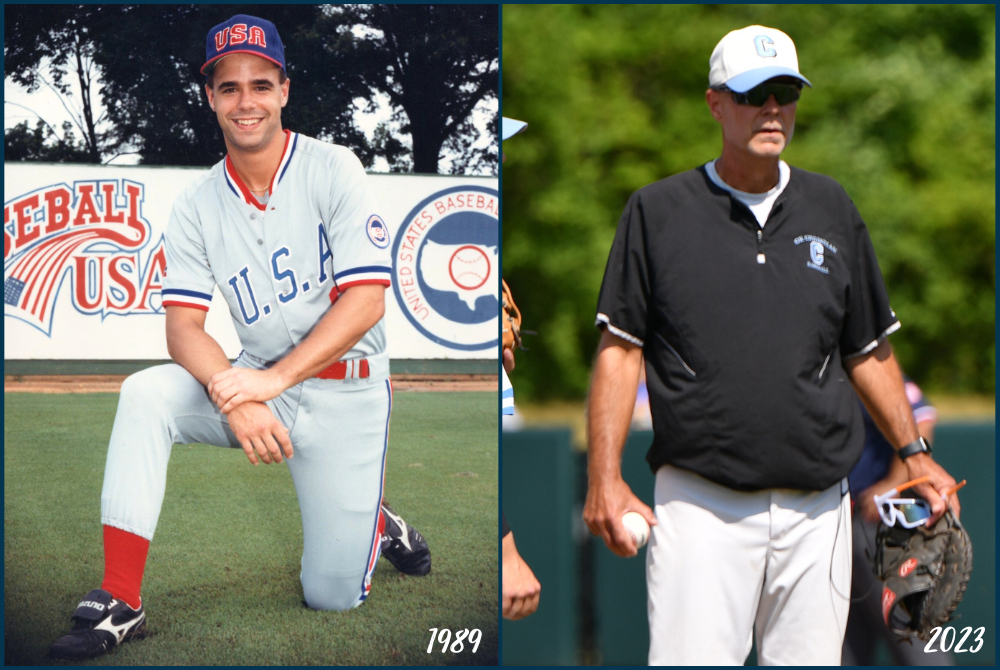
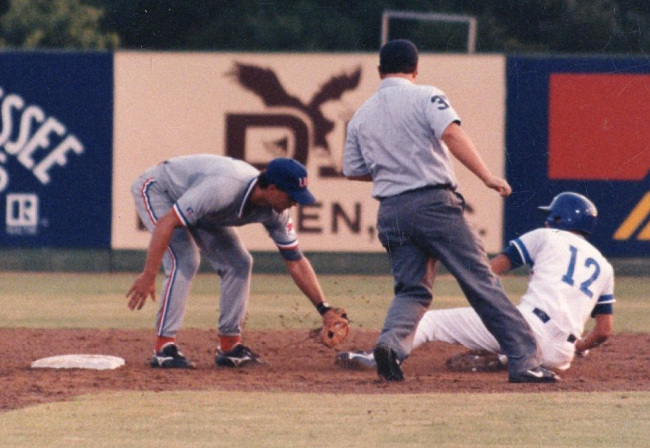
If basketball can spawn what is affectionately known as "gym rats," then Gates is surely a classic example of the diamond's version of someone who has lived and breathed baseball his entire life. He was a two-time all-stater at Grandville who went on to a standout career at the University of Minnesota that included a lifetime .387 batting average. He was named the Big Ten Player of the Year in 1991 and consensus All-American. Gates played internationally with USA Baseball on the 18U team in 1988 and then the collegiate national team in 1989 and 1990. Over those two seasons on the collegiate team he appeared in 68 games, hitting a combined .363 with 49 runs scored and 54 RBIs.
He was drafted by the Oakland A's in the first round (26th overall) of the 1991 draft and went on to hit .264 in 685 major league games over seven seasons.
 Upon his retirement, Gates founded the Frozen Ropes training facility in Grand Rapids, worked as a scout for the Tampa Bay Rays, became the West Michigan Whitecaps' second-ever manager in 2001, coached Byron Center for two years and has compiled a remarkable 298-89 record in two coaching stints at Grand Rapids Christian.
After virtually a lifetime in baseball, Gates said his coaching success can be spread in many directions. He said it began at Grandville, was influenced by such managers as John Anderson at Minnesota and LaRussa and Kelly at the major league level, and with brushing shoulders with many of Grand Rapids' most successful coaches.
The experience led him to a coaching philosophy that includes a priority on building relationships with players, providing a full explanation of his thinking to the players, a quiet but firm coaching of fundamentals, and, above all, communication. If there is anything that Gates does not do, it's relying on the "old-school" coaching method where coaches demand excellence in no uncertain terms.
"I've taken little bits and pieces from a lot of people," said Gates, a member of the Grandville, University of Minnesota and Grand Rapids Halls of Fame. "I want players to figure out who they can be. Whether it's Ken Griffey Jr. as a hitter, Randy Johnson as a pitcher or Terry Steinbach in catching, you don't just take one person and say who can I be? If you want to compete at a high level, you need to be better than anyone you go up against.
"Part of being a good coach, and it doesn't matter if it's a 9U program or high school, is about making players understand and be able to apply what they learn. Baseball is a hard game, one of failure where if you succeed three times out of 10, you're a star. You have to get players to understand failure."
Gates said all three Grand Rapids Christian champions were marked by different strong suits. The 2012 club, for example, breezed its way to a 36-5 record, while the 2013 club finished the regular season just 12-15 but put together a torrid seven-game winning streak during the tournament. This year's team was marked by a deep pitching staff and what Gates describes as a "group of gamers."
"All of them were different, but I firmly believe that pitching and defense win championships," Gates said. "But you also have to get hot at the right time."
It's not unusual for major leaguers to completely hang up the spikes once their playing days are over. They're tired of the pressure, the frustration of fading talent and losing the battle with Father Time, and the constant travel away from family. Gates faced all that and still found himself enthralled with the idea of coaching.
 "I've loved the game since I was like 4 years old. There's nothing better than smelling pine tar or the look of manicured grass. The smells and sounds of baseball, that's what I love," he said.
One of his coaching goals is to impart the love of the game to his players. And it seems the message is getting across.
"It's awesome playing for him," said first baseman/pitcher Ty Uchman, who graduated this spring. "He gets us to focus on the little things. If there is something on our minds, we know we can go to him. He's an open book. I know he'll always talk to us, and that builds trust and a bond."
Another recent grad, infielder Kyle Remington, will follow Gates' footsteps to the University of Minnesota and said one particular trait sticks out to him about his coach.
"He's very patient," Remington said. "There are all levels of players in high school, and he treats them all the same. Doesn't matter if they're struggling; he never raises his voice. He's a very comfortable and relatable coach to play for.
"He knows baseball is a game of failure so if you don't understand a drill or an adjustment to have to make, he'll talk to you in a patient way."
Gates said he suspected even when he was a major leaguer that coaching was likely in his future.
"I did, and it was an easy decision. God has a plan, and I had a feeling I would stay in the game," he said. "Baseball has given me everything. I love the game, and I know I've been blessed. I want to take what I've learned and pass it along. That's always been a part of me."
2023 Made In Michigan
July 25: After All-American Career, Rockford's Bennett Making Impact as Mat Mentor - Read
July 20: Oakridge 3-Sport Star Potts Applying Lessons to 'Second Chapter' in Sales - Read
July 18: Frankfort Hoops Staff Bolstered by Past Stars Giving Back in Banktson, Kreski - Read
July 12: Championship Memories, High School Tennis' Impact Stick with Hackett Pair - Read
July 6: Brother Rice Finals Hero Aiming to Ace Family Life, Financial World - Read
July 5: Lapeer West 4-Time Finals Winner Set to Build Champions at Oklahoma - Read
PHOTOS (Top) Brent Gates appears on the USA Baseball collegiate national team in 1989 and makes a pitching change during this spring’s Division 2 Final. (Middle) Gates makes a tag at second base while playing for the national team. (Below) Gates presents the championship trophy this season to his Grand Rapids Christian players. (National team photos courtesy of USA Baseball.)

Parent Problem
October 29, 2013
For years when I have paused in presentations to ask coaches and school administrators to identify the biggest problems we have in school sports, two problems are far most frequently mentioned:
-
Too little money; and
-
Too many misdirected parents.
Other problems are cited; but far and away, the most frequently mentioned problems are under-funding of programs and over-involvement of parents.
In many aspects of the lives of youth, there is too little parent involvement and direction; but such is not the case in most places when it comes to sports. “Helicopter parents” not only hover, they also seek to rescue their children from the very situations – adversity – that sports uses to teach life lessons.
Parents have no role in decisions regarding playing time and game plans. Should parents ever believe that their child has been put at risk in a sports program, there are prompt and appropriate ways to address those situations, directly and with discretion, not gossip and guile.
And the job description of school administrators today must include the staunch defense of the jobs our committed coaches are doing.