

Weatherlys Cherishing Final Run Together
June 2, 2017
By Geoff Kimmerly
Second Half editor
HOWELL – It’s not hard to pick out the Weatherly boys on a baseball field. Sam, the senior, is 6-foot-3. Ty, a junior, is an inch taller.
 It’s a little tougher to realize Howell co-coach Mike Weatherly is their dad. He's shading just north of 6 foot.
But watch closely, and you’ll figure it out. Jason Ladd, the other half of the Highlanders’ varsity coaching pair, has seen it plenty of times.
“They’ve both got some of their dad’s athleticism for sure, seeing how he played four years at Central Michigan University and they won four MAC championships while he was there,” Ladd said. “He was a captain, and they get a lot of leadership quality from their dad.
“But it’s unique in the fact that they’re able to be so respectful. Sometimes when you get parents who are coaches, (the kids) aren’t respectful. But they’re both totally respectful to their dad, appreciative of what he does, and you can tell there’s a lot of love beyond being the son of the coach.”
It’s a lot of fun at the Weatherly house these days. But really, it’s been that kind of spring as Mike gets one final chance to coach both of his youngest sons on a team that could do some damage when Howell begins Division 1 District play today at Dexter.
Sam Weatherly is arguably the top high school baseball player in Michigan this season. A lefty, he hits 92 mph on the mound, and he’s signed to continue his career at Clemson University – which currently is playing in the NCAA Regionals.
Ty is finishing his first year of varsity ball, but coming on strong. A righty, he throws in the mid 80s and no-hit reigning Division 2 runner-up Linden a week ago.
They’re the youngest two of four athletic children Mike and Marybeth (Chappelle) Weatherly have raised. Bobby, 25, played baseball at Howell and Muskegon Community College, while Tess is three years older than Sam and plays basketball at Northern Michigan University.
It’s a question Mike can’t help but get asked – how do you go about raising such a talented bunch? There are some pointers to be offered there. But right now, the focus is just on enjoying every moment they can share.
Following Mom and Dad's lead
Mike Weatherly was a shortstop at Central Michigan University – and a really good one, in fact.
So it makes sense that when he describes how his wife-to-someday-be flipped through the air in front of him back then, he calls it an “Ozzie Smith” in reference to the acrobatic Hall of Fame shortstop of St. Louis Cardinals lore.
He also knew at that moment that she was the one – or at least one he was interested in knowing better.
According to a Detroit Free Press report when she was a track star at Sterling Heights Stevenson, Marybeth had grown up in gymnastics and also was a cheerleader. She got into track later, but some of her school records still stand, Mike said. And because of her genes, her boys stand tall – the height is from her side of the family, as is their speed and a dose of their toughness.
“My mom had three older brothers. She’s been raised with wolves, and with us, she treats us the same way,” Sam said. “Crybabies never really happened in our house. You have to have a hard nose in this family."
 All four clearly have used those physical gifts to their advantage – Sam and Ty most recently in helping Howell to a 26-9-1 record.
Sam is hitting .500 with 15 doubles, three home runs and 29 RBI, and he’s stolen 16 bases. He’s also 5-1 on the mound with a 0.73 ERA and 61 strikeouts in just more than 38 innings pitched. He’s given up 19 hits and four runs total this spring.
Ty – who grew four inches just over the last year – is finishing up his first varsity season strongly. He has thrown 35 innings and is 5-0 with a 2.00 ERA and 30 strikeouts.
When Sam was 6, he asked his dad about college baseball. Ever since, Sam wanted to be a baseball player. He chose jersey number 6 because it was Mike’s; he’s worn it since.
Sam and Ty always were together as the two youngest kids, and played on the same teams for about five years with Mike as their coach.
“They were fortunate to be born with some coordination, and worked at it. And they had good youth experiences, playing Little League … we let them develop at their own pace, and I think that’s the key,” Mike said.
“There was no extra coaching going on. If you look at their innings pitched, they were really green; they didn’t throw a lot. Sam played freshman baseball (instead of varsity). I think this generation of people push too hard too early. If we did one thing right, that’s it, that’s really it. You have to go out and have fun and enjoy it. Because it can get ugly if you don’t.”
Sharing the fire
Ladd spun a bit of a phrase in describing Sam and Ty. He said they are nothing alike, but just like their dad. And, strange as that might sound, he’s right.
Ty might be the jokester, but Sam is the talker of the two, even if he’s a little more serious. Mike, meanwhile, recalled how his CMU teams were referred to as the “mouths of the Midwest,” but not him – he kept quiet and played, and Ty is much the same.
And yet, competitive fire, however the sons show it, reminds Ladd of their dad.
Ty indeed is more like Mike in that he keeps it under the surface. That’s not to mistake either as calm; it’s just the intensity doesn’t necessarily come with a voice.
Sam’s intensity, on the other hand, “is way out there.” Ty said this perhaps a little tongue-in-cheek – but he also knows that after a bad loss, his brother holes up in his room until morning.
“He gets really ticked off,” Ty said. “He hates it. He wants to win at everything.”
And Ty admires his brother’s work ethic in trying to attain that goal. So much so, he’d love to see his brother go out in a couple weeks as the last one standing on the mound at Michigan State’s McLane Stadium, putting the finishing touches on a championship.
“I know this season has meant a lot to him, and he really, really wants that state championship,” Ty Weatherly said. “I know if he went out there and got that W for us, it would be really special to him.”
Here and now
It would be easy for Sam to look ahead. He wouldn’t have to look far.
Whenever Howell’s season does end over the next three weekends, he’ll officially become a member of the Clemson baseball program.
 In a little more than a week, on June 12, the Major League Baseball draft will begin. He has a legitimate shot of being selected the second day, sometime during rounds 3-10.
But that’s not where his head, or rather feet, are today – or will be until the Highlanders have done everything possible to win their first MHSAA baseball championship.
And that’s not just saying the right thing because Dad is the coach. It’s especially apparent in his relationship with Ty – with all of this going on in Sam’s life, he’s still watching his brother’s moves on the diamond, ready with a few words of wisdom when they can help. Sam has gotten a lot of coaching from great sources the last few years, and through him Ty has been a recipient as well.
“I really care. I care about the team first, and personal accolades follow that,” Sam said. “You should be where your feet are, and my feet right now are in high school with my high school team, and that’s my first priority.”
But …
“All of it kinda hits me off the field,” he added. “I use baseball and friends to get away from it. It’s fun, but I’m very anxious at the same time.”
Howell has eluded a state ranking despite recent wins over No. 5 Birmingham Brother Rice, No. 9 Sterling Heights Stevenson and ranked Division 2 teams Linden and Fowlerville.
With No. 10 Brighton being upset by Ann Arbor Skyline in a Pre-District game Tuesday, today’s possibilities got a lot more interesting. Not that anyone is looking ahead or expecting to win. But simply forecasting from the outside, there are opportunities to keep this thing together a little while longer – especially with a ranked rival no longer in the field.
Mike knows the way. He coached Hartland to the MHSAA Semifinals in 2000, and with Ladd led Howell to the final weekend in 2012 and 2013. Those runs had to be a little bit different, of course; now he's writing his sons into the lineup at this most exciting time of the season.
“We’re trying to enjoy every moment and slow it down because it’s going to be gone before we know it,” Mike Weatherly said. “It’s exciting, but I’ll admit it’s a little stressful too.
“There’s a lot riding on stuff, but at the end of the day things will work out the way they work out. We’ll keep plugging away. All we’re trying to do is win a championship, try to win their last game, and that’s been our focus.”
 Geoff Kimmerly joined the MHSAA as its Media & Content Coordinator in Sept. 2011 after 12 years as Prep Sports Editor of the Lansing State Journal. He has served as Editor of Second Half since its creation in Jan. 2012. Contact him at [email protected] with story ideas for the Barry, Eaton, Ingham, Livingston, Ionia, Clinton, Shiawassee, Gratiot, Isabella, Clare and Montcalm counties.
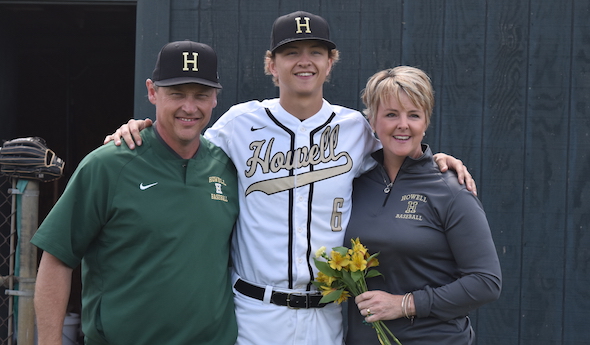
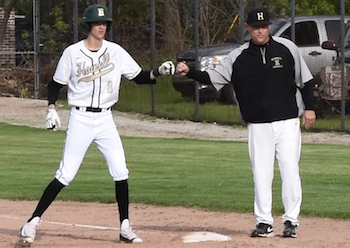
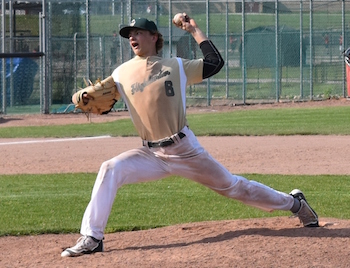
PHOTOS: (Top) Sam Weatherly, middle, stands with parents Mike (also his coach at Howell) and Marybeth. (Middle) Ty Weatherly shares a fist bump with his dad after reaching base. (Below) Sam Weatherly begins to unwind toward the plate during a game this season. (Photos by Andrea Leon.)
Senior-Powered Spring Lake Answering Anticipation, Pursuing High Expectations
By
Dean Holzwarth
Special for MHSAA.com
April 29, 2026
SPRING LAKE – The time is now for the Spring Lake baseball team.
 With the return of 11 veteran seniors, the Lakers entered this spring with lofty expectations and an eye on an extended postseason run.
Anticipation has come to fruition in the form of a state ranking and a nearly perfect start.
“Our motto is we are going to worry about next year next year, and we are going to do all we can this year,” Lakers fourth-year coach Bill Core said. “We knew we were going to have a big experienced group coming back, and that's just how the roster folded out. We have a lot of experience, a lot of returners and pretty high expectations.”
Spring Lake, which finished as Division 2 runner-up in 2024 and won a conference title last year for the first time since 2014, is off to an impressive 13-1 start (9-0 in the Ottawa-Kent Conference Black) and has climbed to No. 7 in the latest coaches poll.
Core said the vast number of returners, which includes five players who will play in college next year, has paid early dividends.
“I think that’s been a big difference,” he said. “We’ve played some younger teams that were breaking in sophomores or juniors or new kids, and our guys were ready to go right from the start. It’s been an advantage early on.”
Senior starting pitchers Oliver Smies and Maddux Kipling believe the strong bond among the senior class has been a major factor in the torrid start.
 “I think something that’s really important about this team is our team chemistry and the amount of seniors we have on the team,” Smies said. “That alone allows us to have a ton of experience, and I think that's a big reason why we are off to such a hot start. We have been playing good team baseball and complementary baseball with good defense and good offense.”
Added Kipling: “We genuinely like being around each other, and every day we show up ready to get a little better. Our team has a real gritty and energetic identity, and I think that shows in how we compete and support each other.”
Kipling and Smies have been dominant on the mound this season. They haven’t allowed an earned run while combining for 80 strikeouts. Kipling earned a second-team all-state accolade as a junior and is headed to Michigan State next year. Smies will play at Calvin University.
“It starts with our pitching,” Core said. “Any time you are going to make a run, it starts with your pitching and we are pretty lucky, especially with our top two.”
Offensively, the Lakers possess a balanced lineup and boast a .330 batting average.
Senior Owen Smies, who will join his twin brother at Calvin, is hitting a team-best .432 with 13 RBIs. Seniors Alex Strauss (Adrian College) and Max Feltner (Muskegon Community College) are both batting .333 and have combined to score 25 runs.
As a team, Spring Lake has produced eight shutouts and nine wins by run differential.
“We got off to a good start, but we are going to play a lot better competition,” Core said. “This is a good week for us because we play Northview and state-ranked East Grand Rapids. We just picked them up, so we were excited to fill in the week with those two schools.”
Spring Lake is 62-6 over its last 68 games and trying to remain focused on each game as it attempts to erase the disappointment of last year’s early exit from the postseason.
 Despite winning 30 games, the Lakers suffered a 3-2 loss to Grand Rapids West Catholic in District play.
“I think there is some motivation there from that loss,” Oliver Smies said. “And I think that loss last year taught us that any team can beat any team, so you have to play your best baseball every single game no matter the opponent.”
Core said last year hasn’t been discussed, but believes it still sits in the back of his players’ minds.
“I think they think about that, but we've had quite a few mercies to start the season, and I said to them that when we get to the tournament it's going to be a one-run game and we are going to have to do the little things to make a difference because we are not going to win 14-0 all the time,” he explained. “We try to keep everyone in the moment.”
Kipling isn’t dwelling on the past – or looking too far ahead.
“As a group we’ve done a great job staying focused on the present and not getting caught up in the past or worrying too much about the future,” Kipling said. “My dad has always told me to focus on what you can control because putting energy into things you can’t control is a waste.
"That mindset has stuck with me, especially on the field. I try to live by ‘one pitch at a time,’ and because of that I haven’t really spent time thinking about last year’s loss. That’s behind us, and we’re just focused on what we can do right now.”
 Dean Holzwarth has covered primarily high school sports for Grand Rapids-based WOOD-TV for five years after serving at the Grand Rapids Press and MLive for 16 years along with shorter stints at the Ionia Sentinel and WZZM. Contact him at [email protected] with story ideas for Allegan, Kent and Ottawa counties.
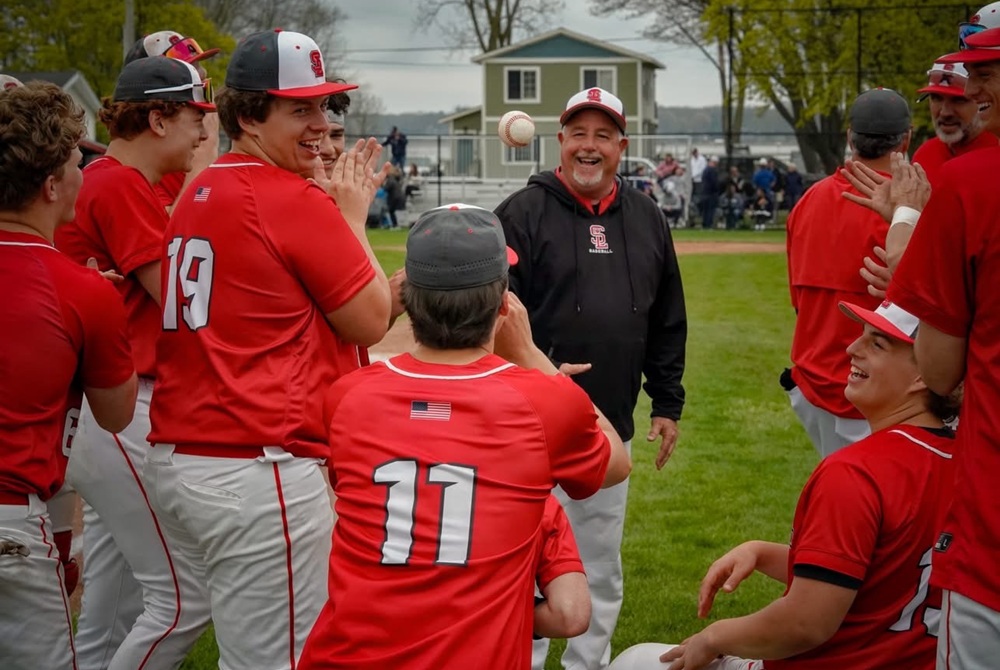
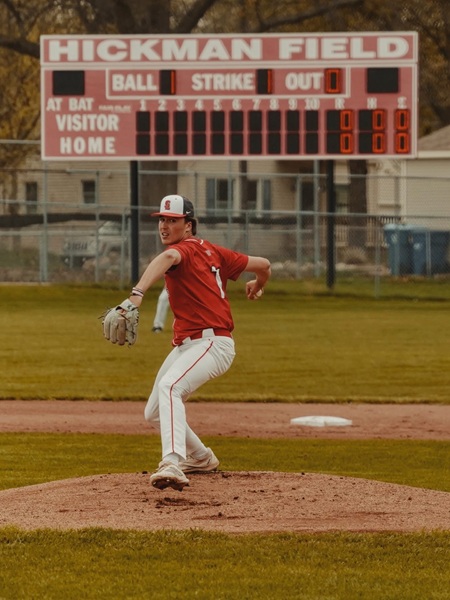
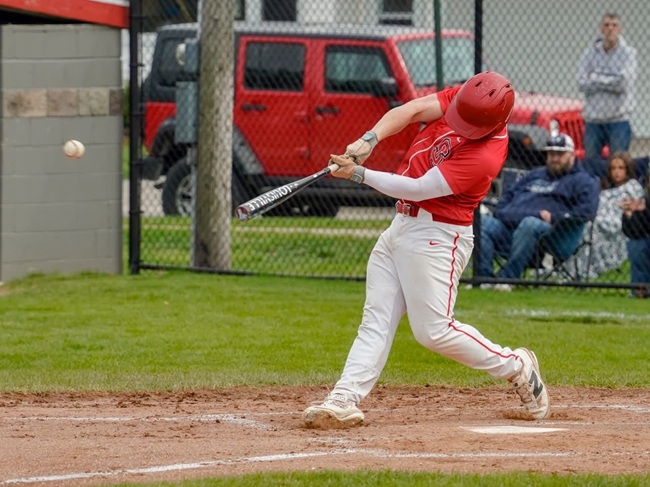
PHOTOS (Top) Spring Lake baseball coach Bill Core tosses Maddux Kipling his home run ball after a win over Fruitport. (Middle) Kipling pitching at Spring Lake's Hickman Field. (Below) Senior Oliver Smies connects with a pitch. (Photos by Trevor McCue/Grand Haven Tribune.)