

A-B Preview: Ready to Make History
March 23, 2017
By Geoff Kimmerly
Second Half editor
Dating back more than 90 years, the MHSAA Boys Basketball Tournament allows us to conjure up “first time since” statements that truly speak to the event’s lengthy and rich history.
Three of eight Class A and B semifinalists this weekend are playing for first championships – including Clarkston, often one of the best in Michigan but frequently just a few wins short of that first title. But also in this weekend’s field are Grand Rapids Christian, playing for its first title since 1938, and Benton Harbor playing for its first since 1965. Ludington last played in an MHSAA Final in 1953. River Rouge won more recently, in 1999, but is best known for its 12 championships over 19 seasons from 1954-72.
Semifinals for Class A and B are Friday at Michigan State University’s Breslin Center, with all four championship games Saturday.
Semifinals – Friday
Class A
West Bloomfield (17-8) vs. Clarkston (25-1), 1 p.m.
Grand Rapids Christian (26-0) vs. Romulus (21-4), 2:50 p.m.
Class B
New Haven (25-1) vs. Benton Harbor (22-3), 6 p.m.
River Rouge (24-1) vs. Ludington (24-2), 7:50 p.m.
Finals - Saturday
Class A - Noon
Class B - 6:30 p.m.
Class C - 4:30 p.m.
Class D - 10 a.m.
Tickets cost $8 per pair of Semifinals and $10 per two-game Finals session. All Semifinals will be streamed live on MHSAA.tv on a pay-per-view basis. All four Finals will be broadcast live on Fox Sports Detroit. Free radio broadcasts of all weekend games will be available on MHSAANetwork.com.
And now, a look at the semifinalists in Class A and B. Click on the name of the school to see that team’s full schedule and results from this season. (Statistics are through teams' Regional Finals.) The Boys Basketball Finals are presented by Sparrow Health System.
Class A
CLARKSTON
Record/rank: 25-1, Tied for No. 3
League finish: First in Oakland Activities Association Red
Coach: Dan Fife, 35th season (675-169)
Championship history: Has never appeared in an MHSAA Final.
Best wins: 68-48 over No. 5 Macomb Dakota in the Regional Semifinal, 60-47 over No. 7 Flint Carman-Ainsworth, 57-51 over honorable mention Romulus, 59-48 and 68-61 over West Bloomfield.
Players to watch: Foster Loyer, 6-0 jr. G (25.1 ppg, 6.4 apg); Dylan Alderson, 6-5 sr. F (23.9 ppg, 5.3 rpg).
Outlook: Clarkston is in the Semifinals for the first time since 2009 seeking the first championship game berth of its storied history. Fife entered this season ranked fourth in MHSAA history for coaching wins, and the Wolves have totaled more than 20 in four straight seasons while winning District titles in 23 of the last 24. His leader on the court, Loyer, already has committed to play at Michigan State after high school, and Alderson has signed with Wisconsin-Milwaukee. The lone loss was by four to Southfield Arts & Technology on Feb. 17, and Clarkston has won all but one game since by at least 20 points.
GRAND RAPIDS CHRISTIAN
Record/rank: 26-0, No. 1
League finish: First in Ottawa-Kent Conference Gold
Coach: Mark Warners, seventh season (116-45)
Championship history: Class B (Lower Peninsula) champion 1938, Class B (Lower Peninsula) runner-up 1939.
Best wins: 66-46 (Quarterfinal) and 53-51 (OT) over No. 8 Kalamazoo Central, 59-56 (Regional Final) and 57-49 over No. 9 Holland West Ottawa, 64-26 over No. 3 Muskegon in the Regional Semifinal, 71-49 over Class B No. 9 Wayland, 72-58 over Class B No. 1 Wyoming Godwin Heights.
Players to watch: Xavier Tillman, 6-8 sr. F (13.2 ppg, 10.7 rpg, 4.7 apg, 4.1 bpg); Duane Washington, Jr., 6-3 jr. G (11.9 ppg, 4,4 apg, 49 3-pointers).
Outlook: The Eagles have played through one of the toughest paths to get to Breslin, against top-10 teams their last three games, to make their first Semifinal since 2013. As a team, Grand Rapids Christian has outrebounded opponents 37-28 on average and held them to only 42 points per game. Tillman was a Mr. Basketball Award finalist and teams with 6-7 senior James Beck II (12.9 ppg 7.0 rpg); they’re signed to play next at MSU and Oakland, respectively, while Washington is considered one of the state’s top juniors.
ROMULUS
Record/rank: 21-4, honorable mention
League finish: Tied for first in Western Wayne Athletic Conference Blue
Coach: Jerret Smith, fourth season (78-23)
Championship history: Class A champions 2013 and 1986, runner-up 2005.
Best wins: 66-63 over No. 6 Detroit U-D Jesuit in the Quarterfinal, 71-58 (Regional Semifinal) and 57-56 over Belleville, 73-63 over No. 9 Kalamazoo Central.
Players to watch: Kaevon Merriweather, 6-2 jr. G (19 ppg), Jaren English, 6-4 sr. F (17 ppg).
Outlook: The Eagles have tested themselves against the best this season, avenging earlier defeats against league rival Belleville and reigning Class A champion U-D Jesuit and falling also to Clarkston and River Rouge – both also semifinalists this weekend. Romulus has been a regular during the final week with eight Quarterfinal appearances over the last 13 seasons and Semifinals this decade in 2013 and 2012 as well. Six players average at least eight points a game; senior forward Dylan Price adds 16 and junior center Darius Lundy 10.
WEST BLOOMFIELD
Record/rank: 17-8, unranked
League finish: Tied for third in the OAA Red
Coach: Jeremy Denha, seventh season (84-66)
Championship history: Has never appeared in an MHSAA Final.
Best wins: 80-43 (Quarterfinal) and 64-61 over Troy, 63-58 (OT) over North Farmington, 57-55 over Southfield Arts & Technology.
Players to watch: Kevin McAdoo, 6-2 sr. G (24.1 ppg, 4.1 apg, 3.0 spg, 53 3-pointers); Tre Harvey, 6-2 jr. G (15.4 ppg, 56 3-pointers).
Outlook: West Bloomfield has gotten hot at the best time to make its first Semifinal since 2003 after losing three of its final four games during the regular season. The Lakers’ league does include Clarkston (above) and reigning Class A runner-up North Farmington, which no doubt helped prepare West Bloomfield to make a run. McAdoo and Harvey can put points on the board – McAdoo has a high game of 40 – and sophomore Tre Mosley also finds the basket from long range with 44 3-pointers entering the week.
Class B
BENTON HARBOR
Record/rank: 22-3, No. 5
League finish: Does not play in a league.
Coach: Corey Sterling, fifth season (86-35)
Championship history: Three MHSAA titles (most recent 1965), seven runner-up finishes.
Best wins: 46-44 over Spring Lake in the Quarterfinal, 60-57 over No. 9 Wayland in the Regional Final, 49-44 (OT) over Stevensville Lakeshore, 55-45 over Battle Creek Central.
Players to watch: Carlos Johnson, 6-6 fr. C (14.2 ppg, 14.1 rpg, 3.3 bpg); Roy Anderson, 6-2 sr. G (13.5 ppg, 5.2 apg, 3.6 spg).
Outlook: Benton Harbor was Class B runner-up in 2014 and is back at the Breslin for the second time in four seasons after bouncing back from two losses over its final three games. All three defeats this winter were to Class A teams, and by a combined nine points. Johnson and Anderson are just two of the standouts; junior forward Shawn Hopkins adds another 13.2 points and 6.3 rebounds per game, and junior guard Elijah Baxter averages 10.5 points, 6.3 rebounds and 3.1 steals.
LUDINGTON
Record/rank: 24-2, No. 8
League finish: Tied for first in Lakes 8 Activities Conference
Coach: Thad Shank, 15th season (235-115)
Championship history: Class B runner-up 1953.
Best wins: 63-49 (District Quarterfinal) and 70-38 over honorable mention Big Rapids, 59-56 over Traverse City West, 60-44 over Muskegon Heights Academy.
Players to watch: Calvin Hackert, 6-0 sr. G (13.3 ppg, 3.1 apg, 45 3-pointers); Sam LaDuke, 6-3 sr. G (10.5 ppg, 30 3-pointers).
Outlook: Ludington is making the trip for its first Semifinal since 1971. The Orioles were 9-13 only two seasons ago before Shank returned after three years away from the program – he coached the girls team during that time, and both teams last winter before coaching just the boys this season. All five of his starters plus two subs average at least five points per game, and five of those seven are seniors looking to continue this finish on a high note.
NEW HAVEN
Record/rank: 25-1, No. 3
League finish: First in Macomb Area Conference Blue
Coach: Tedaro France II, ninth season (157-57)
Championship history: Has never played in an MHSAA Final.
Best wins: 73-66 over Detroit Osborn in the Quarterfinal, 108-104 (3OT) over Class C No. 4 Flint Beecher, 84-56 over St. Clair Shores Lake Shore, 79-50 over Warren Michigan Collegiate.
Players to watch: Eric Williams, Jr., 6-5 sr. G (20.9 ppg, 6.5 rpg, 4.1 apg, 3.8 spg); Romeo Weems, 6-6 soph. F (18.1 ppg, 12.6 rpg, 3.6 apg, 3.9 spg, 3.2 bpg).
Outlook: New Haven played in its third straight Quarterfinal on Tuesday and broke through to make the Semifinals for the first time. And the time couldn’t be more right for the Rockets; Williams is a star finishing off his career alongside Weems, arguably the top sophomore in the state. Junior 6-7 forward Ashton Sherrell adds another 11.7 points and seven rebounds per game, and total six players average at least 6.4 ppg. And of those six, four should be back next season as well.
RIVER ROUGE
Record/rank: 24-1, No. 2
League finish: First in Michigan Metro Athletic Conference
Coach: Mark White, first season (24-1)
Championship history: 14 MHSAA titles (most recent 1999), five runner-up finishes.
Best wins: 54-51 over Williamston in the Quarterfinal, 78-72 over Class A honorable mention Romulus, 57-52 over West Bloomfield, 71-47 over Warren Michigan Collegiate, 62-47 over Class D No. 2 Southfield Christian.
Players to watch: Darian Owens-White, 6-1 soph. G; DreQuan Bell, 6-3 sr. G (Statistics not submitted.).
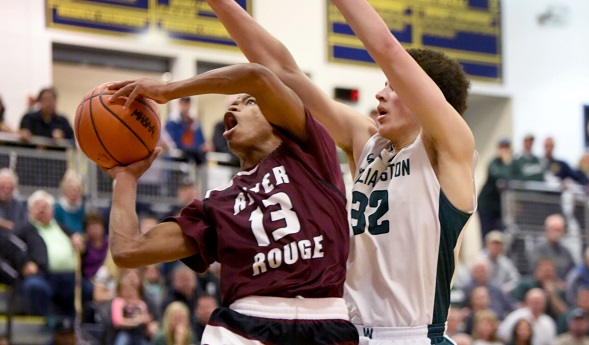
Outlook: River Rouge is one of the most storied programs in MHSAA history, and has arguably its best shot at a championship since last winning in 1999. White took over the program after formerly coaching Detroit Renaissance and Southeastern and the last eight seasons as head coach at Adrian College. This will be the program’s first Semifinal since 1999; it advanced by avenging last season’s Quarterfinal loss to Williamston.
PHOTO: River Rouge's Darian Owens-White works to get up a shot during Tuesday's Quarterfinal win over Williamston. (Click for more from HighSchoolSportsScene.com.)

Beecher Seniors Lead 3-Peat Attempt
March 23, 2017
By Geoff Kimmerly
Second Half editor
EAST LANSING – The day after Flint Beecher won the Class C boys basketball championship in 2013, coach Mike Williams went to watch an eighth-grade game.
He saw Levane Blake get a steal and a dunk, Malik Ellison pull up for a 3-pointer. “I just remember seeing the chemistry between them,” Williams said. “And I thought to myself, I think we’ll be going back down to Lansing a few more times.”
Now seniors, Blake, Ellison and Jordan Roland have a chance to finish their Beecher careers among the most successful players in the program’s storied history.
The Bucs have won seven MHSAA titles, and those three captains have been part of two straight – and earned an opportunity to three-peat with a 76-68 victory over Detroit Edison Public School Academy in Thursday’s first Semifinal at the Breslin Center.
“We feel more poised this year. It’s our senior year, and we want to go out with a bang,” Roland said.
“It’s our senior year, and I won’t be able to wear this jersey anymore,” Blake added, “or play on the court with my team, or lead the young guys. So we work every day in practice, go hard, hard, hard, and Coach Mike pushes us.”
Beecher (22-5) will play Grand Rapids Covenant Christian in Saturday’s 4:30 p.m. Final. The Bucs not only have won the last two Class C titles, but four of the last five.
After watching these seniors star as eighth graders that day in 2013, Williams knew they’d be on varsity as freshmen. Ellison, Roland and Blake all joined the varsity that next winter; Ellison and Blake started as sophomores in the 2015 championship win, and all three started in last year’s title game.
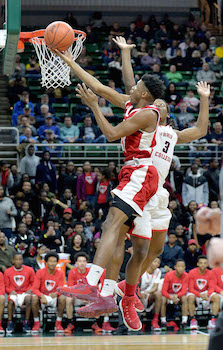 Ellison scored a game-high 28 points and added seven rebounds and seven assists Thursday, while Roland and Blake both scored 10 points, Roland also grabbing seven rebounds and the 6-foot-7 Blake blocking six shots.
Edison (14-12), in its first Semifinal after winning its first Regional title last week, fought back-and-forth for the lead through the first five minutes of the second quarter until Beecher took a one-point lead on a Roland bucket with 3:17 to go in the first half, and never gave up the advantage again.
“We know Malik is a tough little guard, and I think the thing you never can put a hand on is a guy coming up here playing in three state championships games,” DEPSA coach Brandon Neely said. “I think the advantage he had is he just understood how the game would go. … You know that those guys are never going to get rattled. They’ve been in so many wars that when they come to battle, they’re just loose; it’s just another game for them."
Senior guard Jamal Keesee led the Pioneers with 21 points and 12 rebounds, while junior center Deante Johnson had 17 points and nine rebounds. Junior guard Gary Solomon added 15 points, six rebounds and four assists, and junior guard Pierre Mitchell, Jr., had 10 points and also six rebounds and four assists.
Beecher freshman guard Jalen Terry had 15 points as his team’s second-leading scorer, something that spoke to what Williams has emphasized to his successful seniors this winter. He put it on them to play major roles in bringing along the next generation, to work at both continuing the Bucs’ legacy and setting it up for the future as well, just as others did to assist them at the start of their careers.
“I’m just going to go out there and play hard for them,” Terry said. “They gave me everything they’ve got. I’m going to give them everything I’ve got.”
PHOTOS: (Top) Flint Beecher’s Malik Ellison drives hard to the basket during Thursday’s first Class C Semifinal. (Middle) The Bucs score two more on the way to earning their third straight championship game berth.