

BCAM Names '7s' Retro Mr Basketball Winners
May 1, 2017
Basketball Coaches Association of Michigan
Forty years after scoring his last basket at the high school level, Earvin “Magic” Johnson is finally a BCAM Mr. Basketball.
“When we began talking about this award, we thought of all the great players who never had the opportunity to win it,” said Al Schaffer, chairman of the Association’s Mr. Basketball committee at the announcement of the Michigan’s Mr. Basketball award back in 1981. “Players like Earvin Johnson, Dave DeBusschere, Chet Walker, Frank Tanana, Sr.; Mel Peterson, Richie Jordan, Campy Russell and many, many others.”
In 2010, the Basketball Coaches Association of Michigan launched a decade-long program meant to honor those very athletes. The Retro Mr. Basketball award looks back at the state’s top senior prep basketball players for the years 1920 through 1980. This year marks the eighth year of the project, and places the spotlight on the senior athletes for the years that end in seven – 1927, 1937, 1947, 1957, 1967 and 1977.
“Those six school years include some of the state’s greatest names,” said BCAM president Tom Hursey. “BCAM was incorporated in the summer of 1976, and first presented the ‘Mr. Basketball’ award in 1981 to Lansing Eastern’s Sam Vincent. Earvin ‘Magic’ Johnson was one of the inspirations for the award. It’s nice to see him honored after all these years.”
Members of the Association’s Retro Mr. Basketball committee assembled between sessions of the MHSAA Boys Basketball championships in March to identify, then select the latest group of honorees.
“With their selections, a total of 49 seniors from the Retro years have now been named,” said Ron Pesch, historian for the Michigan High School Athletic Association and the individual tasked with identifying candidates for the award. “When combined with the 37 winners of the modern Mr. Basketball award, Michigan now has 86 individuals we call “Mr. Basketball.”
The names of this year’s selections will be added to plaques that surround the base of the original Mr. Basketball trophy created by BCAM in 1981.
PAST WINNERS OF BCAM’S RETRO MR. BASKETBALL AWARD
(College Attended Shown In Parenthesis)
1980 Tim McCormick, Clarkston (Michigan)
1976 Stuart House, Detroit Denby (Washington State)
1975 Bruce Flowers, Berkley (Notre Dame)
1974 Tony Smith, Saginaw (Nevada-Las Vegas)
1973 Tom LaGarde, Detroit Catholic Central (North Carolina)
1972 Larry Fogle, Detroit Cooley (Canisius)
1971 Michael "Campy" Russell, Pontiac Central (Michigan)
1970 Rick Drewitz, Garden City West (Kentucky)
1966 Rudy Tomjanovich, Hamtramck (Michigan)
1965 L.C. Bowen, Benton Harbor (Bradley)
1964 Willie Betts, River Rouge (Bradley)
1963 Craig Dill, Saginaw Arthur Hill (Michigan)
1962 Ernie Thompson, Saginaw (Bradley)
1961 Reggie Harding, Detroit Eastern
1960 Peter Gent, Bangor (Michigan State)
1956 Mel Peterson, Stephenson (Wheaton)
1955 M.C. Burton, Jr., Muskegon Heights (Michigan)
1954 Pete Tillotson, Ludington (Michigan)
1953 Ron Kramer, East Detroit (Michigan)
1952 Frank Tanana, Sr., Detroit St. Andrew
1951 Webster Kirksey, Saginaw (Eastern Michigan)
1950 Charlie Primas, Detroit Miller (Wayne State)
1946 Jack Forestieri, Benton Harbor (Norte Dame)
1945 Bob Swanson, Lansing Sexton (Michigan)
1944 Dick Rifenburg, Saginaw Arthur Hill (Michigan)
1943 Don Boven, Kalamazoo Central (Western Michigan)
1942 Larry Savage, Saginaw (Northwestern)
1941 Don Osterman, Detroit St. Theresa (Villanova)
1940 Ralph Gibert, Flint Northern (Michigan)
1936 Charles Pink, Detroit Northwestern (Michigan)
1935 John Zwier, Holland Christian
1934 Earl Brown, Jr., Benton Harbor (Notre Dame)
1933 Lincoln Dodson Truss, Flint Northern
1932 Lowell Matteson, Portage
1931 Edward Huttenga, Grand Haven (Western Michigan)
1930 John Tooker, Kalamazoo St. Augustine (Michigan)
1926 Roger Grove, Sturgis (Michigan State)
1925 Joe Truskowski, Detroit Northeastern (Michigan)
1924 Bennie Oosterbaan, Muskegon (Michigan)
1923 Henry Schrumpf, Niles (Western Michigan)
1922 Royal Cherry, Grand Rapids Union (Michigan)
1921 George Haggarty, Ypsilanti (Michigan)
1920 Harry Kipke, Lansing Central (Michigan)
2017 SELECTIONS FOR BCAM’S RETRO MR. BASKETBALL AWARD
(The winner of the award is listed below at the top of the page in ALL CAPS, while finalists for the award follow and are listed alphabetically.)
1977 RETRO MR. BASKETBALL
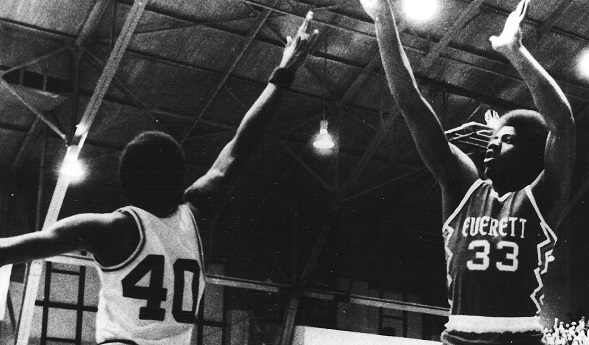
EARVIN ‘MAGIC’ JOHNSON, LANSING EVERETT – “May be the best prep player ever in Michigan” stated United Press International at the conclusion of his prep career, and today, few would debate that assessment. Johnson totaled 2,012 points in his high school career, including an average of 28.8 points per game as a senior. Dominant across all aspects of the game, opposing coaches praised his ability to control a contest. The sophomore fouled out in his varsity debut, missing about a third of the game, but still grabbed 16 rebounds and scored 12 points against Holt in early December 1974. By February of 1975, Lansing sportswriters called him “Magic.” A first-team Parade All-American as a 6-foot-8½, 198 pound senior, Johnson was named a first-team all-stater by The Associated Press in all three years of varsity play. In 1977, Johnson led Everett to a 62-56 overtime victory over Birmingham Brother Rice in one of the all-time classic Class A title games.
1977 FINALISTS
Rick Baillergeon, Maple City Glen Lake, 6-2 – Scored 16 points as Glen Lake downed Detroit East Catholic 70-68 for Class D championship. The points brought Baillergeon’s four-year career total to 2,144 – second most in the state at the time behind Richie Jordan, who tallied 2,210 points for Fennville between 1962 and 1965, and four more than Dom Jacobetti’s total of 2,140 points, scored over four seasons at Negaunee St. Paul. A 60-percent field goal shooter, Baillergeon continued his playing days at Ferris State.
Tim Bracey, Grand Rapids Creston, 6-2, 170 – Excellent at both ends of the court, Bracey was a two-time scoring champion in the City League and averaged 24.3 points, 13 rebounds, and six assists per game as a senior.
Kevin Smith, Birmingham Brother Rice, 6-1½, 165 – Called “the finest guard to ever play basketball in the Catholic League” by Mick McCabe of the Detroit Free Press, Smith was accurate on 81 percent of his free throws while averaging 29 points, seven assists, five steals and six rebounds per contest as a senior. His 47-foot shot at the end of regulation of the 1977 Class A championship against Lansing Everett sent the contest to overtime.
Jay Vincent, Lansing Eastern, 6-7, 230 – Vincent was a starter beginning his sophomore year but played largely in the shadow of Earvin Johnson. Still, he was the second-leading vote getter on the UPI all-state team. Vincent totaled 1,512 points over his prep career, a number that would have been higher had Eastern been able to get past Johnson and Everett in the District round of the annual MHSAA tournament during those three seasons.
1967 RETRO MR. BASKETBALL
SPENCER HAYWOOD, DETROIT PERSHING – “He just might be the finest 16-year-old player in the United States,” said his coach Will Robinson about the transfer from Mississippi who arrived at Pershing in the fall of the 1965-66 school year. Only the Detroit Free Press named the 6-foot-7 junior to its all-state team that winter, but one year later, the Detroit News, Free Press, Associated Press and United Press International had all discovered Haywood, and named him to their respective top all-state squads. Haywood demanded respect around the boards, grabbing 544 rebounds – 169 on offense and 375 on defense – while blocking 160 shots. A Parade magazine third-team All-American, he averaged 29.1 points per game as a junior and 25.6 over his prep career, hitting on 74 percent of his free throws while dishing out 120 assists. Helped lead the Doughboys to the 1967 Class A championship, the first for Robinson.
1967 FINALISTS
Tim Bograkos, Flint Central, 6-1, 175 – The second player in Flint history to score more than 600 points in his career, Bograkos totaled 726 points over two seasons of varsity play. Honor student and team captain of the football, basketball and baseball teams, as a senior he averaged 17 points per game, leading the Indians to the Class A Final, a 90-66 loss to Detroit Pershing.
Dan Fife, Clarkston, 6-3½, 185 – Averaged 12 rebounds and better than 32 points per contest as a senior. Scored 52 points in a game and totaled 1,589 points over his three years of varsity play at Clarkston. Fife played college ball at Michigan, then returned to Clarkston where he has served as varsity basketball coach for 35 years. In March 2017, the Wolves topped Grand Rapids Christian for the Class A championship – a first for Coach Fife.
Ralph Houston, Muskegon Heights, 6-4½, 178 – Possessing excellent size and speed, Houston averaged just shy of 20 points per game for the Tigers, scoring 381 points total while corralling 208 rebounds as a senior.
Kennedy McIntosh, South Haven, 6-6½, 220 – A Class B all-state selection as a junior, McIntosh earned Dream Team recognition from the Detroit News as a senior, averaging 18 rebounds and more than 25 points per game during his graduation year. Attended Eastern Michigan following high school before advancing to the NBA.
1957 RETRO MR. BASKETBALL
ED BURTON, MUSKEGON HEIGHTS – A rugged rebounder who carried a 20-point-plus scoring average as both a forward and center, the 6-foot-6, 201-pound Burton was the top vote getter in the Detroit Free Press coaches all-state poll. Scored 1,143 points to break the Heights’ career scoring mark set by his brother, M.C. Burton, by two points. As a senior, “Big Ed” hit 20 field goals and tallied 44 points versus Traverse City in tournament Quarterfinal play, and 17 points versus Benton Harbor and star junior Chet Walker in the Semifinals. In the 1957 Class A title contest, Burton scored 25 points, including 13 of 15 shooting from the foul line, against Detroit Austin Catholic and its top ballplayer, junior Dave DeBusschere. Burton’s 31 rebounds against Traverse City in Quarterfinal action still stands as an MHSAA final round record.
1957 FINALISTS
Charles North – Detroit Northwestern, 6-3½, 185 – Led Northwestern to the City Championship, and was the team’s top rebounder and clutch scorer. Later played for the University of Detroit.
Dave Southwell – Parma Western – 6-4, 205 – A repeat first-team all-state selection by the Free Press, Southwell was amazingly agile, and turned in his best games against Parma’s toughest opponents. “Would rather set up his teammates than to score himself,” wrote the Michigan Center coach at the time of balloting for the 1957 all-state team. “He took eight shots against us and hit on five.” High praise considering Southwell put up 47 against Michigan Center as a junior.
Tom Villemure, Newberry, 5-10, 180 – Averaged 33.3 ppg as a guard at Newberry, and was the state’s leading scorer in 1957. Later a two-time MVP at Sault Tech (now Lake Superior State) then continued his playing career at University of Detroit. Served as head coach at Grand Valley State for 24 years.
Tom Wilson, Lapeer, 6-1, 178 – The top name in Class B basketball in 1957. Scored over 1,300 points in his career at Lapeer and 36 points or more in six straight games. Tom was the third of the Wilsons to play football at Michigan State behind oldest brother John, a defensive back at MSU, and Pat, a quarterback and basketball player for the Spartans. Tom would also play both sports at Michigan State.
1947 RETRO MR. BASKETBALL
SAMMY GEE, DETROIT MILLER – A 5-foot-8, 150-pound set-up artist, Gee was a quick thinking floor general and one of the city’s top scorers for coach Will Robinson’s Trojans. Well known across the state despite the fact Detroit Public School League teams did not compete in the MHSAA-sponsored tournament, Gee scored 15 points to lead all scorers as Miller won its first-ever PSL championship before 8,000 fans at the State Fairground Coliseum in Detroit. Miller then downed Detroit St. Joseph in Detroit’s first postseason championship between the PSL and the city’s parochial champion. The game was played in front of 16,041 spectators at Olympia Stadium, at the time the largest crowd ever to see a basketball game in Michigan. As a testament to his skills, Gee was signed by the Harlem Globetrotters out of high school. An outstanding baseball player as well, he was inked by the Brooklyn Dodgers and played minor league ball for the organization for parts of two seasons.
1947 FINALISTS
Bill Agre, Saginaw Arthur Hill, 6-0, 150 – Only Saginaw Valley member to score a spot on the Detroit Free Press all-state first team. An aggressive, hard driving guard, Agre was the Valley’s top defensive player and received the most votes when named to the league’s all-conference team.
Chuck Murray, Birmingham, 5-11 – Another first-team selection by the Times, Murray also was named to the second team by the Free Press. Considered one of the state’s most versatile athletes, competing in football, baseball and track, but basketball was considered his best sport. Held Birmingham’s single-season scoring mark with 210 points in 15 games.
Bob Nagel, Lansing Eastern, 6-2, 185 – A unanimous all-5A Conference first-team selection, Nagel was a first-team selection in the Free Press. An outstanding all-around athlete, he was Class A pole vault champion in the spring of 1947.
Bob VanDyke, Holland – 6-5, 200 – Scored 296 points in 17 games to set a new scoring record at Holland, with six games of 20 points or more.
1937 RETRO MR. BASKETBALL
BOB OSTERMAN, DETROIT ST. THERESA – A 6-foot-4 center, Osterman led Detroit St. Theresa to Class B titles in 1936 and 1937. Only first team repeater on the Detroit Free Press all-state squad, he was named to the paper’s second team in 1935 as a sophomore. Scored 793 points over four years at St. Theresa – better than 11 points per game. Tallied 16 points in a little more than three quarters of play, as St. Theresa downed Marshall in the Class B Final in 1937. Later played football at Notre Dame. Brother of Don, who was named Retro Mr. Basketball for the 1940-41 season.
1937 FINALISTS
Gene Brogan – Lansing St. Mary – A clever dribbler and top-notch playmaker, Brogan was the main cog in St. Mary’s drive to back-to-back Class C championships. Helped the “Big Blue” piece together a 27-game win streak spanning the 1936 and 1937 seasons. The loss, to eventual 1937 Class B champion Detroit St. Theresa, was St. Mary’s lone defeat in 25 matchups in ’37 and one of four over the two-year span.
Jack Newman, Grand Rapids Union – “A fine passer,” Newman was the “leading scorer in the Grand Rapids City League for two seasons.”
Melvin Peterson, Muskegon – Captain and top marksman for the Big Reds, Peterson helped guide Muskegon to a flawless 18-0 mark and the Class A championship. A guard praised for his playmaking ability, he finished third in scoring in the Southwestern Conference with 64 points over 10 games. Later played basketball at Michigan State.
Grady Truss, Flint Northern – The first African-American player to captain Northern’s basketball team, the 6-foot-4 Truss played center and finished his senior year as the second-leading scorer in the Saginaw Valley league with 108 points. A first team all-state selection by the Free Press, Truss earned second team all-state honors as a junior, and was a third team pick as a sophomore. Northern finished as runner-up to the state title in 1935, won the Class A title in 1936, and advanced to the Quarterfinals, losing to cross-town rival Flint Central, in 1937. Grady was the younger brother of Lincoln Dodson Truss, who was named Retro Mr. Basketball for the 1932-33 season.
1927 RETRO MR. BASKETBALL
BILL MCCALL, MUSKEGON – Led the basketball team to a 20-1 record and a Class A championship in the winter of 1927. Named to the All-Tournament team, McCall was also a two-time all-state selection in football, where he helped guide Muskegon to mythical championships in the falls of both 1926 and 1927, the first titles under the leadership of head coach C. Leo Redmond. Later starred at Dartmouth University in both sports.
1927 FINALISTS
Harold Green, Detroit Northern – Named captain of the Detroit Free Press mythical All-City team, Green was “a small thin chap,” who played “like a flash of lightning.” Finished second in scoring in Detroit as a senior, he was considered one of the few players who could do all things well.
George Markley, Pontiac – In his first year on varsity, Markley developed into a brilliant player. His specialty was tapping the ball in from under the basket and his work in the MHSAA tournament, played at Detroit Central, earned him the position of All-Tournament forward.
Al Milanski, Detroit Northeastern – Twice named to the first-team All-City squad by the Detroit Free Press. Top scorer in the city, Milanski averaged better than 10 points per game as a senior. “Fast man down the floor, especially adept at receiving passes and one of the surest shots in the city within a reasonable distance of the basket.”
Ray Priest, Battle Creek Central – Outstanding forward of the state tournament, according to the Battle Creek Enquirer. Played a beautiful floor game, offensively and defensively. First player in Battle Creek history to earn all-state in both football and basketball. Mid-year grad. Played football at the University of Michigan following high school.
PHOTO: Lansing Everett's Earvin Johnson (right) puts up a shot over Lansing Eastern's Jay Vincent during their high school careers.
Be the Referee: Held Ball or Traveling?
February 13, 2020
This week, MHSAA officials coordinator Sam Davis offers a basketball "You Make the Call" that comes into play when defensive and offensive players wind up in a stalemate.
Be The Referee is a series of short messages designed to help educate people on the rules of different sports, to help them better understand the art of officiating, and to recruit officials.
Below is this week's segment - Held Ball or Traveling - Listen
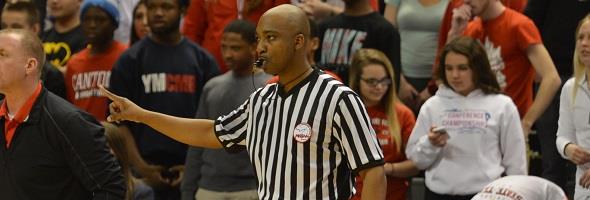
Let’s try a basketball “You Make the Call” play today. The offensive player jumps in an effort to either take a shot or make a pass. The defensive player reaches out and is able to place his or her hands on the ball to keep the offensive player from releasing it, and the offensive player returns to the floor with the ball.
You Make the Call? There was no contact, so there is no foul. Is it a traveling violation, or is it a held ball with the ball going to the team with the possession arrow in its favor?
Some old-timers out there might remember that up until about 1990, a traveling violation would have been called on this play. But the rules now call for a held ball in the situation with the possession arrow, which had just been introduced five years earlier in 1985, prevailing.
Past editions
Feb. 6: Hockey Rules Chart - Listen
Jan. 30: Cheer Safety - Listen
Jan. 23: Goaltending - Listen
Jan. 16: Wrestling Tie-Breaker - Listen
Jan. 9: Pregame Meeting - Listen
Dec. 19: Alternating Possession - Listen
Dec. 12: Ratings - Listen
Dec. 5: Video Review Success - Listen
Nov. 28: More Injury Time - Listen
Nov. 21: Football Review - Listen
Nov. 14: Sideline Safety - Listen
Nov. 7: Officials Playlist - Listen
Oct. 31: Most Important Line - Listen
Oct. 24: Automatic 1st Downs - Listen
Oct. 17: Catch Momentum - Listen
Oct. 10: Golf Rules Changes - Listen
Oct. 3: No Tackle Box - Listen
Sept. 26: You Make the Overtime Call - Listen
Sept. 19: Swimming Finishing Touch - Listen
Sept. 12: Curbing Gamesmanship By Substitution - Listen
Sept. 5: Football Safety Rules Changes - Listen
Aug. 29: 40-Second Play Clock - Listen