

Breslin Bound: Boys A-B Semis Preview
March 20, 2013
By Geoff Kimmerly
Second Half editor
Some semi-ancient history is at risk of being updated during the Class A and B Finals this weekend at Michigan State University's Breslin Center.
Detroit Southeastern is seeking is first title since 1926 and Grand Rapids Christian since 1938. Wyoming Godwin Heights will play for its first championship game berth since 1960, but also as one of three Class B Semifinalists looking to win it all for the first time.
Standing in the way? In Class A, it's reigning champion Saginaw and heavy favorite Romulus. In Class B, one of the state's most successful programs ever, Detroit Country Day.
Below is the schedule for all four Friday Semifinals and Saturday Finals, plus broadcast information and a look at all eight A and B Semifinalists.
Semifinals - Friiday
Class A
Romulus (25-1) vs Grand Rapids Christian (20-6), 1 p.m.
Detroit Southeastern (20-5) vs Saginaw (23-3), 2:50 p.m.
Class B
Cadillac (21-4) vs Detroit Country Day (23-3), 6 p.m.
Detroit Community (17-9) vs Wyoming Godwin Heights (23-2), 7:50 p.m.
Finals - Saturday
Class A - Noon
Class B - 6:30 pm
Class C - 4:30 pm
Class D - 10 am
Tickets cost $8 per pair of Semifinals and $10 per two-game Finals session. All Semifinals will be streamed live on MHSAA.tv and available on a pay-per-view basis for $3.95 per day or $6.95 for the weekend. Saturday's first three Finals will be broadcast live on Fox Sports Detroit, with the Class B game on Fox Sports Plus and then re-broadcast on Fox Sports Detroit at 10:30 p.m.. Free radio broadcasts of all weekend games will be available on MHSAANetwork.com.
And now, a look at the Semifinalists in Class A and B.
Class A
DETROIT SOUTHEASTERN
Record/rank: 20-5, honorable mention
League finish: Second in Detroit Public School League East
Coach: George Ward, fourth season (82-15)
Championship history: Two MHSAA titles (most recently 1926), one runner-up finish.
Best wins: 54-49 (OT) over honorable mention Macomb L’Anse Creuse North (Regional Final), 54-49 over Rochester (Quarterfinal), 71-52 over Class B No. 4 Harper Woods Chandler Park, 48-44 over Class B No. 10 Detroit Douglass.
Players to watch: Jovone Haynes, 6-0 sr. G; Kenyatta Singleton, 6-0 sr. G. (Statistics not submitted.)
Outlook: Although Southeastern’s championships came in 1925 and 1926, they finished Class A runner-up only two seasons ago and with Singleton a prominent player off the bench. That Southeastern was likely the third-best Detroit PSL team during the regular season speaks to the league’s strength again this winter, and the Jungaleers lost to reigning Class A champion Saginaw and No. 8 Detroit Cass Tech by one point apiece and Ann Arbor Pioneer and River Rouge by only two each.
GRAND RAPIDS CHRISTIAN
Record/rank: 20-6, honorable mention
League finish: First in O-K White
Coach: Steve Majerle, first season (20-6)
Championship history: Lower Peninsula Class B champion 1938, one runner-up finish.
Best wins: 72-69 over No. 9 East Kentwood (District Semifinal), 64-61 over honorable mention Lansing Waverly (Regional Semifinal), 78-70 over honorable mention Holt (Regional Final), 64-61 over Muskegon, 70-59 over Class B No. 6 Wyoming Godwin Heights.
Players to watch: Drake Harris, 6-4 jr. G; Wuoi Mach, 6-4 sr. C. (Statistics not submitted.)
Outlook: Grand Rapids Christian has been surging with 10 straight wins and avenged a previous 24-point loss by beating Muskegon in the Quarterfinal. Harris is the catalyst and will try to add a basketball championship to the football title in which he played a large role at the end of November. Majerle previously coached Rockford to the 2003 Class A championship.
ROMULUS
Record/rank: 25-1, No. 2
League finish: First in Western Wayne Athletic Conference Blue
Coach: Nate Oats, 11th season (220-52)
Championship history: Class A champion 1986, one runner-up finish.
Best wins: 93-91 over No. 1 Detroit Pershing (Quarterfinal), 82-71 over No. 4 Saginaw Arthur Hill, 93-63 over No. 6 Saginaw, 75-65 over Class B No. 1 Detroit Country Day.
Players to watch: E.C. Matthews, 6-4 sr. G (16.2 ppg, 6.0 rpg); Leonardo Edwards, 6-8 sr. C (11 ppg, 7.0 rpg, 2.1 bpg), Wes Clark, 6-0 sr. G (11.8 ppg, 5.7 apg).
Outlook: Throw in wins over Lansing Sexton, Detroit Community, Detroit Douglass, Detroit Consortium, Chicago Seton and Indianapolis Cathedral, and no team in Michigan has defeated as impressive a slate. The Eagles’ lone loss was to Pershing by six in their second game this season, and Romulus avenged that Tuesday. Senior forward Jalon Plummer (11.2 ppg, 47 3-pointers) also adds double-digit scoring. Matthews has signed with Rhode Island, Clark with Missouri and Edwards with Louisiana Tech.
SAGINAW
Record/rank: 23-3, No. 6
League finish: Second in Saginaw Valley Association North
Coach: Julian Taylor, second season (48-5)
Championship history: Six MHSAA titles (most recently 2012), four runner-up finishes.
Best wins: 75-64 and 86-76 (District Final) over No. 4 Saginaw Arthur Hill, 57-56 over honorable mention Detroit Southeastern, 86-61 over Class B No. 4 Harper Woods Chandler Park.
Players to watch: Julian Henderson, 6-2 sr. G; Keyon Addison, 6-1 jr. G. (Statistics not submitted.)
Outlook: The Trojans have won three of the last six Class A championships, and Henderson was the second-leading scorer in last season’s title game win over Rockford. Saginaw already avenged its early loss to Arthur Hill, and no doubt would like to face Romulus again after falling to the Eagles in the regular-season finale.
Class B
CADILLAC
Record/rank: 21-4, unranked
League finish: Tied for first in Big North Conference
Coach: Jeff McDonald, 19th season (303-124)
Championship history: Has not played in an MHSAA Final.
Best wins: 41-29 over No. 8 Big Rapids (Semifinal), 47-46 over Petoskey, 56-53 over Traverse City West.
Players to watch: Nick Paquet, 5-9 sr. G (15 ppg, 45 3-pointers); Jalen Brooks, 6-4 jr. F (12.9 ppg, 5.5 rpg).
Outlook: Cadillac is 63-11 over the last three seasons with Regional championships to cap off each. The Vikings also won a share of their league title this season by avenging early losses against other sharers Petoskey and Traverse City West. They have good size, with five players 6-4 or taller, and plenty of balance; four more join Paquet and Brooks to average between four and seven points per game.
DETROIT COMMUNITY
Record/rank: 17-9, unranked
League finish: Second in Michigan Metro Athletic Conference
Coach: Venias Jordan, Jr., first season (17-9)
Championship history: Has not played in an MHSAA Final.
Best wins: 50-47 over honorable mention Jackson Lumen Christi (Quarterfinal), 61-48 over Class C No. 8 Melvindale Academy for Business & Technology,
Player to watch: Byron Zeigler, 6-6 sr. F (statistics not submitted).
Outlook: Don’t be fooled by Community’s nine losses. Instead, consider some of the teams they came against: Class A top-10 teams Detroit Pershing (by two), Cass Tech and Romulus, honorable mention Detroit Southeastern, ranked Class C Detroit Consortium and reigning Class D champion Southfield Christian, among others. Zeigler has signed with South Florida.
DETROIT COUNTRY DAY
Record/rank: 23-3, No. 1
League finish: Does not play in a league.
Coach: Kurt Keener, 35th season (676-180)
Championship history: Eight MHSAA titles (most recently 2010), one runner-up finish.
Best wins: 75-57 over No. 4 Harper Woods Chandler Park (Regional Semifinal), 73-51 over No. 10 Detroit Douglass (Regional Final), 68-48 over Class A honorable mention Macomb L’Anse Creuse North, 86-61 over Class A No. 4 Saginaw Arthur Hill.
Players to watch: Edmond Sumner, 6-3 jr. G (16.1 ppg, 6.2 apg); Austin Price, 6-3 sr. G (12.4 ppg, 4.2 rpg, 63 3-pointers, 3.2 spg); Mory Diane, 6-2 sr. G (12.1 ppg).
Outlook: A few fun Country Day facts: The last time the Yellowjackets didn’t make it to Breslin was 2009; the last time they finished a season with fewer than 20 wins was 2004. Country Day starts out small (relatively speaking; no player is shorter than 5-11) but can get big with future Texas Tech offensive lineman Poet Thomas (6-7, 285 pounds) off the bench. Price has signed with Lehigh and makes nearly 40 percent of his 3-point shots.
WYOMING GODWIN HEIGHTS
Record/rank: 23-2, No. 6
League finish: First in O-K Silver
Coach: Chad Conklin, sixth season (98-39)
Championship history: Two runner-up finishes (most recently 1960).
Best wins: 79-72 over No. 7 Comstock Park (Regional Semifinal), 56-52 over No. 2 Stevensville Lakeshore (Quarterfinal), 60-58 over Class D No. 1 Wyoming Tri-unity Christian
Players to watch: Jamal Bland, 5-10 sr. G (14.9 ppg, 3.2 apg); Quantrell Hastings, 6-1 sr. F (15.9 ppg, 7.3 rpg).
Outlook: One more win and Godwin Heights will have improved on or tied the previous season’s win total in all six of Conklin’s winters running the program. Senior guard Braima Hai (10.9 ppg, 5.2 apg) runs the show, and sophomore guard Delaney Blaylock (11.2 ppg) also scores in double figures.
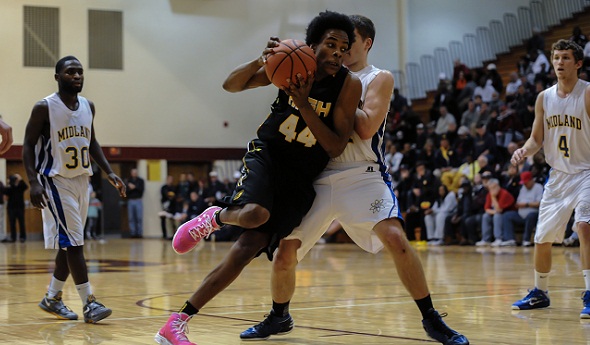
PHOTO: Saginaw junior Joseph Williams-Powell (44) drives against a Midland defender during the Trojans' Regional Semifinal win last week. (Click to see more at HighSchoolSportsScene.com.)
Breslin Bound: 2025-26 Boys Report Week 1
By
Geoff Kimmerly
MHSAA.com senior editor
December 8, 2025
Winter has certainly arrived in Michigan over the last few weeks – at least from a snowy standpoint – and right on the time to signal the start of boys basketball season and our first report on the annual march to Michigan State's Breslin Center.
 Big matchups already are happening, and every game against an MHSAA Tournament opponent counts toward seeding for District brackets, and once again we're diving into the results you need to know from the previous week, teams that are showing up big in each division and matchups coming up that you won't want to miss.
“Breslin Bound” is powered by MI Student Aid and based on results and schedules posted for each school at MHSAA.com.
Week in Review
The countdown of last week’s five most intriguing results:
1. Grand Rapids South Christian 75, Grand Rapids Christian 71 The Sailors (2-0) opened by adding to last season’s District Final win over Grand Rapids Christian (1-1), and after having lost to the Eagles 72-55 in their season opener a year ago.
2. Bloomfield Hills Brother Rice 71, Detroit U-D Jesuit 42 Brother Rice (2-0) enjoyed some significant payback after falling to Jesuit twice last season, during the regular season in what eventually decided the Catholic High School League Central title and then in their Regional Semifinal matchup.
3. Saginaw United 67, Detroit Catholic Central 57 The Phoenix (2-1) opened their new fieldhouse with a notable season-opening victory over the Shamrocks (2-1), who defeated United 69-55 in their opener a year ago.
4. Grand Blanc 76, Hamtramck 75 (OT) The Bobcats (2-0) opened the season with this notable win at the Horatio Williams Tip-Off Classic.
5. Warren Fitzgerald 41, East Kentwood 40 This was another exciting finish at the Horatio Williams event, again in a faceoff of teams with high aspirations this season.
Watch List
With an eye toward March, here are two teams in each division making sparks:
DIVISION 1
Grand Haven (3-0) The Buccaneers finished an opening week of road games without a loss, defeating Coopersville 65-42 and then Traverse City Central 83-71 and Traverse West 79-77 over the weekend. Grand Haven improved from 11-12 in 2023-24 to 18-6 last season and will have some opportunities to get rolling heading into the new calendar year with a Dec. 22 matchup against Freeland and its Lake Michigan Cup on Dec. 29-30.
North Farmington (2-0) The Raiders are coming off a 12-10 finish and third place in the Oakland Activities Association Red last season, and got off to a fast start under first-year coach Peter Mantyla with a 41-35 win over Canton and a 62-47 victory over Davison while hosting the Horatio Williams Tip-Off Classic. Reigning league champion Birmingham Groves is up next, on Friday, and the first matchup with Farmington – which ended the Raiders’ season last winter – is Dec. 19.
DIVISIION 2
Dundee (3-0) The Vikings appear on track to bounce way back after going 21-5 in 2023-24 but then only 5-18 last winter. They opened last week with a 12-point win over Saline Washtenaw Christian, a 47-46 victory over Milan and a 51-45 triumph over Britton Deerfield – and after losing to Washtenaw Christian by six points during the early going a year ago.
Freeland (3-0) The Falcons are coming off a 22-4 finish and run to the Division 2 Quarterfinals last winter, so a fast start isn’t a surprise. But it was still impressive; Freeland opened with a 22-point win over Bridgeport, then defeated Menominee by 22 and Petoskey by 15 at the latter’s Sean Pollion Invitational. Showcase games against Auburn Hills Avondale and Grand Haven later this month will be opportunities to impress.
DIVISION 3
Ishpeming Westwood (3-0) The Patriots reached the Semifinals last season for the first time since 2003 with Ethan Marta leading the way, and he’s doing so again to begin his senior year as Westwood opened with sizable wins over West Iron County and Hancock. They finished a perfect first week with an 83-64 victory over rival Ishpeming.
North Muskegon (3-0) The Norsemen are off to the right start as well after last season’s 23-2 finish and Regional Final run. They won all three of their games last week by at least 20 points, defeating Division 1 Walled Lake Western 64-44 in the championship game of the Will Lynch Invitational at Benzie Central. And they celebrated senior Adam Dugener reaching 1,000 points in the season-opening win over Holton.
DIVISION 4
Clarkston Everest Collegiate (2-0) A Regional finalist and 24-2 overall last season, Everest jumped 10 wins from 2023-24 and is off to a fast start again. The Mountaineers opened with a 61-42 win over Livonia Clarenceville and followed with a 59-42 victory over Flint Beecher. Clarenceville is a Division 2 team, and the great majority of Everest’s regular-season opponents play in Division 2 or 3 with a date as well against Division 1 South Lyon East on Feb. 19.
Eben Junction Superior Central (3-0) Two of last season’s first four losses came to Hannahville Nah Tah Wahsh as Superior Central went on to finish the season 9-14 – after going 16-8 in 2023-24. But the Cougars got on the right track immediately this winter with a 57-42 win over Nah Tah Wahsh to open last week before defeating Cedarville 42-41 and Mackinaw City 48-41 on successive days to win the Battle of the Bridge hosted by the latter.
Can’t-Miss Contests
Be on the lookout for results of these games coming up:
Monday – Ishpeming Westwood (3-0) at Kingsford (2-0) – These two both made it to Breslin Center last season, Westwood reaching the Division 3 Semifinals and Kingsford the same in Division 2.
Tuesday – Flint Powers Catholic (2-0) at Bay City John Glenn (1-1) – These two Division 2 hopefuls both won 20 games last season.
Friday – Grand Rapids Catholic Central (0-0) at Rockford (1-0) – The Division 1 Rams may have won their matchup last season 70-43, but the Cougars went on to finish their season in the Division 2 Semifinals.
Saturday – Warren Lincoln (1-0) vs. Arts & Technology Academy of Pontiac (0-0) at Detroit Mercy – These two also both reached Breslin Center last season, Lincoln winning the Division 2 title and ATAP finishing Division 3 runner-up, and they will face off at the U-D Mercy Showcase.
Saturday – East Lansing (1-0) vs. Detroit Martin Luther King (0-1) at Lansing Eastern – The reigning Division 1 champion Trojans should get a strong challenge at the Moneyball Tip-Off Classic from King, which made the Quarterfinals last winter.
MHSAA.com's weekly “Breslin Bound” reports are powered by MI Student Aid, a division within the Department of Lifelong Education, Advancement, and Potential (MiLEAP). MI Student Aid encourages students to pursue postsecondary education by providing access to student financial resources and information. MI Student Aid administers the state’s scholarship and grant programs that help make college Accessible, Affordable and Attainable for you. Click to connect with MI Student Aid and find more information on Facebook and X @mistudentaid.
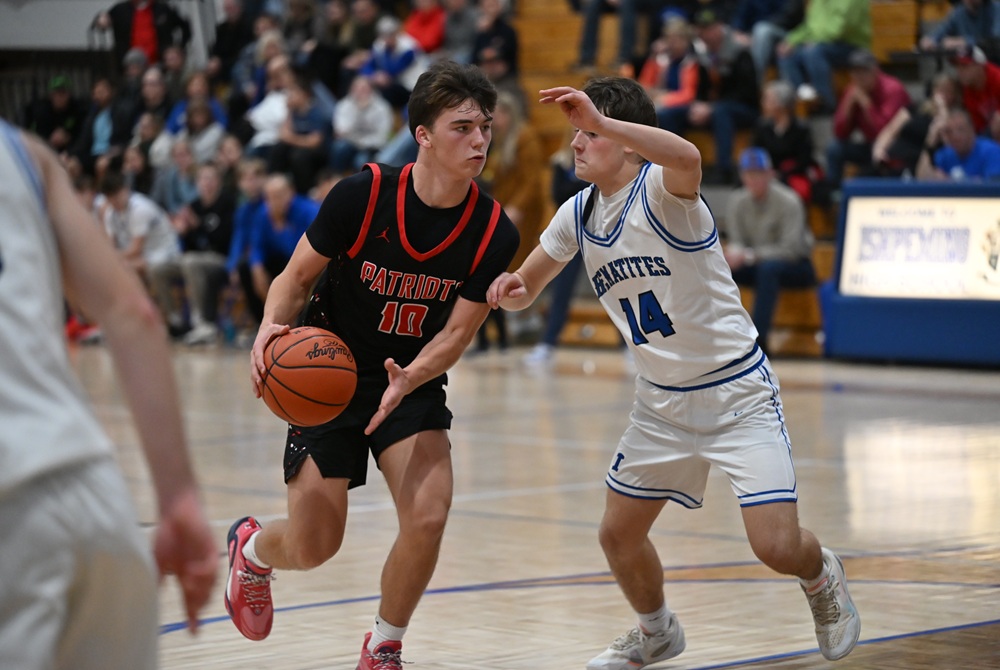
PHOTO While being defended by Ishpeming's Dax Kakkuri on Friday, Ishpeming Westwood's Ethan Marta makes a move to the basket. (Photo by Cara Kamps.)