

Breslin Bound: Boys A-B Semis Preview
March 20, 2013
By Geoff Kimmerly
Second Half editor
Some semi-ancient history is at risk of being updated during the Class A and B Finals this weekend at Michigan State University's Breslin Center.
Detroit Southeastern is seeking is first title since 1926 and Grand Rapids Christian since 1938. Wyoming Godwin Heights will play for its first championship game berth since 1960, but also as one of three Class B Semifinalists looking to win it all for the first time.
Standing in the way? In Class A, it's reigning champion Saginaw and heavy favorite Romulus. In Class B, one of the state's most successful programs ever, Detroit Country Day.
Below is the schedule for all four Friday Semifinals and Saturday Finals, plus broadcast information and a look at all eight A and B Semifinalists.
Semifinals - Friiday
Class A
Romulus (25-1) vs Grand Rapids Christian (20-6), 1 p.m.
Detroit Southeastern (20-5) vs Saginaw (23-3), 2:50 p.m.
Class B
Cadillac (21-4) vs Detroit Country Day (23-3), 6 p.m.
Detroit Community (17-9) vs Wyoming Godwin Heights (23-2), 7:50 p.m.
Finals - Saturday
Class A - Noon
Class B - 6:30 pm
Class C - 4:30 pm
Class D - 10 am
Tickets cost $8 per pair of Semifinals and $10 per two-game Finals session. All Semifinals will be streamed live on MHSAA.tv and available on a pay-per-view basis for $3.95 per day or $6.95 for the weekend. Saturday's first three Finals will be broadcast live on Fox Sports Detroit, with the Class B game on Fox Sports Plus and then re-broadcast on Fox Sports Detroit at 10:30 p.m.. Free radio broadcasts of all weekend games will be available on MHSAANetwork.com.
And now, a look at the Semifinalists in Class A and B.
Class A
DETROIT SOUTHEASTERN
Record/rank: 20-5, honorable mention
League finish: Second in Detroit Public School League East
Coach: George Ward, fourth season (82-15)
Championship history: Two MHSAA titles (most recently 1926), one runner-up finish.
Best wins: 54-49 (OT) over honorable mention Macomb L’Anse Creuse North (Regional Final), 54-49 over Rochester (Quarterfinal), 71-52 over Class B No. 4 Harper Woods Chandler Park, 48-44 over Class B No. 10 Detroit Douglass.
Players to watch: Jovone Haynes, 6-0 sr. G; Kenyatta Singleton, 6-0 sr. G. (Statistics not submitted.)
Outlook: Although Southeastern’s championships came in 1925 and 1926, they finished Class A runner-up only two seasons ago and with Singleton a prominent player off the bench. That Southeastern was likely the third-best Detroit PSL team during the regular season speaks to the league’s strength again this winter, and the Jungaleers lost to reigning Class A champion Saginaw and No. 8 Detroit Cass Tech by one point apiece and Ann Arbor Pioneer and River Rouge by only two each.
GRAND RAPIDS CHRISTIAN
Record/rank: 20-6, honorable mention
League finish: First in O-K White
Coach: Steve Majerle, first season (20-6)
Championship history: Lower Peninsula Class B champion 1938, one runner-up finish.
Best wins: 72-69 over No. 9 East Kentwood (District Semifinal), 64-61 over honorable mention Lansing Waverly (Regional Semifinal), 78-70 over honorable mention Holt (Regional Final), 64-61 over Muskegon, 70-59 over Class B No. 6 Wyoming Godwin Heights.
Players to watch: Drake Harris, 6-4 jr. G; Wuoi Mach, 6-4 sr. C. (Statistics not submitted.)
Outlook: Grand Rapids Christian has been surging with 10 straight wins and avenged a previous 24-point loss by beating Muskegon in the Quarterfinal. Harris is the catalyst and will try to add a basketball championship to the football title in which he played a large role at the end of November. Majerle previously coached Rockford to the 2003 Class A championship.
ROMULUS
Record/rank: 25-1, No. 2
League finish: First in Western Wayne Athletic Conference Blue
Coach: Nate Oats, 11th season (220-52)
Championship history: Class A champion 1986, one runner-up finish.
Best wins: 93-91 over No. 1 Detroit Pershing (Quarterfinal), 82-71 over No. 4 Saginaw Arthur Hill, 93-63 over No. 6 Saginaw, 75-65 over Class B No. 1 Detroit Country Day.
Players to watch: E.C. Matthews, 6-4 sr. G (16.2 ppg, 6.0 rpg); Leonardo Edwards, 6-8 sr. C (11 ppg, 7.0 rpg, 2.1 bpg), Wes Clark, 6-0 sr. G (11.8 ppg, 5.7 apg).
Outlook: Throw in wins over Lansing Sexton, Detroit Community, Detroit Douglass, Detroit Consortium, Chicago Seton and Indianapolis Cathedral, and no team in Michigan has defeated as impressive a slate. The Eagles’ lone loss was to Pershing by six in their second game this season, and Romulus avenged that Tuesday. Senior forward Jalon Plummer (11.2 ppg, 47 3-pointers) also adds double-digit scoring. Matthews has signed with Rhode Island, Clark with Missouri and Edwards with Louisiana Tech.
SAGINAW
Record/rank: 23-3, No. 6
League finish: Second in Saginaw Valley Association North
Coach: Julian Taylor, second season (48-5)
Championship history: Six MHSAA titles (most recently 2012), four runner-up finishes.
Best wins: 75-64 and 86-76 (District Final) over No. 4 Saginaw Arthur Hill, 57-56 over honorable mention Detroit Southeastern, 86-61 over Class B No. 4 Harper Woods Chandler Park.
Players to watch: Julian Henderson, 6-2 sr. G; Keyon Addison, 6-1 jr. G. (Statistics not submitted.)
Outlook: The Trojans have won three of the last six Class A championships, and Henderson was the second-leading scorer in last season’s title game win over Rockford. Saginaw already avenged its early loss to Arthur Hill, and no doubt would like to face Romulus again after falling to the Eagles in the regular-season finale.
Class B
CADILLAC
Record/rank: 21-4, unranked
League finish: Tied for first in Big North Conference
Coach: Jeff McDonald, 19th season (303-124)
Championship history: Has not played in an MHSAA Final.
Best wins: 41-29 over No. 8 Big Rapids (Semifinal), 47-46 over Petoskey, 56-53 over Traverse City West.
Players to watch: Nick Paquet, 5-9 sr. G (15 ppg, 45 3-pointers); Jalen Brooks, 6-4 jr. F (12.9 ppg, 5.5 rpg).
Outlook: Cadillac is 63-11 over the last three seasons with Regional championships to cap off each. The Vikings also won a share of their league title this season by avenging early losses against other sharers Petoskey and Traverse City West. They have good size, with five players 6-4 or taller, and plenty of balance; four more join Paquet and Brooks to average between four and seven points per game.
DETROIT COMMUNITY
Record/rank: 17-9, unranked
League finish: Second in Michigan Metro Athletic Conference
Coach: Venias Jordan, Jr., first season (17-9)
Championship history: Has not played in an MHSAA Final.
Best wins: 50-47 over honorable mention Jackson Lumen Christi (Quarterfinal), 61-48 over Class C No. 8 Melvindale Academy for Business & Technology,
Player to watch: Byron Zeigler, 6-6 sr. F (statistics not submitted).
Outlook: Don’t be fooled by Community’s nine losses. Instead, consider some of the teams they came against: Class A top-10 teams Detroit Pershing (by two), Cass Tech and Romulus, honorable mention Detroit Southeastern, ranked Class C Detroit Consortium and reigning Class D champion Southfield Christian, among others. Zeigler has signed with South Florida.
DETROIT COUNTRY DAY
Record/rank: 23-3, No. 1
League finish: Does not play in a league.
Coach: Kurt Keener, 35th season (676-180)
Championship history: Eight MHSAA titles (most recently 2010), one runner-up finish.
Best wins: 75-57 over No. 4 Harper Woods Chandler Park (Regional Semifinal), 73-51 over No. 10 Detroit Douglass (Regional Final), 68-48 over Class A honorable mention Macomb L’Anse Creuse North, 86-61 over Class A No. 4 Saginaw Arthur Hill.
Players to watch: Edmond Sumner, 6-3 jr. G (16.1 ppg, 6.2 apg); Austin Price, 6-3 sr. G (12.4 ppg, 4.2 rpg, 63 3-pointers, 3.2 spg); Mory Diane, 6-2 sr. G (12.1 ppg).
Outlook: A few fun Country Day facts: The last time the Yellowjackets didn’t make it to Breslin was 2009; the last time they finished a season with fewer than 20 wins was 2004. Country Day starts out small (relatively speaking; no player is shorter than 5-11) but can get big with future Texas Tech offensive lineman Poet Thomas (6-7, 285 pounds) off the bench. Price has signed with Lehigh and makes nearly 40 percent of his 3-point shots.
WYOMING GODWIN HEIGHTS
Record/rank: 23-2, No. 6
League finish: First in O-K Silver
Coach: Chad Conklin, sixth season (98-39)
Championship history: Two runner-up finishes (most recently 1960).
Best wins: 79-72 over No. 7 Comstock Park (Regional Semifinal), 56-52 over No. 2 Stevensville Lakeshore (Quarterfinal), 60-58 over Class D No. 1 Wyoming Tri-unity Christian
Players to watch: Jamal Bland, 5-10 sr. G (14.9 ppg, 3.2 apg); Quantrell Hastings, 6-1 sr. F (15.9 ppg, 7.3 rpg).
Outlook: One more win and Godwin Heights will have improved on or tied the previous season’s win total in all six of Conklin’s winters running the program. Senior guard Braima Hai (10.9 ppg, 5.2 apg) runs the show, and sophomore guard Delaney Blaylock (11.2 ppg) also scores in double figures.
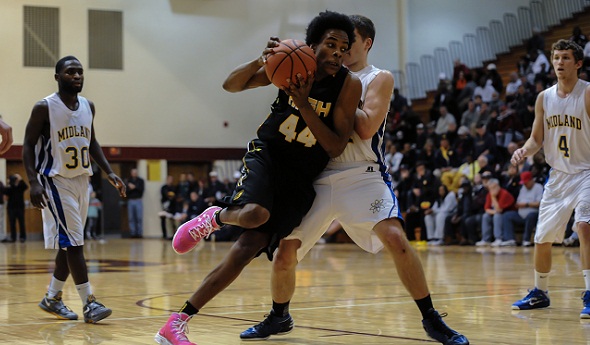
PHOTO: Saginaw junior Joseph Williams-Powell (44) drives against a Midland defender during the Trojans' Regional Semifinal win last week. (Click to see more at HighSchoolSportsScene.com.)
Breslin Bound: Boys District Preview
March 7, 2016
By Geoff Kimmerly
Second Half editor
A total of 11 boys basketball teams head into the MHSAA Tournament today with perfect records.
But there are plenty of others expected to make strong pushes toward a trip to East Lansing in a little more than two weeks.
Below is a look at four teams from each class that look good to be in the hunt. Follow all of the scores and brackets in real time at MHSAA.com, and click for a glance at every team with three or fewer losses heading into the postseason.
Class A
Canton (20-0) – The Chiefs have improved from 15 to 16 to now 20 wins over the last three seasons, and after repeating as Kensington Lakes Activities Association South champions went on to win the league’s overall title with an overtime victory over Walled Lake Western. Canton also put up an incredible 35-point win in early January over Grosse Pointe South, which finished 17-3.
Detroit U-D Jesuit (20-0) – The Cubs might be the favorites after making the Class A Semifinals last season and losing to eventual champion Detroit Western International. Led by Mr. Basketball finalist guard Cassius Winston, U-D Jesuit has beaten an impressive slate including Class C contenders Flint Beecher and Detroit Allen Academy and last week Detroit East English by 16 points.
East Lansing (19-0) – A young Trojans team will have to be careful in a District featuring tough familiar opponents. But led by sophomore Brandon Johns, arguably the best in his class in the state, East Lansing hasn’t had a ton of trouble yet, with only five wins by fewer than 10 points (although that includes two in overtime).
Macomb Dakota (20-0) – The Cougars did go 21-3 before falling in the Regional Final last season, but haven’t been considered this strong of a contender arguably ever. They avenged that postseason loss on Dec. 15 by downing Clarkston by 11, and nonleague wins against Lansing Everett and Saginaw Arthur Hill also provided valuable experience against unfamiliar but solid opponents.
Class B
Lansing Catholic (18-1) – A game against East Lansing last week that would have been telling was canceled because of bad weather, but the Cougars have shown a great combination of post strength and perimeter play while facing most of the rest of the Lansing area’s best. The loss came to rival Williamston by three after Lansing Catholic won the first meeting in overtime by three.
New Haven (18-2) – Unlike last season, New Haven enters the tournament with losses – its first during 2014-15 didn't come until the Quarterfinal. But those defeats this time have come against Class A schools Utica Ford and contender East English (16-4), and the Rockets built their record against a Class A-heavy schedule.
Onsted (19-0) – Mr. Basketball candidate and sizable center Austin Davis gets most of the attention, and with great reason. But he’s also got plenty of help, especially in a veteran backcourt, and it’s paid off in a league with three teams that have won at least 14 games; Hillsdale’s only losses were twice to the Wildcats.
Wyoming Godwin Heights (17-3) – The reigning Class B champion has two more losses heading into the tournament this season than a year ago. But the three defeats came to Class A teams that have won 15, 14 and 19 games, respectively. Tonight’s opponent, Wayland (17-2) provides another tough challenge out of the gate.
Class C
Detroit Allen Academy (18-2) – Allen has taken a big jump from 11-11 last year playing a schedule that hardly resembles the typical for a Class C team. The Wildcats’ best wins were arguably against Class B River Rouge (17-3) by 11, Class A Saginaw Arthur Hill (14-5) by 20 and Class A Detroit Renaissance (16-4) by four.
Flint Beecher (17-2) – The Class C champion three of the last four seasons prepares by facing a number of larger power programs, and this winter was no different; Beecher beat East English by three but also played and lost to reigning Class A champion Detroit Western International and likely Class A favorite Detroit U-D Jesuit.
Kalamazoo Hackett (20-0) – Hackett earns the mention among four undefeated Class C teams because it saw the toughest competition; four of six other teams in the Southwestern Athletic Conference Valley won at least 10 games, and Kalamazoo Christian’s only losses were twice to the Fighting Irish. All of that said, only Christian once and Schoolcraft twice got within 10 points of Hackett this winter.
Southfield Christian (18-2) – The Eagles are regulars in later rounds of the tournament and fell to Beecher in a Regional Semifinal last season. They’ve again prepped for a long run by facing bigger opponents, with a win over Class A Belleville (16-4) and Southfield and that only loss by a point in overtime in December to Class A West Bloomfield.
Class D
Bellaire (19-1) – Aside from a loss to Class C East Jordan in December, Bellaire has dominated winning a Ski Valley Conference featuring five teams with at least 10 wins including Class C Johannesburg-Lewiston (18-2) and Class D Onaway (16-4). The Eagles won their four games against those two opponents all by double figures.
Frankfort (18-2) – The Panthers have made it to at least the Quarterfinals the last three seasons and the Semifinals in 2014, and there’s little reason not to anticipate a similar run. The losses this winter were in overtime to undefeated Class C contender McBain and also-Class C Traverse City St. Francis, and Frankfort has beaten its share of larger schools too.
Hillman (20-0) – The Tigers have made the Regional Finals three straight seasons and played in a Quarterfinal last year, losing to eventual champion Powers North Central. They opened this winter with a 17-point win against Cedarville and have allowed only one opponent to come closer than 11.
Powers North Central (20-0) – The Jets have won 47 straight games and 72 of their last 73 with junior Jason Whitens again leading a group that includes more teammates from their MHSAA 8-player football champion. North Central handed Crystal Falls Forest Park its only two losses and beat Class B Menominee (16-4); no other opponents came close.
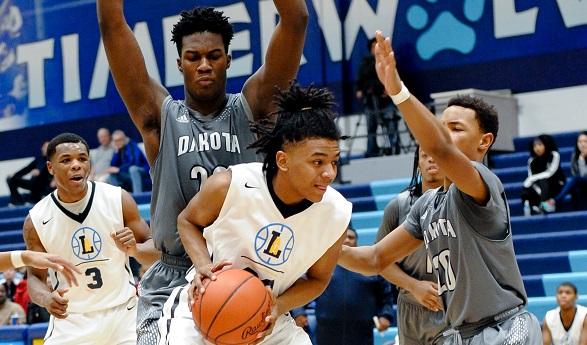
PHOTO: Macomb Dakota defenders surround a Saginaw Arthur Hill player working to get to the hoop during a game earlier this season. (Click to see more at HighSchoolSportsScene.com.)