

Broken Wrist Doesn't Break Season
March 29, 2018
By Geoff Kimmerly
Second Half editor
Never has a basketball player looked forward this much to shooting an airball.
 That’s what Carson Vincent is expecting two months from now, when he gets to fire with his right hand again, just like he has most of his life – until breaking a bone in his right wrist during a 7 on 7 football drill at the end of last summer.
It’s incredible how much would’ve been lost if the Ovid-Elsie senior hadn’t been unknowingly tough and uncommonly flexible.
Vincent played a full season of football not knowing how badly he’d injured his wrist. Once he learned of the break in late November, he decided to play on – learning to shoot with his left hand and finishing his career as the Marauders’ second-leading score all-time while leading them to their best season in 25 years.
And the 6-foot-5 forward saw a clear parallel in the shared team and individual successes.
“It’s the same answer for both,” Vincent said. “Individually I wasn’t doing it for me; I was doing it for the team. I knew they wanted me out there, my family wanted me to be out there, and I wanted to be part of everything.
“The reason the team did well is we all wanted each other to be successful, to win a championship, to see each other happy.”
Ovid-Elsie finished 18-5 this winter, first in the Tri-Valley Conference West and as a Class B District champion. The league title was the program’s first since 1984, and the District its first since 1994.
Individually, Vincent began the winter coming off an all-state season as a junior, when he averaged 17.7 points and eight rebounds per game and set a school record for field goal percentage at 60.8.
With only 20 percent mobility in his dominant right hand, he was forced to become ambidextrous. “Amazingly” – to agree with coach Josh Latz’ description – Vincent upped his scoring to 20.4 points per game, grabbed 7.7 rebounds and added 2.1 assists, a block and a steal per game – and broke his school record by making 62 percent of his shots from the floor.
Vincent learned to shoot free throws left handed and became a better ball handler as well. Despite being able to throw up only an occasional floater right-handed, he became the third 1,000-point scorer in school history and finished with 1,026 points, 441 rebounds, 86 blocks, 74 assists and 60 steals over a three-year varsity career.
“Carson's toughness and resiliency this season was incredible. To be able to accomplish the things he did individually, with the hand he was dealt is remarkable,” Latz said.
“His biggest growth was as a teammate with his unselfishness to put teammates and team success ahead of his health and well-being. That being said, the successes we had as a team were in direct correlation with Carson's leadership and the example of physical and mental toughness he set for us.”
Vincent knew exactly when he was injured. He caught a touchdown pass running backward during that 7 on 7 about a week before the start of practice at the end of summer, and he fell – catching himself by falling directly on the wrist.
 Despite some pain, he started football practice and did all the drills. A receiver and cornerback, he noticed when he dropped some passes he’d otherwise pull in – but he still helped the football team to a 7-3 playoff season.
On the day of the basketball team’s preseason scrimmage, he had the wrist checked out by a doctor who helps out with the Marauders. Diagnosis: broken and shifted bones. But Vincent already had made it through football season and decided to put off surgery until he could no longer manage the pain. He played in the scrimmage that day, although he couldn’t bend the wrist. He tried taping for a while, but gave up on that quickly because it just didn’t feel right.
And the difficulties didn’t come just at practice. Writing was doable but made his arm tired. Eating, even out of a bowl with a spoon, was not as easy as it would seem. Driving was a challenge for a bit. Sometimes he couldn’t open a door. He couldn’t shake people’s hands.
“Sometimes I’d get down on myself. Sometimes it’s frustrating,” Vincent said. “Before I went to the doctor’s office, I knew something was wrong with it – I wasn’t numb to the fact. Once I got told, obviously it was upsetting. All the what-ifs happen – what happens if I fall on it, will I be able to play, what if the pain is too much one day? It was really sad, but I got through it. I took it one day at a time. I wasn’t thinking about a week from now. I just got through what I could.”
He did sit out some parts of practice. Latz would pull him out of games to be cautious, but Vincent would ask right back in. A few opponents knew because they were Vincent’s friends, but mostly the team kept the injury an internal secret.
The Marauders’ season ended in a Regional Semifinal loss to Bridgeport on March 12, and three days later Vincent had surgery that included inserting bone from elsewhere in his arm and putting in a screw to hold everything together.
He’s wearing a cast now, and will switch to a splint in four weeks. He’s missing his track team’s first three meets, but will return after spring break next week – he runs the 200, 400 and on the 800 and 1,600 relays.
He’s planning to play college basketball. He has Division III opportunities and could also play at the junior college level to start out. Wherever he ends up, he’ll bring a much more well-rounded game – a lot of good that came out of what could’ve been a sad situation.
“First of all, (even without hurting) my wrist, if someone would’ve asked me if my team would do this, I would’ve told them I honestly don’t know,” Vincent said. “That alone surprised me. … It’s all shocking to me, to be able to do as good as a team, and I was able to do good individually also.
“Before this I was good left-handed, but I easily could say right-handed I was better. Now, honestly, my left hand is better than my right hand. I’ve learned new moves, I can do right and left hand now. Obviously I wish I hadn’t broken my wrist. But there were a lot of benefits to my game. I’ll take the good things and move on from it.”
 Geoff Kimmerly joined the MHSAA as its Media & Content Coordinator in Sept. 2011 after 12 years as Prep Sports Editor of the Lansing State Journal. He has served as Editor of Second Half since its creation in Jan. 2012. Contact him at [email protected] with story ideas for the Barry, Eaton, Ingham, Livingston, Ionia, Clinton, Shiawassee, Gratiot, Isabella, Clare and Montcalm counties.
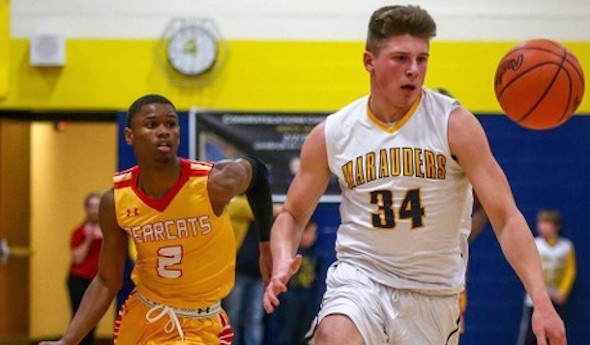
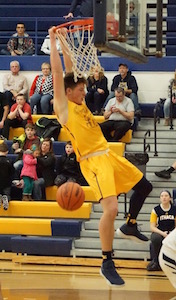
PHOTOS: (Top) Carson Vincent chases down a loose ball against Bridgeport this season. (Middle) Vincent throws down a dunk against Ithaca. (Photos courtesy of the Ovid-Elsie boys basketball program.)
'Petoskey Brand' Shines On Under Past Star
December 20, 2018
By Chris Dobrowolski
Special for Second Half
PETOSKEY — Dennis Starkey was the face of Petoskey basketball for 32 years.
 Now the Northmen have turned to a new, but familiar face to lead them into the next era on the hardwood after Starkey announced his retirement following the 2017-18 boys basketball season.
John Flynn, who suited up for Petoskey from 1996-98 and is among the school’s all-time greats, has taken over for his former coach after spending the last two seasons as a varsity assistant on Starkey’s staff.
“It’s kind of been surreal,” said Flynn. “I guess I never really thought about being Petoskey’s next coach just because when you think of Petoskey basketball you think of Dennis Starkey as the varsity coach. It wouldn’t exist without him. It never really crossed my mind that he would ever step down. He’s been there for so long. That’s all I’ve ever really known.”
Starkey felt like it was time to step down after last season, however. Not because the Northmen weren’t having success. In fact, last season’s 19-3 record was the 14th consecutive season that Petoskey had finished above .500. Starkey, who had already retired from teaching three years ago, was simply ready to enjoy other aspects of life that had been on the backburner during a 36-year coaching run during which he won 553 games — with 515 of those coming at Petoskey — and earned spots in both the Basketball Coaches Association of Michigan and Michigan High School Coaches Association halls of fame. Starkey won 17 Districts and 14 conference championships while turning Petoskey into a model of consistent excellence on the basketball court.
Flynn was one of nine candidates who applied to replace Starkey. He was familiar with the program and seemed to be a natural fit, given the amount of time he had been a part of it. After going through the process with all the candidates, the school felt the same way.
“There were definitely some quality guys (who applied),” said Petoskey athletic director Dave Smith. “We were looking for someone who was going to be around for a while, and that was John.
“It’s nice to have one of Dennis’ former players. (John) certainly learned from one of the best.”
Starkey was pleased when Flynn was announced as his successor last spring and sees Flynn as having a bright future as a head coach.
“I thought it was a great choice,” said Starkey. “He’s a hard worker and he’s got a great personality. John’s always been a student of the game, and I think it’s been a real good fit. Nobody is going to outwork him, and that’s the No. 1 (trait), and he has good relationships with the kids. The combination of his work ethic and his ability to relate to the kids will make him special.”
Coaching basketball comes naturally to Flynn. His dad Joe was a longtime coach at Harbor Springs and had great success there. John Flynn started his high school career as a freshman at Harbor Springs but transferred to Petoskey as a sophomore and — along with backcourt mate Trevor Huffman — helped the Northmen win three straight Class B Regional titles, including getting to the MHSAA Semifinals twice. In 1997 Petoskey lost to Detroit Country Day, which went on to win its third straight Class B championship. In 1998 it was Marshall that ousted the Northmen.
“John was a very intense player — loved a challenge,” said Starkey. “Also really enjoyed the game. John just loves the game.”
That passion took Flynn all the way to Grand Valley State, where he became the all-time leading scorer with 2,220 points as well as the all-time leading scorer in the Great Lakes Intercollegiate Athletic Conference with 1,531 points. Now it’s shining through on the sidelines during games or with a whistle during practice.
 “John understands how important basketball is to this community,” said Smith. “He has quite the drive and passion for the sport. That’s just something I don’t think many coaches can match. It’s not just necessarily about winning (to him), but certainly he holds our guys very accountable for doing things the right way. There’s no letdown with any of that. He just demands that they’re going to work hard and do their best.”
Flynn is a new voice on the bench, and he’s added a few wrinkles to Petoskey’s look, but the Northmen still have the basic tenets that were established under Starkey and remain the backbone of the program.
“We’re going to focus on the fundamentals, hold guys accountable, talk on defense, just be tough-nosed — the Petoskey brand,” said Flynn. “I got that from Coach Starkey, and that’s never going to change. We’re going to give 100 percent. We’re not going to make excuses. We’re going to leave it on the floor, and if we lose some, we lose some. If we win some, we win some, but you can go home at night and go to sleep saying, ‘Hey, we laid it all on the line.’ I know Coach Starkey, that was true to him for more than 30 years and that doesn’t change.
“There might be some different stuff as far as Xs and Os that we do, but he and I both adapt with the talent we’re given each particular year. I’m just trying to give these kids a platform to give them the best chance to succeed. This year that style is a little bit different than what we’ve played in the past, but there’s still some of that core values and beliefs from a program perspective that’s never going to change.”
The results on the floor have so far been consistent amid the transition, too. Flynn’s squad started the season by winning four of the first five games, including a 57-52 win on the road over previously-unbeaten Alpena in the Northmen’s Big North Conference opener.
“The guys I have this year — they’re such good kids, and they work so hard,” said Flynn. “That right there keeps me fired up and motivated to do my best as a coach, because they’re receptive. Now they’re starting to see my method to my madness as far as what I’m saying works. They’re starting to see the fruits of their labor.”
Starkey has purposely tried to keep his distance to give his former player all the space he needs, even scheduling a trip to Florida to coincide with the start of the regular season. The two have spoken a number of times, however, as Flynn continues to glean information from his former coach and mentor.
“We have great conversations,” said Flynn. “It’s great to bounce ideas off of him. I hope he enjoys it as much as I do because he still has that coach mentality that’s been interwoven into his fabric for the last 36 years. I’m glad we’ve got such a great relationship. I respect him and his knowledge so much.”
Flynn may not have specifically set out to become Petoskey’s basketball coach, but the timing of the vacancy, his love for the game and the opportunity to carry on the rich Petoskey basketball tradition made for a perfect match.
“I just felt like there was a need and I had to fill that need because I know I could try to do as good of a job as Coach Starkey and carry on his legacy,” said Flynn. “This is the baton. Now it’s my turn to keep this going. Kind of like, ‘Coach, I got this.’”
 Chris Dobrowolski has covered northern Lower Peninsula sports since 1999 at the Ogemaw County Herald, Alpena News, Traverse City Record-Eagle and currently as sports editor at the Antrim Kalkaska Review since 2016. He can be reached at [email protected] with story ideas for Manistee, Wexford, Missaukee, Roscommon, Ogemaw, Iosco, Alcona, Oscoda, Crawford, Kalkaska, Grand Traverse, Benzie, Leelanau, Antrim, Otsego, Montmorency, Alpena, Presque Isle, Cheboygan, Charlevoix and Emmet counties.
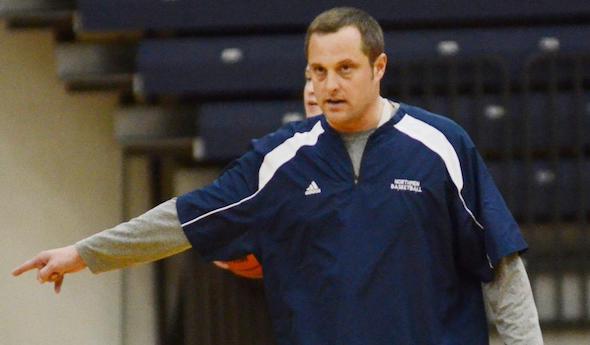
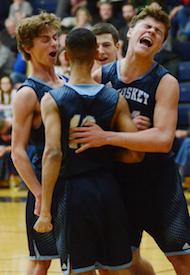
PHOTOS: (Top) Petoskey boys basketball first-year head coach John Flynn directs his players during a practice this season. (Middle) The Northmen celebrate one of many encouraging moments early this winter. (Photos courtesy of the Petoskey News-Review.)