


Championship Memories Still Resonate with St. Thomas Star Lillard
By
Doug Donnelly
Special for MHSAA.com
July 21, 2022
It took about four decades, but a couple of years ago, Len Lillard finally got to watch the 1974 Class D Boys Basketball Final.
The outcome, of course, was the same as when Lillard, a star 6-foot-7 center from Ann Arbor St. Thomas, dominated the game and led the Irish to the championship that March. But it was just as fun to watch it once more.
“It was great fun to watch,” Lillard said. “It was interesting, to say the least.”
Lillard had a sensational athletic career at St. Thomas, now known as Father Gabriel Richard. Not only was he an outstanding basketball player, but he also won Lower Peninsula Class D Finals high jump and shot put championships.
He earned a scholarship to the University of Michigan and played four years for the Wolverines, including the season they made it to the Final Four and faced undefeated and eventual national champion Indiana.
“Their top seven guys played professionally,” Lillard recalled. “That team was outstanding.”
Today, 50 years later, Lillard is a successful investment banker living just outside of Chicago. He hasn’t lived in Michigan since 1987, but still has close ties to teammates from the University of Michigan – and St. Thomas. He plans this month, in fact, to attend a Michigan basketball alumni function in Ann Arbor.
“We stay in touch,” he said.
Lillard said playing for the Michigan Wolverines opened a lot of doors for him professionally.
“It was a very good ice-breaker,” he said. “In the financial world I was in, you had to talk to people about tens of millions, sometimes hundreds of millions of dollars in investments. You have to prove yourself and be competent very quickly. But, the basketball, the Final Four … it was a good conversation starter.”
Lillard was part of an outstanding group of athletes that happened to attend St. Thomas during the same time frame.
“I think it was a case of the stars lining up,” Lillard said. “It was just a couple of really good classes that happened to be at the same school at the same time.”
St. Thomas moved from the Catholic High School League to the Tri-County Conference when Lillard was a senior. The TCC was a new conference and, ultimately, offered little competition for the Irish in almost any sport.
St. Thomas was heads and shoulders better than the rest of the league and easily went 10-0 to claim the first boys basketball league title under coach Mike Ramker. Lillard averaged 23.6 points a game in league play. In one of the most dominating performances in league history, Lillard scored 42 points and pulled down 31 rebounds in a win over Whitmore Lake.
In the Class D Semifinals he scored 31 points and had 13 rebounds. In the 68-53 win over Harbor Springs to clinch the title, Lillard scored 18 points and added 18 rebounds and six blocked shots.
Word around the MHSAA Tournament was Lillard was headed to Notre Dame. Instead, he accepted a scholarship from Michigan, which was located just a couple miles from the gym where St. Thomas played.
“He was a tremendous athlete for his time,” Ramker said.
Lillard was a member of the 1975-76 University of Michigan men’s basketball team that played in the Final Four and was defeated in the national championship game by the undefeated Indiana Hoosiers.
“It was a great experience,” said Lillard. “Our basketball fans, and some football fans as well, were very excited and a lot of them made the trip to Philadelphia, so we had a loud cheering section.”
The Final Four was a bit different during that era, but it still was a big deal.
“This was pre-ESPN, so there was not hourly coverage, but even though players and coaches try to be low key, it was a big deal to make it to the finals,” Lillard said.
Lillard could have gone to a smaller school and received more playing time, or perhaps another Big Ten school. Getting an education from the University of Michigan, however, was worth it. Lillard said making the transition from Class D to Division I college basketball wasn’t easy.
“It was difficult. I knew the competition would be much harder which it was, but there were other issues that I was not as prepared for,” he said. “At the end of the day, I was not going to play professional basketball, and playing for a highly-ranked University of Michigan team and earning a degree from Michigan was a great accomplishment.”
Lillard appeared in five games in 1975-76. He came back to the Wolverines in 1976-77 and appeared in 11 games, making 8 of his 12 field goal attempts, both of his free throws and pulling down 14 rebounds. Coached by Johnny Orr, the Wolverines were ranked No. 1 in the country, won the Big Ten championship and advanced to the Elite 8.
Lillard graduated from Michigan in 1978 and joined his family’s contracting business. At the same time, he started night school in pursuit of a Master of Business Administration degree. He got married and moved away from the Ann Arbor area.
He has more than 30 years of experience working in finance and capital markets as part of such well-respected firms as Merit Capital Partners, Banc One Capital Partners and The Prudential Capital Group. Today, at 66, he is managing partner with Glaucon Capital Partners.
He and his wife Karen raised three sons, now aged 29, 26 and 24. The middle child, Grant, was Big Ten Freshman of the Year and Defensive Player of the Year while playing soccer at the University of Indiana. He now plays professionally in Major League Soccer.
“He was a much better athlete than me,” Lillard said.
Basketball and sports in Michigan are never too far from Lillard’s mind. He checks in with old teammates on occasion and once had coffee with an opponent who he battled in the Final from Harbor Springs who was a sheriff in a town where he vacationed.
“He was a great guy,” Lillard said. “We had a lot of fun with it.”
It was a former St. Thomas teammate who rediscovered the film of the championship game. He had the film converted to a DVD and gave copies to team members. Those Finals were played at Jenison Field House at Michigan State University – one of several interesting places St. Thomas played at during Lillard’s career.
“Some of my fondest memories are playing in some of the old Catholic League gymnasiums,” Lillard said. “Some of the second-floor gyms with a running track around them were so amazing, such tiny little gyms. Some of them had clocks that still wound. You never really knew how much time was left in the quarter. We had some great times, that’s for sure.”
2021-22 Made in Michigan
July 14: Portage Central Champ Rolls to Vanderbilt, Writing Next Chapter in Alabama - Read
July 12: Coaching Couple Passing On Knowledge, Providing Opportunities for Frankfort Wrestlers - Read
June 30: Hrynewich's Star Continuing to Rise with Olympic, Pro Sports Arrivals - Read
PHOTOS (Top) At left, Len Lillard as the standout on the Ann Arbor St. Thomas boys basketball team in 1974; at right, Lillard today as a father of three and successful investment banker. (Action photo courtesy of Doug Donnelly, current photo courtesy of Glaucon Capital Partners).
Breslin Bound: Boys Report Week 2
December 10, 2018
By Geoff Kimmerly
Second Half editor
Pre-New Year’s Day basketball is generally a getting-to-know-you time across Michigan.
 Every week we’re learning a few more things about possible contenders while watching to see if all the preseason hype is panning out.
It’s hard to say we know much after two weeks – and yet, some surprises already are beginning to emerge. We give a glance at a few of those below.
Breslin Bound is powered by MI Student Aid and based on results and schedules posted for each school at MHSAA.com. To offer corrections or fill in scores we’re missing, email me at [email protected].
Week in Review
The countdown of last week’s five most intriguing results:
1. Detroit Renaissance 73, Detroit Edison 60 – The Phoenix bounced back from a three-point opening loss to Flint Beecher to win by double digits over the reigning Class C champion Pioneers.
2. Pontiac 63, Clarkston 58 – This win over the reigning Class A champion should boost a Pontiac turnaround effort detailed a little more below.
3. Pewamo-Westphalia 63, Dansville 45 – The Aggies had taken over as mid-Michigan’s best contender among Class C/Division 3 schools after beating the Pirates by a point in last year’s Regional Semifinal, but that status likely shifted back to the Pirates after this big win.
4. Alma 52, Frankenmuth 48 (OT) – The Panthers lost by 21 when these Tri-Valley Conference contenders met in a crossover Jan. 29, but avenging the defeat last week kept Alma perfect at 4-0.
5. Belleville 63, Romulus 43 – Now in different leagues, these longtime rivals are set to meet for sure just this once – and the Tigers extended their winning streak in the series to three straight.
Watch List
With an eye toward March, here are two teams in each division making sparks:
DIVISION 1
• Hudsonville (2-0) – Coming off a 10-12 finish a season ago, Hudsonville has a lot to be excited about right away. The Eagles opened with a 43-37 win over East Grand Rapids and then beat Wyoming Godwin Heights on Friday 75-64 to avenge last year’s 17-point loss.
• Wayne Memorial (2-0) – The Zebras are following up last season’s 17-8 record and run to the Regional Finals with a nice start. Last week’s win was 61-56 over Ann Arbor Skyline, which is coming off a 23-1 finish in 2017-18.
DIVISION 2
• Pontiac (3-0) – The Phoenix are rising after going 5-15 last season and winning just three games the season before that. Of course the Clarkston win noted above sticks out, but Pontiac also downed Clawson by 25 to end the week.
• St. Clair (4-0) – The Saints will start work on a second straight Macomb Area Conference Gold title coming off a pair of close wins, 54-49 over Marysville and 65-64 in double overtime over Marine City.
DIVISION 3
• Elkton-Pigeon-Bay Port Laker (4-0) – A 5-1 start last season turned into a 12-9 finish, and the Lakers are enjoying the early-going again. They’ve avenged three of last season’s losses, including last week with a 46-42 overtime win over Ubly and 58-43 victory over Brown City.
• Vandercook Lake (4-0) – The Jayhawks already have doubled up last season’s two wins, coming off Friday’s 86-74 overtime victory over Manchester. Junior Tyler Horky is averaging 30.5 points per game and scored 47 against the Flying Dutchmen, including 34 over the second half and overtime.
DIVISION 4
• Central Lake (4-0) – The Trojans have built from two to four to seven to 11 to 13 wins over the last five seasons – and might be in store for more. Last week’s 54-39 win over Bellaire and 84-75 defeat of Onaway both came against teams that beat Central Lake at least once last winter.
• Gaylord St. Mary (2-1) – The Snowbirds finished 9-14 last winter but closed with four wins over their final six games. After losing to Rogers City in the opener two weeks ago, St. Mary earned close wins last week over Mancelona (53-52) and Fife Lake Forest Area (54-50) – after going a combined 1-3 against the pair last season.
Can't-Miss Contests
Be on the lookout for results of these games coming up:
Tuesday – Grand Blanc (1-1) at Detroit U-D Jesuit (2-1) – These are both Division 1 hopefuls which despite an early loss apiece could play deep into this winter.
Tuesday – Grand Rapids Christian (3-0) at Grand Rapids Catholic Central (1-0) – Both have notable early wins, Christian over Wyoming Godwin Heights and GRCC opening with a victory over Holland West Ottawa.
Friday – Saginaw (2-1) at Saginaw Arthur Hill (1-1) – One of the state’s best rivalries rolls again after the Trojans won last season’s games by eight and four points.
Friday – Belleville (1-0) at Ann Arbor Skyline (2-1) – Skyline’s 23-1 run last season included a 14-point win over Belleville, which ended up reaching the Class A Quarterfinals.
Saturday – Detroit Henry Ford (0-1) vs. Benton Harbor (3-0) at Grand Rapids Ottawa Hills – This is likely the premier game of the Battle of I-96 Classic, pitting the reigning Class B champion Tigers against the 2016 title winner in that class.
Second Half’s weekly “Breslin Bound” reports are powered by MI Student Aid, a part of the Student Financial Services Bureau located within the Michigan Department of Treasury. MI Student Aid encourages students to pursue postsecondary education by providing access to student financial resources and information, including various student financial assistance programs to help make college more affordable for Michigan students. MI Student Aid administers the state’s 529 savings programs (MET/MESP) and eight additional aid programs within its Student Scholarships and Grants division. Click for more information and connect with MI Student Aid on Facebook and Twitter @mistudentaid.
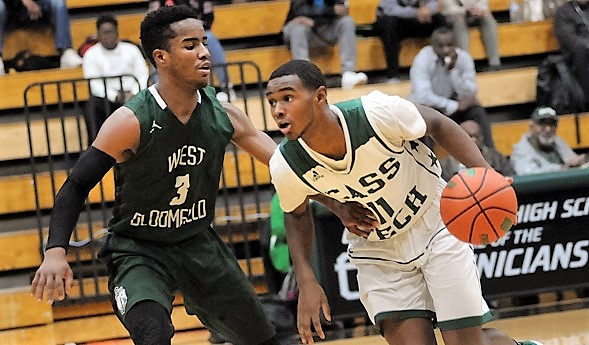
PHOTO: After opening with a two-point loss to Flint Carman-Ainsworth, Detroit Cass Tech bounced back last week with a 74-50 win over West Bloomfield. (Photo courtesy of C&G Newspapers.)