

Coaches Return With College Knowledge
By
Tom Markowski
Special for Second Half
February 24, 2016
North Farmington boys basketball coach Todd Negoshian is not so vain to believe he’s at the top of his profession.
 After all, he’s nearing just his fifth season running what is considered one of the top programs in the Oakland Activities Association.
What Negoshian is certain of is that he is a better coach now than he was during the early 2000s when he entered the profession as an assistant at North Farmington under his father, Tom Negoshian.
In addition to Todd Negoshian’s years as a high school coach, he spent three seasons (2004-07) as an assistant coach at Oakland University under coach Greg Kampe. Having worked at the college level has not only added to his knowledge as a coach but also given him an opportunity to work with different people under different circumstances but with similar goals.
“I learned a lot from Kampe,” Negoshian said. “I learned a lot about relationships. He has the uncanny ability to (scold) a kid and then 30 seconds later have your arms around him. It’s about building relationships.
“It’s his approach to coaching. There’s so many things you learned outside of coaching.”
This brief stint at the collegiate level gave Negoshian, 35, a whole new perspective on how to coach and how to be a coach. Building relationships takes time, and to those committed to being a coach who cares about his or her players, it’s paramount to allow for that time.
Some coaches, like John Beilein at University of Michigan, start out coaching at the high school level, move on to college and remain there. A number of others statewide have taken paths similar to that of Negoshian.
LaMonta Stone at River Rouge and Steve Hall at Detroit Cass Tech started coaching at the high school level and have recently returned to their roots after each spent several years as a college coach.
Stone played for the legendary Lofton Greene at River Rouge and then coached the Panthers to a Class B title in 1999. Stone ambitiously sought a position at the next level and was quite successful. He spent two seasons at Eastern Michigan, two at Ohio State and 10 at Bowling Green before returning to River Rouge last season as head coach.
And he has no regrets.
“At that point, I had goals,” Stone said of making the jump to college. “There were things I wanted to do. I still have goals. People ask me, would I go back to college? I don’t know. If the situation was right, I might.”
Stone, 49, returned for two reasons: family and community. Last season he was able to coach his oldest son, LaMonta, Jr., his senior year. Stone also has two other sons, ages 6 and 9.
 Basketball is king in River Rouge. Greene won a record 12 MHSAA titles and the program has won two more since his departure. But the Panthers relinquished their claim as a state power soon after Stone left and haven’t been much of a factor in the tournament since. Stone intends on changing that.
“It’s a situation where, I’d been (coaching in college) for 14 years,” he said. “I’d reached all my goals. The only one I didn’t was to become a head coach. But you’re an assistant in the Big Ten. You can’t get much higher than that.
“The opportunity to come back to that community, I just couldn’t pass up. I get to be more of a part of my sons’ lives.”
In addition to the high school season, Stone said he enjoys coaching during the summer, in camps and individually.
“I can, within the (Michigan High School Athletic Association) rules, work with kids outside of Rouge,” he said. “I get calls all the time saying can you work with my son. I work with them but they can’t come to Rouge. I like it that way. There’s no pressure on me or them.”
Hall, 45, was one of the state’s top players when he graduated from Cass Tech in 1988. He played four years in college (Washington, Virginia Tech) before playing professionally overseas. In 1996 he became the head coach at Detroit Rogers, an all-boys school in the Detroit Public School League. Hall spent nine seasons there and won three MHSAA titles before the school closed.
Hall went to Detroit Northwestern in 2005 and spent three seasons there, winning one PSL title, before accepting a position as an assistant coach at Duquesne University in Pittsburgh. He spent four seasons there before becoming an assistant coach at Youngstown State. On Aug. 25, Hall officially came back to Detroit as athletic director and boys basketball coach at Cass Tech.
Like Stone, Hall was looking for a more stable lifestyle. Family came first, and the opportunity to coach his alma mater was too good to pass up.
“A lot had to do with my life at this stage,” he said. “I have two young boys (ages 7 and 4) and to be more a part of their lives is important. If I wanted to spend time with them, we’d go to a game where I was recruiting a kid and that would be our time together on that given day.
“And I have a passion for this school. This whole year has been learning on the fly. At Rogers there was a lack of numbers. Here football is huge. We didn’t have a football team at Rogers. And here I have a surplus of numbers. It’s a different dynamic. Rogers was the smallest school in the PSL by enrollment. Cass is the biggest.”
Hall said he doesn’t miss the hours of travelling on the road, going into countless gymnasiums recruiting players and trying to convince them and their coaches that his university was the right one. It’s not that his responsibilities as athletic director and coach are less demanding. But being able to go home every night and see his children and sleep in his bed has its rewards.
Hall said he had more than a few conversations with Stone on returning home.
All three coaches agree that experience has its benefits. It’s not that coaching is any easier at this time. The challenges are still there and in many ways demand different approaches.
“Every stop makes you better,” Negoshian said. “Anytime you coach kids, the more you are around them, it helps.
“The game has changed. Society changed. Kids don’t want to fight through tough times. That’s why you see so many transfers. Everybody wants to be the hero. They want the focus on them. And it’s just not them. It’s the family. I’m not sure all of the parents are committed. They don’t want to go to A, B and C to get to D.”
Hall said the expectations for incoming freshmen and their parents are so different than it was when he was in high school. Then students went to a certain school, whether it was a power like Detroit Southwestern or a neighborhood school like Detroit Mumford, to be a part of an established program.
“It’s a trickle down from college,” Hall said. “It’s not, ‘I want to send my kid to a great program.’ There’s the attitude that if my son isn’t a part of it as a freshman, I’ll go somewhere else instead of being part of the process.”
 Tom Markowski is a columnist and directs website coverage for the State Champs! Sports Network. He previously covered primarily high school sports for the The Detroit News from 1984-2014, focusing on the Detroit area and contributing to statewide coverage of football and basketball. Contact him at [email protected] with story ideas for Oakland, Macomb and Wayne counties.
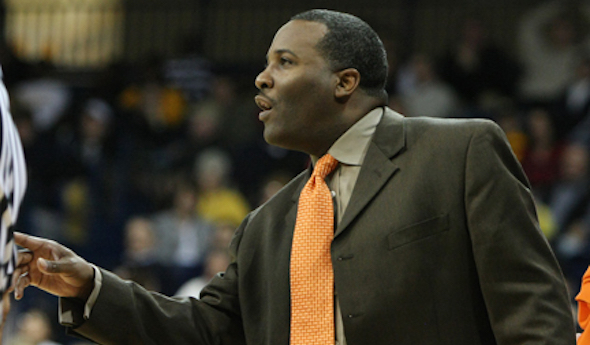
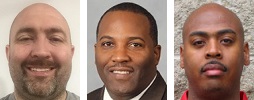
PHOTOS: (Top) Current River Rouge boys basketball coach LaMonta Stone returned to his alma mater after serving as a college assistant including at Bowling Green. (Middle) Todd Negoshian, LaMonta Stone, Steve Hall. (Top photo courtesy of LaMonta Stone.)
Breslin Bound: Boys Quarterfinal Preview
March 18, 2013
By Geoff Kimmerly
Second Half editor
Tonight's MHSAA boys basketball Quarterfinals include plenty of matchups you'd expect to see during the final week of the season – and a few that will establish clear favorites as we move to Breslin Center this weekend.
In Class A, powers Detroit Pershing and Romulus have been considered the frontrunners all season and square off for the second time. In Class C, the winner of Detroit Consortium and Flint Beecher likely will be considered the team to beat this weekend. And in Class D, Southfield Christian and Climax-Scotts meet in a rematch of last season's MHSAA Final.
See below for a quick glance at all 16 games being played this evening. And click here for brackets including tip-off times and sites for every game.
Class A
Detroit Pershing (25-0) vs. Romulus (24-1): This rematch, held at University of Detroit Mercy, pits what most believe are the two best teams in the state regardless of class. Pershing won the first matchup, 83-76 on Dec. 8, and has continued to stack victories by large margins and close – including by two points in two of the last three games. Get there early for the 5 p.m. tip.
Saginaw (22-3) vs. Ypsilanti (20-4): The reigning Class A champion Trojans have rebounded from a 30-point loss to Romulus on the final night of the regular season to beat all of their tournament opponents by double figures. Ypsilanti is riding a 10-game winning streak and is a combined five points from boasting a 23-1 record.
Detroit Southeastern (19-5) vs. Rochester (21-4): Southeastern might’ve gone a little under the radar following Detroit Public School League frontrunners Pershing and Cass Tech. But the Jungaleers can make a loud statement by beating Rochester and Kentucky recruit James Young, a Mr. Basketball finalist this season.
Grand Rapids Christian (19-6) vs. Muskegon (19-6): The Eagles and standout Drake Harris have been making headlines lately and have bounced back nicely from a 2-4 start this winter. But Muskegon has to come in with some confidence as well after beating Christian 72-48 in their lone meeting Jan. 22.
Class B
Big Rapids (23-1) vs. Cadillac (20-4): Both of these teams are league champions – Cadillac as one of three that shared in the Big North Conference and Big Rapids after finishing 18-0 in the Central State Activities Association. Both boast high-scoring guards – Big Rapids led by junior Quinn Tyson (21.7 ppg) and Cadillac countering with senior Nick Paquet (15 ppg).
Detroit Country Day (22-3) vs. Flint Powers Catholic (13-12): Country Day is playing to return to the Semifinals for the fourth straight season and is keyed by 6-foot-3 point guard Edmond Sumner (16.1 ppg). Powers is looking to get back for the first time since 2009 and has made a nice run after a 3-8 start under first-year coach Jeremy Trent, formerly of Swartz Creek and Burton Bentley.
Jackson Lumen Christi (21-3) vs. Detroit Community (16-9): After losing seasons in coach Rich Karasek’s first two, Lumen Christi is having one of its best seasons ever; the Titans are a combined 12 points from being undefeated and eliminated two-time reigning MHSAA champion Lansing Sexton in the Regional. Community’s record is a bit deceiving – four of those losses came to Class A or C Quarterfinalists and two more to out-of-state powers.
Stevensville Lakeshore (24-0) vs. Wyoming Godwin Heights (22-2): Lakeshore is 48-2 over the last two seasons, and another win also would be coach Sean Schroeder’s 400th. Similarly, Godwin Heights is 46-3 over the last two seasons. One of its losses this winter was to Class A Quarterfinalist Grand Rapids Christian, and the Wolverines beat Class D Quarterfinalist Wyoming Tri-unity Christian.
Class C
Detroit Consortium (20-3) vs. Flint Beecher (24-1): Consortium has played courageously since coach Al Anderson died unexpectedly a month ago; the Cougars have won all eight games since that night and 19 of their last 20. Now they’ll contend with reigning Class C champion Flint Beecher and Mr. Basketball Monte Morris (21.5 ppg), whose only loss was by seven to Class A favorite Detroit Pershing on Jan. 19.
Laingsburg (22-2) vs. Beaverton (22-2): This is Beaverton’s fifth Quarterfinal under coach Roy Johnston, who has won 705 games over 39 seasons at four schools and took Beaverton to the Semifinals in 1984. The Wolfpack have made it this far twice before during coach Greg Mitchell’s 24-season career – in 1997 and 2002 – and he’d win his 350th game if Laingsburg advances.
Maple City Glen Lake (23-2) vs. Negaunee (23-1): Glen Lake is only a combined four points from being perfect this season, and the run has included beating reigning Class C runner-up Traverse City St. Francis during the regular season and again in the District Final. Negaunee improved to 45-4 over the last two seasons with its Regional title, and also avenged its lone loss, to Class A Marquette.
Schoolcraft (23-2) vs. Monroe St. Mary Catholic Central (22-2): St. Mary Catholic is back in the Quarterfinals for the second time in three seasons, and aside from a pair of losses to Milan is undefeated this winter. Schoolcraft has won three straight Regionals and was the Class C champion in 2011. Guard Luke Ryskamp was his team’s leading scorer that night as a sophomore, and is finishing off one last run.
Class D
Climax-Scotts (24-1) vs. Southfield Christian: This rematch of the 2012 MHSAA Final takes place a couple games earlier and this time at Battle Creek Central, but should be closer than last season’s 76-44 Southfield Christian win. A one-point loss to Mendon is the only flaw on Climax-Scotts’ record, and Southfield Christian has won 17 straight since opening 3-4.
Cedarville (22-1) vs. Powers North Central (22-3): People still bring up Cedarville’s 3-point fueled run to the 2007 championship, and the Trojans could be back, as their only loss was to another Quarterfinalist, Frankfort. North Central also has a great story – the team won a combined 25 games over coach Adam Mercier’s first four seasons before upping it to 16 each of the last two and 22 this winter.
Lansing Christian (21-3) vs. Beal City (17-7): Both of these teams are hoping to march to a first MHSAA title. The Pilgrims have won 16 straight and boast four players who average double figures scoring. The Aggies will counter with a defensive effort that has held opponents to fewer than 50 points 12 times this season.
Wyoming Tri-unity Christian (23-2) vs. Frankfort (20-5): Tri-unity is back in the hunt for a fifth MHSAA championship and second in three seasons; the Defenders have won 17 straight and as usual against a number of bigger schools. Frankfort has made a major rebound after losing four of its last five during the regular season and counters with 6-3 sophomore David Loney (17.8 ppg).
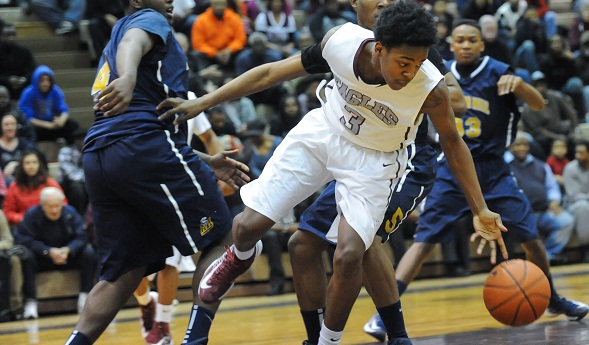
PHOTO: Romulus' Juwan Clark gathers a loose ball during a win over Saginaw Arthur Hill last month. (Click to see more at HighSchoolSportsScene.com.)