

Concord Finishes Strong to End Longest Playoff Run in 40 Years as 1st-Time Champ
By
Paul Costanzo
Special for MHSAA.com
March 14, 2026
EAST LANSING – As his teammate Connor Stevens strode to the free throw line to put the finishing touches on Concord’s 60-47 win over Detroit Douglass in the Division 4 Boys Basketball Final on Saturday, Brady Garrett pulled his jersey over his face.
The Yellowjackets senior shook his head, almost in disbelief before looking up to the massive Concord crowd assembled at the Breslin Center and screaming, “Let’s go!”
“First of all, I love basketball and I love the group of guys that I’m with,” Garrett said. “As time was winding down, it was hitting me. I’m a senior, this is it. This was everything I played for my whole life. To capture it with a state championship, it meant so much to me. I wouldn’t ask for a better group of guys to do it with.”
Garrett and his teammates brought Concord its first Finals title in boys basketball, finishing off the school’s first “final four” appearance since 1986.
“They’ve been waiting on it,” Stevens said. “All season they’ve been riding with us, and there’s no other way I’d want to go out than this. We all looked at each other and knew that’s what we had to do.”
Concord did it for its city and fans, as well as for Fred Garland, who had passed away in a car crash after leaving a Concord practice in December of 2024. Garland was a standout college basketball player who played for Concord coach Marcus Gill Sr. at Albion and was a former club coach of Stevens.
“We did this for Fred Garland,” Gill said. “(His death) rocked our heart and soul, and he wanted this bad. We did this for Fred.”
The Yellowjackets were able to channel all that emotion into an incredible fourth quarter, which broke open a game that was tied after three.
 They outscored Douglass 19-6 in the fourth, holding the Hurricanes to 2-of-16 (12.5 percent) shooting from the field, while hitting 60 percent of their shots and not committing a turnover.
Much of that success hinged on a switch during the quarter to a zone defense, which caught Douglass off guard.
“We are primarily a man-to-man team, but we have our (3-2 zone) in,” Gill said. “We knew we wanted to save it a little bit for the second half today, because they’re a really good driving team, and we knew (Douglass guard Damani Oliver) can really shoot it, so we wanted to wait for the right time to try and get them out of their rhythm. We got into it, it was working and we were making stops, so we just stayed in it.”
Douglass coach Pierre Brooks Sr. credited that zone for slowing his team, but thought it was Concord’s senior-led roster that made the difference down the stretch.
“I think Concord’s experience kind of got the best of us in the second half,” Brooks said. “They’ve got seniors that were pretty hungry, and we just didn’t convert.”
The late push from Concord came despite not having star guard Jett Smith on the court for half of the fourth quarter, as he picked up his fourth foul during the final seconds of the third.
With him out, though, the Yellowjackets jumped ahead, leading by five when he re-entered the game with 4 minutes, 26 seconds to play.
“It was huge, but that’s why we’re a championship team, because we’ve got other guys,” Gill said. “Just like (in the Semifinal against Wyoming Tri-Unity Christian), they did a good job of taking (Smith) out of the game, but we’ve got a lot of good ball handlers. Yesterday it was Darrell (Dean) with the ball in his hands, today it was Brady Garrett. I thought he ran our team unbelievably.”
Smith still finished with 14 points, despite the foul trouble and hounding defense from Douglass junior Jacodi Nathan. Stevens led the Yellowjackets with 15 points and 19 rebounds, while Dean had 15 points. Garrett added six points, five assists and two steals.
Oliver led Douglass (21-8) with 15 points, while Nathan had 12, including a five-point stretch over the final seconds of the first half during which he hit a 3-pointer, stole the inbounds pass and laid the ball in, giving his team a 26-22 lead going into halftime.
“Today, we didn’t finish the first 16 minutes great, but we came out and battled and played Concord basketball the last 16 minutes,” Gill said. “And this is the outcome right here. Can’t be more proud of these guys.”
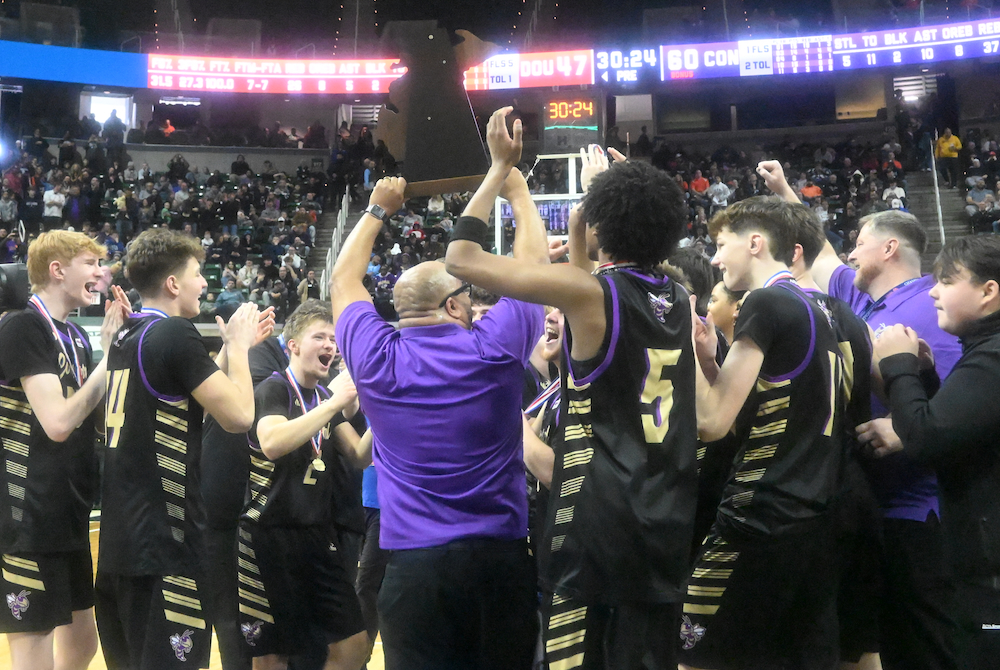
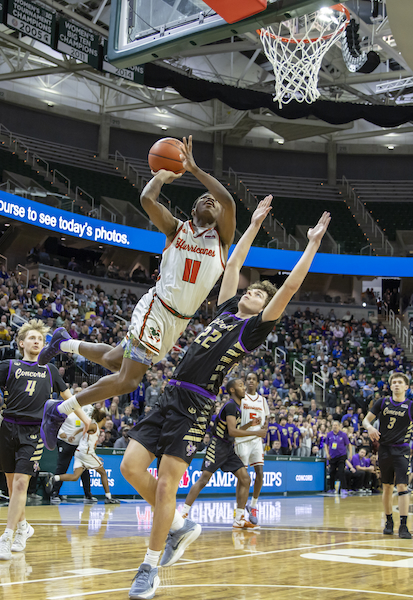
PHOTOS (Top) Concord boys basketball coach Marcus Gill Sr. holds up his team’s newly-won championship trophy Saturday at Breslin Center. (Middle) Douglass’ Jacodi Nathan (11) drives hard to the hoop with Concord’s Tyler Rundle working to wall him off. (Photos by Hockey Weekly Action Photos.)
Breslin Bound: Boys Report Week 3
December 18, 2018
By Geoff Kimmerly
Second Half editor
The third week of this Michigan high school boys basketball season was topsy-turvy, to say the least.
 The first month of the season always includes a lot of sorting out as top teams face off in nonleague play – and in the end, of course, the most important games are when those teams potentially meet again at the end of the winter.
But after how some of the state’s best took turns defeating each other last week, we might have a hard time knowing what to expect down the road.
Breslin Bound is powered by MI Student Aid and based on results and schedules posted for each school at MHSAA.com. To offer corrections or fill in scores we’re missing, email me at [email protected].
Week in Review
The countdown of last week’s five most intriguing results:
1. Okemos 63, Rockford 29 – The headliner of the Battle of I-96 Classic at Grand Rapids Ottawa Hills went to Okemos, which moved to 6-0 with its second-biggest victory of the season.
2. Rockford 65, Muskegon 47 – This Friday night stunner of the annually contending Big Reds was set for the top spot on this list until Saturday’s matchup with the Chiefs; Rockford fell to Muskegon by 16 a year ago.
3. Grand Rapids Catholic Central 50, Grand Rapids Christian 45 – The was expected to be the big game of the week for the Cougars, but wasn’t even their closest as they then survived with a two-point overtime win over Grand Rapids Covenant Christian on Friday.
4. Detroit U-D Jesuit 57, Grand Blanc 44 – The Cubs have had one of the toughest early schedules in the state, and this win was made more impressive when Grand Blanc beat Flint Carman-Ainsworth by 10 to end the week.
5. Ann Arbor Skyline 66, Belleville 56 – The Eagles came back from a loss earlier in the week to Sterling Heights Stevenson to win their fifth straight against Belleville, which rebounded last season to make the Class A Quarterfinals.
Watch List
With an eye toward March, here are two teams in each division making sparks:
DIVISION 1
• Grand Rapids Northview (3-0) – The Wildcats have held on through three overtimes over their last two games to keep a perfect start intact, the most recent Friday in a 77-69 win over always-powerful Wyoming Godwin Heights. Northview is looking to take another step after improving five wins to 15-7 last winter.
• Utica Eisenhower (5-0) – The Eagles have nearly equaled last season’s seven wins and haven’t played a game in single digits since defeating Romeo by five on opening night. Eisenhower can make an even louder statement tonight against another quick starter in Sterling Heights Stevenson.
DIVISION 2
• Alma (6-0) – The Panthers are off to another fast start in trying to build on last season’s league and District championships. Alma has three double-digit wins but also has pulled out victories of six or fewer points against Fowlerville, Frankenmuth (in overtime) and Carrollton.
• Williamston (6-0) – The Hornets can make an argument as the Lansing area’s best team and have high aspirations after going 22-3 and falling to eventual champion Benton Harbor in the Quarterfinals last season. Despite needing overtime against Howell last week, Williamston is winning this winter by nearly 19 points per game.
DIVISION 3
• Carson City-Crystal (5-0) – The Eagles have shared three straight Mid-State Activities Conference championships and already own a one-win advantage in the league standings this winter thanks to a 47-41 win over reigning co-champ Mount Pleasant Sacred Heart two weeks ago. A 46-35 win over Division 2 Lansing Eastern last week was eye-catching.
• Hanover-Horton (5-0) – League titles and 20-win seasons are frequent accomplishments for the Comets, and they appear on the way toward chasing both again. Hanover-Horton took a big step toward repeating as Cascades Conference champ with a 66-56 win over reigning league runner-up Michigan Center last week – the Comets’ closest game so far.
DIVISION 4
• Bessemer (4-1) – The Speedboys fell from sharing a league title two seasons ago to finishing third last winter, but look like the team to chase in the Copper Mountain Conference’s Porcupine Mountain division again. Bessemer handed 2017-18 Class D semifinalist Dollar Bay a 73-60 loss last week, Dollar Bay’s first regular-season defeat since Feb. 17, 2017.
• Carney-Nadeau (4-0) – The Wolves frequently are league title contenders but might be the team to beat in the Skyline Central Conference Small-school division. Although the 61-43 win Thursday against Powers North Central did not count in the league standings, it was a good sign against the reigning league champ.
Can't-Miss Contests
Be on the lookout for results of these games coming up:
Tuesday – Detroit Martin Luther King (2-0) at Detroit Cass Tech (3-1) – The last time these two met, King advanced in last season’s District with a two-point overtime win. They are back in the same league this winter.
Tuesday – Clinton Township Clintondale (5-0) at Madison Heights Madison (6-0) – It’s early in the Macomb Area Conference Silver, but this could end up one of the most meaningful games of the league schedule.
Tuesday – Utica Eisenhower (5-0) at Sterling Heights Stevenson (4-1) – Noted above as well, this could be telling as the MAC Red gets rolling. League foes Roseville and Macomb Dakota also are off to strong starts.
Tuesday – Escanaba (3-1) at Marquette (4-2) – Marquette swept Escanaba to win last season’s Great Northern Upper Peninsula Conference title by one victory.
Wednesday – Wyoming Godwin Heights (1-3) at Grand Rapids Catholic Central (3-0) – Against strong competition, Godwin Heights is off to a slow start. But it’s all relative, and GRCC won’t take the Wolverines lightly.
Second Half’s weekly “Countdown to Calvin” reports are powered by MI Student Aid, a part of the Student Financial Services Bureau located within the Michigan Department of Treasury. MI Student Aid encourages students to pursue postsecondary education by providing access to student financial resources and information, including various student financial assistance programs to help make college more affordable for Michigan students. MI Student Aid administers the state’s 529 savings programs (MET/MESP) and eight additional aid programs within its Student Scholarships and Grants division. Click for more information and connect with MI Student Aid on Facebook and Twitter @mistudentaid.
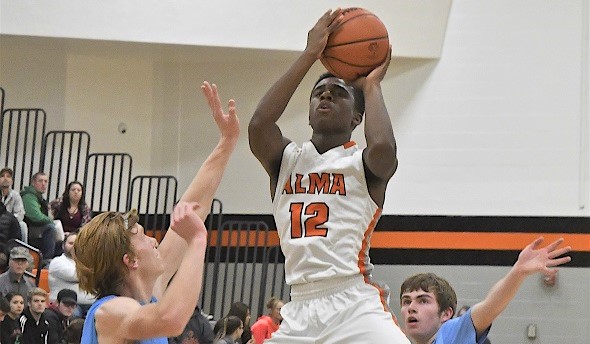
PHOTO: Alma is off to an unbeaten start this winter, earning a victory last week over Essexville Garber. (Click to see more from HighSchoolSportsScene.com.)