

Data Dig Continues for Hoops Histories
March 7, 2017
By Ron Pesch
Special for Second Half
There is a list – well actually two – that sit, unfinished, among the “1,001 Projects I’d Like to Complete Before I Die.”
I became the caretaker of these lists back when I inherited the title “Historian for the MHSAA” in 1993.
The original lists contained the scores of all MHSAA Quarterfinal, Semifinal and Final round games for the MHSAA boys and girls basketball tournaments since their origin.
From the 1930s into the late 1960s, the MHSAA tournament game-day program was generally nothing more than a single sheet document, containing tournament brackets and team rosters for the qualifiers.
 In 1969, the program saw a redesign by Lansing sports personality Tim Staudt and premiered at the MHSAA Tournament. Sold for 50 cents, it included a list of “Past Michigan State Champions” containing the names of the winning teams and those schools’ basketball coaches for each of the four classes. The publication also included a couple of articles from Dick Kishpaugh, the author of the champions list. Kishpaugh was identified as “Sports Information Director at Kalamazoo College and … perhaps the most knowledgeable historian on Michigan high school basketball.”
With the start of the Girls Basketball Tournament in 1973, a similar program design was followed.
Those lists were faithfully updated and published in the game-day programs in the same format until the 1987-88 school year, when the souvenir publications were expanded. For the first time, a list containing opponents and final scores of the boys and girls championship games was now available to the general public.
Among the first tasks I chose to approach when I assumed the duties of MHSAA historian was to chase more information.
Since Kishpaugh’s lists had game scores for the three final rounds of the tournament, and names of the championship coaches, I thought I would try to leave my mark. I began chasing down the names of coaches for the runner-up, as well as final win-loss records for both schools. And while I was at it, I decided to see what I could find for teams that made the Quarterfinals and Semifinals.
Hundreds of hours have gone into adding to and maintaining the lists, and much progress has been made. Yet, some 20+ years later, I’m still trying to fill holes in the data.
The Basketball Coaches Association of Michigan helped spread the word, notifying its membership of the project. Web pages were created for both the boys and girls to show teams still missing information.
 The pursuit has led to friendships, and fascinating stories, documents and images. The late Walter Michael, who had attended the MHSAA Finals for more than 60 years, donated a cache of MHSAA tournament programs from the 1940s through the 1960s that filled in the names of many high school coaches. Del Newell, a sports writer from the Kalamazoo Gazette, knocked out most of the Kalamazoo schools early in my search. Bill Khan, then of the Flint Journal sports department, filled in a large number of missing names and records from the Flint area. The recently retired “Son of Swami,” better known as Mick McCabe, contributed by including the win-loss records of the quarterfinalists in his annual tournament prognostication columns for the Detroit Free Press.
Numerous coaches around the state sent e-mails and letters with the names and records for their predecessors. Prep basketball fans and former players sent along offerings. Rob Madsen from Mt. Pleasant became a huge contributor, and sent regular updates to both lists. He focused on some of the state’s smallest schools, including many from the Upper Peninsula.
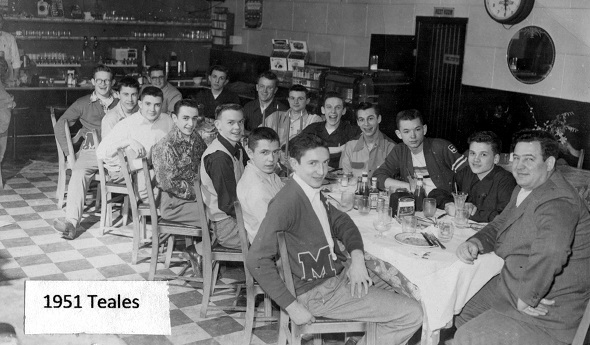
Leon Westover sent the win-loss record for little Marlette, 1951 Class C runner-up, as well as one of my favorite photos from that golden era of prep sports. Marlette had “waltzed through the Mid-Thumb League and district, regional and quarter-final tournament games,” wrote Fred J. Vincent of the Port Huron Times-Herald. Marlette slipped past Stanton 41-37 to advance to the Class C title game against unbeaten Detroit St. Andrew.
“Just one game too many …,” continued Vincent, writing from East Lansing’s Jenison Field House following the title game. “That just about explains the one-sided beating Marlette absorbed in the state class C high school basketball final here Saturday afternoon. The final score was 52-26. … One of the smallest teams, physically, in the tournament, it seemed that the Raiders were just worn out.”
Yet, that night, the team was celebrated like the hometown heroes they really were.
 Westover’s photo shows the Red Raiders on the night of the Final, gathered at Teale’s Restaurant in Marlette. The clock indicates its 11:30. The owner, George Teale, has opened up his restaurant for the team to cook them steaks in honor of their achievement. Coach Nieland "Tommy" Thompson and his 22-2 squad look happy, ready to celebrate a long season.
At tournament time, these lists help answer media requests that arise.
Question: When was the last time two undefeated teams met for an MHSAA Finals championship?
Answer: 2003-Class A for the girls. Detroit Martin Luther King topped Flint Northern 58-53. 1971-Class C for the boys. Shelby downed Stockbridge 71-57.
Question: What coach had the longest span between championship game appearances?
Answer: Eddie Powers, coach of Detroit Northern, went 34 years between his Class A championship team in 1930 and his runner-up squad in 1964. The mark is asterisked, however, as the Detroit Public School League chose to stop participation in the annual state tournament from 1931 through 1961. Saginaw’s Larry Laeding went 20 years between winning the 1942 Class A championship and his squad’s 1962 Class A title. Maple City Glen Lake coach Don Miller went 19 seasons between the school’s 1977 Class D title and its 1996 runner-up finish, also in Class D.
For the girls, both Mary Cicerone at Bloomfield Hills Marian and Carl Wayer at Ashley went 16 seasons between appearances. While Cicerone’s Marian teams have made seven visits to the Finals and have won six Class A titles, 16 years elapsed between Marian’s 1998 and 2014 Class A championships. Marian then captured a second consecutive title in 2015. Coach Wayer advance two teams to the title game. Ashley finished as runner-up in Class D in 1980 and again in Class D in 1996. The loss in 1996 came in overtime, and was the only defeat for Ashley that season.
Michigan’s high school basketball tournaments are an experience shared, mostly unchanged, since their beginnings. At the end of the regular season, everyone qualifies for the madness. Yet in the end, only four teams finish as champions. The path mimics the magical trail taken by fathers, grandfathers and great grandfathers, mothers and grandmothers. Qualifying for the Quarterfinals is still a huge triumph, as the round brings together only 32 teams from a field of more than 700 boys teams and more than 650 girls teams.
In my eyes, these lists emphasize that remarkable, undiluted achievement. In a world consumed with trophies and the number “1,” perhaps it is time to step back and celebrate this rare journey.
Click for Ron Pesch's data "Needs Lists" for girls basketball and boys basketball.
 Ron Pesch has taken an active role in researching the history of MHSAA events since 1985 and began writing for MHSAA Finals programs in 1986, adding additional features and "flashbacks" in 1992. He inherited the title of MHSAA historian from the late Dick Kishpaugh following the 1993-94 school year, and resides in Muskegon. Contact him at [email protected] with ideas for historical articles.
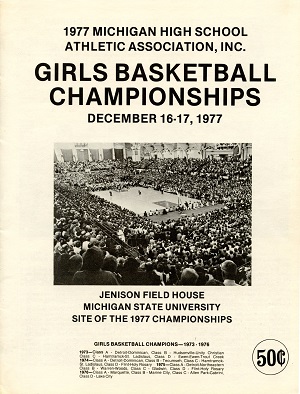
PHOTOS: (Top) Marlette's 1951 boys basketball team gathers for dinner at a local restaurant after the Class C Final. (Middle top) The 1969 Boys Finals saw the addition of updated tournament programs. (Middle below) The 1977 Girls Finals program told of the teams that would meet at Jenison Field House. (Below) The 1947 Boys Finals program was among many that helped fill in data gaps from the early years of the tournament. (Photos provided by Ron Pesch.)
Next Win Will be 500th for Ida's Leonard
November 30, 2018
By Doug Donnelly
Special for Second Half
IDA – There are ups and downs in everyone’s coaching career. Unless you are Tim Leonard.
 Leonard starts his 28th season as head coach of the Ida High School girls basketball team Tuesday. With a win at home against Monroe Jefferson, Leonard would join the exclusive 500-win club.
The Bluestreaks varsity won at least 12 games every one of his first 27 seasons at Ida. His record is a shiny 499-112.
“That’s a credit to our kids and coaching staff,” said Leonard. “Through all of the years, all of our kids have worked hard for everything. They’ve come to practice every day, and they have played hard.”
Leonard is a retired Michigan State Police detective who started coaching at Ida, his alma mater, in 1986 when he was hired as the boys freshman basketball coach. He took over the Ida junior varsity boys the following season and coached them for 15.
In the meantime, he coached Ida’s 8th-grade girls team in 1989 and 1990 and got the Ida girls varsity job in 1991. Ida went 22-2 that season, winning a Class C District crown and the Lenawee County Athletic Association championship.
It was a sign of things to come for Leonard and Ida.
In the years since, his accomplishments have been remarkable:
- 16 LCAA titles
- 10 District championships
- 2 Associated Press Coach of the Year awards
Leonard said basketball was a sport he always had loved. He’s grateful he was able to coach while working for the state police.
“I think a lot of people get into law enforcement for some of the same reasons they get into coaching or educating kids,” Leonard said. “It’s because of a desire to work with young people, to guide them, to help them along the way.”
As a detective, Leonard would often deal with cases in which children were not always in the most positive light. Coaching, he says, helped counter that.
“Coaching definitely allowed that balance for me,” he said. “In law enforcement, you are often dealing with the negative side. Coaching allows you to work with kids that are doing positive things.”
Ida has done a lot of positive things over Leonard’s tenure. He’s become the winningest girls basketball coach in Monroe County history. His 1999 Bluestreaks hold the school record for wins with 23. The 2016-17 team was his latest to win 20 games when it went 20-3. That was the 11th time in his career that Ida won at least 20 games.
“I’m pretty proud of the fact that in our down years, we still were able to win 12 or 14 games,” he said. “The girls just always seem to buy into what we are teaching them.”
Leonard hasn’t been afraid to change with the times. In his early coaching days, his teams were known for a fast, get-up-and-down-the-floor pace with full-court, man-to-man defense. As different athletes cycled through the Ida program, Leonard was able to adapt to fit the strengths of his roster.
“To be successful, one of the things you have to be willing to do is change,” he said. “You have to figure out what suits the kids the best. We’ve been pretty flexible throughout the years.”
In the last few years, Ida’s transitioned from the full-court press to a 2-2-1 zone press. It’s been a subtle change, but the success has continued. Ida is the reigning LCAA champion and has won three consecutive District crowns. Ida will play in Division 2 this season.
This winter, Ida returns just one starter in Taylor Wegener, but has experienced players coming back along with athletic newcomers. Opponents aren’t expecting anything easy when they take on Ida.
“This year is going to be interesting,” Leonard said. “We are still learning, still adjusting. We’re still getting our legs under us. It might take a little while, but I think it will come together.”
After Leonard retired from the state police, he became Ida’s athletic director, a position he still holds. He’s also turned basketball into family – his daughter Anne, who was a 1,000-point scorer at Ida, and son Chris are assistant coaches.
While the victories have piled up, Leonard said it’s never been about that.
“It’s certainly not about the wins and losses,” he said. “It’s definitely to make a difference in young people’s lives, to mentor and help the kids mature. That’s what it has always been about.”
 Doug Donnelly has served as a sports and news reporter and city editor over 25 years, writing for the Daily Chief-Union in Upper Sandusky, Ohio from 1992-1995, the Monroe Evening News from 1995-2012 and the Adrian Daily Telegram since 2013. He's also written a book on high school basketball in Monroe County and compiles record books for various schools in southeast Michigan. E-mail him at [email protected] with story ideas for Jackson, Washtenaw, Hillsdale, Lenawee and Monroe counties.
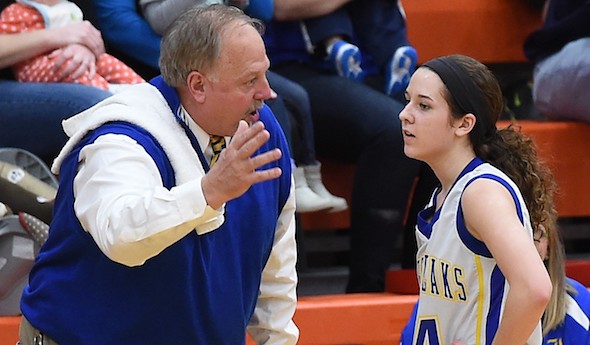
PHOTO: Ida girls basketball coach Tim Leonard instructs one of his players. (Photo by Tom Hawley.)