

Final 'Retro' Mr Basketball Class Named
April 12, 2019
Special from Basketball Coaches Association of Michigan
With the completion of the 2018-19 prep basketball season, the Basketball Coaches Association of Michigan proudly wraps up its decade-long “Retro” Mr. Basketball project with the announcement of the final six honorees.
Over the course of 10 seasons, the project has examined the high school court careers of hundreds of the state’s finest. The list of 61 honorees, when combined with the winners of the current ‘Mr. Basketball’ Award, first presented following the 1980-81 prep season, totals 100. A contiguous list of Michigan’s ‘Best of the Best’ now dates back to 1920.
Noting the amazing pool of talented basketball players produced by the state over the years, past Basketball Coaches Association of Michigan Executive Director Tom Hursey and Michigan High School Athletic Association historian Ron Pesch hatched a plan to replicate the ‘Mr. Basketball’ concept, and apply it to the past. The goal was to name the top high school senior ballplayer for each of the 61 years between 1920 and 1980.
To do so, Pesch hit the archives, examined the data, gathered names and assembled biographies, then provided a ballot. BCAM assembled a committee representing all parts of Michigan to examine the information, narrow the field to the best-of-the-best, and then vote for a winner.
“All along, the idea was to focus solely on the high school playing careers of these individuals, just like the current award,” said Hursey. “The committee did its best to ignore what came later, and to name a Mr. Basketball selection for each year. Now, with the 10th and final round of selections, the project is complete.”
“Just like with the current award, there will always be debate on the selections,” said Pesch. “Dave DeBusschere or Chet Walker? L.C. Bowen or Richie Jordan? Bill Chmielewski or Pete Gent? That’s a good thing. These players should never be forgotten in the halls of their high schools and by basketball fans across the nation. Michigan has produced and continues to turn out amazing athletic talent, year in and year out. So often, folks only recall the recent past. The ‘Retro’ Mr. Basketball project focuses a spotlight on our history.”
That spotlight now shines on the award that captures the names. Following the 2013 presentation of the award, BCAM retired the original Mr. Basketball trophy. The award has since been repurposed to capture the names of the “Retro” Mr. Basketball winners. The trophy now stands on display in East Lansing as part of the Tom Izzo Hall of History at the Breslin Center.
1929 RETRO MR. BASKETBALL
LOUIS JAGNOW, JACKSON –
1929 FINALISTS
Forest Baldwin, Bridgman – Captain of the Class D champion. Although not of unusual size, Baldwin was considered as lightning fast and a deceptive dribbler with an uncanny shot. He scored 22 points in the team’s Quarterfinal victory over Grand Rapids Godwin.
Neil Ludwick, Grand Rapids Creston – Center and top player on the best Creston team to date. Despite a Quarterfinal loss in the Class A tournament, Ludwick was singled out and named to the all-tourney team in 1929. A mid-year graduate in 1930.
Lester Wamsley, Highland Park – A steady, smart cager, Wamsley was an All-City selection by both the Detroit Times and Detroit Free Press, and a United Press International All-Tournament selection. Praised as an outstanding guard, good on long shots.
1939 RETRO MR. BASKETBALL
GENE BROENE, GRAND RAPIDS CHRISTIAN
1939 FINALISTS
Chet Jurwiak, Kalamazoo St. Augustine – “The state’s standout high school basketball player under the basket. He invariably grabbed 80 percent of the balls off the back board during a game,” wrote the Detroit Times when selecting him for first-team all-state honors. “Jurwiak was all-state in football and lost none of his ability on the court.”
Earl Kelly, Flint Northern, 6-foot-3 – described by a veteran Saginaw Valley Conference official as the best player in the league. Scored 176 points in 20 games in leading Northern to its third Class A championship in the school’s 11-year history. A mid-year graduate in 1939-40.
Ed (Nowaczyk) Novak, Flint St. Mary – First team all-state according to both the Free Press and the Times. Scored 260 points as a senior and, with his twin brother Edwin, “helped St. Mary annex the Class C state crown. Through his height he controlled the ball off both backboards, besides tossing in baskets on a highly productive basis.”
Frank Sabo, Detroit Southwestern – “Sabo was considered by many coaches as the best passer in the (Detroit city) league,” said the Free Press. “An outstanding floorman,” added the Detroit Times when naming Sabo to its all-city team. “Superlative off the backboard, a good shot and, above all, a fine leader.” Later played at Wayne University.
1949 RETRO MR. BASKETBALL
KEN BURRELL, HAMTRAMCK, 6-FOOT-3, 182
1949 FINALISTS
Chuck Holloway, Detroit Northern, 5-foot-8 – “He’s an all-around star, outstanding in the clutch as exemplified in the (City League playoff) semifinal game against Central, where he led Northern in a rally to win. He topped the loop in scoring (14 point average), is fast and difficult to stop,” wrote the Times. “Despite his lack of height, was probably the most adept player in the (Detroit City) league. An uncanny shot, he led Northern into the finals of the (league) playoffs,” wrote the Free Press.
Harry Lauder, Ferndale, 5-foot-11, 155 – Spectacular scorer and all-around performer and the spark of his team. “Was ‘raved over’ by virtually everyone who saw him perform,” stated the Times, when selecting him for first-team all-state honors. Called by his coach, Roy Burkhart, “one of the smoothest all-around players I’ve ever seen. The kid also is loaded with basketball sense.” Later played freshman and varsity basketball at Michigan.
Lysle Smith, Port Huron, 5-foot-11, 155 – “Known as a ‘pressure’ player who also draws the evening’s toughest defensive assignment for his team. His 193 points this season were mostly on set shots from far out on the court,” wrote the Free Press, honoring Smith with first-team all-state accolades. Later played at Michigan, where he became the first cager from Port Huron to win a varsity letter.
Carl Tschirhart, Milan, 6-foot-0, 155 – An all-around athlete and key cog in Milan’s 1948 Class C title, Tschirhart “connected on 33 percent of his 288 shots from the floor” as Milan ran its win streak to 40 games straight, spanning two seasons, before falling in the Regionals of the 1949 tournament. Later played for Michigan Normal (now Eastern Michigan University).
1959 RETRO MR. BASKETBALL
DAVID GAINES, DETROIT NORTHEASTERN, 6-FOOT-0, 180
1959 FINALISTS
John Bandy, Pontiac Central, 6-foot-3, 160 – A jump shooting specialist. “Averaged 19 points a game during the regular season to take the individual scoring title in the strong Saginaw Valley League,” said the Detroit Times, including him on its Dream Team. “Was Pontiac’s second leading rebounder,” wrote the Free Press when naming him Class A first-team all-state. “He could score from any spot on the floor.” Played college ball at Western Michigan University.
Jim Ludwig, Sault Ste. Marie, 6-foot-5½, 185 – “Rewrote virtually all of Sault Ste. Marie High’s individual scoring records,” wrote George Maskin in the Times. “A four-year veteran on the Blue Devils, he tossed in more than 1,100 points … During the recent season he collected over 450 points (373 in regular season play) and had a superlative shooting mark of 46 percent. Jim also headed the Soo in rebounds.”
Art Oliver, Muskegon Heights, 6-foot-0, 162 – Clever, sharpshooting guard. Leading scorer for the Tigers, totaling 318 points over 18 games, and 21.5 points per game over the last half of the season before the Heights fell to Grand Rapids Central in Regional play. A first-team all-state selection by both the Free Press and Times.
Art Reid, Hamtramck, 6-foot-2, 186 – “A superior rebounder and jumper, (and tireless worker), averaged 22 points a game for Hamtramck,” said Hal Schram in the Free Press. “Deadly from the corners as well as in front of the basket,” added the Times. He scored 364 points including 44 of 67 from the free throw line.
Jim Tilmon, Grand Rapids Central, 5-foot-9, 170 – “’Tilmon is the best around here since Don Eaddy,” chronicled Eugene Gailmeier of the Grand Rapids Herald. “Although basically a guard, Tilmon rotated so swiftly from one position to another it was impossible to tell at times what job he actually held,” said the Times. Led the city league in scoring. His 27 points in the Regional Final snapped Muskegon Heights’ string of 17 tournament wins and helped place Central in the Quarterfinals for only the third time in postseason history.
1969 RETRO MR. BASKETBALL
ERNIE JOHNSON, GRAND RAPIDS OTTAWA HILLS, 6-FOOT-7, 190
1969 FINALISTS
Ken Brady, Flint Central, 6-foot-9, 220 – Best big man to come out of Flint in many years. “Despite his 220 pounds, Brady gets up and down a basketball court with the agility and speed of a dashman. (Coach Clif) Turner insists he is often more valuable for his defensive play than his point production,” said Hal Schram in a midseason article. Set a new city scoring mark with 521 points in 21 games while helping Central win the Valley conference title. United Press International ‘Player of the Year’ in Michigan.
Tom Marsh, Detroit Northern, 6-foot-1, 168 – “Possibly the best player in either the Detroit Catholic or public school league” said The Associated Press, Marsh “became Northern’s first player to top 1,000 points in three varsity seasons. He averaged 27 points a game and was a fine outside shooter.”
Tim Megge, Orchard Lake St. Mary, 6-foot-2, 175 – Averaged 25.4 points a game, including a school record 56 points in one game, preceded by a 51-point game. Hit 46 percent of his field goal attempts and 72 percent of his foul shots according to UPI. In 81 games during his four-year varsity career, Megge scored 1,612 points.
Bob Rhodin, Ypsilanti – 6-foot-3½, 170 – “Led Ypsilanti to a 22-1 record and a No. 1 rating in the final AP poll. Scored 360 points during the year for a 19 point average and was the team’s top rebounder, grabbing 227,” said the AP. “Coach Dick Ouellette calls him ‘the best all-around player I’ve ever had.’ Rhodin has tremendous hustle and is a great defensive ballplayer.”
Cal Tatum Muskegon, 6-foot-1, 170 – "For his size, I've never seen an athlete who is so proficient in so many phases of the game," said then-Muskegon coach Mike Murphy. A guard, Tatum averaged 22.4 points, 10 rebounds, five assists and four steals per game his senior year to earn first-team all-state honors. He graduated as the Big Reds' all-time leading scorer with 1,250 career points, and an average of 22.7 points per game as a senior.
1979 RETRO MR. BASKETBALL
JAY SMITH, MIO AuSABLE, 6-FOOT-5, 192
1979 FINALISTS
Tim Andree, Birmingham Brother Rice, 6-foot-10, 230 – The “best big man in the state,” wrote Hal Schram in the Free Press. Averaged 23 points and 17 rebounds per game.
James Koger, Saginaw, 6-foot-4, 190 – A 1,000-plus career scorer who averaged 19.7 points, 11 rebounds and shot 47 percent from the floor” said the AP. “He ran the Saginaw offense,” added the Free Press in its first-team all-state write-up. “When he wasn’t in the lineup, Saginaw was a very ordinary team.”
Melvin McLaughlin, Grand Rapids Creston, 6-foot-1, 170 – Considered the state’s top “pure shooter,” McLaughlin scored 1,577 points, a 25.4 average, in his three-year career at Creston. Exceeded the 35-point mark in a game on four occasions as a senior.
Evaristo Perez, Orchard Lake St. Mary, 6-foot-8, 210 – Despite being in the U.S. less than two years, the Dominican Republic native averaged 22 points and 15 rebounds while hitting 57 percent of his shots. “He’s a real competitor and a leader on the flow,” St. Mary coach Bob Shoemaker told the Free Press. “We do a lot of things on the court, and he picked them up right away.”
Derek Perry, River Rouge, 6-foot-6, 210 – Coach Lofton Greene told Hal Schram that Perry was “probably the finest offensive player he has ever coached.” Averaged more than 28 points per game and “an incredible field-goal shooting percentage of 64 percent” entering the postseason.
Erich Santifer, Ann Arbor Huron, 6-foot-5, 165. “He has been the most valuable player in the rugged South Central Conference two years in a row,” said the Lansing State Journal at tournament time. “He prefers to work inside, but can also produce from long range as well.” Santifer held a 22.3 points per game average headed into the tournament Regional Final against Lansing Eastern, then scored 36 points against the Quakers in the contest although Huron was eliminated. “He’s probably the finest player we saw all season,” said Lansing Eastern coach Paul Cook. Later excelled at Syracuse.
MICHIGAN’S MR. BASKETBALL AWARD
Players from 1981-Present were honored as part of the current BCAM/Detroit Free Press Hal Schram Mr. Basketball Award. Players from 1920-1980 were selected as part of BCAM’s decade-long “Retro” Mr. Basketball project, launched in 2010 and completed in 2019.
2019 Romeo Weems, New Haven (DePaul)
2018 Foster Loyer, Clarkston (Michigan State)
2017 Isaiah Livers, Kalamazoo Central (Michigan)
2016 Cassius Winston, University of Detroit Jesuit (Michigan State)
2015 Deyonta Davis, Muskegon (Michigan State)
2014 DeShawn Thrower, Muskegon (Stony Brook/Ferris State)
2013 Monte Morris, Flint Beecher (Iowa State)
2012 Matt Costello, Bay City Western (Michigan State)
2011 Dwaun Anderson, Suttons Bay (Wagner)
2010 Keith Appling, Detroit Pershing (Michigan State)
2009 Derrick Nix, Detroit Pershing (Michigan State)
2008 Brad Redford, Frankenmuth (Xavier)
2007 Corperryale Harris, Detroit Redford (Michigan)
2006 David Kool, Grand Rapids South Christian (Western Michigan)
2005 Wilson Chandler, Benton Harbor (DePaul)
2004 Drew Neitzel, Wyoming Park (Michigan State)
2003 Dion Harris, Detroit Redford (Michigan)
2002 Paul Davis, Rochester (Michigan State)
2001 Kelvin Torbert, Flint Northwestern (Michigan State)
2000 Marcus Taylor, Lansing Waverly (Michigan State)
1999 Jason Richardson, Saginaw Arthur Hill (Michigan State)
1998 Dane Fife, Clarkston (Indiana)
1997 Shane Battier, Detroit Country Day (Duke)
1996 Winfred Walton, Detroit Pershing (Fresno State)
1995 Robert Traylor, Detroit Murray-Wright (Michigan)
1994 Willie Mitchell, Detroit Pershing (Michigan/UAB)
1993 Jon Garavaglia, Southgate Aquinas (Michigan State)
1992 Kenyon Murray, Battle Creek Central (Iowa)
1991 Chris Webber, Detroit Country Day (Michigan)
1990 Anthony Miller, Benton Harbor (Michigan State)
1989 Michael Talley, Detroit Cooley (Michigan)
1988 Matt Steigenga, Grand Rapids South Christian (Michigan State)
1987 Mark Macon, Saginaw Buena Vista (Temple)
1986 Terry Mills, Romulus (Michigan)
1985 Glen Rice, Flint Northwestern (Michigan)
1984 Demetreus Gore, Detroit Chadsey (Pittsburgh)
1983 Antoine Joubert, Detroit Southwestern (Michigan)
1982 Robert Henderson, Lansing Eastern (Michigan)
1981 Sam Vincent, Lansing Eastern (Michigan State)
1980 Tim McCormick, Clarkston (Michigan)
1979 Jay Smith, Mio-AuSable (Bowling Green/Saginaw Valley)
1978 Trent Tucker, Flint Northwestern (Minnesota)
1977 Earvin “Magic” Johnson, Lansing Everett (Michigan State)
1976 Stuart House, Detroit Denby (Washington State)
1975 Bruce Flowers, Berkley (Notre Dame)
1974 Tony Smith, Saginaw (Nevada-Las Vegas)
1973 Tom LaGarde, Detroit Catholic Central (North Carolina)
1972 Larry Fogle, Detroit Cooley (Southern Louisiana/Canisius)
1971 Michael "Campy" Russell, Pontiac Central (Michigan)
1970 Rick Drewitz, Garden City West (Kentucky)
1969 Ernie Johnson, Grand Rapids Ottawa Hills (Michigan)
1968 Ralph Simpson, Detroit Pershing (Michigan State)
1967 Spencer Haywood, Detroit Pershing (University of Detroit)
1966 Rudy Tomjanovich, Hamtramck (Michigan)
1965 L.C. Bowen, Benton Harbor (Bradley)
1964 Willie Betts, River Rouge (Bradley)
1963 Craig Dill, Saginaw Arthur Hill (Michigan)
1962 Ernie Thompson, Saginaw (Bradley)
1961 Reggie Harding, Detroit Eastern
1960 Peter Gent, Bangor (Michigan State)
1959 David Gaines, Detroit Northeastern (LeMoyne, now LeMoyne-Owens)
1958 Chet Walker, Benton Harbor (Bradley)
1957 Ed Burton (Michigan State)
1956 Mel Peterson, Stephenson (Wheaton)
1955 M.C. Burton, Jr., Muskegon Heights (Michigan)
1954 Pete Tillotson, Ludington (Michigan)
1953 Ron Kramer, East Detroit (Michigan)
1952 Frank Tanana, Sr., Detroit St. Andrew, (Cal State-Fullerton – baseball)
1951 Webster Kirksey, Saginaw (Eastern Michigan)
1950 Charlie Primas, Detroit Miller (Wayne State)
1949 Ken Burrell, Hamtramck (Lawrence Tech)
1948 Art McColgan, Saginaw SS Peter & Paul (Villanova)
1947 Sammy Gee, Detroit Miller
1946 Jack Forestieri, Benton Harbor (Notre Dame)
1945 Bob Swanson, Lansing Sexton (Michigan)
1944 Dick Rifenburg, Saginaw Arthur Hill (Michigan)
1943 Don Boven, Kalamazoo Central (Western Michigan)
1942 Larry Savage, Saginaw (Northwestern)
1941 Don Osterman, Detroit St. Theresa (Villanova)
1940 Ralph Gibert, Flint Northern (Michigan)
1939 Gene Broene, Grand Rapids Christian (Calvin College)
1938 John Maartens, Kalamazoo Central
1937 Bob Osterman, Detroit St. Theresa (Notre Dame)
1936 Charles Pink, Detroit Northwestern (Michigan)
1935 John Zwier, Holland Christian
1934 Earl Brown, Jr., Benton Harbor (Notre Dame)
1933 Lincoln Dodson Truss, Flint Northern
1932 Lowell Matteson, Portage
1931 Edward Huttenga, Grand Haven (Western Michigan)
1930 John Tooker, Kalamazoo St. Augustine (Michigan)
1929 Louis Jagnow, Jackson (Carnegie Tech)
1928 Francis Doolittle, Detroit Northwestern
1927 Bill McCall, Muskegon (Dartmouth)
1926 Roger Grove, Sturgis (Michigan State)
1925 Joe Truskowski, Detroit Northeastern (Michigan)
1924 Bennie Oosterbaan, Muskegon (Michigan)
1923 Henry Schrumpf, Niles (Western Michigan)
1922 Royal Cherry, Grand Rapids Union (Michigan)
1921 George Haggarty, Ypsilanti (Michigan)
1920 Harry Kipke, Lansing Central (Michigan)
Hoopfest Returns This Weekend to Jenison
March 21, 2017
By Geoff Kimmerly
Second Half editor
March Magic Hoopfest will return to Jenison Field House for this weekend’s Michigan High School Athletic Association Boys Basketball Finals, marking the eighth championship weekend the event has run concurrent with the games being played at Michigan State University’s Breslin Center.
A number of favorite attractions will return including slam dunk (on lowered rims), 3-point shootout and half-court shot areas where fans can come at any time and participate, and the festivities also will include a court for timed “Around the World” shooting games and another court featuring the Michigan Army National Guard skills challenge. Also returning is the Walk of History, showcasing championship games, life-size photos and display boards from throughout the MHSAA Finals’ near century-long run.
Two Hoopfest center courts will host a number of games throughout the event, including the “JumpBall Jamboree” made up of teams of boys and girls in grades 3-8, and a series of games between Special Olympics Project UNIFY high school teams.
Admission to the March Magic Hoopfest is $2 per person, and fans attending the MHSAA Boys Basketball Semifinals and Finals will be admitted free with their game tickets. Hours on March 23 and 24 will be 2 p.m. to 7 p.m.; the event is open from 10 a.m. to 6 p.m. on March 25. Jenison Field House, site of Hoopfest, also was the site of the MHSAA Boys Basketball Finals for 31 years. To find out more general information about the event, visit the March Magic Hoopfest Website.
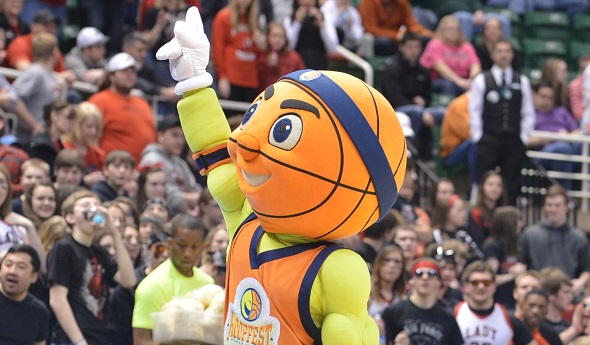
Hoopfest also will be home to Hoopie, the event’s mascot who made his first public appearances during the 2014 MHSAA Finals.
The March Magic Hoopfest is being conducted in partnership between the Greater Lansing Sports Authority (GLSA), a division of the Greater Lansing Convention and Visitors Bureau, and the MHSAA, with vital support coming from the Department of Intercollegiate Athletics at Michigan State University.
“For more than 90 years, basketball teams have ended their seasons at the MHSAA Tournament, and Hoopfest allows fans to share first-hand in the atmosphere that has made this such a historic event,” MHSAA Director of Brand Management Andy Frushour said. “It’s a great stop-over for our fans coming to or leaving the Breslin Center, and it’s also a great place to bring the family for some fun even for those who won’t be attending this weekend’s Finals.”
The Greater Lansing Sports Authority’s mission is to be the leading voice of sports tourism in the Greater Lansing area and to promote economic growth by attracting a diverse range of sporting events to the region. The GLSA strives to enhance the quality of life for area residents through the development of local sports and fitness programs for all ages and supports the continued development and maintenance of safe, high-quality athletic facilities.
“The March Magic Hoopfest sets off a great weekend of MHSAA tournament games and helps create a multi-day event which will involve the Lansing area and thousands of visitors from across the state,” said Mike Price, Executive Director of the Greater Lansing Sports Authority. “If you’re coming to the championships, Hoopfest is a destination to visit before and after the games; and if you’re not coming to the games, Hoopfest is a fun, wholesome, inexpensive, family activity.”
PHOTO: Hoopie entertains the crowd during the 2014 MHSAA Finals.