

Hillsdale Driving Toward Undefeated Run
By
Chip Mundy
Special for Second Half
February 10, 2017
By Chip Mundy
Special for Second Half
 “The pressure is on every year,” Hornets coach Brad Felix said. “I think everybody is complacent with it, they just assume we're going to win 18 or 20 games a year, and they don't realize how difficult it is to do that.”
It wasn't always that way. From 1968 until Felix took over in 2002, Hillsdale not only never won a District tournament, it won just four tournament games.
“We have a great historian around town who keeps up with the basketball program, and he informed me that I was getting into a rat's nest here,” Felix said. “He told me all the stats, with no tournament championships and the winless seasons.”
Still, it was a job coveted by Felix, who had been at Hillsdale for 10 years as girls basketball coach and boys junior varsity coach before he took over the boys varsity team. As a no-nonsense coach, he was prepared for the challenge of changing the culture.
“When I took over the girls program, they hadn't won a game in three years, so I was sort of ready for it and prepared,” he said. “I was extremely upbeat and younger back then, and I had a little pep in my step. I'm very demanding, and I don't really accept that attitude.
“I was fortunate enough to come in and have a lot of good players come through the program. You can't win without having horses in the race, and I've been blessed to have guys with good talent who bought into what I was preaching.”
Success comes in waves
Since Felix has taken over, Hillsdale has two Regional titles and five District championships. The Hornets also have had two unbeaten regular seasons, and after defeating Dundee on Thursday night to clinch the Lenawee County Athletic Association title, they are four wins from a third perfect regular-season run.
“We've mentioned it once,” he said of the potential undefeated season. “I brought it up halfway through the season. I remember the first year I had an unbeaten team here, and the Jackson Citizen Patriot listed all the undefeated teams in the area from 1980. It was like eight teams.
“It is an unusual thing that you might think happens a lot and doesn't happen a lot. It's so hard to do. You can have an off-night, have foul trouble, have injuries. Some team can just play well against you. It's a difficult sport.”
It also has been a somewhat unexpected run, even from Felix's perspective.
“This team has totally surprised me,” Felix said. “I did not think we'd be sitting 16-0. I thought we would be extremely competitive this year, and I thought we'd be a tough out, but for us to run the table at this point has taken me a little off guard.”
Any successful team has talented players, and this Hillsdale team is no exception. But the reasons for its outstanding season might go beyond that. There is a special motivation, and Coach Felix brought in a new defense that has paid off.
The players
The Hornets have talent, and they have a tough 1-2 scoring punch in senior forward Ethan Bernard and junior forward Bryce Drews. Both are averaging more than 20 points a game.
“It is unusual to have two guys average 20 or more, let alone 23 and 21, so if they both finish the year averaging 20, I'll be surprised,” Felix said. “At the same time, we push the ball, and we run a lot of stuff to these two guys and they are getting a lot of sets. They have the green light from everywhere. We go as they go, that's how it is.”
Drews, who was on varsity as a freshman, came into the week averaging 23.2 points, 8.8 rebounds, 2.5 assists and a team-high 3.1 steals per game. Bernard, in his second full year on varsity, checked in at 21.1 points, 5.6 rebounds, 1.5 assists and 1.9 steals per game. And both are shooting at better than 50 percent from the field.
“I can almost talk about those guys at the same time,” Felix said. “Offensively, they are difficult matchups for teams. Both are about 6-4, and if you put your big guy on them, they can go shoot the 3 ball. If you go small, they can post up. They both can put the ball on the floor and drive, so they're tough to guard.”
Hillsdale has gotten some more scoring from sophomore guard Spencer Eves, who is averaging 7.2 points, 2.5 rebounds and 1.8 assists per game.
“People don't realize it because I've got two guys averaging over 20, so they get all the headlines, and this kid is getting his points, and he's doing it quietly,” Felix said. “You don't really notice him on the floor, and that's probably a good thing.
“He's not doing a whole lot of things wrong. We're really looking for him to take a big jump next year, but right now he's chipping in what we need.”
 Senior point guard Connor McCosh inherited the biggest challenge on the team. He replaced three-year starting point guard Joe Philipp, who scored more than 1,000 points in his career. With Bernard and Drews around, McCosh doesn't have to have the scoring touch of Philipp.
McCosh is averaging 2.8 points and 2.4 assists per game, and more importantly, he has made just 1.4 turnovers per game.
“He played 10-to-12 minutes a game last year,” Felix said. “He's good at the point. He's not too worried about scoring points, and he can shoot the 3-pointer when he's wide open. He's more of a spot-up.
“He can run the offense, and he has a good IQ for the game, and he knows where guys are supposed to be. He really has filled in well because we lost a really good point guard in Joe Philipp.”
Junior center Collin Brown rounds out the starters. He is averaging 6.2 points and 5.8 rebounds per game, but the big plus is that he is averaging 2.9 offensive rebounds per contest. And he's getting better as the season progresses.
“He's out there because he rebounds,” Felix said. “He's one of the better offensive rebounders we've had here in a while. He does some dirty work underneath; that's where he scores most of his points.
“He's had a few double-doubles lately, and we hope he's kind of coming into his own. If he can do that for us, it's going to be huge.”
Guards Joe Wilcox, Sam Nash and Trevor Kornak see the most time off the bench. Wilcox brings a threat from the perimeter as he is making 44 percent of his 3-point tries. Nash is grabbing nearly two rebounds per game and Kornak is averaging 1.3 rebounds per game.
“We're not like years in the past when we have three or four 6-5 guys,” Drews said. “Ethan and Collin and me are the tallest guys, and we're 6-3, 6-4. We can play different styles of basketball, though. We can push the ball; we can play down low. We can pretty much play any type of game.”
The motivation
Despite going 18-2 last regular season, Hillsdale had a five-season streak of winning its conference championship snapped. That provided added motivation for this winter.
“You always want to win, and in this program you want to win championships,” Bernard said. “Not winning anything last year was kind of tough. You never want to be the class that lets you down, and actually, my first year on varsity, I was the class that let you down.
“So this year, we have a little chip on our shoulder trying to come back and win championships again.”
As mentioned above, Hillsdale is a member of the Lenawee County Athletic Association, but it began its run of conference titles in the Southern Michigan Athletic Association.
“We were kind of fresh to this league, and we won it three years in a row,” Felix said. “We finished the last league with two championships, so we had won five in a row going into last season.
“We were 18-2 last year, but we were kind of disappointed because both losses were to Onsted, which won our league. At the same time, Onsted was ranked No. 1 in the state; that was a special team with a 7-footer who went on to Michigan. You don't see kids like that very often.”
Then, in a District Semifinal, Adrian edged Hillsdale 42-39 to end the Hornets' season at 18-3.
“I think we got stuck looking ahead in the Districts and got upset,” Felix said. “We wanted to play Onsted one more time, and I think we overlooked Adrian a little bit and ended up losing by three.”
However, Felix goes back to the days in the Twin Valley and sees the move from that conference as a benefit to the program.
“I think it helped that we changed conferences,” he said. “Back in the 1990s when I was the JV coach, we were in the Twin Valley, and it was brutal playing schools that were twice our size. We got beat down every night. It was tough.
“I think the change in atmosphere of playing different teams and playing teams our size definitely helped.”
The new defense
Change can be good, and change has been good for Hillsdale this season. The Hornets have changed their defense, and it is paying off in a big way.
“What triggered it is that we played a team out of Indiana this summer that, quite frankly, we just couldn't score against them,” Felix said. “I was watching them a little bit, and in the second half I just sat down and let the kids play a little bit and watched. They were doing some things that I had thought about doing in the past.
“I didn't feel they were any more athletic than we were. They weren't any bigger than we were. I got with that coach in the summer, and we traded notes, and what they are doing with a few tweaks is what we were doing. I wasn't going to come in here and reinvent the wheel.”
Felix was hesitant to make a complete revision of the defense for a number of reasons.
“He told me it takes a year or a year and a half to put it in, and I said, 'I don't have a year and a half. I've got a good team coming, and I don't want to waste a good team,'” Felix said. “What he was telling me is that I was going to have to change just two or three things, and I thought we could handle that.
“There was some growing pains with it. I have to stay on them. It involves a little more work than in the past, but it's all half-court. We're trapping a little bit at half-court and rotating a little and shortening the floor a little bit and went a little bit to the run and jump in the half-court. I think the guys like it. It's fun.”
It also was important that the players would buy into the change, and they did.
“Defense was one of our main points of focus coming into this year,” Drews said. “We have a new defensive system that we all were excited about, and it's working out well. Usually in the first year of a new system, it isn't that successful, but this year it has been successful.
“We knew there was going to be little cracks and things we needed to figure out. Luckily, we started off good in it, and we found the weaknesses in it in practice and got a lot better at it.”
The coach
On Felix's most recent birthday, he was in the yard outside when his daughter came out to talk to him.
“She said, 'Dad, you need to come in the house real quick.' I come walking in, and there is my whole team for a surprise party,” Felix said. “They came over with all this breakfast food, and they cooked breakfast in my home for me. As tough as I am on these guys, they still surprised me.”
 Felix played basketball and football at Bessemer High School, and he said that he played basketball for a coach who was not nearly as demanding.
“I don't know what brought that out of me,” he said. “I'm from a single-parent home. I grew up without a father figure, so I don't know if that toughened me up a little bit.
“Bessemer went to the state finals in football and quarterfinals in basketball. I wasn't one of the stars of the team. I led the team in charges every year. I was one of those gritty players who would dive into the stands for a loose ball.”
Maybe it's the Upper Peninsula thing. Felix likens his style and attitude to another successful basketball coach from the U.P., although on a much larger level.
“I'm not a Tom Izzo, but I would compare myself to his attitude,” Felix said. “I have that grittiness – kind of like Izzo – and I feel like I coach like he does. He's tough on his guys, and his players love him.”
Like all high school coaches, Felix has to adapt his style of play to the talents of his players instead of vice versa. That sometimes forces him to play a style that isn't what he would like – a style that he was able to employ on some of his teams earlier in his career.
“We don't press like we used to anymore,” he said. “If it was my choice and I could recruit, I'd play that style. I love it. It was fun, and the guys enjoyed playing that way. But now, we're more half-court – more like Hanover-Horton – a strict man-to-man with pretty good pressure.
“Our defensive statistics are actually better in terms of points given up, but we're playing a slower style. We still get after people, but not the full court.”
Felix tries to deflect credit for the turnaround at Hillsdale, but the numbers speak for him with the dramatic redirection of the program.
“I give a lot of credit to my players,” he said. “My wife gets mad at me and says, 'Why don't you ever just say you do a good job?' I'm not going to discredit coaching. When I came in, the press was huge, and I put that team over the hump.
“But I just think the little kids buying into what we do with our youth program and kids wanting to be a part of what we're doing and parents having their kids out dribbling a ball a little bit is so important. We went from a doldrum basketball community to one that supports us.”
Felix concedes he might not be the easiest guy for whom to play. But with all that, he has the respect of his players.
“He's awesome,” Bernard said. “He knows everything about basketball, and he has the best basketball IQ I've ever been around. I've learned a lot of things from him.”
Drews shared those thoughts.
“He's a great coach,” he said. “If you just look at the numbers – and we've consistently had 18- to 20-win seasons – and you can't find that at many other places.”
And in the end – maybe even more than the wins and losses – Felix cherishes the relationships with the players.
“I am sure I will reflect back on all of this when I'm done, but it has been fun to be affiliated with so many fine young men,” Felix said. “I think the biggest pride I have is how many guys come back.
“I'm not an easy guy to play for. I'm tough on my guys, but I think they all realize it's tough love. To see them come back – and my alumni come back for the alumni game we have every year – and to have the guys push our guys and tweet, 'You can't let us down, you're part of the Hornets,' is just great. And going to former players' weddings. I think all of that kind of stuff is where I feel the most pride.”
 Chip Mundy served as sports editor at the Brooklyn Exponent and Albion Recorder from 1980-86, and then as a reporter and later copy editor at the Jackson Citizen-Patriot from 1986-2011. He also co-authored Michigan Sports Trivia. E-mail him at [email protected] with story ideas for Jackson, Washtenaw, Hillsdale, Lenawee and Monroe counties.
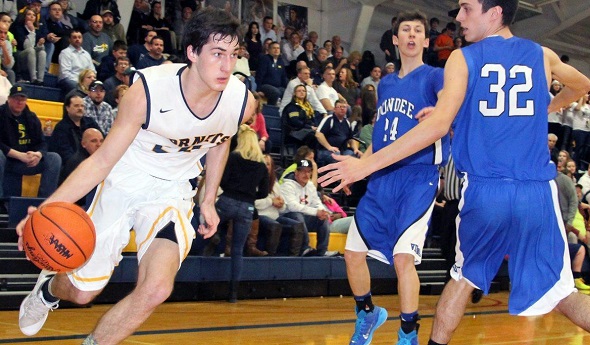
PHOTOS: (Top) Hillsdale's Bryce Drews drives the baseline this season again Ida. (Middle) Hillsdale boys basketball coach Brad Felix. (Below) Ethan Bernard splits a pair of defenders to get an open look. (Photos by Mike Linville and Matthew Lounsberry/Hillsdale Daily News.)

Perez Poised to Lead Hudsonville Charge
December 18, 2019
By Dean Holzwarth
Special for Second Half
HUDSONVILLE – Max Perez remembers the despair he and his Hudsonville teammates felt after a disheartening 61-60 loss to East Kentwood in last season’s Division 1 Regional Final.
 The Eagles stormed back from a 19-point second-half deficit only to watch their season end in the closing seconds.
Hudsonville hopes to use the defeat as a rallying cry for this season.
“The motivation we have going into the season is really high. … We were that close to going to the Quarterfinals, which only three other Hudsonville teams had done,” Perez said. “We beat them twice (in the regular season) and they got us when it counted, so that really stung us.”
Although their postseason run ended prematurely, the Eagles still won 22 games and captured the Ottawa-Kent Conference Red championship.
Perez, a 5-foot-10 point guard, played a major role in the team’s success despite missing nine games with a broken thumb.
That was the first time the four-year varsity player had suffered an injury that forced him to sit out for an extended period of time.
“It was really tough, then I got the news that I would be out six weeks. But I just knew that I couldn’t get down on myself, and I would be back,” Perez said. “I just had to pick up my teammates every day in practice and encourage them and stay positive.”
Perez will be the floor general for an Eagles’ squad that has eight seniors, including 6-foot-7 Justin DeGraaf, who moved back to Hudsonville after five years living in Indiana.
Through an intense passion for the game and a strong work ethic, Perez has made giant strides since beginning his high school career as an undersized freshman on the varsity.
“I think my game has improved a lot,” Perez said. “I’m stronger now, I’m bigger now and I’ve really worked on my game. I’ve implemented more of a drive game because when I was a freshman I was small and just stayed on the 3-point line and shot jumpers.
“As the years have gone on, I’ve become more mature and added more of an arsenal to my game while also improving my defense, which was important to me.”
Hudsonville coach Eric Elliott also has seen Perez’ progression, and it’s been even more evident entering this season.
“I’ve seen a ton of growth in all aspects and every year he has grown up as a player and matured, but I think the largest leap has been from last year to this year and it’s been significant,” Elliott said. “He’s stronger and more mature, and he’s more of a calming force than in the past. He seems more at ease and relaxed.”
Perez, who averaged 15 points per game last season, has had a basketball in his hands since before he could walk.
Through the years, he’s attended numerous camps, played on successful travel teams and spent countless hours in the gym fine-tuning his pure jump shot.
“He’s more than a classic gym rat; he’s non-stop in the gym and on the gun, and there’s no doubt that it has made him a very good basketball player and an incredible shooter,” Elliott said. “He’s an extremely confident kid and a confident shooter, and that comes from repetition and time spent in the gym.”
Perez’ dedication recently helped him fulfill a goal he’s had since middle school.
Last week he committed to Indiana Tech, an NAIA school, on a full-ride scholarship.
“They showed me love since day one, and they were my first offer,” Perez said. “I love the coaching staff, their facilities and campus and I love the guys. I think it will be a great help for the season just to know that I’m playing for my team and not doing anything for myself since I’ve already committed to college.
“I can focus on the season and winning, and I think we can go a long way with this talented senior group.”
Elliott is thrilled for Perez to get the opportunity to play at the next level.
“I’m incredibly happy for Max,” he said. “Anytime you see a kid that puts in the time and the energy and the passion that he has, and then to see him get rewarded, as a coach, it’s awesome to see. I’m excited that he could make a decision now so he can totally relax and can just play now. He has that behind him.”
Perez scored 21 points in a season-opening win over Godwin Heights. It was a solid start for a team that has lofty aspirations.
“Our goal is to win the conference and win Districts, but we know how good teams are around us and the O-K Red is brutal,” Elliott said. “We have high expectations, and we feel like we can beat anybody on any given night. However, we also feel like we can be beaten by anybody. We have some things to work on, but we are very excited.”
 Dean Holzwarth covered primarily high school sports for the Grand Rapids Press and MLive for 16 years and more recently served as sports editor of the Ionia Sentinel and as a sports photojournalist for WZZM. Contact him at[email protected] with story ideas for Allegan, Kent and Ottawa counties.
PHOTO: Point guard Max Perez directs the offense for Hudsonville. (Photo courtesy of the Hudsonville athletic department.)