

Jergens, Howardsville Driven to Go Far
December 4, 2018
By Wes Morgan
Special for Second Half
Its entire student body can fit in a single bus with room to spare.
 Yet Marcellus Howardsville Christian is now regarded as a boys basketball giant with senior scoring point guard Dylan Jergens fueling a historic run.
Last year the Eagles fought all the way to the Class D Quarterfinals, and with most of that roster still intact, they expect nothing less than earning a final-four spot at Michigan State University’s Breslin Center come March.
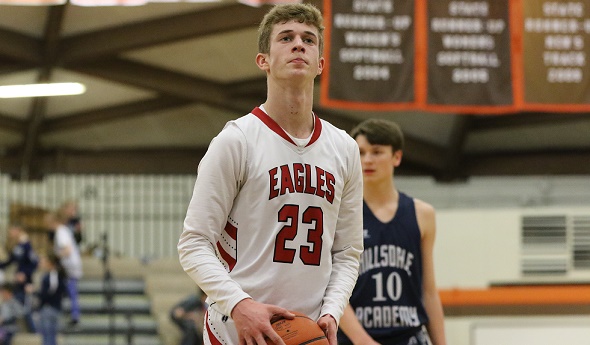
Finishing with a 20-6 record last winter, Howardsville Christian made history when it defeated Bellevue 58-46 for a Regional championship. Faced with a considerable size mismatch in the Quarterfinals versus Hillsdale Academy — a 66-38 defeat — the last chapter of the 2017-18 season was a letdown after a remarkable story otherwise.
Jergens and Co. are determined to prove last year’s success wasn’t just a flash in the pan.
“I’m excited for this season and the opportunities we have ahead of us,” he said. “Towards the end of the season we kind of had it going. It was an amazing feeling. Winning Districts and then winning Regionals for the first time in history was amazing. We were disappointed because we didn’t complete our goal of making it to Breslin, but we had a lot of fun.
“We came out a little overconfident (against Hillsdale Academy), thinking we were only one game away. We thought, ‘We’ve made it this far; we don’t think we can lose.’ We should have prepared more for their big guy; he really killed us on the boards and got layups. Looking back, we could have had a better game plan of how to guard him. But they were a good team, so give them credit.”
A junior-heavy class last winter soaked in everything it could in order to apply that experience to 2018-19.
“We’re definitely going to be ready for it and anything that is thrown at us,” Jergens said. “It’s going to be difficult. Last week we opened up against Mendon and really struggled. We know every team wants a piece of us after that run. They want to be able to come at us. It’s going to be more challenging because everyone wants to knock us off.”
As a junior, the 6-foot-4 Jergens averaged 32.1 points, 5.4 rebounds, 6.3 assists and 3.2 steals per contest. He shot 58 percent from the field and 41 percent from 3-point land. At the free throw line, he knocked down 76 percent of his shots.
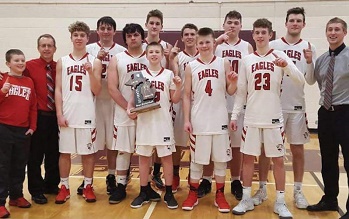 Though he certainly has been the catalyst of the Eagles’ success the last two years and a key player since joining the varsity squad as a freshman, the two-time Associated Press and Basketball Coaches Association of Michigan all-state first team selection is surrounded by an unselfish cast of players he’s shared the court with most of his life.
Fellow seniors Logan Cornwell (forward), David Cripps (guard), Colton Fair (small forward) and Reece Herschbach (center) all return, and exciting sophomores Jason Jergens (shooting guard) and Josh Parks (guard) bring long-range marksmanship to the table after seeing meaningful minutes as freshmen. Junior forwards Zach Grandlinard and Joe Nagel, and sophomore forward Ethan Johnson and sophomore guard Michael Cripps fill out a capable bench.
“The biggest strengths of our team this year are we have experience, and we have talent,” Howardsville Christian coach Tim Jergens said. “We return five starters from last year, and they have played together since elementary school. The team as a whole has great basketball I.Q., and we have players that have put the time in to be really good.”
None more than Dylan Jergens, whose effort over the years resulted in a scholarship offer from Central Michigan University, where he remains verbally committed. It’s a reminder that college programs will find talent no matter where it resides, even if it is at a school of only 32 students.
“Ever since I was little I wanted to play Division I basketball, not knowing if it would happen or not,” he said. “I just fell in love with the game and worked at it my whole life, every day. Last summer I felt like I was getting a lot better and thought good things were coming and could play at the next level.”
Though he’s certainly aware of the areas of his game he’d like to improve this year in order to have a better chance of seeing the floor sooner in Mount Pleasant next season, he’s not letting his future plans become a distraction.
“I don’t feel special,” Jergens said. “Everybody means something at our school, and everybody looks out for one another. It’s a super small classroom, and I’ve grown close to everyone in my class. None of it would be possible without my teammates and coaches and the school rallying around me. We’re hoping we can just do what we know we can do.”
 Wes Morgan has reported for the Kalamazoo Gazette, ESPN and ESPNChicago.com, 247Sports and Blue & Gold Illustrated over the last 12 years and is the publisher of JoeInsider.com. He can be reached at [email protected] with story ideas for Berrien, Cass, St. Joseph and Branch counties.
PHOTOS: (Top) Howardsville Christian’s Dylan Jergens lines up a free throw during last season’s Quarterfinal against Hillsdale Academy. (Middle) Jergens and his teammates hold up a piece of the hardware they won during last season’s historic run. (Photos courtesy of JoeInsider.com.)
Cass Tech 'Gamers' Force OT, Finish Surge to Reach 1st Final Since 1974
By
Dean Holzwarth
Special for MHSAA.com
March 24, 2023
EAST LANSING – Detroit Cass Tech’s Darius Acuff was held in check for a majority of the second half Friday by Grand Blanc’s defense.
The talented sophomore, however, came up clutch in a pivotal moment.
The 6-foot-2 guard forced overtime with a 3-pointer and then scored four points in the extra period to help lift the Technicians to a thrilling 62-56 win in a Division 1 Semifinal at Breslin Center.
Cass Tech (27-1) will play Muskegon in Saturday’s Division 1 Final.
After Grand Blanc senior Robert Williams made two free throws with 9.1 seconds left in regulation to put his team ahead 54-51, Acuff banked in a 3-pointer in the waning seconds.
It was only his second field goal of the second half after tallying 10 first-half points.
“Once I got open, I called for the ball and I knew I was going to shoot it,” said Acuff, who finished with a game-high 19 points, five assists and three steals. “I knew it was going in.”
The Technicians took control in the extra session.
A breakaway layup by Acuff pushed the Cass Tech lead to 59-56 with 55 seconds to play. He followed with a pair of free throws to make it 61-56.
“We have some gamers on this team, and he doesn’t practice to my liking a lot of times, but when those lights come on I can count on him,” Technicians coach Steven Hall said of his standout sophomore. “The last play out of the timeout that we got a 3 on, they executed it to the T.”
Cass Tech was making its first Semifinal appearance since 1993, and will play in its first Final since 1974, when it finished Class A runner-up.
Hall guided Detroit Rogers to three straight Class D titles (2003-05) and returned to his alma mater in 2015-16.
“It’s a wide range of emotions right now,” Hall said. “I’m happy to still be living to fight another day.
“For me, it’s my sixth time here but the first time with my school, and it's a dream of mine. It was a dream of mine for these guys. We came so close last year, and sitting here last year and watching the Semifinals was painful, but I’ve been dreaming of getting here with my school.”
Cass Tech ended a 22-game winning streak by Grand Blanc, which was denied a third-straight appearance in the Division 1 Final.
The Bobcats (25-3) rallied from an early deficit, but committed 18 turnovers for the game and were held to one field goal in overtime.
“We didn’t handle the pressure, and one of the keys of our offensive game plan was limiting turnovers,” first-year Grand Blanc coach Tory Jackson said. “You can't beat great teams like that with 18 turnovers, and we just didn’t handle the pressure like we were supposed to.
“Hats off to Acuff. He’s a tough player and by far one of the best players we've played all year. We got undisciplined at the end, and it’s frustrating because this was supposed to be ours. We left money on the table.”
Cass Tech jumped out to an early 11-4 lead as Acuff scored six quick points.
The Bobcats, however, trimmed the deficit to 17-15 in the second quarter with a 3-pointer in the corner from sophomore Donnie Huddleston.
The Technicians took a slim 26-25 lead into halftime.
Grand Blanc took its first lead, 35-34, midway through the third quarter on an offensive rebound and put-back by junior Anthony Perdue.
Cass Tech has become accustomed to close games.
“That’s us being tough and scrappy,” Acuff said. “It’s always going to come down to one possession, and it came down to that. Once we went to overtime we knew we were going to win, but we knew we had to fight for it.”
Senior Tae Boyd led the Bobcats with 16 points and 10 rebounds, while senior RJ Taylor had nine points.
Senior Kenneth Robertson added 15 points for Cass Tech, and freshman Corey Sadler Jr. added 14 points.
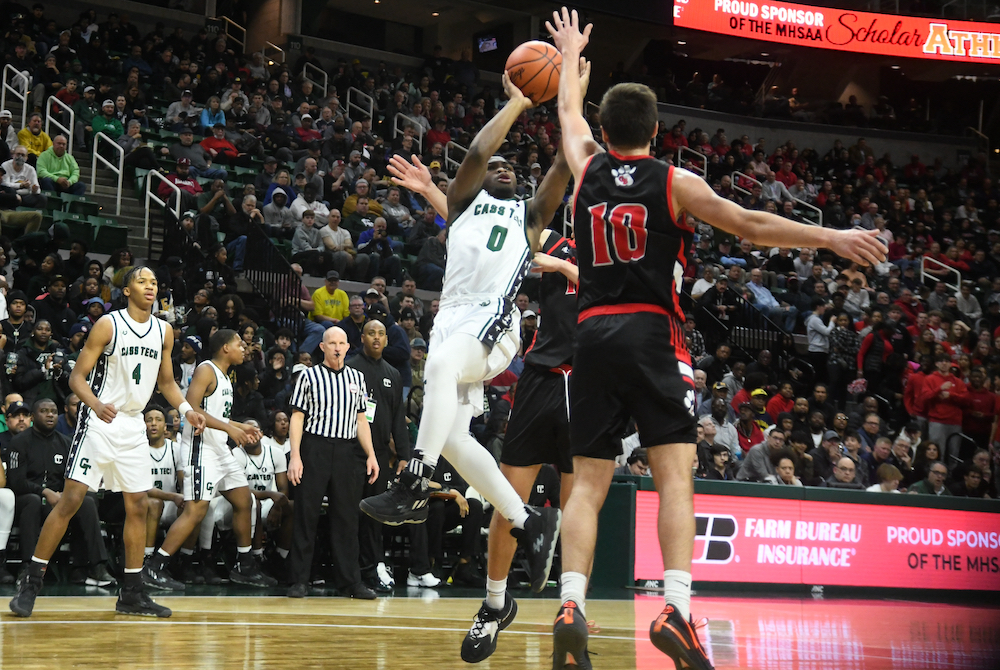
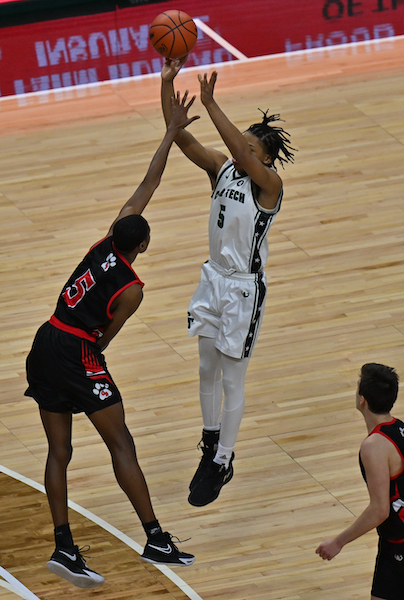
PHOTOS (Top) Detroit Cass Tech’s Corey Sadler Jr. (0) gets up a shot during his team’s Division 1 Semifinal overtime win Friday. (Middle) The Technicians’ Darius Acuff shoots the game-tying 3-pointer at the end of regulation despite the defense of Grand Blanc’s Anthony Perdue (5).