

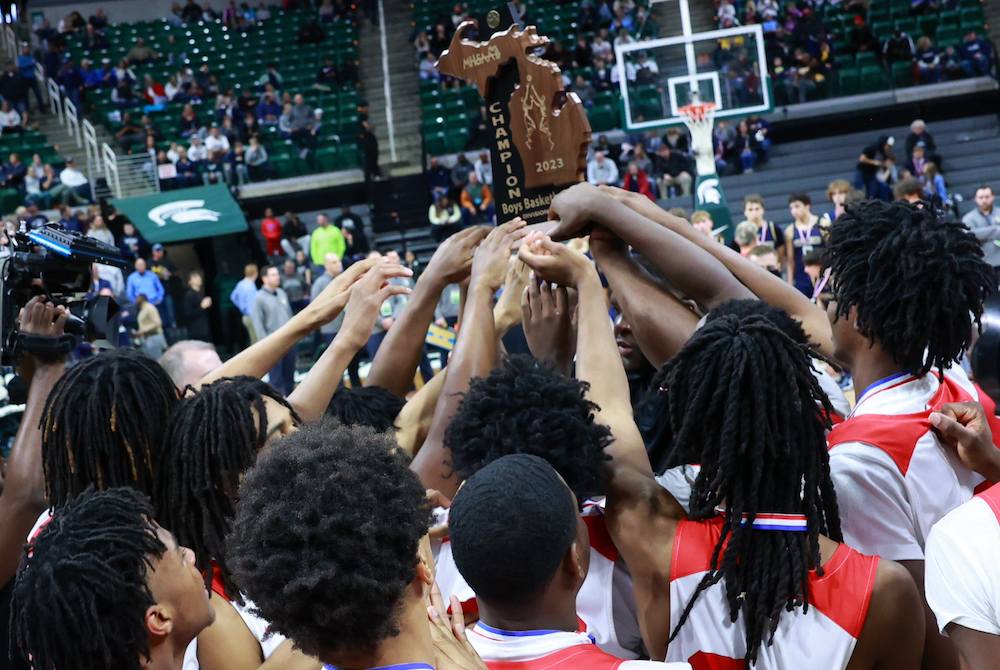
With Lee in Lead, Beecher Seizes Day Again with 2nd Title in 3 Seasons
By
Dean Holzwarth
Special for MHSAA.com
March 25, 2023
EAST LANSING – Robert Lee Jr. didn’t mind shouldering the scoring load in Saturday’s Division 3 Final.
Especially with a championship at stake.
The Flint Beecher senior guard scored a game-high 29 points to lead Flint Beecher past Traverse City St. Francis 64-50 at Breslin Center.
“Before the game I got up some shots at a high school, and usually when I do that I feel good,” Lee Jr. said. “I felt like I had to step up for my team. I did my part, and my teammates did their part. We won it together.”
It was Beecher’s second Finals title in three years and sixth since 2012. The Bucs lost in the Semifinals last year and were eager to return and reclaim the championship.
“Last year I brought my team up here and it was tears of hurt and disappointment, and that's something we talked about not just tonight, but all season long,” Beecher coach Marquise Gray said. “I constantly reminded the guys of that feeling and I think it drove us, and we are fortunate and blessed to come away with a title tonight.”
The 6-foot-2 Lee Jr. scored 18 of his 29 in the second half. He was 12 of 19 from the field and also grabbed 11 rebounds.
“I couldn’t score that many points without my teammates,” said Lee Jr., who also was part of a Division 3 title team as a sophomore. “It feels good … and spring break is going to feel a lot better, and food is going to taste better.”
Beecher (24-4) blitzed St. Francis early and led 8-0 after the first three minutes. The opening run included a pair of layups and an emphatic dunk by Lee Jr.
However, the Gladiators fought back and ended the quarter on a 7-0 run. Senior Wyatt Nausadis drilled a long 3-pointer at the buzzer to give St. Francis a 17-15 lead.
The Gladiators carried the momentum into the second quarter and built a 28-21 lead. But defense helped bring Beecher closer as it scored the last four points of the half and trailed 30-27.
Lee Jr. helped Beecher reclaim the lead (35-32) with back-to-back buckets. He then had a three-point play and mid-range jumper to make it 42-34 – and a steal and layup to push the lead to 10. A 3-pointer from Wasir James in the final minute of the quarter gave Beecher its biggest lead (47-35) of the game.
Lee Jr. then added 13 points in the third quarter as Beecher outscored the Gladiators 20-7.
 “Both of my calves started cramping up (at the end of the third quarter),” Lee Jr. said. “I tried to do whatever I could to prevent it, but I had to fight through it. When we got the win, I knew it was going to feel good.”
In the fourth quarter, St. Francis got to within five (47-42), but a Lee Jr. 3-pointer ignited a 7-0 surge that put the game out of reach.
Lee Jr. was the only Beecher player in double figures. Senior Jaylen Townsend had nine points and five rebounds, while senior Kevin Tiggs Jr. had eight points.
The Bucs shot 50 percent (26-52) from the field and recorded nine steals.
“We talked all year about seizing the moment, and tonight I think we did a great job of that,” Gray said. “Our road wasn't easy, but we continued to believe.”
St. Francis (24-4) was seeking its first Finals championship. Its best finish was Class C runner-up in 2012.
“That’s a good team, and we battled well,” Gladiators coach Sean Finnegan said. “We had a good first half and put ourselves in position, but they made a couple runs in the second half and we struggled to finish a little bit at times.
“But I can’t say how proud I am of the boys and the fact that we’re here and had the opportunity we had.”
Nausadis finished with a team-high 20 points, while senior center John Hagelstein added 12 points and seven rebounds. Senior Drew Breimayer had nine points.
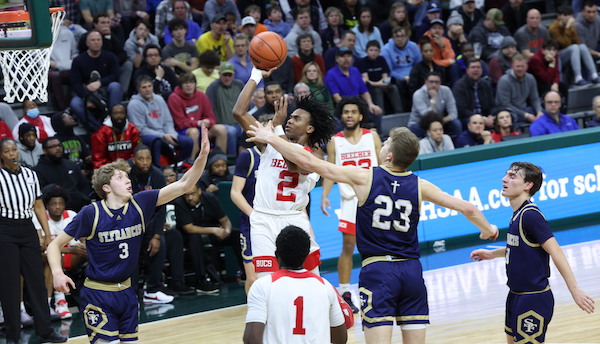
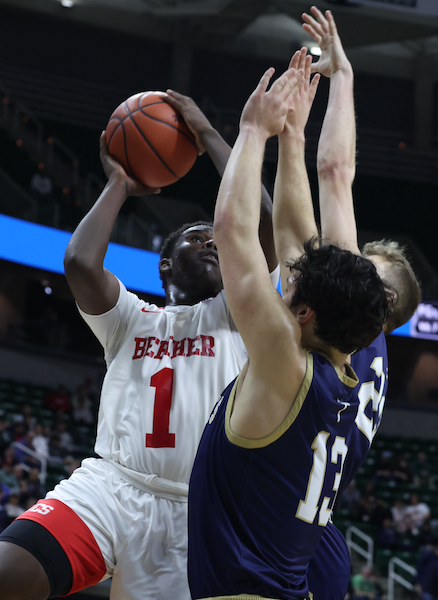
PHOTOS (Top) Flint Beecher celebrates its Division 3 championship Saturday at Breslin Center. (Middle) The Bucs’ Keyonta Menifield (2) finds his way to the basket with Drew Breimayer (3) and John Hagelstein (23) defending. (Below) Kevin Tiggs Jr. elevates for a shot as Hagelstein and Joey Donahue (13) look to block it.
GR Christian Ends 80-year Finals Wait
March 24, 2017
By Geoff Kimmerly
Second Half editor
EAST LANSING – Xavier Tillman stood taller, literally, than anyone else on the court during his team’s Class A Semifinal on Friday at the Breslin Center.
Figuratively as well, the Grand Rapids Christian senior has stood as tall as any of the giants who have dominated the floor in Michigan this season.
But if Christian wins its first MHSAA championship Saturday since 1938, just as much credit will belong to his supporting cast – even as he called himself not the star, but rather the distributor after they beat Romulus 74-52 to advance to the Final.
Five teammates scored more than Tillman on Friday. But that doesn’t mean the 6-foot-8 forward’s presence was negligible. He took only three shots, scored only five points, but also had eight rebounds, six assists and seven blocks and drew plenty of attention from Romulus to help Christian make its first championship game in 80 years.
“I have a team full of scorers,” Tillman said, “so my job is to facilitate on my team.”
“We’ve always said we have to get the ball in to Xavier and let him make a play, whether it’s for himself or his teammates, or at least draw attention,” Grand Rapids Christian coach Mark Warners added. “Xavier said it; you don’t know who is going to score, and with these guys what’s been great all year is they don’t care.”
Grand Rapids Christian (27-0), No. 1 in Class A at the end of the regular season, will face No. 3 Clarkston at noon Saturday for its first MHSAA title since winning the Lower Peninsula Class B championship in 1938 (from 1932-47, one champion was awarded from each peninsula in Classes B, C and D; in 1943 no statewide champions were awarded).
Romulus (21-5) last had been to Breslin much more recently, winning Class A in 2013. But although it gave a strong challenge into the third quarter this time, no one has stood in Christian’s way for the entirety this season.
Christian opened the third quarter on a 15-3 run over five minutes, as senior James Beck II had six of his game-high 24 points.
“He did keep us in it,” Warners said. “He gets the points where it’s off a rebound or putback, or he gets an and-one on the break and makes the free throw, or he gets the dump down from a guard or Xavier and can score around the rim in so many ways. It’s a really nice thing to have.”
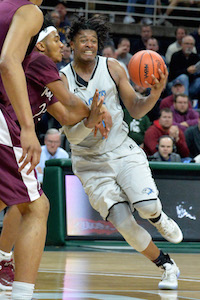 For the game, Beck connected on 11 of 17 shots from the field as Christian made 54 percent as a team.
Romulus hit only 35 percent of its shots from the floor and 31 percent from 3-point range, hindering a team that already had a tough time matching up with more sizable Christian.
“It’s kind’ve a shock. We’ve never gone 8 for 26 from the 3-point line,” Romulus coach Jerret Smith said. “We prided ourselves on hitting shots this year, and when you can’t hit shots it’s hard – especially when you have the kid who’s 6-8, 260 in the lane. It’s very hard to get him out of the lane if you’re not hitting shots.”
Junior guards Duane Washington, Jr., and Setrick Millner, Jr., added 15 and 11 points, respectively, and senior guard Thad Shymanski had 10 for Grand Rapids Christian. Washington also had six assists and senior guard Emmett Warners had five.
Junior Kaevon Merriweather had 18 points to lead Romulus, and senior forward Jaren English had 17 points and eight rebounds. Senior forward Dylan Price added 12 points and nine boards.
Three starters and the top-playing sub from Friday should be back for Romulus next season. Romulus entered the postseason an honorable mention in the Class A poll, but eliminated reigning champion Detroit U-D Jesuit in the Quarterfinal.
“The good thing about this is the foundation has been laid,” Smith said. “We hadn’t been here in four years, and that was a long time for us. I’m so proud of these seniors; all around, they put a lot of work in. … When you get tough losses, you’ve gotta except those too. Grand Rapids Christian was a better team today. We’re not going to make excuses. We’ll just come back and get in the gym, and hopefully next year will be our year.”
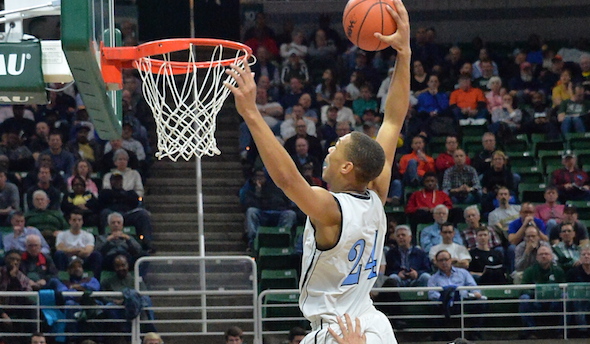
PHOTOS: (Top) Grand Rapids Christian’s Setrick Millner, Jr., goes in for a dunk during Friday’s Class A Semifinal win. (Middle) Christian’s Xavier Tillman works for position against a pair of Romulus defenders.