

Longtime Coach Researches Photos to Tell Story of Grand Rapids Sports' Past
By
Steve Vedder
Special for MHSAA.com
September 16, 2022
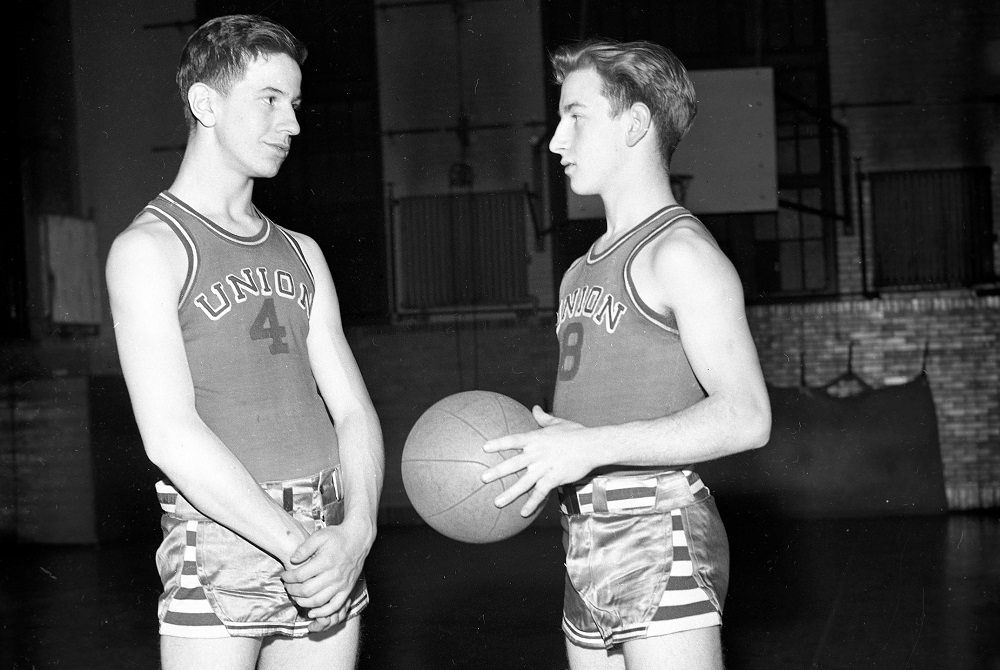
GRAND RAPIDS – Bob Schichtel always pauses when he comes across the ancient black and white photo long enough to ponder whatever became of the two youngsters adorned in Grand Rapids Union basketball uniforms.
The posed shot shows two players facing each other in a local gymnasium in a photo apparently taken four days after the Japanese surprise attack on Pearl Harbor in 1941 that launched the country into World War II. Only a handful of fans today would recognize the players' striped, ultra-short shots and simple sleeveless shirts with "Union" emblazed across the front as recognizable basketball uniforms. One holds a battered-looking basketball, while the other looks on. The two players, whose uniform numbers are "4" and "9," aren't really smiling, but still seem as close as any teammates, whether 81 years ago or today.
In fact, it's the look the youngsters share that intrigues Schichtel, whose thankless, pro bono job it is to identify the two players.
"Once you start," said Schichtel, a former longtime Grand Rapids basketball coach, "it's like looking down a deep rabbit hole."
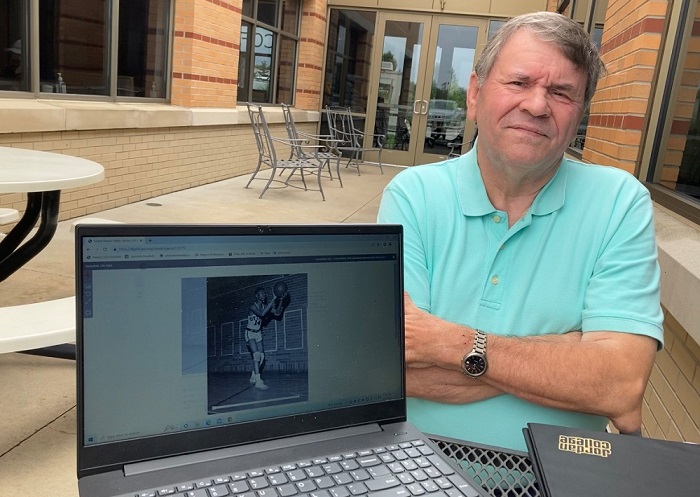 Schichtel works as a volunteer for the Grand Rapids Public Library trying to identify mostly former Grand Rapids City League basketball players from approximately 1938 through the early fifties. The online photos are mostly from the Robinson Photo Studio Collection taken in conjunction with the Grand Rapids Herald newspaper. The library says the unique collection spans some 950 basketball negatives from the entire Robinson/Herald collection that totals well over 900,000 Grand Rapids photos.
While the work – which amounts to a ton of patience combined with a detective ability – can be exhausting, it's still what Schichtel describes as a labor of love. For example, there's the shot of the two still-unidentified Union players. Schichtel looks at the photo and can't help but wonder whatever happened to the kids. Were they exceptional athletes? Did they leave their marks on Grand Rapids history, whether it was in education, politics, business, industry, the arts or another field? He doesn't even know, as in many photos from this era, whether the two entered the military and thus even survived World War II.
Schichtel has searched everywhere for the answers, but has come up short. Too many times, in fact.
Which isn't to say he'll quit looking or chalk up his research as inconsequential. Schichtel said the foremost reason he spends hours on the project is that many of the athletes he identifies deserve the recognition for achievements far beyond basketball. In many cases former City League basketball, football, baseball, track and tennis athletes became the foundation on which Grand Rapids was built. If Schichtel can uncover an old photo which depicts these youngsters during their high school careers, so much the better, he said.
"It's important to recognize Grand Rapids sports history, and I don't know if we've given enough attention to their past," Schichtel said. "They are what got us here, and I'm a firm believer they need to be recognized for it."
Figuring out that history, however, ranges from, at the least, extremely time consuming to – in too many frustrating cases – virtually impossible. The City League was formed in the late 1920s and featured original schools Grand Rapids Central, Creston, South, Union, Ottawa Hills, Catholic Central and Davis Tech. The league was eventually folded into the Ottawa-Kent Conference in 2008.
"It was a long, evolving league," Schichtel said.
 The identification tools available to Schichtel are actually more numerous than most would suspect. For starters, he's formed an impressive database of information by pouring through old City League yearbooks and programs, photos from other collections and microfilm of old newspapers, And then there's also the knowledge gathered by Schichtel himself, a 1968 Grand Rapids Catholic Central graduate. After playing in many old City League gymnasiums, Schichtel went on to compile a 389-197 record in 27 years as the Cougars girls basketball coach. He uses countless City League contacts as both a player and coach to identify athletes. In all, Schichtel taught in the Grand Rapids school system for 34 years.
He also uses the game itself to identify the photos. For instance, he can pinpoint some photos simply by the styles of the uniforms worn by players. He also figures out who is who by other clues such as what the players are doing in the photo. If a player is taking a set shot in the photo, it's likely pre-World War II. The beginnings of the jump shot, or what Schichtel calls "elevation while shooting," is probably mid-1940s. In addition, Schichtel can identify photos through pure basketball athleticism. Players can look a bit awkward in shots from the thirties as compared to players from the late 1940s who were beginning to play with a more obvious flare.
Put all the information together and Schichtel, who has uncovered more than two dozen personal connections to subjects in the photos, believes he has a reasonable shot at identifying them.
Since he signed on with the project, Schichtel figures he's identified about 10 percent of the photos he's viewed. Among the City League athletes he's found shots of Central's John Lavan, who was born in 1890 and played Major League Baseball during the Babe Ruth era and became a military hero who is buried in Arlington National Cemetery; Creston basketball player Roger Wilkins, an assistant United States attorney general during the Watergate hearings; Art Spoelstra of Godwin, a former NBA player and member of the Grand Rapids Hall of Fame; and Grand Rapids native Bill Cutler, who turned a chance post-World War II meeting with then-American League president Will Harridge into a position as commissioner of the Pacific Coast League,
Schichtel said gaining information through photos on the people who became the bedrock of Grand Rapids should be celebrated.
"I think it's a great approach for the community; they shouldn't be forgotten," Schichtel said. "Who else is going to do this? Why do I do it? I see a certain, for lack of a better word, a nobility. These kids played for the love of game, and they became the “Greatest Generation.” These kids did great things. It's not just, 'Well, there's No. 58,’ in a photo.
"You want to know more about them. That's the real intrigue for me."
 Tim Gloege of the Grand Rapids Public Library said the collection of photos – and their identification – is continually growing. As more people log onto the library's website, more people want to either add to the collection or have information that leads to an identification. The library estimates about 1,200 photos are searched monthly. But as time grows, many of the original photos are disintegrating. The library is in a constant state of preservation, Gloege said.
"It's a massive project, and we're working to get as many photos online as possible," he said. "The numbers (of photos) we have are rising pretty significantly as people post them on social media.
"When you think of the past and now, you need to realize these are people, kids who used to play basketball and did other things. The work is hard and very time-intensive, but it brings a whole new dimension to history."
Schichtel said he's "kind of picked the low-hanging fruit" on many of the easy photos to identify. But the work will continue.
"Yes, it can be frustrating," he said. "There are limitations if you want it to be accurate. Sometimes you look at a photo and you know it's not going to happen, and you move on. But this a chance to learn about people who made Grand Rapids what it is. That's important to me."
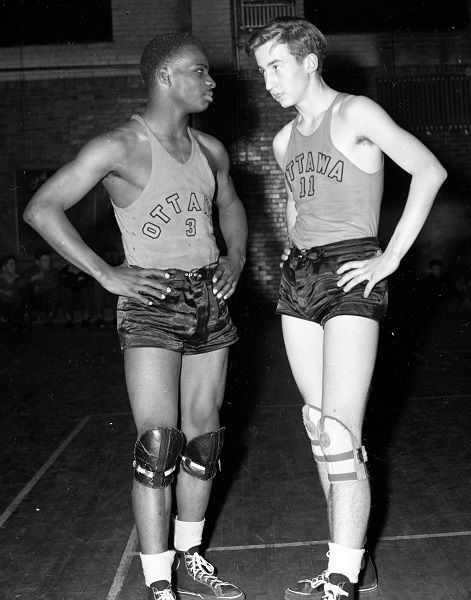
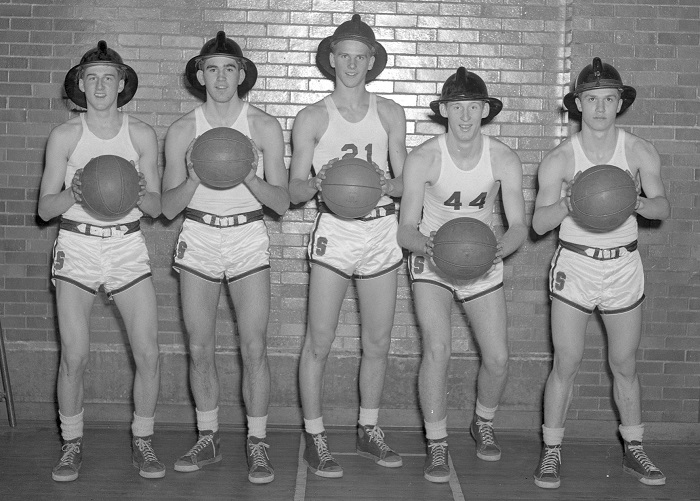
PHOTOS (Top) Two Grand Rapids Union basketball players stand for a photo taken Dec. 12, 1941. (2) Longtime area coach Bob Schichtel researches hundreds of photos that are part of the Grand Rapids Public Library archive. (3) Schichtel has identified these 1941 Grand Rapids Ottawa Hills basketball players as James Horn (left) and Chuch Reynier. (4) Schichtel identified Grand Rapids South High’s “Fireman Five” of, from left, Fred Esslair, Lee Morrow, Jack Carroll, Bob Youngberg and Bruce Bigford. (Historic photos courtesy of the Grand Rapids Public Library.)

Work Ethic Continues to Drive Van Dyk's Endeavors as Co-Owner of Family Farm
By
Paul Costanzo
Special for MHSAA.com
August 4, 2026
Matt Van Dyk’s work ethic was always easy to spot, even for those not spending every day at Imlay City’s basketball practices.
 “The only way he could get out of work in the summer was for church or basketball, nothing else,” Imlay City boys basketball coach Don Gauthier said. “We would have summer league games in Flint or wherever we were playing, and he would show up five minutes before tip off, covered in mud, dirt, or whatever he was doing on the farm, and with no excuses, would come out there and play as hard as anybody. That work ethic, it was contagious to everybody else.”
That work ethic was born in the fields at Van Dyk Farms, grew through his time on the court for Imlay City and eventually Michigan State, and continues to serve him in his role as part owner of that same family farm, which serves as one of the largest produce suppliers in the eastern United States.
“I’ve had some phenomenal coaches in my life,” Van Dyk said. “My high school coach was Don Gauthier, and he really instilled work ethic into us. I think his favorite quote was, ‘Hard work beats talent when talent doesn’t work hard.’ When I think about high school, just that work ethic of working hard every day really helped with being at the college level, but also with farming. And, really, I’ve been blessed to have role models that have all echoed that same mentality. My high school coach, my junior college (St. Clair County Community College) coach Dale Vos, and at Michigan State with coach (Tom) Izzo, plus my father, Doug Van Dyk.”
Matt Van Dyk, a 2012 Imlay City graduate, returned home to the 1,000-acre family vegetable farm after graduating with his agri-business degree from MSU in 2017.
While he’s officially one of the owners, he said his unofficial title is field operations, as he oversees planting, growing and harvest operations.
“I’m the person they call when something’s broken down, or they need to know what field to go into next,” he said.
Van Dyk has immersed himself in the Imlay City community since his return, joining the township board for a while, as well as his church council. He’s also giving back as an athlete, helping with the basketball program. His wife, Rachel, who played volleyball at MSU, was the varsity girls volleyball coach at Imlay City for three seasons and still works with clubs in the area.
“The Bible says that to who much is given, much is expected, and I’ve been given a lot, more so than I deserve,” he said. “The opportunity to play at Michigan State, not many people get that opportunity. For me, to be able to use that and give back is what we’re called to do. With the farm, too. I have the opportunity to work on a family business, and some people will say that you’re starting on second base – well there’s a lot that’s expected from me with this opportunity that I’m given. That is where my true worth comes from; it doesn’t come from personal success, it comes from what our team here at Van Dyk farms can accomplish.”
While Van Dyk describes his time at MSU as an opportunity he was given, the reality is it was one he fought long and hard to earn.
After becoming an all-state selection in Class B and Blue Water Area Conference MVP at Imlay City, he originally went to Hope College after high school but transferred to SC4 following one semester.
During his lone year there, he was named the Michigan Community College Athletic Association Eastern Conference Freshman of the Year, First-Team All-MCCAA and National Junior College Athletic Association Region XII All-Defense.
That earned him scholarship offers from in-state Division II programs, but he chose instead to walk-on at MSU and follow his dream of playing for the Spartans. At worst, he thought, he would graduate with a top-notch degree in the field he wanted.
Of course, he ended up with much more than that. After two years as a walk-on, Van Dyk earned a scholarship for his final season at MSU. He wound up playing in 53 games during his career, starting four during the 2016-17 season.
“I guess while you’re in it, it’s just work,” he said. “You put your head down, take it one day at a time. Looking back and seeing how there are no days off in life, you’re like, ‘OK, maybe that was pretty awesome what I did.’ I got to go to Italy, got to go to Madison Square Garden, got to play at Duke, got to travel the world.”
He also went viral.
While work ethic was what pushed Van Dyk to reach his dreams, he was also a remarkable athlete, possessing one of the best vertical leaps on the roster. That came out in a game against Ohio State his junior season, during which he threw down a massive dunk off an alley-oop. The play made the ESPN SportsCenter Top 10.
“That’s not my style of play at all,” Van Dyk said with a laugh. “Dunking, that’s what got me on the team, was my athleticism. But being flashy, that’s not my thing. It’s a funny way to work things out, and I’m forever indebted to Alvin Ellis for throwing it off the backboard.”
Now, as Van Dyk is back in Imlay City with his wife and two young daughters with another on the way in November, he’s putting his head down to better his family’s business and the community at large. All while continuing to set the right example for the next potential athlete willing to work for what he earned.
“They see him, and he played at Michigan State, and there’s his picture on the wall,” Gauthier said. “Most young kids have big dreams, and they have a guy right there in their hometown that did it. They look up to that. For the athlete and basketball player he is, he’s just a better person. He’s very humble, he doesn’t act big time toward anybody. That’s even more impressive.”
2026 Made In Michigan
July 24: Hackett Mentor's Care Sparked Lifetime in Hoops for BCAM President White - Report
July 24: Mackey Leaving Court with 500+ College Hoops Wins, Many More Lessons Shared - Report
July 16: Country Day Two-Time Champ Moore Building Perennial Winner at Harvard - Report
July 9: Multi-Sport Career at TC West Helps Gillis Thrive as Pro in Game She Once Left Behind - Report
July 2: Inspired by Home, Eager to Give Back, Spencer Hosts Hoop City Alumni Games - Report
PHOTOS (Top) At left, Matt Van Dyk puts up a jumper for Imlay City. At right, Van Dyk and his daughters enjoy a moment in one of his family’s fields. (Photos provided by Matt Van Dyk.)