

MCC's Glover Fills Key Role as Athletic Trainer for Super Bowl Champions
By
Tom Kendra
Special for MHSAA.com
August 6, 2024
David Glover never had the glamour role – and didn’t even play the glamour sport – during his high school days at Muskegon Catholic Central.
 MCC is known statewide as a football powerhouse that ranks third in state history with 12 MHSAA Finals championships during the playoff era. But basketball was Glover’s sport of choice, and his specialty didn’t show up in the box score.
“I was the defensive stopper,” explained Glover, who graduated from MCC in 1996. “I was always the guy that Coach (Greg) Earnest would put on the other team’s best scorer. I took a lot of pride in that.”
Glover continues to be the ultimate team player, only now his role is the first assistant athletic trainer for the Kansas City Chiefs, who are aiming to three-peat this season as Super Bowl champions.
“As the team and the goals have grown, so have I,” said Glover, who has been on the Chiefs’ training staff for the past 18 years. “The job is the same, which is getting the players onto the field and back onto the field after injuries so that they can perform at their highest level. I have become more comfortable and experienced in that role.”
Glover broke into the NFL as an athletic training intern with the New York Jets in 2004. He came to Kansas City in 2006 when Jets head coach Herman Edwards took the KC job, bringing Glover and several other members of the training staff with him.
Glover quickly fell in love with the Chiefs’ famous family-first culture, along with the area’s world-famous barbecues. He also met his future wife, Jera.
He is known as a tireless worker and student of his craft, which has allowed him to steadily move up to his current position as first assistant athletic trainer on the Chiefs’ five-member training staff, second only to Rick Burkholder, the vice president of sports medicine and performance.
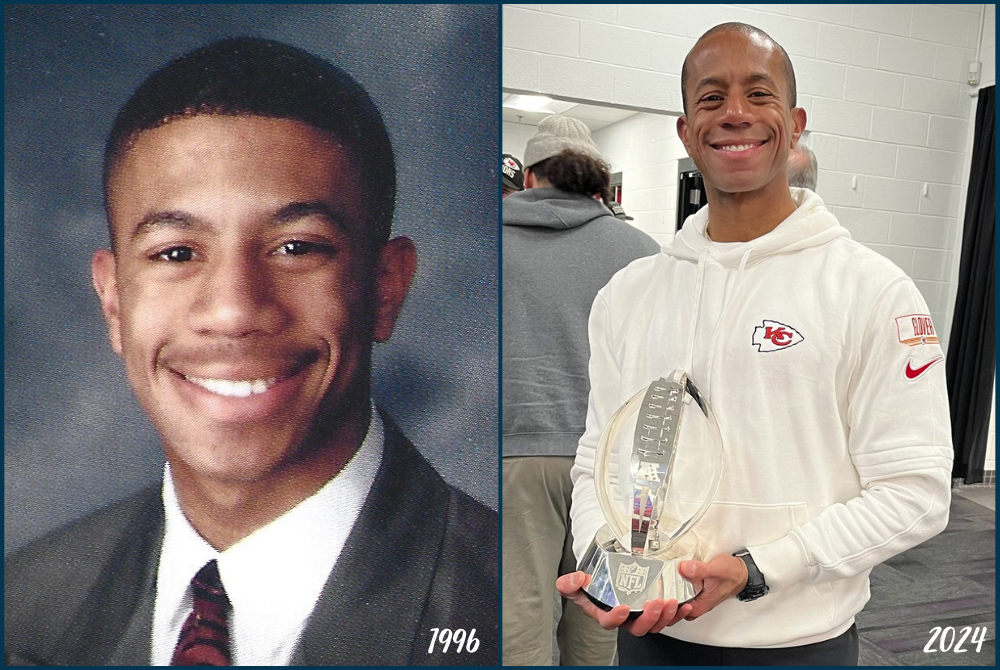
Glover’s skills also have caught the attention of his colleagues across the NFL, who awarded him the 2022 Tim Davey AFC Assistant Athletic Trainer of the Year Award – given annually to someone who represents an unyielding commitment, dedication and integrity in the profession of athletic training.
Glover said a big reason for his success in his profession can be traced back to high school.
 “Playing sports at MCC, especially for a smaller school, gave me such a sense of camaraderie, teamwork and a family outside of my normal family,” said Glover, the son of David and Lyndah Glover. “Those teammates energized me to be my best.
“There’s no doubt that some of the lessons that I learned playing sports in high school help me out in my job.”
Glover also ran track for the Crusaders – competing in the long jump, 200 meters, 400 meters and various relays – and said he enjoyed himself, even though he ran track initially as a way to stay in shape for basketball.
The highlight of his MCC basketball career came his senior year, when the underdog Crusaders captured a Class C District championship.
Growing up in Muskegon and close to Lake Michigan, Glover thought he would become a marine biologist someday – that is, until he suffered an injury during his senior basketball season.
Glover went up for a block and actually pinned the opponent’s shot against the backboard. However, the shooter inadvertently took his legs out on the play, causing him to crash violently to the court and lose feeling in his right leg for about 10 seconds.
The injury to his hip flexor put him on crutches for two weeks and off the court total for about a month, which he said “felt like the end of the world” at the time.
But the injury led him into rehab with Brian Hanks, a 1988 MCC graduate who was back working at his alma mater as an athletic trainer through Mercy Hospital.
Glover and Hanks turned out to be a perfect match. Glover was naturally curious about the entire process and wanted to know the “why” of his rebab program. Hanks recognized Glover’s interest in how the human body works and encouraged him to consider studying athletic training in college.
“God works in mysterious ways,” said Glover. “I was devastated when I got injured, but that experience opened my eyes to a whole new career. I wanted to learn everything I could about the human body and how it works.
“Looking back, the injury was a blessing in disguise. I wouldn’t change anything at all.”
Glover followed in Hanks’ footsteps and attended Central Michigan University, spending countless hours in the training room working with athletes in every sport – from football to track to gymnastics – graduating with a degree in health fitness and exercise science.
He said a huge inspiration in his career was CMU professor Dr. Rene Shingles, who in 2018 became the first African-American woman to be inducted into the National Athletic Trainers Association Hall of Fame. Shingles encouraged Glover to continue his studies at Seton Hall University in New Jersey, where he earned his master’s of science in athletic training.
He got his break into the NFL with his internship with the Jets, and his work ethic has kept him there for the past 20 years.
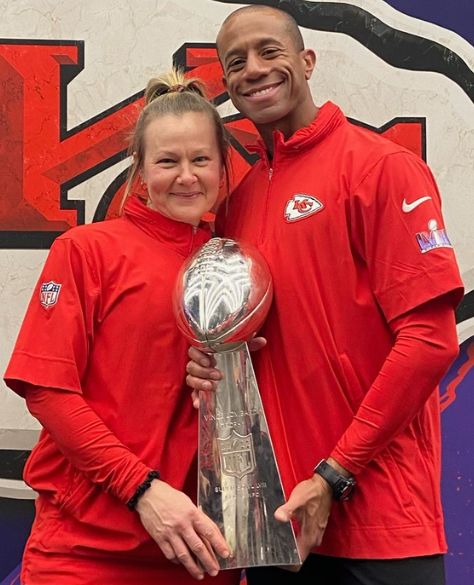 “If there are high school kids out there reading this, I guess I would tell them that there are a lot of different avenues to get to the NFL or the NBA,” Glover said. “I’m a perfect example. I didn’t even play high school football, but through athletic training I have been part of three Super Bowls.”
The Chiefs, who won their first Super Bowl way back in 1970, would have to wait 50 years (until 2020) to win their next one. But Kansas City now has won three Super Bowls in five years, adding titles in 2023 and 2024.
“To have these kind of experiences, and to be able to share so much of it with my family, is really a dream come true,” said Glover, 45, who said his ultimate goal is to become the head athletic trainer for an NFL team.
“I am always open to see what opportunities God has for me and what doors he opens.”
More immediately, with the start of training camp last month, Glover is back to his seven-day-a-week schedule, sharing the organization’s goal of making it to the Super Bowl for the third consecutive season.
Glover has worked with all of the Chiefs star players at some point, including star quarterback Patrick Mahomes, who he calls “a great, humble man.”
But perhaps the player he has worked with most is standout tight end Travis Kelce.
Kelce, who has become a huge name outside of football as the boyfriend of pop sensation Taylor Swift, injured his knee during his rookie preseason in 2013, sidelining him for the entire year. Glover was assigned to Kelce for his rehab.
With Glover’s daily help, Kelce was able to get back on the field the following year and emerged as a star, earning him the 2014 NFL Ed Block Courage Award as a model of inspiration, sportsmanship and courage.
After winning the award, Kelce invited Glover (he calls him “DG”) and his wife to attend the award ceremony with him in Baltimore.
“That was a huge honor for me, and I was blown away,” said Glover. “I look at it that I was just doing my job. He entrusted and believed in me throughout the process, and it worked out great.”
2024 Made In Michigan
August 1: Lessons from Multi-Sport Experience Guide Person in Leading New Team - Read
July 30: After Successful 'Sequel,' Suttons Bay's Hursey Embarking on Next Chapter - Read
July 24: East Kentwood Run Part of Memorable Start on Knuble's Way to NHL, Olympics - Read
July 22: Monroe High Memories Remain Rich for Michigan's 1987 Mr. Baseball - Read
July 17: Record-Setting Viney Gained Lifelong Confidence at Marine City - Read
July 11: High School 'Hoop Squad' Close to Heart as Hughes Continues Coaching Climb - Read
July 10: Nightingale Embarking on 1st Season as College Football Head Coach - Read
June 28: E-TC's Witt Bulldozing Path from Small Town to Football's Biggest Stage - Read
PHOTOS (Top) At left, David Glover as a senor during the 1995-96 school year at Muskegon Catholic Central, and at right Glover shows the AFC Championship trophy after Kansas City's 17-10 win at Baltimore on Jan. 28. (Middle) Glover, left, hugs teammate Doug Dozier after a victory over rival Muskegon Mona Shores in 1995-1996 basketball season opener. MCC finished 17-7 and a District champion. (Below) Glover poses with this year's Super Bowl Championship trophy alongside fellow Chiefs athletic trainer Julie Frymyer. (Trophy photos courtesy of David Glover; 1996 photos courtesy of the MCC yearbook.)
Breslin Bound: Boys A-B Semis Preview
March 20, 2013
By Geoff Kimmerly
Second Half editor
Some semi-ancient history is at risk of being updated during the Class A and B Finals this weekend at Michigan State University's Breslin Center.
Detroit Southeastern is seeking is first title since 1926 and Grand Rapids Christian since 1938. Wyoming Godwin Heights will play for its first championship game berth since 1960, but also as one of three Class B Semifinalists looking to win it all for the first time.
Standing in the way? In Class A, it's reigning champion Saginaw and heavy favorite Romulus. In Class B, one of the state's most successful programs ever, Detroit Country Day.
Below is the schedule for all four Friday Semifinals and Saturday Finals, plus broadcast information and a look at all eight A and B Semifinalists.
Semifinals - Friiday
Class A
Romulus (25-1) vs Grand Rapids Christian (20-6), 1 p.m.
Detroit Southeastern (20-5) vs Saginaw (23-3), 2:50 p.m.
Class B
Cadillac (21-4) vs Detroit Country Day (23-3), 6 p.m.
Detroit Community (17-9) vs Wyoming Godwin Heights (23-2), 7:50 p.m.
Finals - Saturday
Class A - Noon
Class B - 6:30 pm
Class C - 4:30 pm
Class D - 10 am
Tickets cost $8 per pair of Semifinals and $10 per two-game Finals session. All Semifinals will be streamed live on MHSAA.tv and available on a pay-per-view basis for $3.95 per day or $6.95 for the weekend. Saturday's first three Finals will be broadcast live on Fox Sports Detroit, with the Class B game on Fox Sports Plus and then re-broadcast on Fox Sports Detroit at 10:30 p.m.. Free radio broadcasts of all weekend games will be available on MHSAANetwork.com.
And now, a look at the Semifinalists in Class A and B.
Class A
DETROIT SOUTHEASTERN
Record/rank: 20-5, honorable mention
League finish: Second in Detroit Public School League East
Coach: George Ward, fourth season (82-15)
Championship history: Two MHSAA titles (most recently 1926), one runner-up finish.
Best wins: 54-49 (OT) over honorable mention Macomb L’Anse Creuse North (Regional Final), 54-49 over Rochester (Quarterfinal), 71-52 over Class B No. 4 Harper Woods Chandler Park, 48-44 over Class B No. 10 Detroit Douglass.
Players to watch: Jovone Haynes, 6-0 sr. G; Kenyatta Singleton, 6-0 sr. G. (Statistics not submitted.)
Outlook: Although Southeastern’s championships came in 1925 and 1926, they finished Class A runner-up only two seasons ago and with Singleton a prominent player off the bench. That Southeastern was likely the third-best Detroit PSL team during the regular season speaks to the league’s strength again this winter, and the Jungaleers lost to reigning Class A champion Saginaw and No. 8 Detroit Cass Tech by one point apiece and Ann Arbor Pioneer and River Rouge by only two each.
GRAND RAPIDS CHRISTIAN
Record/rank: 20-6, honorable mention
League finish: First in O-K White
Coach: Steve Majerle, first season (20-6)
Championship history: Lower Peninsula Class B champion 1938, one runner-up finish.
Best wins: 72-69 over No. 9 East Kentwood (District Semifinal), 64-61 over honorable mention Lansing Waverly (Regional Semifinal), 78-70 over honorable mention Holt (Regional Final), 64-61 over Muskegon, 70-59 over Class B No. 6 Wyoming Godwin Heights.
Players to watch: Drake Harris, 6-4 jr. G; Wuoi Mach, 6-4 sr. C. (Statistics not submitted.)
Outlook: Grand Rapids Christian has been surging with 10 straight wins and avenged a previous 24-point loss by beating Muskegon in the Quarterfinal. Harris is the catalyst and will try to add a basketball championship to the football title in which he played a large role at the end of November. Majerle previously coached Rockford to the 2003 Class A championship.
ROMULUS
Record/rank: 25-1, No. 2
League finish: First in Western Wayne Athletic Conference Blue
Coach: Nate Oats, 11th season (220-52)
Championship history: Class A champion 1986, one runner-up finish.
Best wins: 93-91 over No. 1 Detroit Pershing (Quarterfinal), 82-71 over No. 4 Saginaw Arthur Hill, 93-63 over No. 6 Saginaw, 75-65 over Class B No. 1 Detroit Country Day.
Players to watch: E.C. Matthews, 6-4 sr. G (16.2 ppg, 6.0 rpg); Leonardo Edwards, 6-8 sr. C (11 ppg, 7.0 rpg, 2.1 bpg), Wes Clark, 6-0 sr. G (11.8 ppg, 5.7 apg).
Outlook: Throw in wins over Lansing Sexton, Detroit Community, Detroit Douglass, Detroit Consortium, Chicago Seton and Indianapolis Cathedral, and no team in Michigan has defeated as impressive a slate. The Eagles’ lone loss was to Pershing by six in their second game this season, and Romulus avenged that Tuesday. Senior forward Jalon Plummer (11.2 ppg, 47 3-pointers) also adds double-digit scoring. Matthews has signed with Rhode Island, Clark with Missouri and Edwards with Louisiana Tech.
SAGINAW
Record/rank: 23-3, No. 6
League finish: Second in Saginaw Valley Association North
Coach: Julian Taylor, second season (48-5)
Championship history: Six MHSAA titles (most recently 2012), four runner-up finishes.
Best wins: 75-64 and 86-76 (District Final) over No. 4 Saginaw Arthur Hill, 57-56 over honorable mention Detroit Southeastern, 86-61 over Class B No. 4 Harper Woods Chandler Park.
Players to watch: Julian Henderson, 6-2 sr. G; Keyon Addison, 6-1 jr. G. (Statistics not submitted.)
Outlook: The Trojans have won three of the last six Class A championships, and Henderson was the second-leading scorer in last season’s title game win over Rockford. Saginaw already avenged its early loss to Arthur Hill, and no doubt would like to face Romulus again after falling to the Eagles in the regular-season finale.
Class B
CADILLAC
Record/rank: 21-4, unranked
League finish: Tied for first in Big North Conference
Coach: Jeff McDonald, 19th season (303-124)
Championship history: Has not played in an MHSAA Final.
Best wins: 41-29 over No. 8 Big Rapids (Semifinal), 47-46 over Petoskey, 56-53 over Traverse City West.
Players to watch: Nick Paquet, 5-9 sr. G (15 ppg, 45 3-pointers); Jalen Brooks, 6-4 jr. F (12.9 ppg, 5.5 rpg).
Outlook: Cadillac is 63-11 over the last three seasons with Regional championships to cap off each. The Vikings also won a share of their league title this season by avenging early losses against other sharers Petoskey and Traverse City West. They have good size, with five players 6-4 or taller, and plenty of balance; four more join Paquet and Brooks to average between four and seven points per game.
DETROIT COMMUNITY
Record/rank: 17-9, unranked
League finish: Second in Michigan Metro Athletic Conference
Coach: Venias Jordan, Jr., first season (17-9)
Championship history: Has not played in an MHSAA Final.
Best wins: 50-47 over honorable mention Jackson Lumen Christi (Quarterfinal), 61-48 over Class C No. 8 Melvindale Academy for Business & Technology,
Player to watch: Byron Zeigler, 6-6 sr. F (statistics not submitted).
Outlook: Don’t be fooled by Community’s nine losses. Instead, consider some of the teams they came against: Class A top-10 teams Detroit Pershing (by two), Cass Tech and Romulus, honorable mention Detroit Southeastern, ranked Class C Detroit Consortium and reigning Class D champion Southfield Christian, among others. Zeigler has signed with South Florida.
DETROIT COUNTRY DAY
Record/rank: 23-3, No. 1
League finish: Does not play in a league.
Coach: Kurt Keener, 35th season (676-180)
Championship history: Eight MHSAA titles (most recently 2010), one runner-up finish.
Best wins: 75-57 over No. 4 Harper Woods Chandler Park (Regional Semifinal), 73-51 over No. 10 Detroit Douglass (Regional Final), 68-48 over Class A honorable mention Macomb L’Anse Creuse North, 86-61 over Class A No. 4 Saginaw Arthur Hill.
Players to watch: Edmond Sumner, 6-3 jr. G (16.1 ppg, 6.2 apg); Austin Price, 6-3 sr. G (12.4 ppg, 4.2 rpg, 63 3-pointers, 3.2 spg); Mory Diane, 6-2 sr. G (12.1 ppg).
Outlook: A few fun Country Day facts: The last time the Yellowjackets didn’t make it to Breslin was 2009; the last time they finished a season with fewer than 20 wins was 2004. Country Day starts out small (relatively speaking; no player is shorter than 5-11) but can get big with future Texas Tech offensive lineman Poet Thomas (6-7, 285 pounds) off the bench. Price has signed with Lehigh and makes nearly 40 percent of his 3-point shots.
WYOMING GODWIN HEIGHTS
Record/rank: 23-2, No. 6
League finish: First in O-K Silver
Coach: Chad Conklin, sixth season (98-39)
Championship history: Two runner-up finishes (most recently 1960).
Best wins: 79-72 over No. 7 Comstock Park (Regional Semifinal), 56-52 over No. 2 Stevensville Lakeshore (Quarterfinal), 60-58 over Class D No. 1 Wyoming Tri-unity Christian
Players to watch: Jamal Bland, 5-10 sr. G (14.9 ppg, 3.2 apg); Quantrell Hastings, 6-1 sr. F (15.9 ppg, 7.3 rpg).
Outlook: One more win and Godwin Heights will have improved on or tied the previous season’s win total in all six of Conklin’s winters running the program. Senior guard Braima Hai (10.9 ppg, 5.2 apg) runs the show, and sophomore guard Delaney Blaylock (11.2 ppg) also scores in double figures.
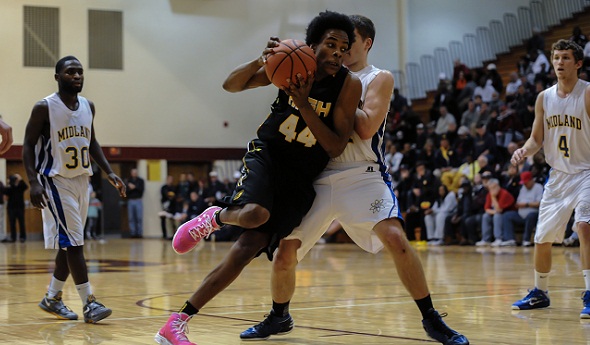
PHOTO: Saginaw junior Joseph Williams-Powell (44) drives against a Midland defender during the Trojans' Regional Semifinal win last week. (Click to see more at HighSchoolSportsScene.com.)