


MHSA(Q&A): Flint Beecher boys basketball coach Mike Williams
March 30, 2012
 Mike Williams had brought Flint Beecher to the MHSAA Semifinals at Michigan State's Breslin Center at the end of both the 2008-09 and 2009-10 seasons, and also coached the team that made the Class C Final in 2008. All three times the Buccaneers had to settle with great runs, but losses to end them.
But not Saturday.
Beecher and Williams capped one of the best season's in MHSAA history, becoming the 12th team to finish with 28 wins and claiming the Class C championship. Beecher finished with a perfect record, and the championship was the Bucs' first since claiming the Class B title in 1987.
Williams graduated from Grand Blanc High in 1994 before then getting degrees at Ferris State and Eastern Michigan University. He's led Beecher to a 138-61 record over the last eight seasons, and had some powerful things to say after Saturday's win, both about the Bucs' legacy but also about what the win could mean to the entire Flint community.
"I’m just overwhelmed with excitement. Very humbled by this entire process, by this entire season, by the way our kids performed. Just fortunate to be a part of this. We put in a lot of work to get here. It feels unbelievable. I really can’t describe it with words.
"I know we did everything the right way. And we worked from the ground up"
This is the third time in school history (Beecher) finished with an undefeated season. You yopped the last two teams by one game. How does it feel for you guys to do this?
"It’s incredible. The only thing that I can say is we’ve got the full support of all the Beecher alumni, all the supporters that came out. … Everybody was pulling for us to do this. Like I said, it’s humbling to be considered and to be known right up there with all those great teams that have played in the past at Beecher. And to add to the legacy of Beecher, that’s the main thing.
With all things you guys have been through up to this point, not even just basketball, but off the court, on the court, talk about the feeling you guys have to be able to finish it on top and be able to celebrate a victory.
"I think with the things that our kids have gone through and the things our community has gone through, for me this is more than about basketball. This is about these kids' lives. I feel like I’m their father. The toughest part is that this is over. I won’t get to coach Antuan (Burks) anymore. I won’t get to coach Montana (Gooch) anymore. These are like my sons. I put more into their lives than into basketball. We revert everything back to their lives.
"Because you’re looking at some kids that overcome some things that you can never imagine. For them to make it here and accomplish this, it's setting a standard for all the kids in our city that we don’t have to act up. We can achieve. We can be successful. Because too many bad things are going on in our city, and I want these kids to be representatives of our city, of their generation turning around and being positive. And that’s been the biggest thing. It’s been about their lives. For them to accomplish this, it doesn’t even compare to the things they’ve overcome in their lives.
"So we just want to bring it back home and show everybody we can be successful. We don’t have to be in the streets. We don’t have to do things that are getting written about in paper that Flint is known for. Let’s get back to being successful. And our community and the whole Flint area, everybody supported us. Not just Beecher. That’s what I’m more proud of -- that we get to bring some positive attention to our area."
Baseball Pro Windham Winters at Monroe St. Mary as Dad's Assistant Coach
By
Doug Donnelly
Special for MHSAA.com
December 15, 2022
When Bryce Windham was about 6 years old, he was the ball boy for the Monroe St. Mary Catholic Central basketball team.
 At halftime, rather than go inside the locker room, Bryce would stay on the court and shoot 3-pointers.
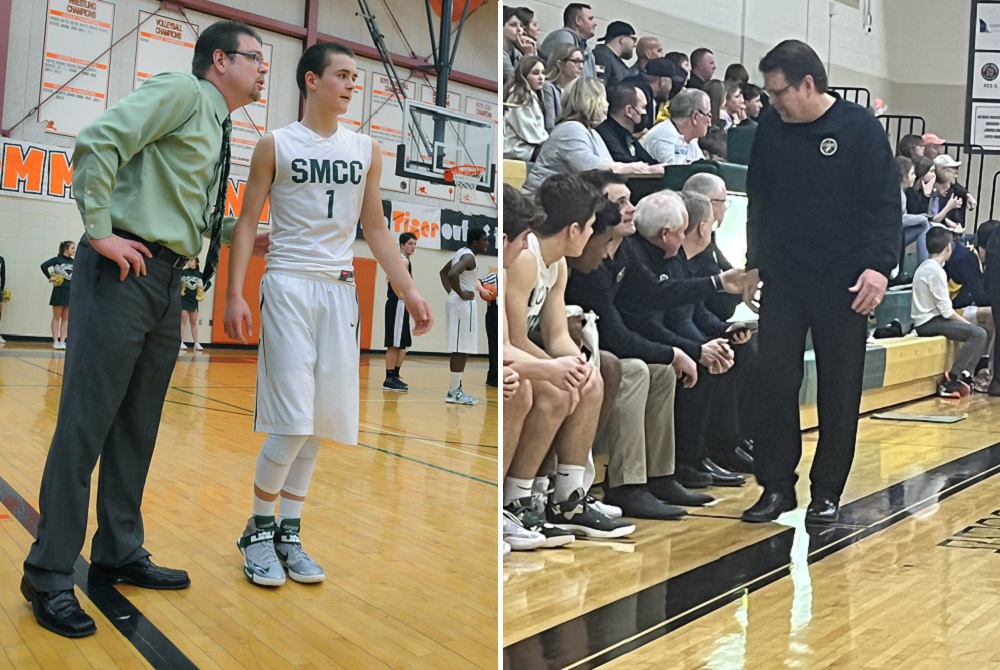
“He was the halftime entertainment,” SMCC head boys basketball coach Randy Windham said. “I’d hear some big cheers, and I’d open the door and look out and just shake my head. Bryce would be out there shooting 3s.”
Bryce is now 26 and a minor league baseball player in the Chicago Cubs organization. Being a professional baseball player hasn’t changed who he is or where he is. Only now, Bryce goes into the locker room because he’s an assistant coach for his dad’s SMCC Falcons.
“He’s ready right now,” Randy Windham said. “He could be head coach right now. I tell him, ‘Once you are done messing around with the baseball thing, you can coach this team.’”
Bryce had a dream high school sports career at SMCC.
He was the Falcons’ starting shortstop, point guard on the basketball team, and was quarterback for the football team. He was all-state in all three sports. He quarterbacked SMCC to the 2014 Division 6 championship in football. The Falcons boys basketball team – coached by his dad – reached the 2015 Class C Quarterfinals. He was MVP of the 2015 all-star baseball game at Comerica Park.
“He’s always been a thinker, no matter what sport he’s been in,” Randy Windham said. “He’s always analyzed the game. That helps. He’s so humble. That’s the best thing about him.”
Bryce could have played basketball at the University of Toledo, but took a different turn when Old Dominion University offered him a baseball scholarship.
“I was nowhere’s near as good at baseball as I was at basketball,” he said. “I didn’t think I was very good. I wanted to see how good I could be at baseball.”
The lure of Virginia Beach, Va., helped push him to baseball, too. It was a couple of years into baseball on the east coast that he picked up catching. After graduating, he ended up getting drafted by the Cubs and is now at the Double A level.
Bryce reports back to the Cubs on Feb. 17. He expects to return to the Tennessee Smokies, where he played last season.
 “Double A is where the prospects are. Players are competitive, pushing hard,” he said. “I think they really want me to get some at-bats and get more miles catching on my body.”
For now, in Monroe, he works out daily to stay in shape, hits the batting cages to keep his swing sharp and works at the family business. He will leave for baseball just at the time SMCC begins final preparations for the District tournament, and he’s okay with that.
“By then, the teaching is done,” he said.
It’s no shocker that Bryce is coaching in his spare time. Not only is his dad an ultra-successful boys basketball coach at SMCC, but his mom Kim also has had great success coaching volleyball in Monroe County for years. As soon as Bryce’s high school career was finished, he started to coach.
“I started helping right after I graduated high school,” Bryce said. “In college, I’d come home, and I’d practice with the guys. That allowed me to stay in shape, and I kind of kept the relationship with guys. Once I officially graduated from college, I jumped right into coaching.”
“I always felt like a player-coach when I played,” Bryce continued. “I felt like I knew what was going on, even outside of myself.”
Coaching just came naturally.
“I knew that was something I wanted to do. It’s because of him,” he said, pointing to his dad. “He was my coach from fifth grade all the way up. I knew the game. I tell my pitching coach all the time that if my baseball IQ was as high as my basketball IQ, I’d be in the Major Leagues right now.”
Randy Windham is in his 14th season as the SMCC varsity coach. He took over for longtime coach Ray Lauwers and built on that success and brought the Falcons to new heights, with multiple deep runs in the postseason. He came into this winter with a record of 229-71. A lot of those wins came with Bryce on the court. Another victory during his tenure actually belongs to Bryce as coach.
Randy was ill last year and, for the first time in nearly three decades of coaching, he sat out a game. Bryce took the reins and led SMCC to a Huron League win at Milan.
“I was so nervous,” Bryce said. “I’m glad it was on the road. If it would have been at home with all the home fans, I would have been more nervous.”
Randy said he was comfortable with missing the game because he knew Bryce would be fine.
“I give him a lot of responsibility now,” Randy said. “He’s ready right now to be a head coach. He’s ready for that. Coaches must do more than Xs and Os. A coach must be able to handle problems before they happen. He’s ready for that. I can walk away from practice, and he can handle it.”
“He just knows the game so well. I know for a fact that I could step away, and the success would continue. He’s natural at it.”
Windham said having his son on the bench next to him provides a lot of comfort, and the players like having him there. Bryce rarely talks about being a professional baseball player, but that gets the attention and respect of the players right away.
“He’s helped me come back,” Randy said. “I’ve been around here 25 years (including his time as an assistant to Lauwers). He helps refresh me. In the fall, he comes back and jumps right into the skill work with the kids. That allows me to refresh and have the energy to coach this time of year. I love this time of year.”
For now, Bryce will continue to pursue professional baseball but knows coaching is in his future at some point.
“I’m still an athlete and a coach. Right now, I kind of have that bridge between the players and (my dad). I keep them out of trouble. I catch things before he catches it. I bring a lot of energy to practice every day. Basketball practice is so much fun,” Windham said.
He also has a different perspective now as an assistant coach, but one he relishes. As he said, again referring to his father, “I only know what I know because of him.”
 Doug Donnelly has served as a sports and news reporter and city editor over 25 years, writing for the Daily Chief-Union in Upper Sandusky, Ohio from 1992-1995, the Monroe Evening News from 1995-2012 and the Adrian Daily Telegram since 2013. He's also written a book on high school basketball in Monroe County and compiles record books for various schools in southeast Michigan. E-mail him at [email protected] with story ideas for Jackson, Washtenaw, Hillsdale, Lenawee and Monroe counties.
PHOTOS (Top) At left, coach Randy Windham and his son/point guard Bryce Windham confer during Monroe St. Mary’s Regional run in 2014. At right, Randy talks things over this season with Bryce, now his assistant coach. (Middle) Bryce Windham mans the plate this summer for the Tennessee Smokies, a Cubs affiliate. (Top photos by Tom Hawley and Doug Donnelly, respectively. Middle photo by Mike Krebs.)