


MHSA(Q&)A: Historian Ron Pesch
April 16, 2012
 When we receive a question on the history of MHSAA athletics that we can't answer on the spot, Muskegon's Ron Pesch is the first person we seek out for help.
Pesch took the reins as Michigan's chief high school sports historian during the mid 1990s after the retirement of legendary MHSAA record book originator Dick Kishpaugh and has contributed to various efforts and publications across the state.
One of his latest projects is the awarding of "retro" Mr. Basketball Awards. The first Hal Schram Mr. Basketball Award was given by the Basketball Coaches Association of Michigan in 1981 to Lansing Eastern's Sam Vincent. Three seasons ago, BCAM -- with research work by Pesch -- began awarding retro winners for the previous decades beginning with the 1920s. This winter, BCAM honored retro winners from 1922, 1932, 1942, 1952, 1962 and 1972.
Click to read more about those winners and the finalists recognized last month. Also, click for links to the previous retro winners. The retro Mr. Basketball project will last seven more seasons. Pesch explains more below.
How did you come up with rewarding a “Retro” Mr. Basketball?
The project came out of a conversation I had with (BCAM executive director) Tom Hursey at the basketball finals back in '99. Together, we hatched an approach honoring the state's past basketball greats. He let me run with it, while he worked on getting a subcommittee launched to make the selection.
How do you dig up all of this nomination info?
Between votes, I work on digging out the details. My initial target list always begins with all-state teams - if, of course they exist. All-tournament teams for the early years also serve as a starting point -- if they exist. Best I can tell, the Detroit Times, the Free Press and the News have all named all-state squads, at various points, back to about 1935. The Associated Press and UPI came to the game much later - somewhere around the early to mid 1960s. I then work on creating a crosstab on the players selected, noting the "teams" on which they were named (Class A 1st team, Dream Team, Class C 3rd team), and try to find quotes detailing their games. The result is really a reflection of the times and the history of newspaper reporting.
In early years, we can struggle to uncover a player’s first name, let alone his class in school. And statistical coverage of a player's abilities was very limited. It's simply the way things were back then. Everyone in town knew King Lewis, or Red Cherry, or Young Jacks. And the final box score only contained points, fouls, substitutions, as they were all you really needed to know about the game. But by visiting the state library in Lansing, and looking at a cross-section of newspapers, you can usually dig out what you need.
Do you collect from other sources as well?
Another source is high school yearbooks. Some resources have started to emerge online. I also tap into the MHSAA site and make contact with ADs around the state, asking for their assistance on digging out details - especially class in school. Like the current program, only "seniors" are considered for the award. Mid-year graduates can create a challenge, but the rule currently in place is a player is considered a nominee in the year in which he was last eligible for the state tournament. In other words, if you graduated in January or February of 1943, you would be considered for the 1942 ballot. It appears that a similar approach was used in selecting all-state teams.
|
Year |
Player |
High School |
Age |
Height |
Weight |
Year |
DFP |
DN |
DT |
AP |
UPI |
Tourney |
|
1971 A-1 G. |
Frank Tanana, Jr. (C) |
Detroit Catholic Central |
17 |
6-3 |
170 |
Sr. |
A1 |
A1 |
A1 |
A1 |
||
|
1971 A-1 C |
Tom McGill |
Flint Northern |
17 |
6-3 |
190 |
Sr. |
A1 |
DM |
A1 |
A1 |
||
|
1971 A-1 F. |
Lindsay Hairston |
Detroit Kettering |
17 |
6-9 |
203 |
Sr. |
A1 |
DM |
A1 |
A1 |
||
|
1971 A-1 F. |
Campy Russell |
Pontiac Central |
18 |
6-7 |
190 |
Sr. |
A1 |
DM |
A1 |
A1 |
That cross-tab table will help establish a list of nominees. A consensus first-team pick is an obvious candidate. When only a single all-state team is available, I'll do what I can to look up all-conference teams or all-area teams from around the state to see who else might be considered. While life after high school is not a considered when trying to pick a winner, a player who emerges as a star in college or in the pros may emerge as a candidate when you see his details in a local paper.
Bios are assembled from the newspaper reports, detailing as much as we can find on high school player's career. I'll tap into a variety of resources including old team histories when available. When needed, I'll toss out request to reporters, old and new, around the state. Local librarians and historians are another wonderful resource.
How does voting work?
Between sessions of the Boys Finals, the committee assembles to hash out a final ballot, and to make a selection. I don't vote, but I may guide the conversation and provide any additional details when needed, reminding members that we're focusing on their high school careers. The process is certainly imperfect. But the committee approach prevents the process from becoming a popularity contest. These guys have the benefit of watching many of the players play. And, like the current Mr. Basketball program, they sometimes surprise. But that's what makes it fun. And, of course, stirs the pot. It gets people talking about the history of basketball in this state.
Is there a theme to MHSAA basketball that has remained constant over the years?
For me the greatest thing about the basketball tournament is that it assembles a wide range of folks who want to see players they've heard about in action. And the process, for the most part, hasn't change since the 1920s. While the style of the game has changed, winning a title is much the same as it was back when our great-grandfathers played: You gotta get through the tournament. And only four trophies are awarded.
These guys were the "Magic" of their day. I'm hoping we never forget that.
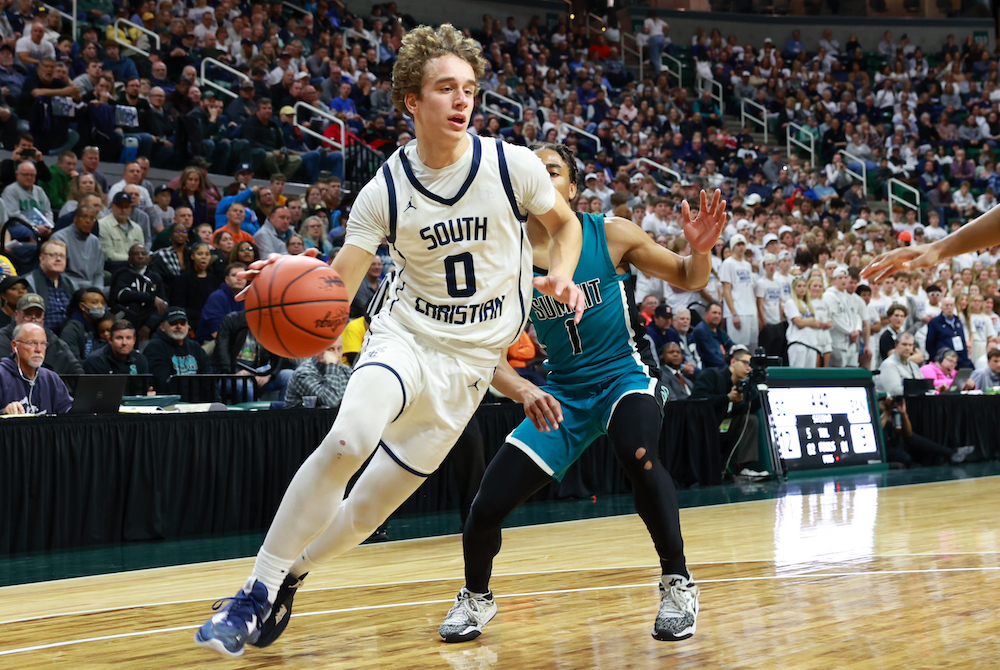
South Christian Sails Into Latest Challenge, Earns Saturday Return
By
Dean Holzwarth
Special for MHSAA.com
March 24, 2023
EAST LANSING – The Grand Rapids South Christian boys basketball team faced adversity when it lost standout sophomore Carson Vis to season-ending injuries in last week’s Regional Final.
The Sailors faced a different kind of adversity Friday in a Division 2 Semifinal, as they were tested for the first time since late January.
South Christian responded, and showed a steely resolve that put the team one step closer to a championship following a 40-35 overtime win over Romulus Summit Academy North at Breslin Center.
The Sailors will play Ferndale in Saturday’s Division 2 Final.
“We talk about adversity all the time, and we’re missing our 20 points a game star player, and so we’ve had some throughout the season,” South Christian coach Taylor Johnson said. “It builds character.”
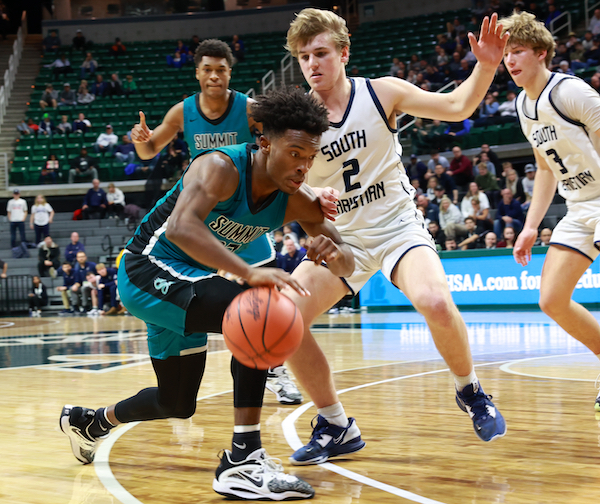
South Christian had won 15 games in a row entering Friday, all by double digits. Summit gave the Sailors their closest game since losing to Grand Rapids Catholic Central on Jan. 24.
“We’ve been on a run here, and even as a coach, I feel like I haven’t done enough because we haven’t been in these situations,” Johnson said. “What a battle, and that’s what it’s all about. Two great teams with a lot of great players, and we found a way.”
Senior Jake DeHaan, who led the Sailors with 14 points, said he embraces playing in these types of games.
“This is what our team talks about, adversity, and we want to play in the biggest moments,” DeHaan said. “As a competitor, that's what you want to do. You want to play on the biggest stage against the best teams, and that's what we like to do.”
In a defensive struggle with points hard to come by, the Sailors maintained the lead throughout.
The Sailors took a 19-13 advantage into the half, but the Dragons rallied and cut the deficit to 23-21 with a minute left in the third quarter.
Summit’s Dominic Krzesowiak drained a 3-pointer from the top of the key to knot the score at 31-31 with 30 seconds remaining in regulation.
In overtime, Nate Brinks buried a 3-pointer for South Christian after Summit took its only lead of the game.
Junior Jake Vermaas, who finished with 12 points, then made 6 of 6 from the free throw line to keep Summit at bay.
“I just kept dribbling with my head up and knocking down free throws when we needed them,” Vermaas said. “Staying focused and locked in, and I think that’s a credit to being on a big stage like this in football and being comfortable.”
The Sailors, who won the Division 4 football championship in November, will search for their first basketball Finals title since 2005.
Summit Academy (25-3), which shot 35 percent (16-46) from the field, was playing in its first Semifinal.
“We expected it to be a defensive game and every possession to be tough,” Summit coach Mark White said. “We expected to be challenged to execute and to challenge them to execute.
“We knew it would come down to who executed the best and took advantage of their opportunities. We came to battle, and I’m very proud of our team and our program that we made it this far.”
James White led Summit with 13 points and seven rebounds. Krzesowiak finished with six points and six rebounds.
PHOTOS (Top) South Christian’s Jake Vermaas (0) makes a move toward the basket during his team’s Division 2 Semifinal win. (Middle) Summit’s Dontez Scott Jr. works to get past the Sailors’ Nate Brinks.