


MHSA(Q&)A: Historian Ron Pesch
April 16, 2012
 When we receive a question on the history of MHSAA athletics that we can't answer on the spot, Muskegon's Ron Pesch is the first person we seek out for help.
Pesch took the reins as Michigan's chief high school sports historian during the mid 1990s after the retirement of legendary MHSAA record book originator Dick Kishpaugh and has contributed to various efforts and publications across the state.
One of his latest projects is the awarding of "retro" Mr. Basketball Awards. The first Hal Schram Mr. Basketball Award was given by the Basketball Coaches Association of Michigan in 1981 to Lansing Eastern's Sam Vincent. Three seasons ago, BCAM -- with research work by Pesch -- began awarding retro winners for the previous decades beginning with the 1920s. This winter, BCAM honored retro winners from 1922, 1932, 1942, 1952, 1962 and 1972.
Click to read more about those winners and the finalists recognized last month. Also, click for links to the previous retro winners. The retro Mr. Basketball project will last seven more seasons. Pesch explains more below.
How did you come up with rewarding a “Retro” Mr. Basketball?
The project came out of a conversation I had with (BCAM executive director) Tom Hursey at the basketball finals back in '99. Together, we hatched an approach honoring the state's past basketball greats. He let me run with it, while he worked on getting a subcommittee launched to make the selection.
How do you dig up all of this nomination info?
Between votes, I work on digging out the details. My initial target list always begins with all-state teams - if, of course they exist. All-tournament teams for the early years also serve as a starting point -- if they exist. Best I can tell, the Detroit Times, the Free Press and the News have all named all-state squads, at various points, back to about 1935. The Associated Press and UPI came to the game much later - somewhere around the early to mid 1960s. I then work on creating a crosstab on the players selected, noting the "teams" on which they were named (Class A 1st team, Dream Team, Class C 3rd team), and try to find quotes detailing their games. The result is really a reflection of the times and the history of newspaper reporting.
In early years, we can struggle to uncover a player’s first name, let alone his class in school. And statistical coverage of a player's abilities was very limited. It's simply the way things were back then. Everyone in town knew King Lewis, or Red Cherry, or Young Jacks. And the final box score only contained points, fouls, substitutions, as they were all you really needed to know about the game. But by visiting the state library in Lansing, and looking at a cross-section of newspapers, you can usually dig out what you need.
Do you collect from other sources as well?
Another source is high school yearbooks. Some resources have started to emerge online. I also tap into the MHSAA site and make contact with ADs around the state, asking for their assistance on digging out details - especially class in school. Like the current program, only "seniors" are considered for the award. Mid-year graduates can create a challenge, but the rule currently in place is a player is considered a nominee in the year in which he was last eligible for the state tournament. In other words, if you graduated in January or February of 1943, you would be considered for the 1942 ballot. It appears that a similar approach was used in selecting all-state teams.
|
Year |
Player |
High School |
Age |
Height |
Weight |
Year |
DFP |
DN |
DT |
AP |
UPI |
Tourney |
|
1971 A-1 G. |
Frank Tanana, Jr. (C) |
Detroit Catholic Central |
17 |
6-3 |
170 |
Sr. |
A1 |
A1 |
A1 |
A1 |
||
|
1971 A-1 C |
Tom McGill |
Flint Northern |
17 |
6-3 |
190 |
Sr. |
A1 |
DM |
A1 |
A1 |
||
|
1971 A-1 F. |
Lindsay Hairston |
Detroit Kettering |
17 |
6-9 |
203 |
Sr. |
A1 |
DM |
A1 |
A1 |
||
|
1971 A-1 F. |
Campy Russell |
Pontiac Central |
18 |
6-7 |
190 |
Sr. |
A1 |
DM |
A1 |
A1 |
That cross-tab table will help establish a list of nominees. A consensus first-team pick is an obvious candidate. When only a single all-state team is available, I'll do what I can to look up all-conference teams or all-area teams from around the state to see who else might be considered. While life after high school is not a considered when trying to pick a winner, a player who emerges as a star in college or in the pros may emerge as a candidate when you see his details in a local paper.
Bios are assembled from the newspaper reports, detailing as much as we can find on high school player's career. I'll tap into a variety of resources including old team histories when available. When needed, I'll toss out request to reporters, old and new, around the state. Local librarians and historians are another wonderful resource.
How does voting work?
Between sessions of the Boys Finals, the committee assembles to hash out a final ballot, and to make a selection. I don't vote, but I may guide the conversation and provide any additional details when needed, reminding members that we're focusing on their high school careers. The process is certainly imperfect. But the committee approach prevents the process from becoming a popularity contest. These guys have the benefit of watching many of the players play. And, like the current Mr. Basketball program, they sometimes surprise. But that's what makes it fun. And, of course, stirs the pot. It gets people talking about the history of basketball in this state.
Is there a theme to MHSAA basketball that has remained constant over the years?
For me the greatest thing about the basketball tournament is that it assembles a wide range of folks who want to see players they've heard about in action. And the process, for the most part, hasn't change since the 1920s. While the style of the game has changed, winning a title is much the same as it was back when our great-grandfathers played: You gotta get through the tournament. And only four trophies are awarded.
These guys were the "Magic" of their day. I'm hoping we never forget that.
Energy, Competition, Moments & More Continue to Spark Unity Coach Soodsma
By
Steve Vedder
Special for MHSAA.com
February 15, 2023
HUDSONVILLE – The pep band is blaring the school fight song, the boisterous crowd of a couple of thousand fans has long grown weary waiting for the opening tip-off, and the antsy players are crowded behind the locker room doors ready to spring like a pack of lions.
It's like the scene from the epic basketball movie "Hoosiers" where coach Norman Dale pauses before entering a rollicking and packed Friday night gymnasium to mutter to himself, "Welcome to Indiana basketball."
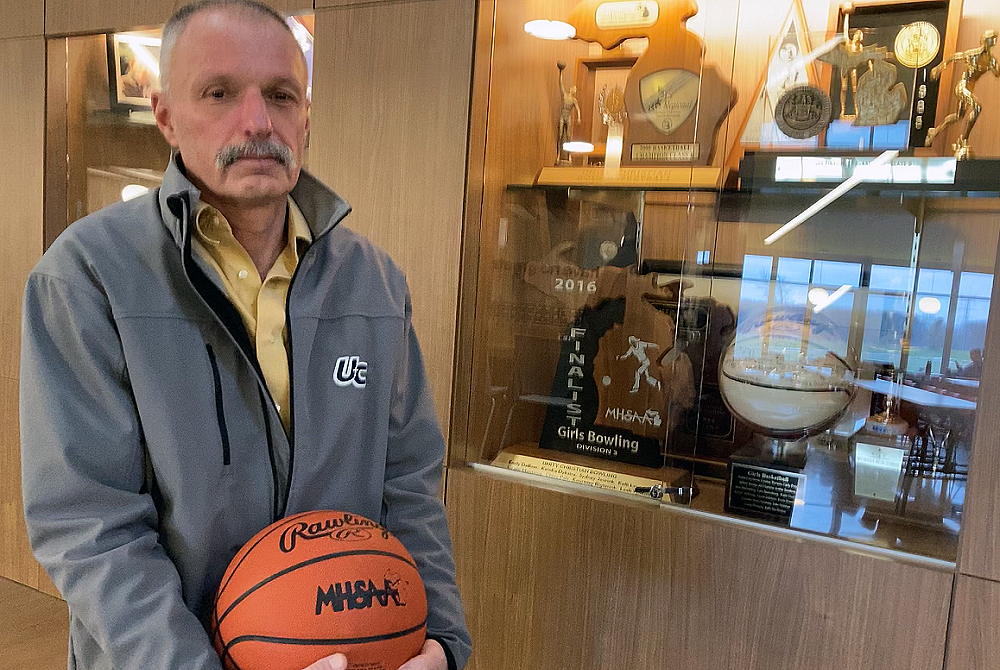
Scott Soodsma not only grasps the significance of that scene firsthand, it's why after four decades he still loves coaching.
"The fierce competition, the band, your heart pounding like a dog – it's still like it was 30 years ago," said Soodsma, the Hudsonville Unity Christian coach and dean of West Michigan basketball coaches in his 41st season of a run that’s included two states and three schools.
"How does it get any better than that? I'm always telling the kids to live for the moment. You can't replace all that; I still get the shivers. I've had so many moments like that."
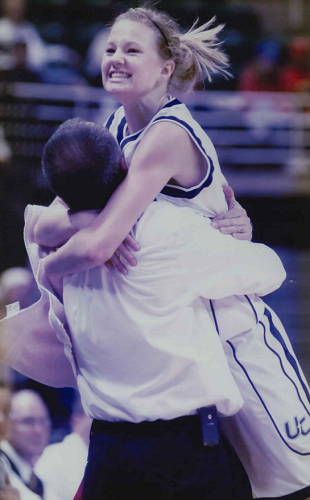
Among those highlight moments are being one of just three Michigan coaches to win both girls and boys MHSAA Finals championships (Paul Cook of Lansing Eastern boys/Lansing Catholic girls and Johnny Jones of Lansing Everett were the others), and the moment he claims is easily No. 1 on his all-time personal list: coaching his daughter Amber as part of the 2006 Class B champ. Unity Christian also won a 2019 boys state title. He also won a third Finals championship with the boys at McBain Northern Michigan Christian.
Soodsma, 63, admits there have been myriad changes in coaching basketball since his first season at North Dakota's James Valley Christian High School in 1983 and coming to Unity Christian in 1993. For starters, players are bigger and stronger and are more schooled in the game through AAU and offseason programs. In addition, the influence of parents – for better or worse – has increased dramatically. As for the on-court game, Soodsma unabashedly admits he at first fought the institution of the 3-point shot. And the emphasis on winning has definitely only increased pressure on many coaches.
Soodsma, a member of the Basketball Coaches Association of Michigan Hall of Fame who ranks ninth on the state's all-time boys wins list with 635, said he's adapted to the times. He wants to win as much as he ever has, still broods for days after losses and still considers himself receptive to the changing Xs and Os aspect of coaching.
But where his booming voice routinely used to resonate loudly into the middle sections of the Unity Christian bleachers, most of those comments now are only audible to fans perched in the first couple rows of the stands. Which is probably a good thing, Soodsma adds sheepishly.
 Coaching, he readily contends, is still coaching – and winning still heads the list of priorities. He does add one disclaimer, however, in terms of winning. Whereas it used to be about a young coach building a resume through wins, it's now about what winning can do for today's teenager athlete. An old-school coach? Yeah, probably. But one who has learned much about himself, players and parents after 41 years.
"I've learned to enjoy the kids more; I'm definitely a different kind of person in the ’90s as opposed to now in the 2000s," he said. "I am a stubborn man, and it took a long time (to change). But winning? Oh, yeah. I've never backed down. The winning and losing hasn't changed, and I make no excuses that I still want to win."
Which is then strange, perhaps, that he doesn't list being just one of two coaches to win Finals titles in both girls and boys basketball as the zenith of coaching for 41 seasons. That honor goes to having his daughter, who went on to a stellar career at Dort College, on the state championship club.
"It's not that big of a deal," he said of being on the bench for what likely will never happen again as boys and girls basketball are now in the same season. "To me it's not an accomplishment I would rank (at the top). I'm just being honest. Winning a state title with Amber, and the picture I have of her and me in my office, that's the best."
How well has Soodsma adapted his coaching style over the years? Two people in a position to know offer their own opinions on the topic, including 22-year assistant Bruce Capel and Randy Oosterheert, who with son Rylan are the only father/son combination that Soodsma has coached.
"Scott has always been vocal on the sidelines as a coach. As I sit in the stands and watch as a spectator, same Scott," said Randy Oosterheert who played for Soodsma in 1992-93 and 1993-94 and whose son is a current Unity Christian player. "I will say that my son and I agree, if you do something wrong on the floor, he is the first person to greet you on the sidelines and point out your failure. However, if you do good, he is the first person to greet you on the sidelines and tell you good job.
"The latter is done at a little lower decibel level than the offense, and those with a watchful eye from up in the stands unfortunately (don’t) get to hear the praise, only the punishment. Scott is obviously very competitive, then and now. He expects a lot but gives a lot."
As far as the competitive side, Capel hasn’t seen much of a difference over their two decades together.
"Certainly, coaching is a lot different in how you approach kids from more than 20 years ago," he said. "There's a difference in society and you have to change with it, and he's done that. I don't think it's as much life and death with Scott anymore. But in terms of winning, I haven't seen that go away."
It's a coin flip as for how much longer Soodsma will be directing traffic from the sidelines. He broke into the top 10 among the all-time winningest boys coaches in Michigan history by passing Warren De La Salle's Bernie Holowicki and Ray Lauwers of Morley Stanwood last season. Next on the list is Big Rapids' Kent Ingles (644). When you factor in Soodsma's win total as both boys and girls coach, the 742-and-counting combined wins rank eighth in state history.
He does admit the desire to spend more time with wife Mary, the longtime away scorekeeper for the program, and 11 grandkids scattered from Denver to Seattle to San Diego. Retirement could strike when this season ends in March, or it could still be several Marches away. But when the end comes he anticipates making a contented transition from arguing with officials, coming to an "understanding" with parents and devising new Xs and Os. Soon, he mused, will come time for much-anticipated passions such as hunting, fishing and pickleball.
"For the first time I've contemplated it," he said. "There are a lot of things I'd like to do. I'm not a basketball junkie."
That may be true. But it'll still be tough to surrender those noisy pep bands, bright gymnasium lights and the din of Friday night crowds.
PHOTOS (Top) Hudsonville Unity Christian boys basketball coach Scott Soodsma stands in front of a portion of the school’s trophy case, which he’s helped fill over decades coaching basketball. (Middle) Soodsma and daughter Amber embrace during their team’s 2006 Class B Final victory. (Top photo by Steve Vedder. Middle photo courtesy of the Soodsma family.)