


MHSA(Q&)A: Historian Ron Pesch
April 16, 2012
 When we receive a question on the history of MHSAA athletics that we can't answer on the spot, Muskegon's Ron Pesch is the first person we seek out for help.
Pesch took the reins as Michigan's chief high school sports historian during the mid 1990s after the retirement of legendary MHSAA record book originator Dick Kishpaugh and has contributed to various efforts and publications across the state.
One of his latest projects is the awarding of "retro" Mr. Basketball Awards. The first Hal Schram Mr. Basketball Award was given by the Basketball Coaches Association of Michigan in 1981 to Lansing Eastern's Sam Vincent. Three seasons ago, BCAM -- with research work by Pesch -- began awarding retro winners for the previous decades beginning with the 1920s. This winter, BCAM honored retro winners from 1922, 1932, 1942, 1952, 1962 and 1972.
Click to read more about those winners and the finalists recognized last month. Also, click for links to the previous retro winners. The retro Mr. Basketball project will last seven more seasons. Pesch explains more below.
How did you come up with rewarding a “Retro” Mr. Basketball?
The project came out of a conversation I had with (BCAM executive director) Tom Hursey at the basketball finals back in '99. Together, we hatched an approach honoring the state's past basketball greats. He let me run with it, while he worked on getting a subcommittee launched to make the selection.
How do you dig up all of this nomination info?
Between votes, I work on digging out the details. My initial target list always begins with all-state teams - if, of course they exist. All-tournament teams for the early years also serve as a starting point -- if they exist. Best I can tell, the Detroit Times, the Free Press and the News have all named all-state squads, at various points, back to about 1935. The Associated Press and UPI came to the game much later - somewhere around the early to mid 1960s. I then work on creating a crosstab on the players selected, noting the "teams" on which they were named (Class A 1st team, Dream Team, Class C 3rd team), and try to find quotes detailing their games. The result is really a reflection of the times and the history of newspaper reporting.
In early years, we can struggle to uncover a player’s first name, let alone his class in school. And statistical coverage of a player's abilities was very limited. It's simply the way things were back then. Everyone in town knew King Lewis, or Red Cherry, or Young Jacks. And the final box score only contained points, fouls, substitutions, as they were all you really needed to know about the game. But by visiting the state library in Lansing, and looking at a cross-section of newspapers, you can usually dig out what you need.
Do you collect from other sources as well?
Another source is high school yearbooks. Some resources have started to emerge online. I also tap into the MHSAA site and make contact with ADs around the state, asking for their assistance on digging out details - especially class in school. Like the current program, only "seniors" are considered for the award. Mid-year graduates can create a challenge, but the rule currently in place is a player is considered a nominee in the year in which he was last eligible for the state tournament. In other words, if you graduated in January or February of 1943, you would be considered for the 1942 ballot. It appears that a similar approach was used in selecting all-state teams.
|
Year |
Player |
High School |
Age |
Height |
Weight |
Year |
DFP |
DN |
DT |
AP |
UPI |
Tourney |
|
1971 A-1 G. |
Frank Tanana, Jr. (C) |
Detroit Catholic Central |
17 |
6-3 |
170 |
Sr. |
A1 |
A1 |
A1 |
A1 |
||
|
1971 A-1 C |
Tom McGill |
Flint Northern |
17 |
6-3 |
190 |
Sr. |
A1 |
DM |
A1 |
A1 |
||
|
1971 A-1 F. |
Lindsay Hairston |
Detroit Kettering |
17 |
6-9 |
203 |
Sr. |
A1 |
DM |
A1 |
A1 |
||
|
1971 A-1 F. |
Campy Russell |
Pontiac Central |
18 |
6-7 |
190 |
Sr. |
A1 |
DM |
A1 |
A1 |
That cross-tab table will help establish a list of nominees. A consensus first-team pick is an obvious candidate. When only a single all-state team is available, I'll do what I can to look up all-conference teams or all-area teams from around the state to see who else might be considered. While life after high school is not a considered when trying to pick a winner, a player who emerges as a star in college or in the pros may emerge as a candidate when you see his details in a local paper.
Bios are assembled from the newspaper reports, detailing as much as we can find on high school player's career. I'll tap into a variety of resources including old team histories when available. When needed, I'll toss out request to reporters, old and new, around the state. Local librarians and historians are another wonderful resource.
How does voting work?
Between sessions of the Boys Finals, the committee assembles to hash out a final ballot, and to make a selection. I don't vote, but I may guide the conversation and provide any additional details when needed, reminding members that we're focusing on their high school careers. The process is certainly imperfect. But the committee approach prevents the process from becoming a popularity contest. These guys have the benefit of watching many of the players play. And, like the current Mr. Basketball program, they sometimes surprise. But that's what makes it fun. And, of course, stirs the pot. It gets people talking about the history of basketball in this state.
Is there a theme to MHSAA basketball that has remained constant over the years?
For me the greatest thing about the basketball tournament is that it assembles a wide range of folks who want to see players they've heard about in action. And the process, for the most part, hasn't change since the 1920s. While the style of the game has changed, winning a title is much the same as it was back when our great-grandfathers played: You gotta get through the tournament. And only four trophies are awarded.
These guys were the "Magic" of their day. I'm hoping we never forget that.
U-D Jesuit Continues Tourney Dominance
March 15, 2019
By Geoff Kimmerly
Second Half editor
EAST LANSING – Only three Detroit U-D Jesuit players have seen action in all 27 of their team’s games this winter.
Friday was further evidence of what the Cubs had been missing for parts of this season.
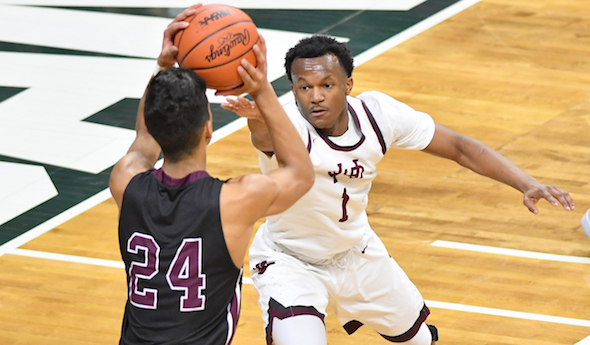
Now together and in game shape after injuries and illnesses, Jesuit has won its seven tournament games by an average of 28 points, adding a 63-25 Division 1 Semifinal win over Okemos to earn its second championship game appearance in four seasons.
The Cubs’ closest postseason win over the last three weeks was by 11 over league rival Warren DeLaSalle in the Regional Semifinal.
Total, Jesuit has won 19 straight games since its last defeat.
“It’s great being on the floor when we’re playing well like this,” Jesuit senior guard Daniel Friday said. “Everybody’s clicking and playing for each other and playing together. It’s really been a pleasure being with these guys on the floor. It’s been translating to blowouts; hopefully we keep that up.”
Jesuit (25-2) will take on Ypsilanti Lincoln in Saturday’s 12:15 p.m. Final at the Breslin Center, seeking its second championship to go with the Class A title won in 2016. Okemos finished 23-3.
Of course, it took only a few minutes into Friday’s press conference for the first questions to come about defending Lincoln’s freshman sensation Emoni Bates. Defense has been the Cubs’ strength as it’s worked through this season’s player absences, adding to the intrigue of Saturday’s matchup.
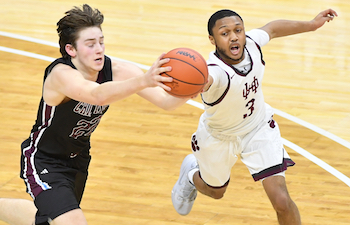 Jesuit has kept teams to 50 or fewer points 13 times this winter, including four times during the postseason. The Cubs held a usually strong-shooting Okemos team to 21 percent from the floor and outrebounded the Chiefs 34-24 including 28-7 on Jesuit’s side of the court.
The Cubs scored the game’s first seven points and led by double digits for good by 1:35 to go in the first quarter. They made 55 percent of their shots from the floor for the game, including 7-of-8 during a second quarter that saw them extend the lead from 13 to 21 points.
“They’re a really deep team. They have a lot of threats outside and inside, and we never really played a team that big before,” said Okemos senior forward Evan Thomas, who led the Chiefs with 13 points and six rebounds. “It was definitely a big challenge to stop them inside, then they’d start hitting outside shots too and it just piled on. I think we worked hard and did what we could.”
Eleven players scored for Jesuit, with senior guard Jordan Montgomery leading with 17 points. Senior center Jalen Thomas added 15 points on 7-of-9 shooting and 11 rebounds, and senior guard Daniel Friday made 5-of-6 shots for 10 points.
Five Cubs had at least three assists.
“It’s been a very interesting year in terms of starting lineups and who we’ve had available off the bench,” Jesuit coach Pat Donnelly said. “This stretch … we’ve had that opportunity to build chemistry, and that’s what I like. I remember looking down at the stat sheet in the first half and we had 15 field goals on 10 assists. These guys are unselfish. They play the right way.
They move the basketball. They don’t care who’s scoring.”
PHOTOS: (Top) U-D Jesuit’s Julian Dozier defends Okemos’ Evan Thomas during Friday’s second Division 1 Semifinal. (Middle) The Cubs’ Jordan Montgomery (3) and Chiefs’ Mason Kaczmarek go after a loose ball.