

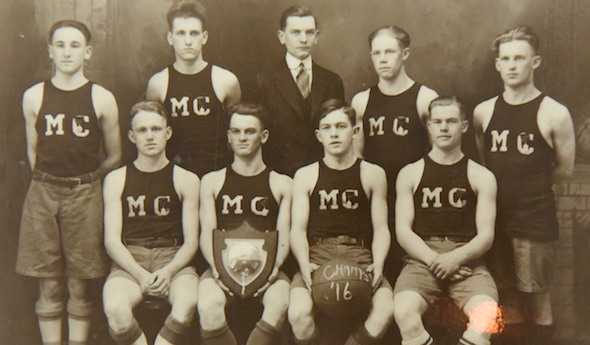
Michigan HS Hoops Celebrate a Century
By
Ron Pesch
MHSAA historian
February 27, 2016
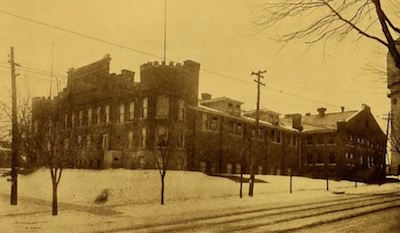
Today we know the campus, and the buildings and playing fields it contains, as Eastern Michigan University. But 100 years ago, the grounds were known as Michigan State Normal College.
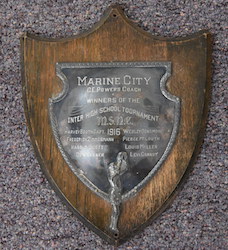
On an unusually warm 2016 February day, down on the court of Eastern’s Convocation Center, the Eagles of Eastern and the University of Toledo Rockets warmed up for tip-off. Standing near the doorway of a suite, above the action, Chris Ming, athletic director at Marine City High School, showed off an oak plaque, adorned with a beautiful silver shield featuring a basketball design in relief.
“I can tell you, they don’t make them like this anymore,” Ming said.
 At halftime, Ming and five other representatives from Michigan high schools met at center court to celebrate an event that had occurred a century ago on this campus. In March 1916, around 100 students total representing 12 high schools traveled to Ypsilanti to participate in what has been billed as the first organized high school basketball tournament in Michigan.
Historically speaking, the college was a perfect location for that tournament.
“In 1894 the Michigan State Normal College in Ypsilanti had started a new major in physical education. (Professor) Wilber Bowen was appointed chairman of that program,” wrote Dr. Erik (Rick) Pedersen, Professor Emeritus from EMU’s School of Health Promotion & Human Performance in a 2006 article for the Ypsilanti Historical Society. “Bowen had met James Naismith (who developed the game of basketball in 1891 at Springfield College in Massachusetts) through their involvement with the American Association for the Advancement of Physical Education in the late 1880's and early 1890's. To meet the needs of a new major program, the college had also completed construction of a new gymnasium in April of 1894. Bowen was looking for ideas to help with the dedication ceremony of the new gymnasium and recognition of the new major program. Consequently, arrangements were made to have the first basketball game played west of the Allegheny Mountains on May 18th, 1894, in Ypsilanti, Michigan.”
According to newspaper articles covering the 1916 high school tournament, the goal of the event was to arouse “greater interest in basketball in the smaller schools.” Around 300 invitations were sent out to high schools across the state having enrollments of “less than 200 students to take part in a basketball tournament.” It was through the efforts of the college’s Men’s Union, with cooperation from the Athletic Department, that the tournament was organized. According to the 1916 Michigan State Normal College yearbook, Aurora, the tournament also had a second goal. Acting in the best interests of the college, the Men’s Union wanted to showcase the “advantages offered at the Normal” in hopes of attracting future enrollment.
Enrollment at the time was fewer than 2,000 students. The college was the nation’s first teacher-training school to offer a four-year degree, and enrollment was dominated by females. The Men’s Union was formed in 1914 with the stated goal of bringing the male student body together socially, and to work toward recruiting more men to the college.
“Expenses related to transportation, room, and board (for the tournament) had to be provided by the participating schools,” noted Pedersen prior to the 2016 centennial gathering. “The Michigan State Normal College's Physical Education Department made it easier for schools to participate by making arrangements with local residents to provide food at 20 to 25 cents a meal and lodging at 25 cents a night for each player.”
 As things fell into place in Ypsilanti, awards were purchased, and prior to the contests, the trophies were placed on display at The Rowima Company, a general store near the school, to help build excitement for the games. It was also announced that players of the winning team would receive individual medals.
“The event is the first of its kind in the state and will be made an annual affair,” it was stated in the Daily Ypsilantian Press prior to the start of the tournament. “It is the aim to have larger high schools included in the contest if the affair is a success and as interest develops a more extensive list of prizes will be arranged. A small admission will be charged for each session which will include three or four games.”
Spread over three days, March 23 – March 25, sessions were scheduled for 7:30 on Thursday evening, 9:30 a.m., 1:30 p.m. and 7:30 p.m. on Friday, and Saturday at 9 in the morning and 1:30 in the afternoon at the Normal college gymnasium.
By Saturday afternoon, Dundee and Marine City had emerged as the tournament’s top teams, with 5-1 records, forcing a title game.
“Half the town turned out Saturday night to welcome the victorious basketball team home from Ypsilanti,” wrote a reporter for the Port Huron Times-Herald following Marine City’s thrilling 23-22 victory in the title game. “The silver shield, a trophy of the state championship, was proudly displayed by Coach Powers and every boy was glad to show his own individual (silver) medal.”
With a second-place finish, Dundee was awarded a handsome silver cup, while Milan, Mancelona and Farmington each received a banner in the Normal school colors of green and white, signifying a three-way tie in the tournament for third. Teams from East Lansing, Elkton, Middleville, Mount Clemens, Royal Oak, Saline, and Wayne also competed in the event. Teams were eliminated from play after two losses.
 “… It was a great day for Marine City when her team won,” continued the Times-Herald article. “Each member of the high school can take credit for the victory as the money to defray the expenses of the clash was earned in a series of inter-class games played during the last two weeks.”
Conversations about the use of tournaments to identify a state basketball champion in Michigan had been kicked around in years past.
“As long as teams journey about the state taking on different teams, making a fairly good showing and then trying to win titles by arguments based on comparative scores, all that will result in argument and three or four champions,” stated coach Edbert C. Buss of Detroit Central High School in a 1914 article in the Jackson Citizen Patriot. “The only way I can see to settle the title on the proper team and make it undisputed is by dividing the state into three sections, an eastern, western, and northern district.”
After determining district champions, Buss suggested then a state tournament at a central location to identify a true state champion.
Teams in the Upper Peninsula of Michigan staged basketball tournaments as early as 1913, with Ishpeming claiming the U.P. crown that winter.
“Calumet claims an Upper Peninsula title for 1914,” said Robert Erkkila, a U.P. historian from the city. “We’ve never claimed it to be a state championship.” Yearbooks attest to the fact, indicating they beat Ishpeming 24-21 in the U.P. tournament hosted at the Ishpeming YMCA. “While (Notre Dame legend) George Gipp didn’t spend a lot of time in high school, and never played on Calumet’s football team, he did play basketball, and was on that team,” stated Erkkila.
In January 1917, Northern Michigan Normal College (today, Northern Michigan University) announced plans for the very first U.P. tournament, scheduled for March 2 in Marquette. Michigan State Normal College hosted their second annual tournament, beginning on March 15th, while the University of Michigan and the Michigan College of the Mines in Houghton (known these days as Michigan Tech) scheduled tournaments for the following week.
Again, 12 teams entered the Michigan State Normal College tournament, which still targeted schools with high school enrollment of 200 of fewer.
“Four games of basketball will be played at one time in the state normal gymnasium,” wrote a Flint Journal correspondent, describing Mount Morris’ planned visit to the Normal tournament. “While on this trip the boys will visit the University of Michigan and will do some sight-seeing in Detroit on the trip home.”
“The visiting teams were so well-treated and the tournament was such a success that this year not enough rooms could be found to provide for the teams, and so the offices of the Gym were turned into a veritable dormitory,” recalled the 1917 Normal annual, Aurora.
“The games were all played in quarters with a minute rest between quarters and ten minutes rest between halves,” added the Journal correspondent following the tournament. “The (Mount Morris) boys were accorded a splendid time, given free use of the swimming pool, shower baths and were treated to a banquet in the gymnasium hall by members of the faculty of the State Normal College Friday evening.”
 Grayling emerged as the winner of the Normal tournament, winning four games over the two-day gathering. With a 49-9 win over Chelsea, the team earned a silver cup, while team members each earned medals. With confidence, the team stayed over, rested for a few days, then entered the U-M tournament, which was open to all schools of the state.
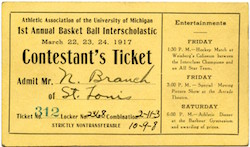
The interscholastic department of University of Michigan sent out around 250 printed circulars throughout the state, inviting teams to the “first annual inter-scholastic basketball tournament,” according to a January 5, 1917, article in the Flint Journal.
“Michigan’s first interscholastic basketball tournament is to be held in Waterman Gymnasium on March 22, 23 and 24, and replies from high schools of the State indicate that more than fifty quintets will battle through an elimination series for the State High school championship,” stated the February 1917 edition of The Michigan Alumnus. “This is the first time the University Athletic Association has attempted such a tournament and in view of the fact that Michigan is to have a Varsity basketball five next winter, the inauguration of the high school tourney this year becomes especially important.”
A recent enlargement of Waterman made the tournament possible. With four available courts, it was felt that the tournament could handle more than 60 teams and still be run in three days.
In total, the final field totaled 39 teams from 38 schools including squads from both peninsulas. Detroit Northwestern entered two teams, both coached by Bert Maris. The field was broken into four divisions.
“The meet is expected to result in a more satisfactory settlement of the scholastic championship than has been possible heretofore and to interest promising high school athletes in the University,” noted the March edition of the Alumnus.
The Michigan fraternities hosted the high school players during their stay with “a variety of entertainment … prepared to fill the odd hours,” including a hockey game at Weinberg Coliseum and a moving picture show at the Arcade Theater on Friday. A big dinner was planned for the final night of the tournament at the Barbour gymnasium, “at which the various cups and medals will be awarded,” according to the Alumnus. “The high school men were given the chance to get acquainted with University life and Michigan life in particular.”
“Three hundred high school players and coaches descended on the campus, and in a scene of mass confusion, 17 games were played on the first day alone,” wrote the late Dick Kishpaugh, historian for the MHSAA for 50 years. “Eventually, Detroit Northwestern, coached by Bert Maris, defeated Jackson, 24-21, to capture what virtually all observers at the time recognized as the first true state boys’ basketball champion.”
 In 1918, the Michigan State Normal tournament marched on for a third year, with 16 teams participating. The title was won by Milan, with Grayling finishing second. World War I halted the University of Michigan’s plan to repeat the format of 1917. However, the desire to find a champion among the state’s larger schools saw the state’s top teams, Kalamazoo Central and Detroit Central, travel to Ann Arbor for a special one-game championship contest. The teams had split two previous meetings that year. The rubber match, and hence the title, was won by Kalamazoo 26-18.
“Just who was in charge of the tournaments was the subject of heated debates in the early years,” Kishpaugh added. “High school administrators and the University of Michigan shared the responsibility in 1917 and 1918, but then (Michigan Agricultural College) wanted a piece of the action, and the finals were moved to East Lansing in 1919.”
That year, competition was divided into two, Class A for the larger schools and Class B for the smaller ones, setting a precedent for class competition which has been the hallmark of Michigan tournaments ever since.
In 1920, the predecessor to the MHSAA, a group called the Michigan Interscholastic Athletic Association, headed by high school administrators, took control of prep athletics and the tournament. Among their first actions was to split the finals between Ann Arbor and East Lansing each year. That year, Class A championship games were played at U-M in Ann Arbor, while Class B games were hosted at M.A.C. in East Lansing. Sites were reversed in 1921. The addition of Class C, segmenting the tournament further, came in 1922, and those games were played in the same city as Class B. The pattern was followed until 1926.
When the present Michigan High School Athletic Association was formed in the fall of 1924, Alden W. (Tommy) Thompson was hired on a full-time basis as State Director of the sport. Every tournament since 1925 has been under the direction of the MHSAA. In 1926, Class D was added, forming the approach taken to naming basketball champions in Michigan that we still use today.
 Ron Pesch has taken an active role in researching the history of MHSAA events since 1985 and began writing for MHSAA Finals programs in 1986, adding additional features and "flashbacks" in 1992. He inherited the title of MHSAA historian from the late Dick Kishpaugh following the 1993-94 school year, and resides in Muskegon. Contact him at [email protected] with ideas for historical articles.
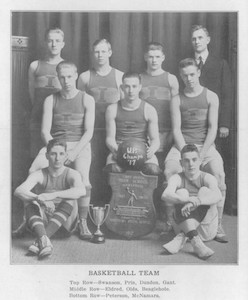
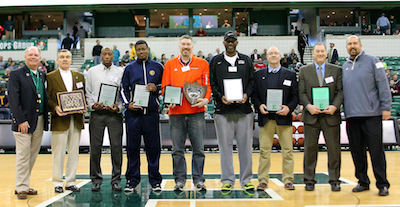
PHOTOS: (1) The Marine City boys basketball team won the inaugural high school basketball tournament at Michigan State Normal College. (2) A plaque commemorating the achievement hangs at the school. (3) The gymnasium at what is now Eastern Michigan University hosted the event. (4) Ishpeming won the first basketball tournament played in the Upper Peninsula. (5) University of Michigan hosted a tournament for schools of all enrollments in 1917. (6) Representatives of schools that played in the 1916 tournament at Michigan State Normal College receive plaques during a game this season at EMU. (Top five photos collected by Ron Pesch; bottom photo by Jonathan Knight.)
#Charleytough Getting Stronger Amid Outpouring of Support
By
Tim Robinson
Special for MHSAA.com
March 11, 2021
On a recent evening at the home of Corunna boys basketball coach John “Rocky” Buscemi and his wife Chloe, the household is a whirlwind of activity.
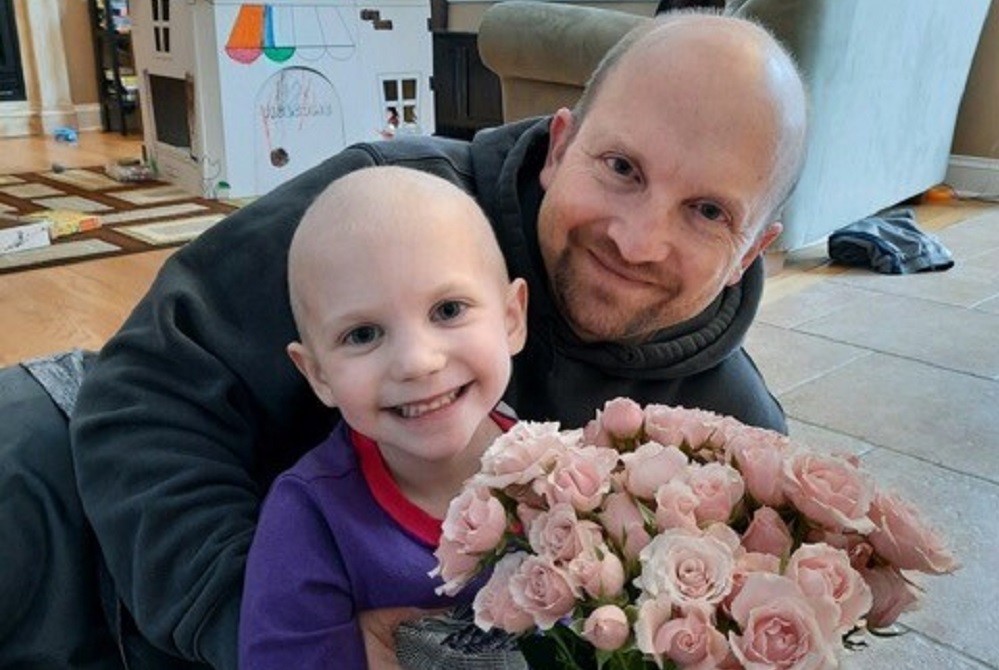
 Their daughter Charley, 5, darts in and out of the Buscemis’ home office to ask questions, mimic riding a horse, or whatever else comes to the mind of a little girl full of energy.
The only thing that would tell you that cancer had interrupted their lives for five months in the fall and winter is the hair that just now is starting to grow on Charley’s scalp.
Shock, then Support
Charley Buscemi is named after her grandfather, Charley Silm, who refereed high school basketball for 22 years in and around mid-Michigan when he wasn’t working on the farm. He often took his daughter, Chloe, to games he worked when she was a youngster.
“I remember packing up my little bag with snacks and watch my dad officiate,” Chloe Silm-Buscemi recalled. “Even though I didn’t play basketball, I grew up in the gym, just like Charley did.”
Her daughter has grown up watching her dad coach. She confidently refers to Corunna players as “her boys” and announces that she wants to coach with him some day.
Last summer, Charley was having trouble sleeping, and sleep apnea was diagnosed. Her doctor advised that removing Charley’s tonsils would likely eliminate the apnea.
 The Buscemis agreed, and her tonsils were removed Sept. 25.
“We knew nothing else,” Chloe said, “but apparently the doctor noticed that one of the tonsils looked abnormal, or a little awkward, so he sent it off for testing.”
Chloe said she was told that any complications might require another operation to stop bleeding in the area, but she was stunned when the doctor’s office called back Oct. 1.
“We didn’t know the testing had been done,” Chloe said. “We got a call that said ‘the findings of the pathology are consistent with a diagnosis of lymphoma.’ And we were like, ‘Wait. What?’ It caught us completely off guard. (Charley) was racing in circles around our kitchen island and our dining room table, and I was like, no, you’ve got the wrong kid here. There’s no way this kid has cancer.”
“Initially, it was, this can’t be right,” Rocky said. “I was trying to read between the lines and find some wording that gave some idea that this is what they think. I tried to hang onto the idea that there’s got to be more tests, and those tests will show us that it’s not (cancer).”
The diagnosis was correct. Charley had diffuse large B-cell lymphoma, the most common type of non-Hodgkin lymphoma. It’s a fast-growing cancer that affects B-lymphocytes, a type of blood cell that helps fight infection.
While it is a fast-growing lymphoma, it’s considered potentially curable.
The cancerous cells found in Charley’s tonsil were sent to the Mayo Clinic and the National Institute of Health, and the diagnosis was confirmed.
Charley began chemotherapy at Sparrow Hospital in Lansing and celebrated her fifth birthday there.
Chloe, meanwhile, was also navigating the second trimester of her pregnancy.
“I spent most of my second trimester sleeping on a cot in the hospital while she got chemo treatments,” Chloe said.
“Her first round of chemo was horrible,” Rocky said. “She didn’t react to it well, and we were there 20 of 25 days.”
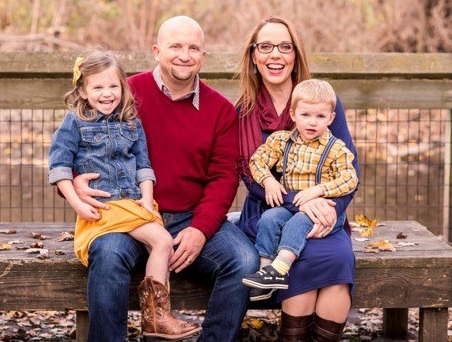
 But once word got out, people in the Corunna school system, neighbors, fellow coaches and others reached out in the Buscemis’ time of need.
“The schools were so understanding,” Rocky said. “Once we found out, it was, go be with your family. Put in for your (Family and Medical Leave Act). Everyone was supportive from that end.”
The Corunna basketball players drove out to the Buscemi home and raked up its leaves. Some Corunna alumni got together to string up Christmas lights, the Orchard Lake St. Mary’s team sent her a giant stuffed panda, and many more showed support.
“We’re working on thank-yous now,” Chloe said. “My mom says people would know if you posted a thank-you (online), but I want to be able to send something out. Right now there’s something like 250 thank-yous.”
Strength & Sliver Linings
Charley had two rounds of chemotherapy and has been pronounced cancer-free. She has monthly meetings with her oncologist and quarterly CT scans scheduled for the next year.
“They’re watching her heart, because the chemo can affect that, so we meet with the cardiologist,” Chloe says.
“It’s a lot for a little person,” she adds as Charley flits back and forth between parents, announcing at one point she has cleaned her plate at dinner with no small amount of pride. “But for the most part, she’s just like this. She’s pretty happy, pretty easy-going, and takes it in stride. Sometimes I struggle with it more than she does. You feel totally helpless.”
For Rocky, the whole experience is full of silver linings, however hard-won.
“You’re always trying to find the silver linings,’ he said. “We had no idea she had cancer, but the silver lining was once we found out what it was, and it was confined to the tonsil, the blessing was it was almost a miracle we had her tonsils removed almost at the same time it was starting to develop. It wasn’t found anywhere else, so that’s a silver lining.
“Recently she’s been diagnosed as having celiac disease, and we’ve been given the OK to (shift) to a gluten-free diet. If she hadn’t had cancer, we might not have known until she was a teenager and had permanent damage. We’ve been so fortunate and blessed to find things out when we did.”
The Buscemis talk in tones of awe and appreciation for the caring and other gestures that have come their way.
“It’s incredibly humbling,” Rocky said. “It makes you want to do for someone else. I’m much more aware of people in need, and I hope to pay it forward. There are a lot of people you wouldn’t have anticipated reaching out who have reached out.”
The fear and stress of that time, he said, are often near, even with Charley in the clear.
“I wanted to be strong for Chloe and my family and be that rock that could be leaned on,” he said. “But man, oh man, there are still mornings when I drive to school and tear up. It’s nice to have other guys who understand that or have been through it. I’d be the rock here (at home) and then I’d be emotional with my friends in the coaching fraternity.”
Charley and 3-year-old brother Sam were mainstays at practice last year, playing quietly in a corner of the gym while the team practiced. Charley was at most every game, and Rocky always made a point of looking for her and her mother in the stands.
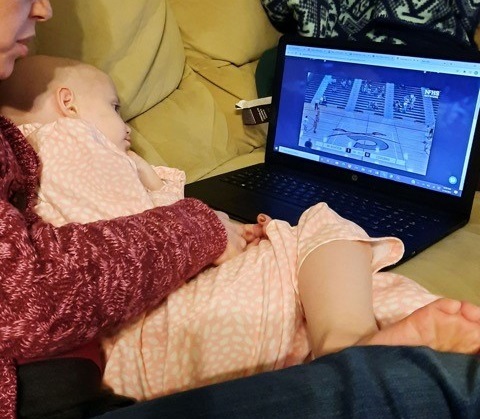
That hasn’t been the case this year, as Charley’s immune system has been weakened by the chemo and has kept her at home this season, watching the Cavaliers play on her mother’s laptop.
There’s been another change, too.
 “I’ve adopted a one-day-at-a-time, appreciate-every-moment approach,” Rocky said. “A year ago in 9-degree weather, I might have been trying to find reasons not to go outside. Now if Charley wants to go sledding, we’re going sledding!”
He laughs as he says that, a man who has a new appreciation of things.
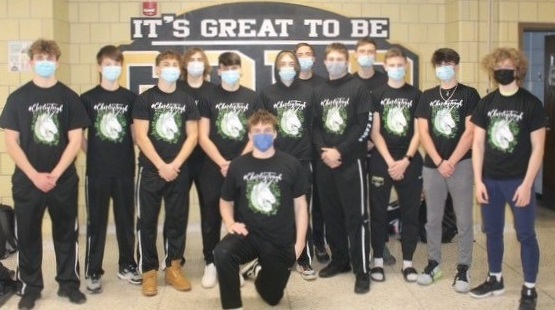
His players have been honoring her, too, wearing black T-shirts at warmups with a large unicorn on the front with the hashtag #Charleytough and the Corunna logo on a basketball.
As for Charley, she will go back to kindergarten next year, but at the moment, she’s anxiously awaiting the birth of her brother or sister March 22.
She already has informed her parents that her new sibling will be a girl, named Maggie, and wants the newborn to sleep in her room.
“She says, ‘Mommy, I’ll feed the baby,’” Chloe said, chuckling. “I told Rocky we don’t have to worry about parenting a third baby. Charley’s got it.”
Besides another new brother or sister, if all goes well, Charley will be back on the sideline with her dad and her basketball team next winter.
Rocky says his family’s experience, among other things, showed him how strong the ties are in the coaching community.
“It was nice to see the game be the bridge that allowed me to reach out and depend on people a little bit,” he said “Without it, you don’t have those relationships. Things like this make you realize how special those things really are. If you don’t experience it, you don’t get to understand people’s true motivations.
“It was humbling,” he added. “It was scary at times, but all in all it was a little bit of everything that helped us to be able to get through this.”
PHOTOS: (Top) Charley Buscemi and her dad Rocky enjoy a fun moment at home. (2) From left: Charley, Rocky, Chloe and Sam Buscemi. (3) Corunna players wear #Charleytough T-shirts as warm-ups for their games. They prominently feature Charley’s favorite animal, a unicorn. (4) Charley’s immune system isn’t robust enough for her to attend games in person, but she never misses a chance to watch “her boys” play on her mom’s laptop. (Photos courtesy of the Buscemi family.)