

Midland Boys Hoops Earns 'Football' Buzz
March 21, 2016
By Bill Khan
Special for Second Half
MIDLAND — Payton DeWildt is accustomed to pep rallies at school.
 Just not during basketball season.
"It's just not something they do," the Midland High senior said. "Only when we play Dow, our crosstown rival."
And only in football.
"Midland High is known as a football school," said DeWildt, the quarterback on the Chemics' football team last fall. "When I was a freshman (on the varsity basketball team), the seniors were good. I said we've got to keep this winning tradition going and make Midland a basketball school, also."
In four seasons of basketball, DeWildt has known nothing but success, a concept that was foreign to a generation of hoopsters at Midland. The Chemics have won District championships in three of his four years after going 13 years without a title.
What sets this year's team apart is that it also added a Regional championship to the mix, the first for the Chemics since winning back-to-back titles in 1978 and 1979.
Suddenly, basketball is a big deal at Midland, worthy of the treatment usually reserved for the football team. A pep assembly will be part of the pregame hype at Midland before the Chemics face Macomb Dakota at 7 p.m. Tuesday at Grand Blanc in the MHSAA Class A Quarterfinals.
"There's quite a buzz," said 14-year coach Eric Krause. "It was really nice to see the people very excited. In the past football has been there, but it was really cool to see guys getting recognized. You like to see the efforts being rewarded, so it's really exciting. It's nice to see some of the older members of the community who will come to games, no matter what your record, and to see the excitement in their faces."
For the players, there is a sense that they are making history.
"Definitely," DeWildt said. "We just won the first Regional Final since 1979. We're trying to make it one more game. We just want to prove we're one of the best teams to come through Midland High, so we want to make it as far as we can."
If Midland can topple second-ranked Dakota (25-0), the Chemics (17-6) will reach the MHSAA Semifinals for only the second time in school history. The Chemics reached the semis in 1970, losing 82-71 to Detroit Pershing. Midland made the Quarterfinals two more times in the '70s, losing 72-53 to Flint Northern in 1978 and 66-58 to Saginaw in 1979.
A major reason why the Chemics haven't lasted to the final week of the postseason is geography. They not only play in one of the toughest leagues in the state, but they have had to go head-to-head with Saginaw Valley League rivals in the tournament. In the last three seasons, the Chemics lost in the 2013 Regional Semifinals to a Saginaw team that made the MHSAA Semifinals, in the 2014 District Semifinals to a Mount Pleasant team that made the MHSAA Semifinals, and in the 2015 Regional championship game to a Saginaw Arthur Hill team that was the MHSAA runner-up.
It's tough to go deep into the tournament when so many nearby schools are capable of going all the way to the Breslin Center. The Valley has had 12 schools combine to make the MHSAA Class A Quarterfinals 137 times. Five Valley schools — all from Flint or Saginaw — have combined for 22 MHSAA Class A championships.
"You had to play in a league that is arguably the best public school league, some years, in the nation in the 1990s before I got into it," Krause said. "I don't mean to take anything away from what we're doing, but Flint isn't Flint anymore — not the way it was. Dave MacDonald is a good friend of mine who coached Midland Dow for over 30 years. He'd be over .500 most years, some years with 12 or 13 wins. The amount of pros he coached against, people just don't understand.
"I believe the Valley is one of the best leagues in the state. The difference is it used to be one of the best leagues in the nation."
To reach the Quarterfinals, Midland had to take down one of the two elite Saginaw programs for the first time in the postseason since beating Arthur Hill in the 1971 District Final.
The Chemics split their regular-season series with Saginaw, each winning on its own home court, so what happened when the teams met for the Regional championship shouldn't come as a huge surprise. On a night in which the tension was felt on the court and in the stands, Midland knocked off Saginaw, 60-56.
Midland held a 10-point lead in the fourth quarter before Saginaw rallied to grab a four-point lead. Midland finished the game on a 12-4 run.
 "It was the best game I've ever played in my life, the most exciting game," said senior Matt Jarema, another four-year varsity player. "I can probably say that most of my teammates all said it was the most exciting game they ever played; it was something. We knew we were bigger and stronger than them. We knew we could beat them. That's what we came in and did."
The impetus for this year's Regional championship run was a tough loss to Arthur Hill in last year's Regional Final. Midland was within four points early in the fourth quarter before current University of Texas freshman Eric Davis scored 12 points in the final period to lead the Lumberjacks to a 66-52 victory. Arthur Hill went on to play for the Class A title.
"Ever since last year after that Regional Final loss against Arthur Hill, we knew this year we would win the Regionals and we'd be in the Quarterfinals," Jarema said. "Playing against Saginaw and Arthur Hill, they prepare us for pressure like no other. They get up on you. We believe their pressure is some of the best pressure we'll have to face each year to prepare us for this moment now."
Midland has won four postseason games but, much like its regular season, nothing has been easy. Three of the four games have been decided by four points or fewer.
The Chemics opened the postseason by beating Mount Pleasant, 49-48, taking the lead for good on Martin Money's layup with 34 seconds left. After a 58-37 rout of Saginaw Heritage in the District Final, the Chemics overcame adversity to edge Traverse City West, 61-59, in the Regional Semifinal at Gaylord. Center Kyle Johnson was nearly late for that game because of a flat tire, Krause was dealing with a flooded basement before leaving for the game, and West's cheering section dwarfed Midland's because of the travel. Then came the four-point victory over long-time nemesis Saginaw in the Regional Final.
And now a team that has lost six games is within one victory of playing in the Breslin Center.
"We're a very odd team," Krause said. "We know we can play with very elite teams, but we honestly can lose to a lot of teams that are levels below that elite level. We can lose to a lot of teams. Usually when you have teams go this far, that's not the case. We have a strange quality where if things aren't going well, we have to be ready for a close game. Sometimes that makes you not panic when the game is close, because you figure you're going to win the game. We're kind of an interesting team that way."
DeWildt returned from a shoulder injury for the postseason opener to lead Midland's tournament run. He is the only Chemics player averaging in double figures during the tournament, scoring 16.8 points per game.
The scoring is balanced after that, with Virgil Walker averaging 8.8 points, Garrett Willis and Johnson 7.3 apiece, and Jarema 7.0.
 Bill Khan served as a sportswriter at The Flint Journal from 1981-2011 and currently contributes to the State Champs! Sports Network. He can be reached at [email protected] with story ideas for Genesee, Lapeer, St. Clair, Sanilac, Huron, Tuscola, Saginaw, Bay, Arenac, Midland and Gladwin counties.
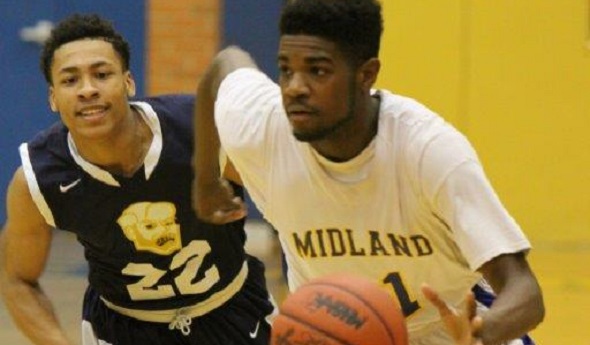
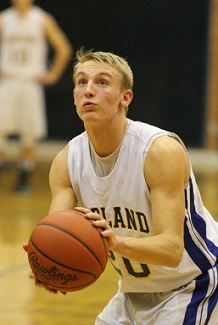
PHOTOS: Midland’s Virgil Walker drives past a Saginaw Arthur Hill player this season. (Middle) Payton DeWildt lines up for a free throw. (Photos courtesy of the Midland athletic department.)
Beecher Finishes Emotion-Filled Run with Title #9
By
Dean Holzwarth
Special for MHSAA.com
April 10, 2021
EAST LANSING – Eight wasn’t enough for the Flint Beecher boys basketball team.
The Bucs won the program’s ninth MHSAA Finals championship Saturday with an impressive 75-47 victory over Iron Mountain in the Division 3 Final at the Breslin Center.
Beecher moved into a tie for second with Detroit Country Day and Muskegon Christian/Western Michigan Christian for all-time boys basketball championships won. River Rouge tops all schools with 14.
“We just wanted to come out and establish our defense,” Bucs coach Mike Williams said. “They prepared and fought, and they executed. I couldn’t be more proud.”
Beecher had last won a Finals title in 2017. The Bucs’ only loss this winter was to Division 1 contender Orchard Lake St. Mary’s in the second game of the season.
This was an emotional title run for Williams, whose father passed away nearly a year ago to the championship game date from COVID-19.
Senior Keyon Menifield Jr. lost his grandfather the day after due to COVID-19 complications.
“It’s extremely special and these kids have been my therapy,” Williams said. “This has been a long year for me and my family, and we had some other kids deal with it as well. This is a part of the healing for me and the community and the people that have gone through this pandemic. I’m just glad we got to the finish line.”
Menifield Jr. scored a game-high 37 points – the ninth-most in an MHSAA Final. He was 17 of 27 from the field with only one 3-pointer and two free throws contributing to his total.
“We locked down our defense and we knew we had to get stops, close out and get rebounds,” Menifield Jr. said. “I had to attack, and I had to make sure I got in the lane and made shots. The team that makes the most shots wins the battle.”
Williams, whose team won its last 15 games with only two opponents coming within single digits, said Menifield Jr. hasn’t received the attention he deserves.
“I’ve been saying all along that he is either the most underrated player or the best player in the state of Michigan, period,” he said. “I don’t know anyone who wants to guard him, and I’ve talked to college coaches who have not recruited him and told them they were crazy.”
The Bucs also were able to contain Iron Mountain senior standout Foster Wonders, who scored more than 2,000 career points.
He was held to 13 points and didn’t score until the third quarter.
“The best compliment I can give a player is I would pay money to watch him play,” Williams said. “That kid can play, and we knew that we had to neutralize him one way or the other for us to have a chance to win.”
The Bucs held a commanding 38-19 at halftime. They led by as many as 34 in the second half en route to the decisive victory.
The Mountaineers simply couldn't match Flint Beecher’s size, speed and athleticism. The Bucs’ full-court pressure forced 20 turnovers
“All the credit goes to Flint Beecher,” Iron Mountain coach Harvey Johnson said. “They were tough, and they did to us what no other team could do completely. They’re quick, they’re fast and their press and ability to create off the dribble bothered us. He had his team well-prepared.”
Iron Mountain finished as Division 3 runner-up for the second time in three seasons, and Saturday’s loss was only the Mountaineers’ second over the last two seasons. They were 21-1 last year before the pandemic halted the postseason.
“These eight guys were outstanding, and we beat some great teams to get here,” Johnson said. “I think they represented themselves, our school, our community, and the entire Upper Peninsula with great class. They worked hard and overcame a ton of adversity like every other athlete in the state did to get here. Not many kids get to play here, and we were blessed to be able to do that.”
Jurgen Kleiman added 12 points and eight rebounds for Iron Mountain, while Dante Basanese chipped in 11 points.
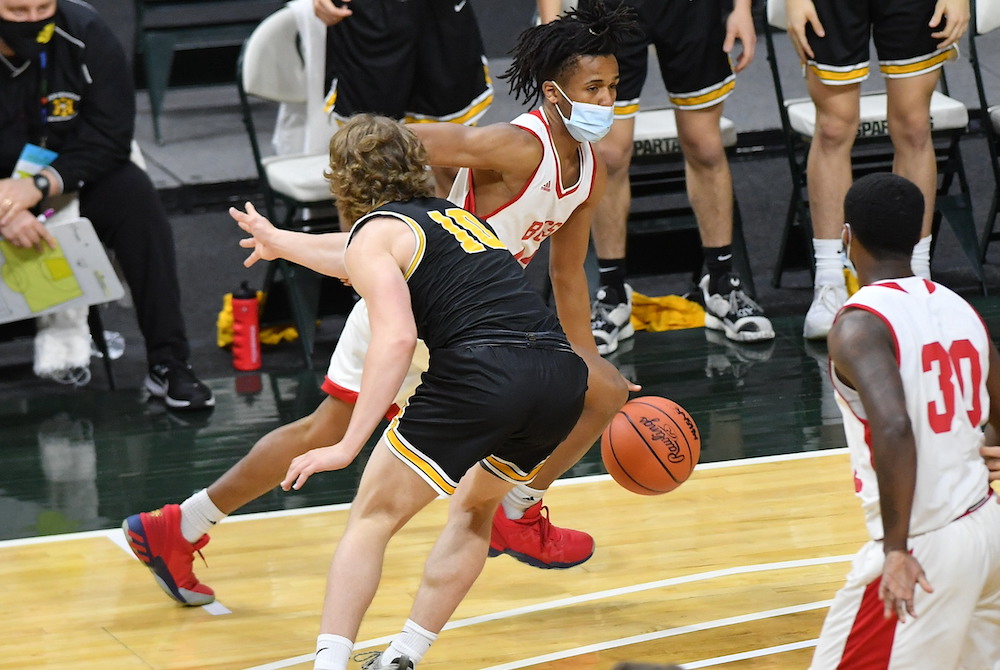
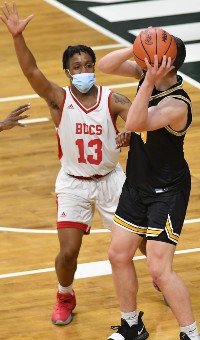
PHOTOS: (Top) Beecher's Carmelo Harris makes his move toward the lane during Saturday's Division 3 Final. (Middle) The Bucs' Taylin Muldrew (13) gets a hand up as Iron Mountain's Foster Wonders looks to pass. (Click for more from Hockey Weekly Action Photos.)