

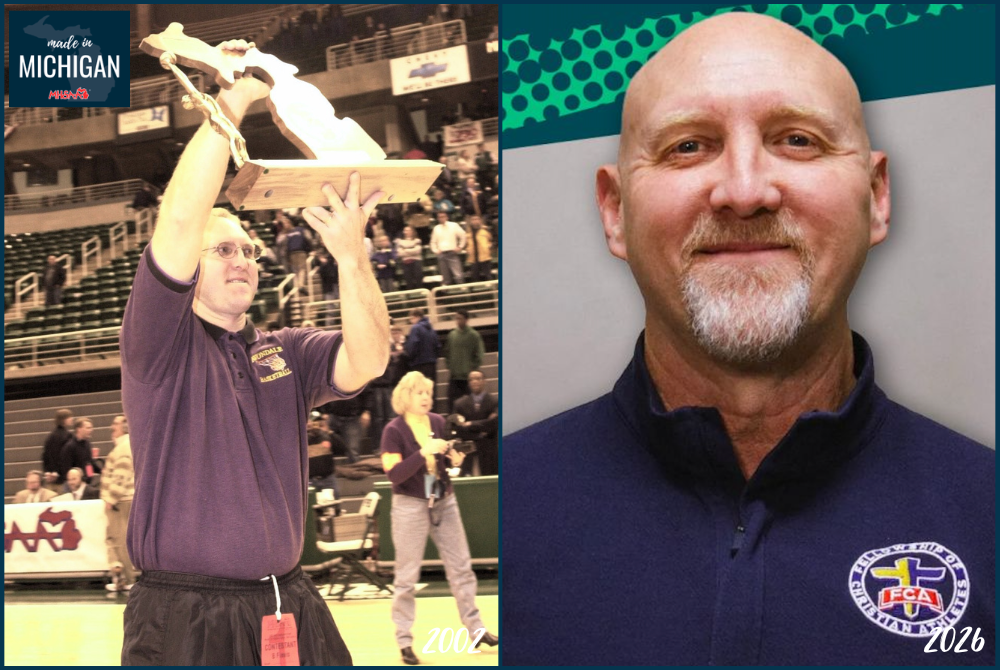
Nearly 25 Years After Leading Unexpected Run, Morton Directing Life-Changing Mission
By
Keith Dunlap
Special for MHSAA.com
August 11, 2026
Nearly a quarter century after presiding over arguably one of the most improbable boys basketball state championships in Michigan history, the same fight and underdog mentality still exists for Tim Morton.
 Back in 2002, Morton was the head boys basketball head coach at Auburn Hills Avondale, which produced a Hollywood-type run during that season’s Class B tournament.
Unranked and without a future Division I college player in the lineup, a Yellow Jackets team headlined by seven seniors went on a quest that stunned many statewide observers.
Avondale avenged the disappointment of not getting out of the District round the previous year and then recorded a stunning upset of a highly-ranked Flint Southwestern team in their Regional Final, winning in double overtime. But after squeaking out a six-point win over a solid Williamston team in a Quarterfinal and earning an 11-point win over Comstock Park in the Semifinals, surely midnight was going to strike for Cinderella in the championship game. After all, Avondale was up against a powerful Grand Rapids South Christian team which had multiple future Division I college players on its roster.
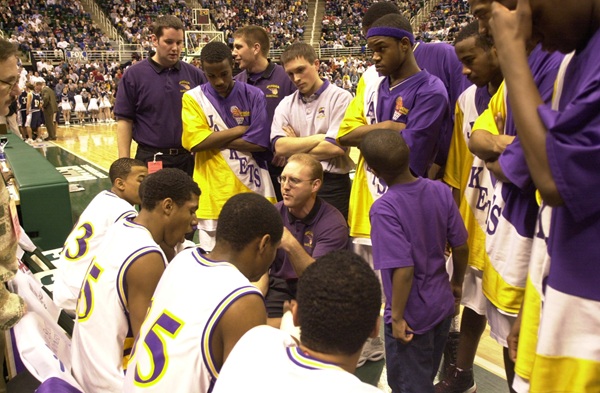
It didn’t matter as Avondale, led by tough-as-nails captains Mike Lewis and Wes Whiteside, senior Dionte Miller and sophomore Dave Holston, completed its stunning run with a 70-65 win to capture what still stands as the program’s only Finals basketball championship.
Morton said he thought his team the previous year that couldn’t make it out of Districts was more talented, but there were intangibles the 2001-02 team possessed that couldn’t be matched.
“I think that nobody really thought that they’d have a shot,” Morton said of his team. “I think that is why we were unranked, because of what had left. But you’ve got to have something to fight for, and I think the reason was the year before. We were motivated. I think playing that underdog role, we just loved it. We won games in so many different ways and got on that roll.”
This past March, Morton and other alumni of the Avondale team certainly were thrilled to see this year’s squad advance to the Semifinals for the first time since their 2001-02 team did so. This time, the Yellow Jackets suffered a three-point Semifinal loss to eventual Class A champion Rockford.
Today, Morton is also heading another team that has an underdog mentality but is motivated to fight for each other and surrounding communities.
Morton is the multi-area director for the Southeast Michigan chapter of the Fellowship of Christian Athletes, which aims to serve kids, coaches and communities by promoting through activities faith, self-esteem, serving others and being the best version of yourself.
The organization has roughly 50 student-led “huddles” that meet at high schools or middle schools, where students can have a safe haven to talk about problems, promote successes, go over scripture and bond during a challenging time of life.
Through volunteers and other staff members, the organization also conducts camps throughout the state for coaches, athletes and others to learn from each other and grow as leaders.
The chapter will have its annual golf outing Sept. 28 at Oakland University’s Sharf Golf Course.
“We just want to be really good at cultivating those relationships, making sure that we’re following up with people, and sharing what the Lord is doing so people feel like they can be connected to something bigger than themselves.”
 Playing for something bigger than themselves certainly worked for the 2002 team, and Morton said there is a 25th anniversary reunion in the works for next spring.
But while he nor anyone else in the Avondale community will forget that run in 2002, these days Morton is spearheading a team he said is playing for an even greater purpose, one he tried to describe to a group of youth football coaches in Flint during a recent gathering.
“I had only about 15 to 20 minutes to share with these guys,” Morton said. “I shared that we won a state title in 2002 and I was driven to be the best coach I could possibly be. A lot of great things happened, and the state championship happened. I’m on my way home from the state championship and we’re watching the video, and it’s crazy because this fear came over me. How are we going to do this again?
“Every coach that puts his or her full identity in the performance of the team, that’s scary and that’s not good. I got out six years later because of that fear. The most important relationships of my life were not good because I had to be validated by the performance of my team. That conversation kind of led into, “Why are you coaching? Why are you doing what you are doing? I wanted them to be motivated to be the best versions of themselves, for those kids, their wives and children. That’s why I’m in FCA. That’s my cause to fight for.”
2026 Made In Michigan
Aug. 7: Significance of Historic Run, Relationships Formed Live On for 1973 Unity Champs - Report
Aug. 4: Work Ethic Continues to Drive Van Dyk's Endeavors as Co-Owner of Family Farm - Report
July 24: Hackett Mentor's Care Sparked Lifetime in Hoops for BCAM President White - Report
July 24: Mackey Leaving Court with 500+ College Hoops Wins, Many More Lessons Shared - Report
July 16: Country Day Two-Time Champ Moore Building Perennial Winner at Harvard - Report
July 9: Multi-Sport Career at TC West Helps Gillis Thrive as Pro in Game She Once Left Behind - Report
July 2: Inspired by Home, Eager to Give Back, Spencer Hosts Hoop City Alumni Games - Report
PHOTOS At left, Tim Morton raises the Class B championship trophy in 2002. At right, Morton now a director for Fellowship of Christian Athletes. (Middle) Morton, kneeling, speaks to his team during the championship win at Breslin Center. (MHSAA archives)

Task Force Building Multi-Sport Message
November 11, 2016
By Geoff Kimmerly
Second Half editor
Walled Lake Western’s Cody White draws his perspective on high school sports from a background that, while perhaps not unique, has to be close.
The Warriors senior is one of the top college football prospects in Michigan, a Big Ten-caliber player who has committed to continue his career at Michigan State University after he graduates in the spring.
Our state has a handful of athletes like that every year, of course. But White also is the son of former NFL player and Detroit Lions executive Sheldon White – and has followed his father’s Dayton, Ohio, footsteps in playing three sports during his high school career.
White plays football, basketball during the winter and baseball in the spring, in addition to travel basketball and baseball during the summer. He has played these same sports throughout high school. His freshman year he also competed in track & field, along with baseball. As of May – when White and his multi-sport experience were featured on Second Half – he hadn’t ruled out returning to track & field, in addition to baseball, as a senior.
“I couldn’t see myself not competing in those sports,” White said at the time. “I love them so much. I want to finish my senior year playing all three.”
It’s White’s experience, and the benefits enjoyed by so many who have shunned the recent trend toward specialization, that is driving the MHSAA’s Multi-Sport Task Force as it aims to promote the value of a varied sports experience through high school, even for athletes considered “elite” in a sport they’ll go on to play at higher levels.
The Multi-Sport Task Force met for the third time Oct. 27 and includes coaches, administrators and teachers with diverse experiences in athletics at schools large and small; urban, suburban and rural and in both the interscholastic and club settings.
The idea of moving away from specialization and back toward playing multiple sports has gained steam in recent years with pronouncements of how doing so paid off for nationally-recognized stars like professional golfer Jordan Spieth, baseball Hall of Famer John Smoltz and a number of members of the U.S. women’s soccer national team who played multiple sports through high school.
The MHSAA’s task force is working to develop that message, package it in the most digestible formats, and deliver it to the key decision-makers to benefit athletes at the age where the message can have the heaviest impact on their sports careers and growth into physically fit adults.
“This is a fundamental topic in school sports,” MHSAA Executive Director Jack Roberts told the task force during its most recent meeting. “This is something we’ll be talking about five and 10 years from now.”
The task force is charged with a series of goals that will be discussed below and are still in development. But there’s no doubt coaches will play a significant part in promoting and carrying out this important mission.
“Growing up was a little different (for me) than the usual kid. Going to Lions games and just being around football all the time. I think I love the game more because I was around it so much. But I think playing three sports helped me, too. The twisting of your hips in baseball, when you swing the bat, you’re using different muscles. And all the jumping you do in basketball. You have to move in tight spaces. With football, you’re with the football guys. By doing all three you meet different people.” – Cody White, “Western’s White Enjoys ‘Special’ Career” – May 4, 2016
What we’ve learned
The task force’s first meeting in April included discussions with Dr. Tony Moreno of Eastern Michigan University, a frequent Coaches Advancement Program instructor, and Dr. Brooke Lemmon of the MSU Sports Medicine Clinic. Among points from their focus on medical issues that result from specialization:
• Specialization has chronic, long-term affects; young people who do not learn physical literacy – how to solve movement problems – are less likely to be physically active and, hence, less likely to be physically fit. This is becoming an expensive health issue for society.
• The loss of physical education from schools is the root of these problems and has led to the creation of “privatized PE” for those who can afford a club sports experience. Physical education in schools, done correctly, can create a relatively noncompetitive environment that increases student interest in becoming physically active.
• More time spent in one activity will lead to more injuries, especially of the chronic nature. The number of hours per week a child spends on one sport activity shouldn’t exceed that child’s age (8 hours per week for an 8-year-old, for example).
Dr. Dan Gould, the director of the MSU Institute for the Study of Youth Sports, talked to the task force during its second meeting about how children perceive sports – and the need to adjust parents’ expectations for their kids’ success. He explained how kids can lose their identity focusing on just one sport, and also the importance of free play – the games kids make up themselves while playing in a structure-free environment.
Bob Mancini of USA Hockey visited with the task force most recently, explaining how his was the first governing body to tell athletes it wanted them to play their sport – but in order to do so well, play other sports also. USA Hockey’s American Development Model was launched in 2009 to in part promote multi-sport participation – and is growing hockey in the process, with increased participation seen at youth levels over the last three years.
“It’s just really fun to do different things. We don’t have a lot of the numbers, but we have the people who are willing to put in the hard work, even if it’s not their best sport. Each season is only three to four months at the most. So it keeps things exciting.”— 2016 Bronson graduate Kelsey Robinson, a defensive specialist in volleyball, former cross country runner, guard in basketball and a third baseman and centerfielder in softball, “Multi-Sport Experience ‘Special’ for Bronson” – February 2, 2016
Questions & Answers
The task force will meet again Feb. 8, and in the meantime there are a number of questions – and answers – to be considered.
The group has pinpointed a series of goals:
1. Partner with groups promoting diverse physical activity.
2. Encourage those promoting more and better physical education.
3. Prepare tools for administrators for use in interviewing prospective coaches, conducting meetings with their coaching staffs and encouraging them to “walk the talk” of balanced participation.
4. Assist in the explanation of the multi-sport experience to parents through a variety of media, including a guidebook and video explaining its benefits.
Carrying out these aspirations comes with plenty to discuss.
Who most needs to hear the message of multi-sport participation? It’s most likely junior high and middle school parents, or even those of elementary students just starting to experience organized athletics.
 What do these parents and children most need to know? Parents are stakeholders in their children’s athletic ventures. The challenge is convincing them our way is best for their kids’ futures, from a health and development standpoint.
Who should deliver this message? Celebrities obviously carry clout when they talk about how their multi-sport experiences led them to become successful adults. But there also could be a strong emotional tug from current student-athletes who tell their stories.
How can coaches and athletic directors help spread the word? The MHSAA, with input from the task force, will develop tools to help. But the options are many: could it come in video form, eye-catching graphics for use at coaches meetings, or live interaction at regional summits?
We are looking for ideas, both for getting out the message and incentivizing taking part in the multi-sport experience. Schools already are doing great things to promote multi-sport participation, and we’d love to hear about what's working.
To that vein, we’ll close with a final success story from this fall about a team that benefited from a lineup of multi-sport athletes:
Grosse Pointe Woods University Liggett on Oct. 15 ended an eight-year championship run by Ann Arbor Greenhills at Lower Peninsula Division 4 Boys Tennis Finals. Knights coach Matt Sobieralski relied on a roster filled with multi-sport athletes, including No. 1 singles player T.J. Dulac, who also ran cross country this fall.
Only one player on the Liggett roster plays only tennis, and Sobieralski says his players’ multi-sport participation served them well.
“It makes you tough, mentally tough and strong. And they’re competitive. That’s important. I think tennis, a lot of times, is 80 percent mental and 20 percent ability. You win a lot of matches with guts and just hanging in there. I always say a good player can win even when they’re not playing their best, because they’ll try something different and they keep fighting. That’s the team I’ve got. I’m really proud of their fight.” – Matt Sobieralski, “Liggett Ends Greenhills’ 8-Year Reign” – October 16, 2016
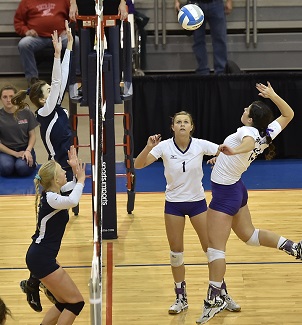
PHOTOS: (Top) Walled Lake Western's Cody White runs ahead of a group of Lowell defenders during last season's Division 2 Semifinals. (Middle) Bronson (right) goes for a kill during last season's Class C Semifinal against Traverse City St. Francis. (Top photo courtesy of Walled Lake Western athletic department.)