

P-W Finishes Historic March Atop D3
March 16, 2019
By Geoff Kimmerly
Second Half editor
EAST LANSING – Collin Trierweiler found himself outside with his older brother again, firing up free throws, one of his favorite things to do when he was younger.
Except this time, he was standing at the free-throw line at the Breslin Center, with no one else on his side of the court, less than a second remaining on the clock, and Pewamo-Westphalia’s first MHSAA Finals championship hanging on the shots he was about to take.
A meeting of undefeated finalists came down to the slimmest of margins Saturday at the Breslin Center. Trierweiler, on the line after an intentional foul was called on Iron Mountain with seven tenths of a second to play, made it through two timeouts before sinking the first shot, and a third timeout before making the second to put the Pirates ahead 53-52 and all but ice the Division 3 championship.
Trierweiler hadn’t practiced all postseason, and sat out multiple games with an ankle injury. But he played 26 minutes in the Final, on the court when it counted most.
“As a senior, right around the time when I get hurt, right as the playoffs start, it was frustrating, Trierweiler said. “Coach said it would be best to sit out the practices and just fight through the games. Every game I just had my teammates on my back saying you’ve got this, you’re fine, just keep playing the game. And when I was feeling pain, they’d help me forget about it.
“The free throws, I just tried to calm myself down and think about myself out in the driveway with my older brother. We used to practice all the time, and it was one of my favorite things to do. I always dreamed of a moment to be put on the free-throw line, a big moment. Maybe not quite this big, it was a little scary, but I tried to just block out the background, see the trees in my yard, and put them up and shoot them in.”
P-W (28-0) previously had finished Class C runner-up in 1993 and 2014.
Trierweiler entered this week making 59 percent of his free-throw tries this season.
But his absence from normal practice activities the last few weeks may have been a blessing in disguise.
“When he’s been sitting out, he’s been shooting free throws. I had him shooting free throws again (Saturday),” P-W coach Luke Pohl said. “Was I a little leery? Not really, because he’s a pretty tough-minded kid.
 “I remember his mother telling me this season, (that) when he was just a little boy, he’d be dribbling the basketball in front of his mom saying, ‘Mom, someday I’m going to be the point guard at Pewamo-Westphalia,’ and he was so proud of that.”
The Pirates had led most of the first five minutes of the first quarter, but didn’t lead again until Trierweiler’s free throws at the end.
Iron Mountain (27-1) led by as many as eight points during the second and third quarters and by six multiple times during the fourth. Pirates senior Andre Smith took a six-point lead to three with a 3-pointer with 1:44 to play. After Trierweiler missed two 3-point tries to tie the score, he went in for a layup instead with 22.7 seconds left to bring the margin down to one.
Two free throws by Mountaineers’ sophomore Foster Wonders pushed the lead back to three, but again Trierweiler scored with 11.5 seconds left to make the margin one. Iron Mountain broke the ensuing pressure but was called for a travel, and on P-W’s last attempt to get down the court for a final shot, Trierweiler drew the intentional foul.
The ending was emotional for obvious reasons. Pohl said his heart went out to Iron Mountain. But he believed if Trierweiler hadn’t been fouled, he would have scored.
The Iron Mountain contingent certainly was disappointed, but completed a memorable run that saw the Mountaineers defeat last season’s Class C champ Detroit Edison in the Semifinal on the way to Saturday.
“We put in tremendous effort. It didn’t just start this year – it’s been going on for years with these guys,” Iron Mountain coach Bucky Johnson said. “Their effort has never been in question. I’m really proud of them for that. Pewamo, great effort by them too.”
Smith finished with 21 points, including five 3-pointers, for P-W. Junior Aaron Bearss had 15 points and eight rebounds.
Wonders scored a game-high 20 points for Iron Mountain, and junior Marcus Johnson had 17 points, six rebounds and three assists.
“I thought our kids played awesome,” Bucky Johnson added. “They went toe to toe, both teams. Give them credit, give us credit, what do you say? … It’s part of the game. It stinks to be on this end of it.”
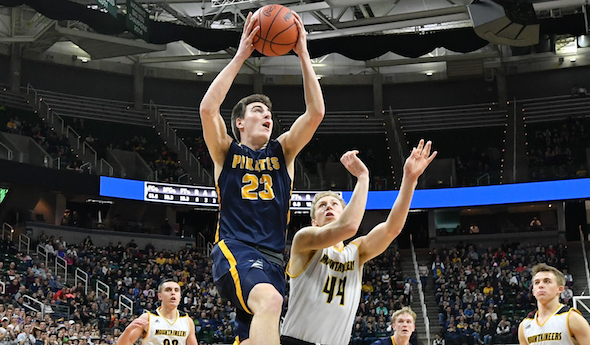
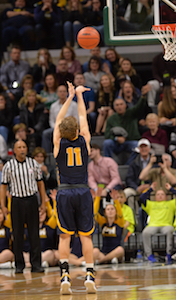
PHOTOS: (Top) Pewamo-Westphalia’s Aaron Bearss makes a move to the basket while Iron Mountain’s Charlie Gerhard defends during Saturday’s Division 3 Final. (Middle) Collin Trierweiler shoots one of his last-second free throws.
Breslin Bound: Boys Report Post-Break
January 8, 2018
By Geoff Kimmerly
Second Half editor
The holiday break across our state is over, and the drive toward March will click into a second gear as most teams this week jump into the heart of league play.
 Today’s Breslin Bound – powered my MI Student Aid – takes a look at a number of contenders that made impressive strides over the last three weeks while classes were out of session, plus gets us back into the regular swing with a look at five games of special note coming up.
These reports are based on results and schedules posted for each school at MHSAA.com – to offer corrections, email me at [email protected].
Week in Review
The countdown of holiday break’s five most intriguing results:
1. Detroit East English 80, Clarkston 71 – East English’s David DeJulius scored 42 points at North Farmington’s Holiday Extravaganza as his team handed reigning Class A champion Clarkston its only loss this season.
2. Grand Rapids Forest Hills Central 72, Wyoming Godwin Heights 68 (OT) – After two losses to open this season, Forest Hills Central has strung together three nice wins with this one over the previously-unbeaten Wolverines at Cornerstone’s tournament the most impressive.
3. Ann Arbor Skyline 74, Belleville 60 – Skyline emerged from a tough holiday schedule still undefeated and having handed possible Class A contender Belleville its third loss.
4. Bridgeport 68, Frankenmuth 54 – The first round between these Class B powers went Bridgeport’s way after last season’s split led to the rivals sharing the Tri-Valley Conference East title while finishing a combined 40-6 overall.
5. River Rouge 52, West Bloomfield 50 (OT) – The Panthers’ perfect start has included two overtime wins including this one over a Lakers team that has two two-point losses and made the Class A Semifinals a year ago.
Watch List
With an eye toward March, here are two teams in each class making sparks:
CLASS A
Grand Haven (7-1) – The Buccaneers also opened 7-1 last season on the way to finishing 18-5, but this start is more impressive. The only loss was by three in double overtime to Spring Lake, which won 19 games last season. And the wins have included Grand Haven’s first over Muskegon since 2012.
Hazel Park (7-0) – There may not be another team that has started more impressively. Coming off 15-8 last season, the Vikings have double-digit wins against Class A powers Detroit East English and U-D Jesuit, an overtime win over Class B standout Detroit Henry Ford and a six-point win over possible Class C contenders Detroit Edison Public School Academy and Pershing (plus another double-digit win over Loyola).
CLASS B
Hillsdale (6-1) – Since opening with a loss to Hanover-Horton, Hillsdale has been rolling. The Hornets followed up a Pat Patterson Tournament championship at Hillsdale College with a 61-44 revenge victory over Onsted – which abruptly ended Hillsdale’s 2016-17 at 21-1 with an upset during last year’s District.
Otsego (5-1) – A slow start last season contributed to an 11-11 finish, but the outlook is better this winter. Otsego’s only loss was to Dowagiac by six during the first week, and the Bulldogs closed December by handing Marshall its only defeat, 80-60.
CLASS C
Detroit Edison Public School Academy (3-3) – DEPSA plays only a few schools its size as part of the Detroit Public School League, and similar experience paid off with a run to the MHSAA Semifinals last season. The wins this winter are over Belleville, Saginaw Arthur Hill and Southfield Christian, and the losses just as impressively have come against U-D Jesuit, Detroit Martin Luther King and Hazel Park.
Kalamazoo Hackett (7-0) – The Irish are another team surely fueled by an early exit last season; they were 19-1 when they fell to Kalamazoo Christian in their first District game. Hackett has a four-point win over reigning Class D runner-up Buckley and gets Christian for the first time this season Friday.
CLASS D
Hillman (6-0) – An MHSAA quarterfinalist last season, Hillman is up to its usual level of regular-season dominance. The Tigers have won all of their games by at least 14 points, with an 18-pointer over Cedarville (5-2) looking like the best so far.
Kingston (6-0) – The Cardinals are halfway to equaling last season’s 12-9 finish and survived their only single-digit scare to win by six over Sandusky on Dec. 20. Kingston followed that with 13 and 28-point wins to claim the Brown City Invitational title.
Can't-Miss Contests
Be on the lookout for results of these games coming up:
Tuesday – Maple City Glen Lake (4-0) at Buckley (2-2) – Reigning Northwest Conference champion Buckley is in third starting the week but gets the two first-place teams back-to-back, Glen Lake followed by also-undefeated Frankfort on Thursday.
Friday – Detroit East English (5-2) at Detroit Edison PSA (3-3) – The PSL East Division 1 is loaded with potential statewide contenders, and these are two with high hopes.
Friday – Canton (7-0) at Wayne Memorial (5-1) – These two lead the Kensington Lakes Activities Association Black, with Wayne’s opening loss to Clarkston the only defeat between them.
Friday – Wyoming Tri-unity Christian (6-0) at Grand Rapids Covenant Christian (5-1) – This will be a major test for the Grand Rapids area’s small-school powers.
Friday – Orchard Lake St. Mary’s (6-1) at Detroit U-D Jesuit (5-2) – This should prove key again as the Eaglets chase the reigning Detroit Catholic League Central champ Cubs.
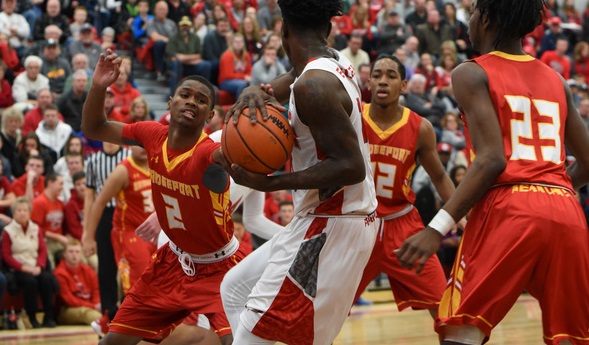
PHOTO: Bridgeport applies defensive pressure during its win over rival Frankenmuth on Friday. (Click for more from HighSchoolSportsScene.com.)