

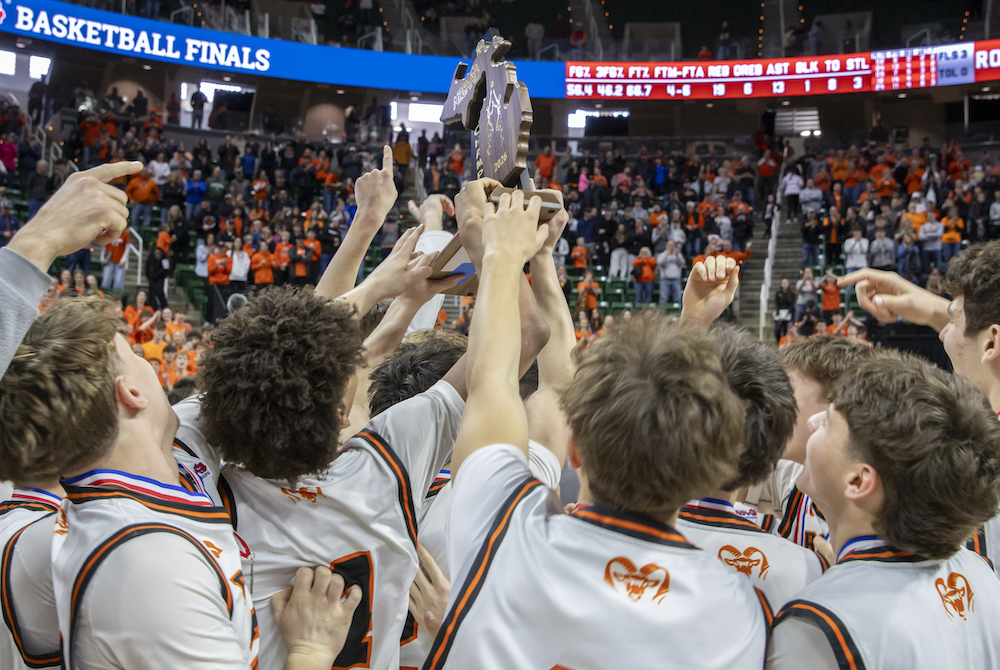
Rockford Adds to Program Legends in Claiming 1st Finals Title Since 2003
By
Paul Costanzo
Special for MHSAA.com
March 14, 2026
EAST LANSING – When Kyle Clough took over the Rockford boys basketball program 10 years ago, he called his shot.
Clough had a state championship shirt printed, leaving little doubt about his aim for a program that had not won a Finals title since 2003. He didn’t put a timeframe on it however, with “20??” following the lofty declaration.
Now he can replace those question marks with a two and a six.
Clough’s Rams defeated East Lansing 54-50 on Saturday in the Division 1 Boys Basketball Final at the Breslin Center, putting their program back on top for the first time in more than 20 years.
“I was confident going into that interview, and I thought I needed to be in that place,” Clough said. “All of us remember 2003 and 2012 (when Rockford finished runner-up), and Steve Majerle and Ryan DeKuiper and Michael Redell – those guys are legendary in this state. So, when you get the job in a place like Rockford, you walk in and see the state championships everywhere, there is a pressure. There’s a pressure on these kids.
“We’ve kind of been knocking on the door here of making a run here these last couple years and fell short for one reason or another. This year, these guys were really determined. These guys are some of the greatest kids this school’s ever had. For them to be now in the great part of Rockford basketball history and Rockford athletic history makes me awfully proud.”
Rockford (25-3) now has two titles in program history, as it ended East Lansing’s bid for a championship repeat in a game that came down to the final seconds.
It wasn’t until Jace Opoku-Agyeman broke free for a lay-up with one second to play that it was wrapped up, and the orange half of the capacity crowd at Breslin erupted in celebration.
“At first, I looked at Josh (Bascom) and I was setting up my guy to go to the opposite hoop, then I saw Josh and he called me over to come get the ball,” Opoku-Agyeman said. “I saw the clock with three, four seconds left and I made the lay-up to (go) up two scores so we had the advantage.”
 Opoku-Agyeman was one of three Rams in double figures, scoring 13 points. He was joined by the Bascom brothers, Josh (14) and Jake (11), at the tip of an incredibly balanced Rockford scoring effort.
Dylan Gross added eight, and Eli Wolfe had seven, including the go-ahead layup with 56 seconds remaining.
Wolfe, a sophomore guard who holds scholarship offers from multiple schools in the state, including Central Michigan, has spent much of this season dealing with injuries and will have surgery on his hips in the offseason.
“What he did for us this year is absolutely incredible,” Clough said. “Two torn labrums in his hips, he rolled his ankle in the Regional Semifinal against Saginaw, and he just wouldn’t take any time off. Even at times when we asked him to sit out during practice, he knew he had to be in there with his teammates. He’s one of the best guards in the whole state, period. This year he played incredibly limited. It’s an incredible commitment to his team. He could have stopped early, had the surgery and been back for AAU, but he loves these guys. And what he did deserves a lot of attention, because it was absolutely selfless and incredible.”
While Wolfe’s shot put the Rams ahead and Opoku-Agyeman’s sealed the game, it was their team defense in between that won the game.
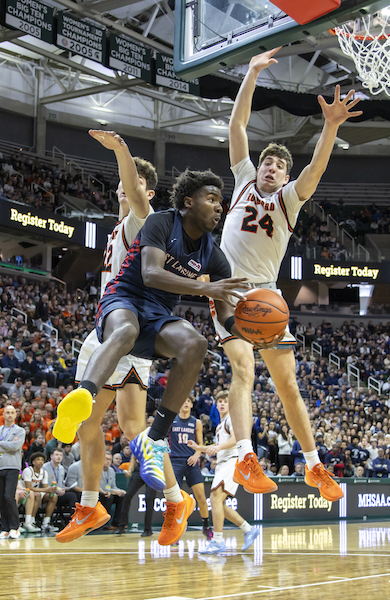
Rockford would not let Mr. Basketball Award winner KJ Torbert get a look at the basket, running a second defender to him every time he got the ball. East Lansing called a pair of timeouts to try and set something up, but Rockford continued to force the ball out of Torbert’s hands or deny him all together.
Clough credited his coaching staff and a morning walkthrough for preparing his team to deny Torbert his chance.
Nearly 50 seconds passed after Wolfe's go-ahead basket, but eventually the Trojans (27-2) did find an open shot from the baseline. But it didn't fall.
“I said, ‘Somebody else is going to have to make a play,’” East Lansing coach Ray Mitchell said. “Obviously they’re doubling KJ, we tried to draw up a scheme to get the ball for an open shot, and actually we got an open shot, but couldn’t knock it down.”
Torbert did finish with 28 points on the day, adding five rebounds in his final game for East Lansing. He will continue his career at Bowling Green, where he’ll be a conference rival of Rockford’s Jake Bascom, who is headed to Central Michigan.
“What can you say about KJ Torbert?” Clough said. “Maybe one of the best players in this state in quite a while, and he stuck here with us in the state. As a coach in this state, I appreciate a guy so much like that. He’s got such a talent level that it brings that kind of a crowd like that into the Breslin Center.”
Kingston Thomas added 10 points for the Trojans, while Tyree Anthony had seven.
PHOTOS (Top) Rockford players raise their championship trophy after winning the Division 1 championship Saturday at Breslin Center. (Middle) Jake Bascom (24) and Drew Ferwerda (22) wall off East Lansing’s KJ Torbert under the basket. (Photos by Adam Sheehan/Hockey Weekly Action Photos.)
Be the Referee: Basketball Measurements
By
Sam Davis
MHSAA Director of Officials
January 4, 2023
Be The Referee is a series of short messages designed to help educate people on the rules of different sports, to help them better understand the art of officiating, and to recruit officials.
Below is this week's segment – Basketball Measurements - Listen
If you’ve seen the movie “Hoosiers,” you know that a basketball rim is 10 feet above the ground. That’s the same if you are in the gym at Beaver Island High School or at Little Caesars Arena. But what are the other court dimensions?
To start – courts are typically 84 feet long but can be up to 94 feet long. They are 50 feet wide.
The free throw line is 15 feet from the face of the backboard and the high school 3-point line is 19 feet, 9 inches from the basket.
Each hoop is a circle, 18 inches in diameter.
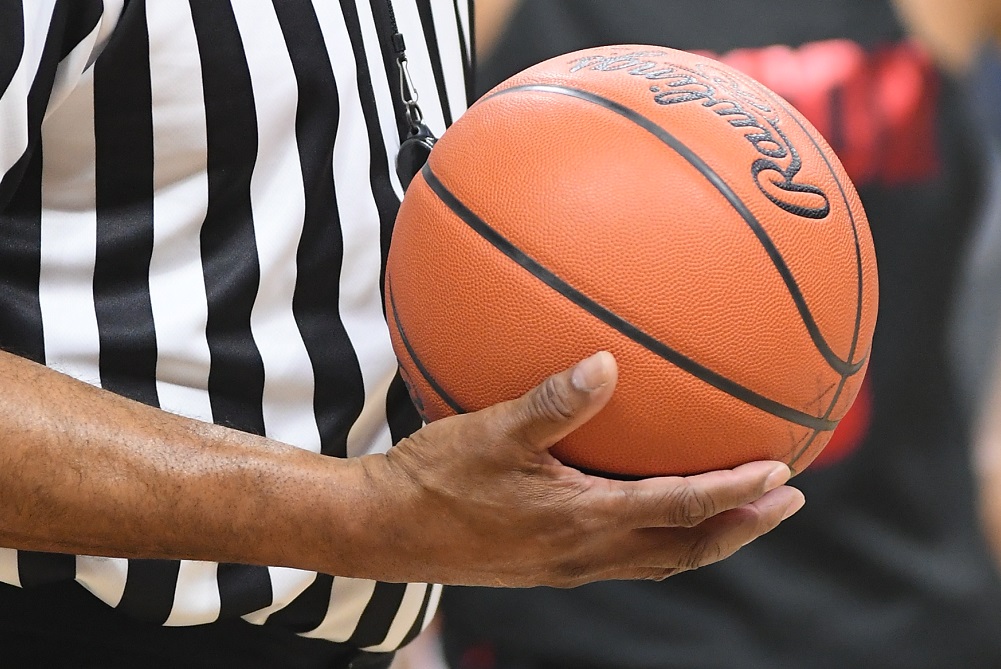
The boys play with a basketball 29½ inches in circumference, the girls with one 28½ inches in circumference.
And believe it or not, two girls balls will go through a standard rim at the same time.
Previous Editions:
Dec. 13: Pregame Dunks - Listen
Dec. 6: Gymnastics Judges - Listen
Nov. 22: Football Finals Replay - Listen
Nov. 15: Back Row Illegal Blocker - Listen
Nov. 8: Swim Turn Judges - Listen
Nov. 1: Soccer Referee Jersey Colors - Listen
Oct. 25: Cross Country Tie-Breaker - Listen
Oct. 18: Soccer Shootouts - Listen
Oct. 11: Safety in End Zone - Listen
Oct. 4: Football Overtime Penalty - Listen
Sept. 27: Kickoff Goal - Listen
Sept. 20: Soccer Timing - Listen
Sept. 13: Volleyball Replays - Listen
Sept. 6: Switching Sides - Listen
Aug. 30: Play Clock - Listen
Aug. 23: Intentional Grounding Change - Listen