

Sand Creek Celebrates Long-Sought Success
By
Chip Mundy
Special for Second Half
February 24, 2017
By Chip Mundy
Special for Second Half
SAND CREEK – It is a season of special anniversaries for the Sand Creek boys basketball team.
 It's also becoming a special season.
Twenty-five years ago, Sand Creek made its only appearance in an MHSAA championship game, losing to Muskegon Western Michigan Christian in the Class D Final.
Twenty years ago, it won the Tri-County Conference title – a feat it had not repeated until Tuesday night when the Aggies downed Ottawa Lake Whiteford 55-40 to remain undefeated and win its first conference championship since 1997.
“It's awesome; it hasn't been done in 20 years,” junior point guard Noah Hague said. “It's very special to be a TCC champ and be a part of Sand Creek history.”
While preseason expectations were high, not many could have predicted a 17-0 start and a No. 4 ranking in The Associated Press’ Class C state poll. But that's where the Aggies are after an 11-11 season last winter that was the first time in a decade Sand Creek reached the .500 mark.
At Sand Creek, football has been the high-profile program with 17 postseason appearances from 1984-2008, including eight trips to the MHSAA Semifinals and one to the Class DD championship game. However, from 2009-2015, the football team had just one playoff appearance and even endured a winless season – but last fall the Aggies rebounded to make the playoffs.
Senior Michaja Wilson played quarterback in the fall, and he starts for the basketball team.
“We had a good year in football,” he said. “We went 8-1 in the regular season, but the last couple of years we were under .500. To bring what we did in football and put it on the basketball court has definitely put us on the map.”
Coach Tory VanSickle believes the football success helped the basketball program.
“They realized how much support you can get in a small town like this when you win games,” he said.
Laying the groundwork
In VanSickle, Sand Creek hired an experienced basketball coach three years ago who had guided varsities at Addison, Hudson and Onsted. He knew it was going to take time to get his new program running in the right direction.
“It was somewhat easier for me coming in as opposed to the last job I had because they hadn't been successful, so the kids were willing to buy into what we wanted to do,” VanSickle said. “The hardest part was getting them to buy into something new that wasn't necessarily best for the team at that time but was best for the program to get back in the right direction.
“For them to buy into playing man-to-man the first year - and now we're not playing that at all. We are pressing a lot and playing a lot of zone and letting the kids do things that they are comfortable doing right now.”
The first year, the Aggies finished a few more wins under .500 but advanced to the District Final before losing. Last year, they won 11 games but again lost in the District Final.
“It was a feather in our cap to get to the District Finals the first year, and the second year was kind of a kick in the teeth to not be able to seal the deal,” he said. “They set the goal this year to win the conference and win the District. We hope to readjust the goals as we go along.”
VanSickle said he saw hints of what has turned out to be a special season a year ago.
“Last year, we lost at least five games that we had in the fourth quarter and gave away in some shape or form,” he said. “I thought we could have been a little better last year, so we might have snuck up on a few people early this year who thought we were just a .500 team from last year. I thought we were more like a 13-7 team.
“We expected to win 15 games and, if we were coachable and truly team players, we thought we had a chance of doing what we're doing. We hadn't been truly coachable or truly team players in the two years prior. We've been a little bit stubborn about changing and somewhat individualistic – and not on purpose, just not recognizing when to pass up a pretty good shot for a really good shot. Make two more passes and realize the impact that has on a team. When everyone touches the ball and we score, everybody plays better defense. When you make one pass and score, you lose some of that camaraderie.”
Making a season special
It was a different summer for the Aggies. Instead of long road trips to scrimmage teams, Sand Creek stayed close to home and worked on fundamentals.
“We spent our summer in this little old pole barn basically,” VanSickle said of the school gymnasium. “We didn't go to any team camps, we didn't go play any games against anyone other than we scrimmaged Addison once and Grass Lake once. The rest of the time we've been in here with the football team lifting weights.
“We tried to build ourselves from the ground up. The year before we played 30-some games, but it's so hard in the summer with kids playing baseball and 7-on-7 football. We would get somewhere and have five kids. It was frustrating more than anything, and it was a real eye-opener for me. This summer we got a lot more work done because we had kids around, and we could keep them for another hour or hour and a half that we would have spent on the road.”
 Sand Creek won its first six games with relative ease. Each of the first three victories were by more than 20 points, and the Aggies didn't have a single-digit win until their seventh game. That opened some eyes on the team.
“At the beginning of the season, we were playing good as a team,” Hague said. “The first couple of games we blew teams out, and in the past those games had been closer. So playing as a team and blowing them out felt good because in the past they had been close games.”
A five-point win at Adrian Madison was next, and it, too, was a key victory.
“Beating Madison at their place was really good for this group of guys because Madison has sort of owned Sand Creek for the last decade,” VanSickle said. “That one let us know we could play with good teams.”
Four double-digit wins followed, and one of those wins came against a then-unbeaten Ottawa Lake Whiteford squad. The 70-53 road victory was a confidence-builder for certain.
“Honestly, I didn't expect to be undefeated,” senior Hunter Gallagher said. “I knew that Madison, Summerfield and Whiteford were going to be good, so I didn't expect to go undefeated.
I think it was after we beat Whiteford the first time. When you beat a good team like Whiteford, you get the rest of the teams' attention.”
Two games later, Sand Creek played what Wilson called “an awful game.”
“We went to Summerfield – their gym is haunted; there is something wrong with their gym – and we were down by seven with two minutes to go, and we ended up coming back and winning,” he said. “It was an awful game, but we ended up winning by one, and we haven't had any close games since.”
It might have been “an awful game,” as Wilson said, but it was a meaningful game, too.
“We saved ourselves when we went down to Summerfield,” VanSickle said. “It's a team we always struggle with; we struggled with them at home and trailed by 10 in the first half and ended up beating them in the second half.
“We were down seven with a minute, 40 to go and pulled it out 49-48. That game told us we had what it took to win those close games. We really hadn't been in many close games.”
The Aggies continued to steamroll opponents, and going into Tuesday night's home game against Whiteford, they needed to win to clinch the outright conference title. A loss likely would have left Sand Creek as co-champion.
“After having a year like this, you don't want to stub your toe at the end,” VanSickle said. “We didn't want to share the title.”
Sand Creek beat Ottawa Lake Whiteford 55-40 to win the Tri-County Conference championship. It was the ninth TCC title for Sand Creek, and seven schools have won the conference since the last time Sand Creek did it. Thirteen players got into the game for Sand Creek.
“We have 14 on the team, and 11 or 12 play in the first half,” VanSickle said. “Our big three kids are Parker Randall, Noah Hague and Hunter Gallagher. They all average between 14 and 15 (points per game), so they're all bunched.”
Gallagher came into the week averaging 15.2 points and 6.6 rebounds per game. Randall is at 15.1 points per game with 5.9 assists and 5.5 steals, and Hague is scoring 13.7 points per game with 4.8 rebounds and 2.4 assists.
“Noah's the point guard,” VanSickle said. “He's 6-3 and the best free-throw shooter in the county and gets to the basket. He's our second-best post-up guy besides Hunter.”
Wilson, one of four senior starters, is averaging 5.3 points, 3.5 rebounds and 2.8 assists per game, and he has scored in double figures in three of the past four. Logen Gallagher – twin brother of Hunter Gallagher – is averaging 6.0 points, 4.1 rebounds and 2.0 assists per game.
“Wilson is starting to come on, and Tim Gritzmaker has started at the wing for us,” VanSickle said. “He's a good 3-point shooter and a smart kid, Logen comes in and backs Tim up, and he's another 6-3 kid who can shoot the ball from a ways out and can score from inside.
“We have a lot of seniors who can do a lot of different things. We bring in Jake Houston, who was an all-conference center in football. When we need a guy to get rough and tough and rebound the ball, Jake plays. When you have a team that is trapping and pressing, Jake watches. They all buy into it. No one gets mad about not playing. They understand the goal is the name on the front of the jersey.
“There are five juniors off the bench who play between three and four minutes in the second quarter, but they get some time so hopefully next year we don't have a real letdown in terms of our experience. Most of our scoring comes from our seniors, but our juniors are getting game experience and letting our seniors get breaks. The depth has been huge for us.”
Of course, the mission is not complete. Sand Creek has a shot at an undefeated regular season, and then it will try to win its first District championship since 1996.
“We went to the District finals in football, and in basketball the past two years we went to the district finals, and we ended up losing every time,” Wilson said. “Quite honestly, I'm sick of losing District Finals, so I am hoping we can win a District and then keep going.”
That attitude is contagious.
“We came into the season feeling like we needed to win the league, and we needed to win the District,” Randall said.
The architect
VanSickle has a connection with the Sand Creek program from the magical 1992 season. When the Aggies played for the Class D championship, VanSickle called the game for WLEN radio.
 “I worked for the radio station and announced that game, and Jason Boring, the best player off that team, is now helping me coach here,” VanSickle said. “So I've kind of come full circle a little bit.”
VanSickle comes from a coaching family, and a successful one at that. His father, Denny, coached Onsted to an undefeated regular season in 1969-70, and his uncle Steve Prange coached Onsted to an unbeaten regular season in 1982-83.
VanSickle hopes to add another unbeaten team to the family circle.
“I remember that 1982-83 team was a deep team and a lot of guys who could play,” he said. “They kind of remind me of ourselves with a lot of depth and a lot of guys who can bump down and play a different spot depending on the opponent. I was at the age when I was pretty impressionable, so a lot of those guys were guys I looked up to.”
Now, the Aggies are looking up to him, and in three years, they have totally bought into what VanSickle is selling.
“I think when coach came in, we had more freedom to play our game instead of what he wants us to do,” Gritzmaker said. “He wants us to play within ourselves and do what we can do. He likes what everybody brings to the table.”
VanSickle has the Aggies playing a full-court press, and that aggressive attitude has been welcomed by the players.
“I'm liking the press,” Hague said. “It helps keep the game high-tempo, and that benefits us more than the other team playing, at that fast pace.”
With a high-tempo game comes some mistakes, and Hunter Gallagher said Coach VanSickle sent a message about those miscues.
“If we turn the ball over, he expects us to hustle back on defense,” Gallagher said. “He says that instead of complaining about something we did wrong on offense, take it out on the other team by playing defense.
“It was about halfway between my sophomore year when I really understood what he wanted to do offensively and defensively.”
VanSickle seems to be a perfect match. He is a basketball coach who has resurrected his program at a school that is known for football. That is not always a simple thing to do.
“It's fun to be a part of a resurgence, and it's good for me, too,” he said. “I kind of needed a resurgence after my last job. I've been kicked in the teeth a little bit, so it's nice to see the team and our school have a little revival, and myself, also.
“They are really starting to buy in, especially in the last month as we started to get ranked in the state. We talk and say, 'Hey, it's just an opinion,' but it does draw some attention, and it's a matter of respect, not only for us but for our conference, too.”
And the Sand Creek community has noticed. In the middle of winter, fans are parking near the football field and walking past the green bull outside the gym to watch the basketball team.
“The crowds have been great,” VanSickle said. “We're getting a lot of the old-timers to come out, and they take the young kids under their wing. You can see them pointing at the kids during the game and talking to them after the game. It's neat to see.”
And likely, vice versa.
 Chip Mundy served as sports editor at the Brooklyn Exponent and Albion Recorder from 1980-86, and then as a reporter and later copy editor at the Jackson Citizen-Patriot from 1986-2011. He also co-authored Michigan Sports Trivia. E-mail him at [email protected] with story ideas for Jackson, Washtenaw, Hillsdale, Lenawee and Monroe counties.
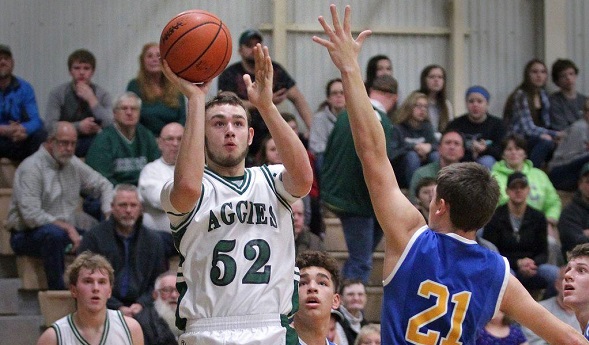
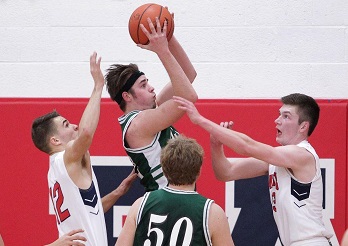
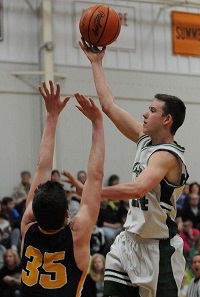
PHOTOS: (Top) Sand Creek's Hunter Gallagher pulls up for a shot against Adrian Madison. (Middle) Noah Hague splits a pair of defenders while retaining possession. (Below) Parker Randall rises above an opponent to take a shot. (Photos courtesy of the Adrian Daily Telegram; top and middle by John Discher and below by Deloris Clark-Osborne.)
Breslin Bound: 2025-26 Boys Report Week 1
By
Geoff Kimmerly
MHSAA.com senior editor
December 8, 2025
Winter has certainly arrived in Michigan over the last few weeks – at least from a snowy standpoint – and right on the time to signal the start of boys basketball season and our first report on the annual march to Michigan State's Breslin Center.
 Big matchups already are happening, and every game against an MHSAA Tournament opponent counts toward seeding for District brackets, and once again we're diving into the results you need to know from the previous week, teams that are showing up big in each division and matchups coming up that you won't want to miss.
“Breslin Bound” is powered by MI Student Aid and based on results and schedules posted for each school at MHSAA.com.
Week in Review
The countdown of last week’s five most intriguing results:
1. Grand Rapids South Christian 75, Grand Rapids Christian 71 The Sailors (2-0) opened by adding to last season’s District Final win over Grand Rapids Christian (1-1), and after having lost to the Eagles 72-55 in their season opener a year ago.
2. Bloomfield Hills Brother Rice 71, Detroit U-D Jesuit 42 Brother Rice (2-0) enjoyed some significant payback after falling to Jesuit twice last season, during the regular season in what eventually decided the Catholic High School League Central title and then in their Regional Semifinal matchup.
3. Saginaw United 67, Detroit Catholic Central 57 The Phoenix (2-1) opened their new fieldhouse with a notable season-opening victory over the Shamrocks (2-1), who defeated United 69-55 in their opener a year ago.
4. Grand Blanc 76, Hamtramck 75 (OT) The Bobcats (2-0) opened the season with this notable win at the Horatio Williams Tip-Off Classic.
5. Warren Fitzgerald 41, East Kentwood 40 This was another exciting finish at the Horatio Williams event, again in a faceoff of teams with high aspirations this season.
Watch List
With an eye toward March, here are two teams in each division making sparks:
DIVISION 1
Grand Haven (3-0) The Buccaneers finished an opening week of road games without a loss, defeating Coopersville 65-42 and then Traverse City Central 83-71 and Traverse West 79-77 over the weekend. Grand Haven improved from 11-12 in 2023-24 to 18-6 last season and will have some opportunities to get rolling heading into the new calendar year with a Dec. 22 matchup against Freeland and its Lake Michigan Cup on Dec. 29-30.
North Farmington (2-0) The Raiders are coming off a 12-10 finish and third place in the Oakland Activities Association Red last season, and got off to a fast start under first-year coach Peter Mantyla with a 41-35 win over Canton and a 62-47 victory over Davison while hosting the Horatio Williams Tip-Off Classic. Reigning league champion Birmingham Groves is up next, on Friday, and the first matchup with Farmington – which ended the Raiders’ season last winter – is Dec. 19.
DIVISIION 2
Dundee (3-0) The Vikings appear on track to bounce way back after going 21-5 in 2023-24 but then only 5-18 last winter. They opened last week with a 12-point win over Saline Washtenaw Christian, a 47-46 victory over Milan and a 51-45 triumph over Britton Deerfield – and after losing to Washtenaw Christian by six points during the early going a year ago.
Freeland (3-0) The Falcons are coming off a 22-4 finish and run to the Division 2 Quarterfinals last winter, so a fast start isn’t a surprise. But it was still impressive; Freeland opened with a 22-point win over Bridgeport, then defeated Menominee by 22 and Petoskey by 15 at the latter’s Sean Pollion Invitational. Showcase games against Auburn Hills Avondale and Grand Haven later this month will be opportunities to impress.
DIVISION 3
Ishpeming Westwood (3-0) The Patriots reached the Semifinals last season for the first time since 2003 with Ethan Marta leading the way, and he’s doing so again to begin his senior year as Westwood opened with sizable wins over West Iron County and Hancock. They finished a perfect first week with an 83-64 victory over rival Ishpeming.
North Muskegon (3-0) The Norsemen are off to the right start as well after last season’s 23-2 finish and Regional Final run. They won all three of their games last week by at least 20 points, defeating Division 1 Walled Lake Western 64-44 in the championship game of the Will Lynch Invitational at Benzie Central. And they celebrated senior Adam Dugener reaching 1,000 points in the season-opening win over Holton.
DIVISION 4
Clarkston Everest Collegiate (2-0) A Regional finalist and 24-2 overall last season, Everest jumped 10 wins from 2023-24 and is off to a fast start again. The Mountaineers opened with a 61-42 win over Livonia Clarenceville and followed with a 59-42 victory over Flint Beecher. Clarenceville is a Division 2 team, and the great majority of Everest’s regular-season opponents play in Division 2 or 3 with a date as well against Division 1 South Lyon East on Feb. 19.
Eben Junction Superior Central (3-0) Two of last season’s first four losses came to Hannahville Nah Tah Wahsh as Superior Central went on to finish the season 9-14 – after going 16-8 in 2023-24. But the Cougars got on the right track immediately this winter with a 57-42 win over Nah Tah Wahsh to open last week before defeating Cedarville 42-41 and Mackinaw City 48-41 on successive days to win the Battle of the Bridge hosted by the latter.
Can’t-Miss Contests
Be on the lookout for results of these games coming up:
Monday – Ishpeming Westwood (3-0) at Kingsford (2-0) – These two both made it to Breslin Center last season, Westwood reaching the Division 3 Semifinals and Kingsford the same in Division 2.
Tuesday – Flint Powers Catholic (2-0) at Bay City John Glenn (1-1) – These two Division 2 hopefuls both won 20 games last season.
Friday – Grand Rapids Catholic Central (0-0) at Rockford (1-0) – The Division 1 Rams may have won their matchup last season 70-43, but the Cougars went on to finish their season in the Division 2 Semifinals.
Saturday – Warren Lincoln (1-0) vs. Arts & Technology Academy of Pontiac (0-0) at Detroit Mercy – These two also both reached Breslin Center last season, Lincoln winning the Division 2 title and ATAP finishing Division 3 runner-up, and they will face off at the U-D Mercy Showcase.
Saturday – East Lansing (1-0) vs. Detroit Martin Luther King (0-1) at Lansing Eastern – The reigning Division 1 champion Trojans should get a strong challenge at the Moneyball Tip-Off Classic from King, which made the Quarterfinals last winter.
MHSAA.com's weekly “Breslin Bound” reports are powered by MI Student Aid, a division within the Department of Lifelong Education, Advancement, and Potential (MiLEAP). MI Student Aid encourages students to pursue postsecondary education by providing access to student financial resources and information. MI Student Aid administers the state’s scholarship and grant programs that help make college Accessible, Affordable and Attainable for you. Click to connect with MI Student Aid and find more information on Facebook and X @mistudentaid.
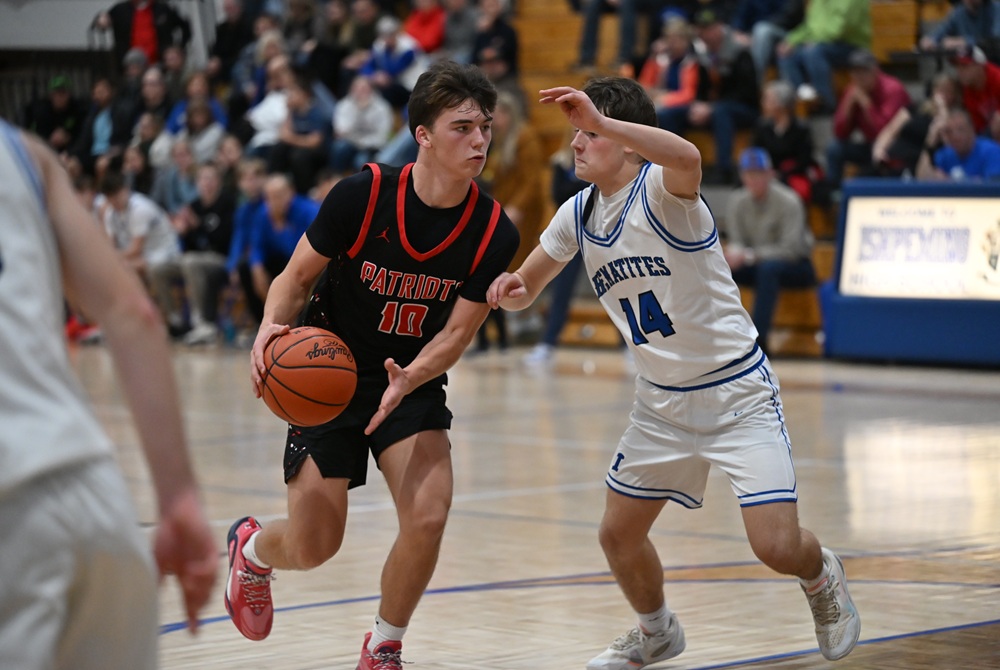
PHOTO While being defended by Ishpeming's Dax Kakkuri on Friday, Ishpeming Westwood's Ethan Marta makes a move to the basket. (Photo by Cara Kamps.)