

Soaring Eagles Score Big with Record Range
By
John Vrancic
Special for MHSAA.com
February 25, 2020
HANNAHVILLE – The Hannahville Nah Tah Wahsh boys basketball team likes to play uptempo and has a knack for hitting 3-point field goals.

The Soaring Eagles excelled at both on their home court Feb. 5 when they sank an Upper Peninsula-record 24 3-point shots in a 73-39 triumph over Northern Lights League rival Big Bay de Noc. They also drained 20 trifectas just four days earlier in a 68-20 victory on Mackinac Island.
In addition to tops in the U.P., the 24 3-pointers also rank third all-time in MHSAA history, while the 20 are tied for seventh-most by a team in one game.
"We didn't think that was a big deal," said 6-foot-2 junior Joe Larson, who connected on six 3-point shots for 18 points against Big Bay. "It's just great to be part of this program. It's like a family atmosphere.
“Coach (Josh Eagle) wants us to split it up a little. He wants us to work the ball inside and continue shooting the threes. Getting the record was so much fun and getting 20 at Mackinac Island got us a step closer. We still need to work on some little things in practice. Once we get those ironed out, we'll be fine."
Eagle tries to encourage the players to take the 3-point shots, which he believes is just part of the game.
"We try to get a shot up pretty quick," he said. "Earlier this season, the kids were pretty shy about shooting the threes when we were facing zones. Now, they're not shy. Our strength is running the floor. We try to launch as many threes as we can and get offensive rebounds."
The Soaring Eagles (14-4) rode an eight-game winning streak into last weekend's NLL Tournament, where they beat Beaver Island and then lost in the championship game to Kinross Maplewood Baptist.
 In their previous outing the Saturday before, sophomore Gage Sagataw scored 23 points as the Soaring Eagles hung on for a 60-58 triumph over Bay Mills Ojibwe Charter.
Sagataw sank seven triples and scored 22 points on Hannahville's record-setting night.
"It felt great to do that," he said. "We've been close friends for a long time, which made it more special. We put a lot of time in on our shooting in the offseason, but sometimes we have to rely on our defense. It doesn't bother me if I miss a three because I know we just have to get back on defense.”
Hannahville now will prepare for the Division 4 District tournament at Rapid River. The Soaring Eagles face Rock Mid Peninsula in a District Semifinal on March 11.
Eagle coached the girls team at neighboring Bark River-Harris for three seasons prior to returning as boys coach to the school on the Potawatomi Reservation in northeastern Menominee County.
"They always work real hard, and we're giving them the opportunity to become men," said Eagle, who coached boys and girls basketball at Hannahville prior to his time at BR-H. "Training the kids to be good people and teaching them the value of hard work is the main objective. Seth Miller (former coach), Ross Rahoi (current assistant coach) and I work with each other and other people from the community to help make them good representatives.
"We're proud of all the players. They're good ambassadors for the community, and as always, there's a long road ahead of us."
 John Vrancic has covered high school sports in the Upper Peninsula since joining the Escanaba Daily Press staff in 1985. He is known most prominently across the peninsula for his extensive coverage of cross country and track & field that frequently appears in newspapers from the Wisconsin border to Lake Huron. He received the James Trethewey Award for Distinguished Service in 2015 from the Upper Peninsula Sportswriters and Sportscasters Association.
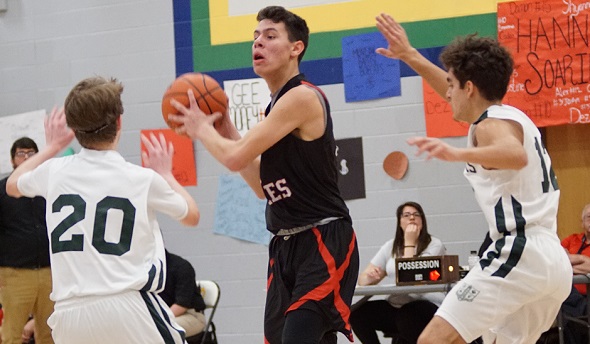
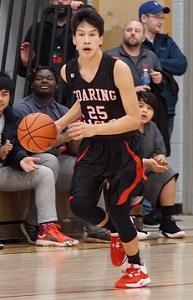
PHOTOS: (Top) Hannahville’s Joe Larson (14) looks for an open teammate during this past weekend’s Northern Lights League Tournament game against Mackinac Island. (Middle) Gage Sagataw brings the ball up the court. (Photos by Robyn Rhode.)

Guards Answer Call for Country Day
March 23, 2013
By Geoff Kimmerly
Second Half editor
EAST LANSING – Before Saturday’s MHSAA Class B Final, Kurt Keener challenged guards Edmond Sumner, Mory Diane and Austin Price to carry Detroit Country Day to one more win.
In the recent past, Keener might’ve asked something similar of guys like 6-foot-11 Amir Williams or 7-0 Da’Shonte Riley. But this was not like most teams Keener has coached to 678 wins over the last 35 seasons.
Of course, Country Day has had outstanding guards lately as well – Ray McCallum and Kenny Knight keyed the 2010 title run – but it’s been a while since a Yellowjackets team has been this guard-driven.
But as they’ve done all season, the trio was ready to answer. Price had 15 points, Sumner 13 and an ill Diane seven in just 16 minutes as Country Day survived its closest game of the tournament to defeat Detroit Community 57-49 and earn its ninth MHSAA championship.
“We’re used to it. With our hard work in practice, we knew what to do when we came down the stretch,” Edmond said. “It was nothing new to us.”
But a title is to this group. Although Price played in Semifinals the last two seasons and Diane joined him in the starting lineup in 2012, none had played in a championship game before facing Community, located just 10 miles south of the Yellowjackets’ campus.
Country Day (25-3) was the favorite coming in to the tournament as the top-ranked team in the final Associated Press poll. But Community (18-10) proved to be much closer in ability than the teams’ records indicated.
 Much has been mentioned during the tournament of the tough schedules both played during the regular season, and particularly of the ranked Class A teams that handed Community a few losses but also pointed the Hurricanes down the path toward their first championship game.
Although Country Day led by a handful of points for most of the final three quarters, Community tied the score 36 seconds into the fourth.
“Sports at times, you’ve got to just dig deep and make a stop. I just kept saying, ‘one more,’” Keener said. “I asked Mory at one point at halftime, ‘Can you give us one or two plays?’ One or two plays in a game like this make all the difference in the world.”
Diane made the jumper that put Country Day back ahead 46-44 with 7:09 to play. Price hit six free throws and Sumner a pair down the stretch as the Yellowjackets finally pulled away for good.
But not until the final minute did it feel like Community had run out of comeback opportunities.
Country Day broke 100 points twice but scored fewer than 62 points only once before Saturday. The Hurricanes outshot the Yellowjackets 41 percent to 39 and had only one fewer rebound. The difference came in part at the free throw line, where Country Day made 20 of 26 tries and Community made only 9 of 16.
“The pressure bothered us a little bit. … If we made some free throws and layups, I think we’re right there,” Community coach Venias Jordan, Jr., said. “This is right where we wanted it. Going into the game, I told (my players) if we keep them 55ish, we had a chance to win.”
But Country Day and especially 6-foot-4 sophomore Deshawn Thomas also did well in limiting South Florida recruit Byron Zeigler. The 6-6 senior had 17 points Friday, but only nine on five shots in the Final.
“They made it pretty hard for us to get in our spots on offense, made it tough for us in the post,” Zeigler said. “They fronted us, double-teamed us, trapped us. They did everything possible to make us uncomfortable so we couldn’t get into our sweet spots.”
Senior forward Jerrell Martin led Community with 13 points and eight rebounds.
Thomas had six points and eight rebounds in 18 minutes off the bench for the Yellowjackets.
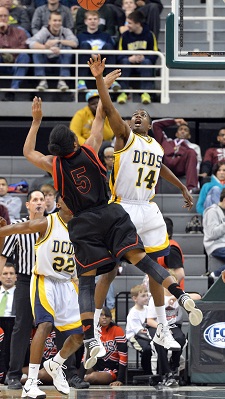
PHOTOS: (Top) Detroit Country Day's Maurice Ways (22) and his teammates rush the floor after the Yellowjackets clinched the Class B title Saturday. (Middle) Country Day's Austin Price (14) and Community's Landie Davis go for a loose ball during the championship game. (Click to see more at HighSchoolSportsScene.com.)