

Stars-Now-Educators Relish Northport Run
March 3, 2017
By Dennis Chase
Special for Second Half
TRAVERSE CITY – Coach Gordie Wick was addressing the crowd that had gathered to celebrate Northport’s Class D boys basketball championship when he glanced at the trophy in front of him.
 “You look at this trophy, and it’s just a piece of wood with a little brass on it,” he said. “But when you put Class D state champions on it, that tells the whole story. We were not No. 2 or No. 3. We were No. 1.”
That will be the goal for hundreds of teams throughout the state when the MHSAA boys tournament tips off Monday.
And Northport’s magical seven-game postseason run in 1988 provides hope for the underdogs. The Wildcats, ranked 16th in the final Associated Press poll, beat four top-10 teams en route to their first and only MHSAA Finals title.
“I don’t think people gave us a shot,” said Jason Stowe, a senior guard on that team.
The players and coaching staff believed, though, and that March produced two of the most memorable shots in Northport history.
First, Jason Stowe hit an arching jumper from the top of the key in the waning seconds to lift Northport to the District title with a 67-65 win over Maple City Glen Lake, which had beaten the Wildcats twice during the regular season. Then, in the Class D championship game, Jason’s cousin, Dan Stowe, leaned in between two Beal City defenders and put up a shot that bounded around the rim and fell through with two seconds left to give Northport an 80-78 win – and the title.
“Every player has a dream to be in a situation like that,” said Dan Stowe, reflecting back. “I was lucky enough to have the ball in my hands, and I was lucky enough to have the shot go in.”
The championship trophy represented a collective effort. Among the starters, all-state guard Sander Scott, then a junior, averaged nearly 29 points a game in the tournament. He lit it up for 39, 40 and 46 in a span of 12 days. Senior guard Freddie Thomas, playing the best basketball of his career, averaged nearly 17 a game during the run. He was the star of the Semifinals with 27 points, seven steals and four assists in a win over Iron Mountain North Dickinson at Jenison Fieldhouse. Jason Korson and Dan Stowe, 6-foot-2 juniors, averaged double figures scoring, too, although it was their interior defense that proved critical. Jason Stowe’s tournament was interrupted by strep throat, but he had another moment to remember at the end – intercepting Beal City’s last gasp in-bounds pass and heaving the ball into the air to start the celebration.
For Jason Stowe, Scott and Dan Stowe, those days as students and players marked the start of their educational paths in Leelanau County. All three became teachers, coaches and school administrators. Jason Stowe is now in his seventh year as superintendent at Leland Public Schools. Scott, who previously served as associate superintendent at Traverse City Area Public Schools, was hired as superintendent at Glen Lake last year. Dan Stowe served as a principal at Northport before returning to the classroom two years ago.
Back to the classroom
It was a coincidence all three former Eagle Scouts went into education.
Jason Stowe made the switch to elementary education after his freshman year at Western Michigan University. He returned to Northport during his break and helped coach tennis, another sport he played in high school. He had experience teaching tennis, previously helping with youth lessons. It all made an impact.
“I realized I needed to teach,” Stowe recalled. “I was pretty good at it, and I loved being around a school environment. I thought it would be a great fit.”
Stowe’s sister, Tammy, was an elementary teacher and would become a big influence on his career choice.
Stowe landed his first job at Northport.
“I was a December graduate and there was an opening in mid-year,” he said. “I lucked out.”
He spent more than five years in Northport before taking a job at Leland. In addition to teaching, he coached varsity basketball for 12 years at the two schools. Two of his teams at Leland reached the Class D Quarterfinals.
Stowe, who has two children with his wife Cathy, said the most satisfying part of his job as an educator is helping students grow, and providing opportunities for them.
“I’ve been fortunate to work in Northport and Leland my entire (23-year) career with incredible people in incredible communities,” he said. “I go to work every day, and it’s a good day.”
Scott had visions of coaching college basketball when he was in high school. He went on to a stellar career at Central Michigan University – finishing 14th all-time in scoring (1,187 points), fourth in 3-pointers, third in 3-point accuracy (43 percent), and third in free throw accuracy (82.4 percent) – but his focus changed after his oldest son was born between his sophomore and juniors years. By then, he had also developed a keen interest in psychology.
“The life of a college basketball coach, especially when you’re starting off, is not very family oriented,” he said. “I didn’t want to spend that much time away from my family.
“After I began my course work at Central Michigan, I took some psychology classes from Gary Dunbar (whose brother Dirk was a basketball standout at Cadillac High School and later CMU). He was quite an inspiration to me. I fell in love with psychology. He was so engaging. His classes were so powerful that it drew me in.”
Scott, who has three children with his wife Shannon, majored in psychology, and then added English as a second major. Secondary teaching was in his plans.
“In order to get a good job, I knew I couldn’t just major in psychology,” he said. “I had to have something that would be more in demand.”
Hence, English, a subject his grandfather once taught.
Scott’s first teaching job was at Leland, where he also coached boys and girls basketball. He would later coach boys basketball for one year at Elk Rapids and Traverse City St. Francis. Scott then moved into administrative roles in Oscoda, Kingsley and Traverse City before taking over at Glen Lake.
Although he’s no longer in the classroom, Scott values the relationships he builds with students. Providing them with the best learning environment is his ultimate goal.
“I’m passionate about how human beings learn and what I can do in my current role to help develop systems that can (enhance) that,” he said.
Dan Stowe also completed his undergraduate studies at Central Michigan, where he majored in social studies. Returning to the classroom made sense.
“I enjoyed my time in school as a student,” he said. “In small northern Michigan communities, the school is the hub, the center of activity, whether it’s a homecoming celebration, a prom, a critical meeting regarding something in the community. I was always interested in that. I liked to be in places where people were talking about issues.”
 Like Jason, Dan Stowe was able to come back to Northport to start his teaching career. He’s now been there 21 years. Most of that time has been in the classroom, although he spent four years as an assistant principal and one year as a principal under superintendent Jeff Tropf (a former Holt High School and CMU basketball standout). He coached girls varsity basketball for several years and boys varsity basketball for one. He and his wife Beth also run a beef cattle farm.
Stowe said he’s enjoyed his return to the classroom.
“It was a good time to do it,” said Stowe, who has two children in school. “I would be interested in going back into administration at some point. But I missed the classroom and the life-long relationships you make there. I still have students that stop by unannounced to tell me what’s going on in their lives and sharing their experiences. I missed that.”
Stowe said the teachers he had at Northport were instrumental in his career decision.
“I had a good experience,” he said. “I’m forever grateful to the teachers I had. They were top notch.”
Coach and teacher
All three former players count Wick as one of their mentors. Wick coached all the players in seventh and eighth grade, and most of them at the junior varsity level. He was in his second year as varsity coach when the Wildcats won the Class D crown.
Wick inherited a driven, athletic team. All the players competed in soccer as well, and that’s where they got their first taste of success at the statewide level, reaching the Class D Finals three consecutive years. The Wildcats – with a student enrollment of 72 - won it all in 1987. In the fall of 1988, Northport lost in a Semifinal shootout to Detroit Country Day.
But the players made amends for that disappointment in basketball.
“Think about it, four state finals in four years, that’s incredible,” said Jason Stowe.
The players back then were almost inseparable.
“We were together a lot, I mean a lot,” said Jason Stowe. “That helped build that bond. We all came from hard-working families where the message was always to do your best and don’t get outworked. I think that’s why we were so successful. Now, some teams beat us, but they never outworked us.”
The players credit Wick’s leadership in harnessing the talent in basketball.
“He was a great coach,” said Jason Stowe. “He was really thoughtful. He put a lot of time into preparation – and he had a good temperament. He knew when to keep his calm and when to get after us, which wasn’t very often. He knew he had kids who were dedicated and put a ton of time into basketball. His job was to put the pieces together, and he did a great job doing that.”
Scott, who finished his career with 2,358 points, agreed.
“Gordie was always a very soothing person to me,” he said. “Basketball, I was obsessed with it and was very self-critical. Gordie knew he had a group of highly competitive individuals, and he was able to get us to come together and really develop a chemistry.”
For Scott, part of that development came in seventh grade, his first year playing for Wick.
“We had just started practice and I was trying to demonstrate how good I was to my coach,” he said. “We were doing a 3-on-2 drill and in my attempt to show I could play, I was taking it the basket myself and scoring. I did that once too many times and Gordie (cornered) me against the mat (under the basket) and said, ‘You need to learn how to pass the ball.’
“I had a temper as a kid and was mad so I stormed out and ran down the hill to my parents’ gas station. I proceeded to tell my dad what just happened. As I was telling the story my dad’s face was getting redder and redder and he was shaking his head up and down. I could tell I was digging my hole even deeper. Finally, he said to me, ‘Are you quite finished? You get your rear end back up there and apologize and get back into practice.’
“Gordie’s lesson that day was powerful to me. It was like ‘sure you can show me how good you are, but you’re not going to be able to do it alone. It’s a team sport, and to accomplish (success) it takes a team effort.’”
That was evident in 1988.
Ready to run
Northport, 15-4 in the regular season, opened the Districts with a 74-61 verdict over Leland. All five starters scored in double digits.
That set the stage for the District Final battle with No. 7 Glen Lake before a packed crowd at Traverse City Senior High.
It didn’t start well for the Wildcats as Glen Lake raced out to a 14-1 lead.
“Gordie told us to relax and chip away at it,” Jason Stowe recalled.
That’s what happened. The game was tied nine times in the fourth quarter – the last at 65 when the Lakers hit one of two free throws with 14 seconds left. As Northport looked to get off the final shot, Glen Lake pressured Scott, who spotted Stowe open at the top of the key. His shot was all net.
“He (Stowe) sure was cool, wasn’t he?” said a smiling Wick afterwards. “I’m about 10 feet off the ground right now. You always dream about those kind of things happening and tonight our dreams came true, but I’m still pinching myself to make sure this really happened.”
He wasn’t alone.
“Winning that district against Glen Lake was pretty special,” Stowe reminisced. “It wasn’t just that shot. I got the opportunity and took advantage of it. But playing in front of a packed crowd like that in Traverse City was special. Kids nowadays have a hard time imagining that 2,400 people would show up for a District Final to watch two Class D teams.”
And it was just the start.
In the two Regional games, Scott went off for a combined 86 points and 20 assists in wins over No. 8 Mio (87-72) and Bellaire (103-72). Thomas, a 5-8 senior guard, added 40 points and 13 steals over the two triumphs.
“Freddie is the heartbeat of this team,” declared Wick after the Mio win. “When he gets excited, we get excited. He represents the spirit on this team.”
It was Northport’s first Regional title in 43 years.
In the Regional Final with Bellaire, Jason Stowe started but could not continue.
“I was running a fever of 102, but I didn’t tell my parents or Gordie,” he said. “I didn’t want to miss that game.”
After the first quarter, he was taken to the locker room. Antibiotics helped restore his health in time for the Quarterfinals.
 The Quarterfinal showdown with reigning Class D champion McBain Northern Michigan Christian also was held at Traverse City Senior High, and once again it was filled to capacity. Some officials estimated the crowd close to 3,000.
Northern Michigan Christian, ranked No. 10, had beaten Northport by about 10 in a summer tournament at Manton. But the results were different this night. The 6-foot Scott filled the stat sheet with 24 points, nine rebounds, seven assists, four steals and three blocks in a 71-55 win. Thomas contributed 18 points, five assists and four steals while Dan Stowe chipped in 15 points and 10 rebounds.
“I still think Beal City is the best team we’ve faced this season,” Northern Michigan Christian coach Scott Soodsma said afterwards, ‘but don’t sell Northport short. They’re right up there.”
The Wildcats turned it on again with Thomas leading the way in a 79-55 victory over North Dickinson in the Semifinals.
That put Northport into the Finals opposite No. 5 Beal City. Down 11 with just more than three minutes left in the third quarter, the Wildcats mounted a comeback and actually built a five-point lead with less than three minutes to play. But that’s when Scott fouled out.
Once again the players turned to Wick.
“He was that calm voice we needed,” Jason Stowe remembered. “We were strong-willed kids and he just said, ‘We’ve got good leadership on this team. We’re fine. We can finish this.’”
Beal City, though, tied the contest at 78 with 16 seconds remaining.
The Wildcats set up a play, but Dan Stowe said that option was taken away and he ended up with the ball.
“I’m sure if you were to ask Gordie he would tell you the plan wasn’t for Dan Stowe to take an off-balanced shot,” he said.
Stowe did, and it went in.
And after Jason Stowe intercepted the inbounds pass, the celebration was on.
As Scott was celebrating he saw McBain Northern Michigan Christian all-state center Mike Heuker watching from the sideline. Heuker, Scott recalled, had stayed on the court after their Quarterfinal game to congratulate the Wildcats. He told Scott then that “if you’re able to win this, it will be one of the best moments in your life.”
So at Crisler Arena that day, during the celebration, Scott went over to Heuker and the two shook hands. As they did, Heuker said, “It’s true, isn’t it?”
Scott could not argue.
Segments from that game can still be viewed on YouTube. Players have copies of it, but Dan Stowe has watched it only a couple times.
“I want to remember it for how it felt at that point in time,” he said.
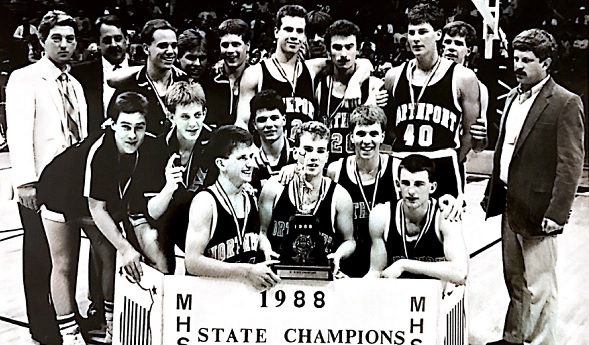
When Scott looks at the team picture taken at mid-court that day, he realizes that, with the exception of one player, all had older brothers who had played before them.
“They toughened us up,” he said. “They had a lot to do with our competitiveness.”
Jason Stowe agreed.
“We grew up in a culture of working hard, playing hard,” he said. “There was no other option. When you’re growing up and watching your older brothers you’re so involved that you live and breathe it. They set the standard for us, and we carried the torch a little further.
“And it kind of helps to have Sander Scott on your team, by the way,” he added, laughing. “Those type of players come around once in a lifetime.”
The school held a celebration the day after winning the championship. Wick talked about how the team embraced the role of underdog.
JV coach Hugh Cook and his wife had planned a spring break trip long before the tournament run. He left the team after the Regional, but vowed to fly back if the Wildcats reached the Final Four. Sure enough, he was back on the bench that weekend. He had listened to the broadcast of the Quarterfinal game via a long distance call.
“I knew he’d be there. That’s just the way he is,” said Wick. “But I bet he’s not looking forward to his next phone bill.”
“That’s when you paid by the minute,” added Jason Stowe.
Wick closed out the ceremony by telling his players there would be no practice the next day.
“They won’t let us play anymore,” he said.
To which his brother, Jim, who helped as a scout, responded, “That’s because there’s no one left to beat.”
 Dennis Chase worked 32 years as a sportswriter at the Traverse City Record-Eagle, including as sports editor from 2000-14. He can be reached at [email protected] with story ideas for Manistee, Wexford, Missaukee, Roscommon, Ogemaw, Iosco, Alcona, Oscoda, Crawford, Kalkaska, Grand Traverse, Benzie, Leelanau, Antrim, Otsego, Montmorency, Alpena, Presque Isle, Cheboygan, Charlevoix and Emmet counties.
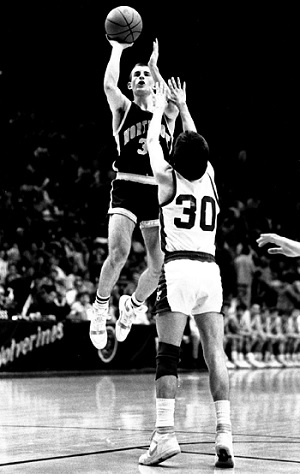
PHOTOS: (Top) The 1988 Class D title-winning Northport boys basketball team poses with its championship trophy. (Middle) From left: Sander Scott, Dan Stowe, Jason Stowe. (Below) Northport's Sander Scott launches a jumper against Beal City during the 1988 Final. (Top photo courtesy of Dan Stowe.)
Breslin Bound: 2025-26 Boys Report Week 1
By
Geoff Kimmerly
MHSAA.com senior editor
December 8, 2025
Winter has certainly arrived in Michigan over the last few weeks – at least from a snowy standpoint – and right on the time to signal the start of boys basketball season and our first report on the annual march to Michigan State's Breslin Center.
 Big matchups already are happening, and every game against an MHSAA Tournament opponent counts toward seeding for District brackets, and once again we're diving into the results you need to know from the previous week, teams that are showing up big in each division and matchups coming up that you won't want to miss.
“Breslin Bound” is powered by MI Student Aid and based on results and schedules posted for each school at MHSAA.com.
Week in Review
The countdown of last week’s five most intriguing results:
1. Grand Rapids South Christian 75, Grand Rapids Christian 71 The Sailors (2-0) opened by adding to last season’s District Final win over Grand Rapids Christian (1-1), and after having lost to the Eagles 72-55 in their season opener a year ago.
2. Bloomfield Hills Brother Rice 71, Detroit U-D Jesuit 42 Brother Rice (2-0) enjoyed some significant payback after falling to Jesuit twice last season, during the regular season in what eventually decided the Catholic High School League Central title and then in their Regional Semifinal matchup.
3. Saginaw United 67, Detroit Catholic Central 57 The Phoenix (2-1) opened their new fieldhouse with a notable season-opening victory over the Shamrocks (2-1), who defeated United 69-55 in their opener a year ago.
4. Grand Blanc 76, Hamtramck 75 (OT) The Bobcats (2-0) opened the season with this notable win at the Horatio Williams Tip-Off Classic.
5. Warren Fitzgerald 41, East Kentwood 40 This was another exciting finish at the Horatio Williams event, again in a faceoff of teams with high aspirations this season.
Watch List
With an eye toward March, here are two teams in each division making sparks:
DIVISION 1
Grand Haven (3-0) The Buccaneers finished an opening week of road games without a loss, defeating Coopersville 65-42 and then Traverse City Central 83-71 and Traverse West 79-77 over the weekend. Grand Haven improved from 11-12 in 2023-24 to 18-6 last season and will have some opportunities to get rolling heading into the new calendar year with a Dec. 22 matchup against Freeland and its Lake Michigan Cup on Dec. 29-30.
North Farmington (2-0) The Raiders are coming off a 12-10 finish and third place in the Oakland Activities Association Red last season, and got off to a fast start under first-year coach Peter Mantyla with a 41-35 win over Canton and a 62-47 victory over Davison while hosting the Horatio Williams Tip-Off Classic. Reigning league champion Birmingham Groves is up next, on Friday, and the first matchup with Farmington – which ended the Raiders’ season last winter – is Dec. 19.
DIVISIION 2
Dundee (3-0) The Vikings appear on track to bounce way back after going 21-5 in 2023-24 but then only 5-18 last winter. They opened last week with a 12-point win over Saline Washtenaw Christian, a 47-46 victory over Milan and a 51-45 triumph over Britton Deerfield – and after losing to Washtenaw Christian by six points during the early going a year ago.
Freeland (3-0) The Falcons are coming off a 22-4 finish and run to the Division 2 Quarterfinals last winter, so a fast start isn’t a surprise. But it was still impressive; Freeland opened with a 22-point win over Bridgeport, then defeated Menominee by 22 and Petoskey by 15 at the latter’s Sean Pollion Invitational. Showcase games against Auburn Hills Avondale and Grand Haven later this month will be opportunities to impress.
DIVISION 3
Ishpeming Westwood (3-0) The Patriots reached the Semifinals last season for the first time since 2003 with Ethan Marta leading the way, and he’s doing so again to begin his senior year as Westwood opened with sizable wins over West Iron County and Hancock. They finished a perfect first week with an 83-64 victory over rival Ishpeming.
North Muskegon (3-0) The Norsemen are off to the right start as well after last season’s 23-2 finish and Regional Final run. They won all three of their games last week by at least 20 points, defeating Division 1 Walled Lake Western 64-44 in the championship game of the Will Lynch Invitational at Benzie Central. And they celebrated senior Adam Dugener reaching 1,000 points in the season-opening win over Holton.
DIVISION 4
Clarkston Everest Collegiate (2-0) A Regional finalist and 24-2 overall last season, Everest jumped 10 wins from 2023-24 and is off to a fast start again. The Mountaineers opened with a 61-42 win over Livonia Clarenceville and followed with a 59-42 victory over Flint Beecher. Clarenceville is a Division 2 team, and the great majority of Everest’s regular-season opponents play in Division 2 or 3 with a date as well against Division 1 South Lyon East on Feb. 19.
Eben Junction Superior Central (3-0) Two of last season’s first four losses came to Hannahville Nah Tah Wahsh as Superior Central went on to finish the season 9-14 – after going 16-8 in 2023-24. But the Cougars got on the right track immediately this winter with a 57-42 win over Nah Tah Wahsh to open last week before defeating Cedarville 42-41 and Mackinaw City 48-41 on successive days to win the Battle of the Bridge hosted by the latter.
Can’t-Miss Contests
Be on the lookout for results of these games coming up:
Monday – Ishpeming Westwood (3-0) at Kingsford (2-0) – These two both made it to Breslin Center last season, Westwood reaching the Division 3 Semifinals and Kingsford the same in Division 2.
Tuesday – Flint Powers Catholic (2-0) at Bay City John Glenn (1-1) – These two Division 2 hopefuls both won 20 games last season.
Friday – Grand Rapids Catholic Central (0-0) at Rockford (1-0) – The Division 1 Rams may have won their matchup last season 70-43, but the Cougars went on to finish their season in the Division 2 Semifinals.
Saturday – Warren Lincoln (1-0) vs. Arts & Technology Academy of Pontiac (0-0) at Detroit Mercy – These two also both reached Breslin Center last season, Lincoln winning the Division 2 title and ATAP finishing Division 3 runner-up, and they will face off at the U-D Mercy Showcase.
Saturday – East Lansing (1-0) vs. Detroit Martin Luther King (0-1) at Lansing Eastern – The reigning Division 1 champion Trojans should get a strong challenge at the Moneyball Tip-Off Classic from King, which made the Quarterfinals last winter.
MHSAA.com's weekly “Breslin Bound” reports are powered by MI Student Aid, a division within the Department of Lifelong Education, Advancement, and Potential (MiLEAP). MI Student Aid encourages students to pursue postsecondary education by providing access to student financial resources and information. MI Student Aid administers the state’s scholarship and grant programs that help make college Accessible, Affordable and Attainable for you. Click to connect with MI Student Aid and find more information on Facebook and X @mistudentaid.
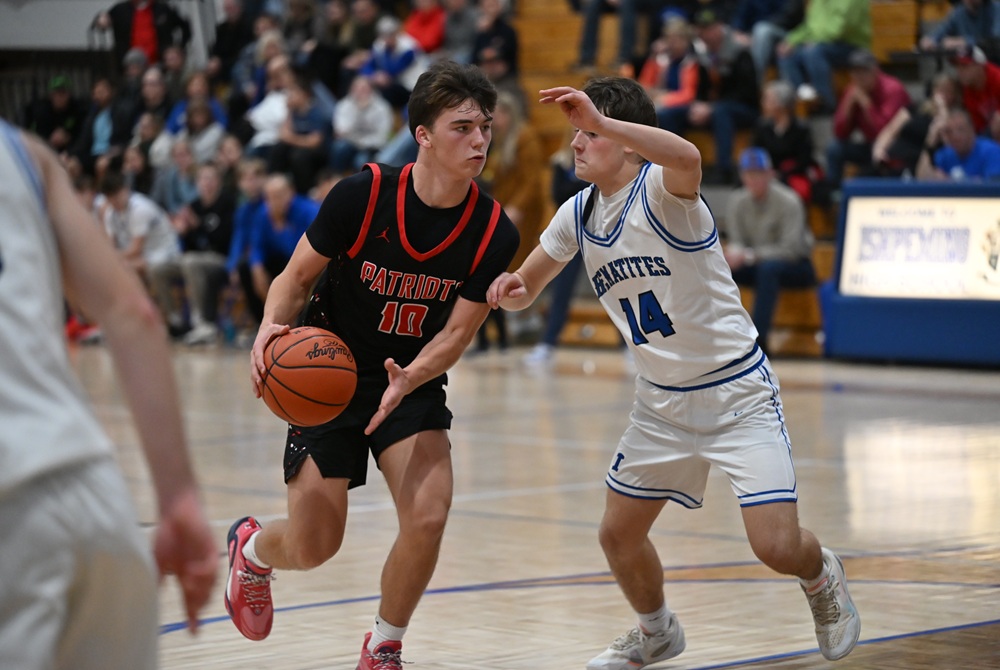
PHOTO While being defended by Ishpeming's Dax Kakkuri on Friday, Ishpeming Westwood's Ethan Marta makes a move to the basket. (Photo by Cara Kamps.)