

#TBT: Sticks’ Record 50 Still Stands
April 10, 2014
By Geoff Kimmerly
Second Half editor
Last month marked the 58th anniversary of the longest-standing individual record in MHSAA Basketball Finals history.
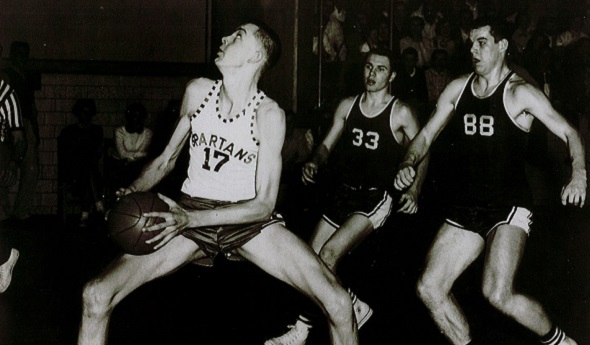
In 1956, Battle Creek Lakeview center Bob “Sticks” Bolton scored 50 points in a Quarterfinal against Kalamazoo State High School. His points remain the most scored during the final round of the tournament – Quarterfinal-Semifinal-Final.
What follows are edited excerpts from a piece in the MHSAA archives written by former Battle Creek Enquirer reporter Allen Palmeri:
The date was March 21, 1956, and seating capacity in the Hastings High School gymnasium had been expanded to 2,000 this Wednesday night in anticipation of a marvelous Class B Quarterfinal basketball game between two sizzling teams.
New bleachers beckoned behind both goals as Battle Creek Lakeview, 18-2 with a 16-game winning streak, prepared to battle Kalamazoo State High, 19-2 with a 17-game winning streak.
The bleachers weren’t sufficient. About 2,500 fans were able to shoehorn their way in, ringing the court and leaving others in the school’s hallways and out on the sidewalk as one of the most spectacular individual efforts in MHSAA Boys Basketball Tournament history was about to unfold.
In one corner was Lakeview center Bob “Sticks” Bolton, a 6-9 rod of fury. In the other corner was State High’s mountain range of a front line, with peaks standing 6-6, 6-6 and 6-5.
“We looked forward to the game with quite confidence, because we really respected them for the tremendous team they had,” Bolton recalled in 1996. “We knew it was going to be a battle royale because of their size.”
The game within a game of one-on-three was no contest as Bolton simply pulverized the peaks. He poured in 50 points in a 90-73 Lakeview victory, setting a final round record for single game scoring that has withstood decades of assaults by the likes of Ralph Simpson, Spencer Haywood, Earvin Johnson, Jay and Sam Vincent, Antoine Joubert, Jay Smith, Mark Brown and Chris Webber.
***
(He scored) 12, 20, 10 and 8 points through four quarters against State High. He was particularly impressive in the second quarter, when he wound up scoring 20 of his team’s 21 points. Overall, he sank 17 of 27 shots from the field and 16 of 20 from the free throw line.
Though State High took the brunt of Bolton’s blows during the tournament, his effort throughout Lakeview’s run was just as spectacular. ... When Marshall tried to stall away the district opener, Bolton had to settle for 18 points in 40-20 victory. In an 80-58 win over Albion for the district championship, he punched in with a 34-point effort.
In carrying Lakeview to its first regional title, Bolton went ballistic, pumping in 42 points against Three Rivers and a school-record 46 points against an East Lansing team coached by Gus Ganakas. He then went out and topped that in the quarterfinal.
In the semifinals two days later, Bolton was whistled to the sideline with 25 points with a little over half the game played, fouling out in a 74-69 loss to eventual champion Stephenson. Opposing center Mel Peterson, who went on to play for Wheaton College and the NBA’s Baltimore Bullets, had scored 21 points when Bolton fouled out.
Though the memory of that game is painful, he fondly recalls his five-game scoring spree as “lifting my game to a higher level as the competition got tougher and tougher. Praise the Lord for that!”
***
Bolton went on to play collegiately at Western Michigan University, where he cracked the 1,000-point barrier, set a school rebounding record and outscored future NBA Hall of Famer Nate Thurmond on two of three occasions. After his college career, in a semi-pro championship game, he managed to outplay another Hall of Fame center, Walt Bellamy.
But his passion for basketball was never the same after high school. His dedication, vigor and enthusiasm gradually shifted towards the ministry.
At the time of this writing, Bolton served in Marquette, as pastor and administrator of Bethesda Baptist Church and Bethesda Baptist School. He died in 2008.
PHOTO: Bob "Sticks" Bolton dropped 46 points on East Lansing in a 1956 Class A Regional championship game. He followed that with a record 50 points in the Quarterfinal.
Breslin Bound: Boys Quarterfinal Preview
March 20, 2017
By Geoff Kimmerly
Second Half editor
It's easy to enter this final week of the boys basketball season noting how many of last year's MHSAA champions are still around with possible repeats only three wins away.
 That number is three, by the way: Detroit U-D Jesuit in Class A, Flint Beecher in Class C and Powers North Central in Class D. But isn't it more intriguing that 14 of 24 champions during this decade are still alive – and 14 of 18 in A, C and D, since no matter which team wins Class B, it will be for the first time since at least 1999.
The final Breslin Bound report – powered by MI Student Aid – looks at all 16 Quarterfinals that will be played Tuesday evening. Click below for brackets:
Class A | Class B | Class C | Class D
All games tip off at 7 p.m. unless noted below. All also will be available with subscription for viewing on MHSAA.tv.
CLASS A
West Bloomfield (16-8) vs. Troy (21-4) at University of Detroit Mercy
This will be Troy’s first Quarterfinal since 1989 and West Bloomfield’s since 2003. The Lakers emerged after finishing third in an Oakland Activities Association Red that also included Clarkston (below) and 2016 Class A runner-up North Farmington. Senior guard Kevin McAdoo leads with 24.1 points and 4.1 assists per game. Troy shared the OAA White title and is paced by junior guard Jason Dietz (17.2 ppg).
Clarkston (24-1) vs. Saginaw (21-4) at Davison, 7:30 p.m.
The Wolves won the OAA Red and are led by one of the winningest coaches in MHSAA history in Dan Fife (674-169 over 35 seasons) and one of the state’s top juniors in point guard Foster Loyer (25.1 ppg, 6.4 apg). Saginaw is a frequent qualifier at this stage, with this to be its third Quarterfinal in six seasons. Senior forward Henry Speight stars with 22 points, 14 rebounds and five assists per game for the Saginaw Valley League North champion.
Kalamazoo Central (21-3) vs. Grand Rapids Christian (25-0) at Lansing Eastern
For the second straight game, Grand Rapids Christian will play in arguably the most anticipated statewide. The Eagles feature star forward Xavier Tillman (13.2 ppg, 10.7 rpg, 4.7 apg, 4.1 bpg), but Kalamazoo Central will counter with Mr. Basketball Award winner Isaiah Livers (17.5 ppg, 14 rpg) as it looks to avenge a 53-51 overtime loss to Christian on March 2. The Eagles downed previously-undefeated Muskegon and then needed a buzzer beater against Holland West Ottawa last week.
Romulus (20-4) vs. Detroit U-D Jesuit (20-3) at University of Detroit Mercy, 5 p.m.
Romulus is another regular during the final week, making its fifth Quarterfinal appearance this decade but first since 2014. Junior guard Kaevon Merriweather and senior forwards Dylan Price and Jaren English all average between 16 and 19 points per game. Reigning Class A champion U-D Jesuit has won 12 straight and again has a major post presence in 6-foot-9 Greg Eboigbodin (13.4 points, 13 rebounds per game).
CLASS B
Detroit Osborn (16-9) vs. New Haven (24-1) at Marysville
Osborn won its second Regional title and will play in a Quarterfinal for the first time since 2007 after finishing fourth in a Detroit Public School League East Division 1 that included Class A powers Detroit Martin Luther King and East English and Class C quarterfinalist Edison Public School Academy. New Haven is playing in a third straight Quarterfinal and seeking to advance for the first time. Senior Eric Williams (20.9 ppg) and sophomore Romeo Weems (18.1 ppg, 12.6 rpg) provide a powerful 1-2 punch.
Benton Harbor (21-3) vs. Spring Lake (19-6) at Caledonia
The Tigers won one of the state’s strongest Regionals to make the final week for the first time since 2014. Freshman 6-6 center Carlos Johnson leads four scoring in double figures at 14.2 points, 14.1 rebounds and 3.3 blocked shots per game. Spring Lake is making its second Quarterfinal appearance in three seasons and also second ever; the Lakers upset Grand Rapids Catholic Central in the Regional Final after finishing third behind the Ottawa-Kent Conference Blue champion in their league.
Williamston (21-4) vs. River Rouge (23-1) at Chelsea
This is a rematch from 2016, with Williamston winning last season 53-46. The Hornets are one of the surprise teams still around this week, not because of lack of success but because they eliminated presumed Class B favorite Wyoming Godwin Heights in a Regional Semifinal for the second straight season. Williamston has won 10 of its last 12 games and three of its losses are to Class A schools. River Rouge owns win over Class A quarterfinalists West Bloomfield and Romulus and Class D quarterfinalist Southfield Christian.
Lake Fenton (20-5) vs. Ludington (23-2) at Mount Pleasant
Lake Fenton rolled into its first Quarterfinal after downing 20-win Freeland and 21-win Frankenmuth last week, but maybe those shouldn’t be considered upsets – the Blue Devils tied for second in the Genesee Area Conference Red behind only reigning Class C champion Flint Beecher. Senior forward Jalen Miller leads with 20.9 points per game. Ludington is in its first Quarterfinal since 2009 looking to advance for the first time since 1971. Senior guard Calvin Hackert leads the balanced Lakes 8 Activities Conference champion at 13.3 points per game.
CLASS C
Monroe St. Mary Catholic Central (24-0) vs. Detroit Edison PSA (13-11) at Tecumseh, 6 p.m.
This will be Monroe St. Mary’s fourth Quarterfinal this decade – the Falcons have made the final week every odd year over the last seven, and advanced to the Semifinals in 2013. Senior 6-7 forward Nick Welch leads at 20.7 ppg, and he could face an interesting matchup with 6-8 Deante Johnson. Edison, as noted above, came from the same PSL division at Osborn and lost four of its last five regular-season games – but then upset expected contender Cornerstone Health & Technology in the Regional Final. DEPSA did earn regular-season rematch wins over Detroit King and East English after losing first games to both, and split with Osborn as well.
Flint Beecher (20-5) vs. Beaverton (20-5) at Bay City Central
Beecher has won two straight Class C titles and played in nine straight Quarterfinals, and is led again by standout Malik Ellison (23.8 ppg). The Buccaneers’ only losses since mid-January were to Class A Ypsilanti Community by two and Class B quarterfinalist New Haven in overtime. Beaverton has enjoyed a history-making winter as coach Roy Johnston took over the MHSAA lead for career wins, and the Beavers have bounced back from a four-game losing streak in early February to make their first Quarterfinal since 2013. Johnston's grandson Carter leads with 23.7 ppg.
Kalamazoo Christian (18-7) vs. Grand Rapids Covenant Christian (19-5) at Holland West Ottawa, 7:30 p.m.
This is another matchup of schools advancing for the first time in at least a little while; Covenant Christian won its first Regional since 1994 in Class D, and Kalamazoo Christian advanced to this week for the first time since 2008. Senior guard Alex Visser and junior forward Jordan Katje both score 11 points per game to lead Kalamazoo Christian, while junior forward Carson Meulenberg paces Covenant at 13.4 ppg.
Manton (20-4) vs. Negaunee (20-4) at Petoskey
Manton has its best record in at least 11 seasons to go along with its first Regional title since 1998. Three players have made at least 48 3-pointers this season, paced by leading scorer Jayden Perry (16 ppg) with 53. In addition to upsetting formerly undefeated McBain in the District, Manton has a win over Beaverton. Negaunee is another frequent quarterfinalist, this being its fifth time in the final week this decade. The Miners hope to take the next step for the third time of this run led by big-time scorers Dre’ Tuominen (20.4 ppg) and Trent Bell (19.7), who both make more than 50 percent of their shots from the field.
CLASS D
Hillman (24-1) vs. Powers North Central (25-0) at Sault Ste. Marie
These two met in a 2015 Quarterfinal, two games before North Central claimed its first Class D title of this recent run, and they meet again with the Jets two wins from a third straight and carrying the nation’s longest active winning streak of 80 victories. Jason Whitens (22.6 ppg) and Dawson Bilski (19.7) have starred throughout the run and are part of a talented senior class finishing things up. But Hillman has an excellent senior as well in Gunnar Libby, who leads his team with 19.1 points and 5.5 assists per game.
Southfield Christian (20-5) vs. Fowler (17-7) at Imlay City, 7:30 p.m.
After two seasons – and two District titles – in Class C, Southfield Christian is back in Class D and seeking its fourth title this decade. Two of its losses were to quarterfinalists U-D Jesuit and River Rouge, and it beat West Bloomfield. Junior guard Bryce Washington leads four averaging in double figures with 18.5 ppg. Fowler is back in the Quarterfinals for the first time since finishing off five straight appearances in 2005, and it owns a win this season over Lansing Christian. Senior 6-7 center Jeremy Pung is a force, averaging 18 points and 9.5 rebounds per game.
Benton Harbor Dream Academy (11-7) vs. Lansing Christian (18-6) at Kalamazoo Loy Norrix
Dream Academy has won 10 of its last 12 games, avenging its loss to St. Joseph Lake Michigan Catholic during that run with an overtime win over the Lakers in the District Final. Lansing Christian last made a Quarterfinal (and then Semifinal) in 2013, and after losing three of its final four regular-season games has bounced back with four double-digit wins in the playoffs. Seniors Matt Havey and Preston Granger average 17.9 and 15.4 ppg, respectively, for the Pilgrims.
Wyoming Tri-unity Christian (16-8) vs. Buckley (24-0) at Cadillac
Tri-Unity is back in the Quarterfinals for the third straight season and fifth this decade, seeking its first championship since 2011. Four seniors start for a balanced attack; forward Braydon Sherrod and guard Collin Rosendall top the scoring at 10.2 and 10.9 ppg, respectively. Buckley has twice made Quarterfinals, in 1998 and 2010, and is looking to advance for the first time. Junior Denver Cade scores a team-high 21 ppg for a group that’s won all but two games this season by double digits – with a victory over Class C quarterfinalist Manton one of the two by fewer than 10 points.
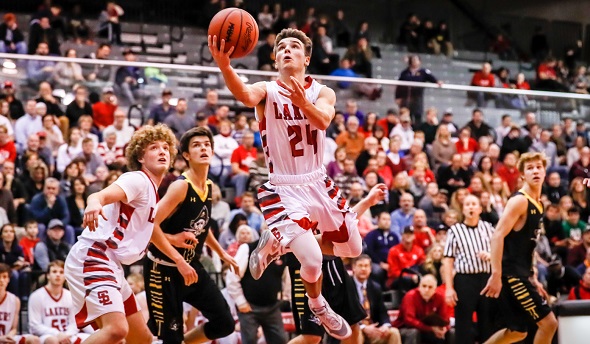
PHOTO: Spring Lake's Cameron Ball (24) lays up a shot this season against Grand Haven. (Photo by Tim Reilly.)