

Thumb Rivals Honor Connor 'One Last Time'
By
Paul Costanzo
Special for MHSAA.com
February 28, 2017
Jay Burton said one of his biggest fears after his son Connor passed away in 2009 was that he would be forgotten.
 But eight years after his death, the memory of Connor Burton is as strong as ever in Marlette and Brown City, the two communities he managed to make a big impact on during his 10 years on Earth.
“Any parent that’s lost a child, one of the biggest fears is that your child will be forgotten,” Jay Burton said. “They never are, but that’s any parent’s fear. But he’ll be a part of this community for the rest of our lives.”
This past Friday, the two schools met in Marlette for the eighth and final Team Connor Classic, a game that has celebrated Connor’s life since the year after it ended. On this night, Marlette came away with a 49-40 victory, winning the game for the eighth straight time in what would have been Connor’s senior year.
“It’s a good time to call it quits,” Jay Burton said.
Connor’s life
On Thursday, April 16, 2009, Connor went to his gymnastics and baseball practices before shooting baskets outside his house until the sun set and he could no longer see the hoop.
It was a typical day for the energetic 10-year-old, who was described by many as a gym rat and a lover of all sports.
“Whatever sport was in season, he would be ready to play,” said Connor’s uncle Tony Burton, Brown City’s athletic director and former boys basketball coach. “During the winter, basketball was something that was a high priority with him. Obviously, he got taken from us too soon, but he sure loved sports.”
He was good at them, too. His friend Hunter Kelly, now a senior on Marlette’s boys basketball team, said Connor was a better basketball player than most of their friends when they were young.
 In the Thumb, Burtons and basketball are synonymous, and Connor seemed poised to be the next in that line – even if he was coming through the Marlette program and not the Brown City one his uncle was leading and for which his cousins had starred. Connor was even a manager, along with his cousin Caleb Muxlow (who is a senior on this year’s Brown City team), for his uncle’s team.
On Friday, April 17, 2009, Connor, who it would be found suffered from Long QT – a heart rhythm disorder – passed away less than 24 hours after shooting his last shot.
“Basically the electrical system in the heart, which tells it to beat, his wasn’t running correctly,” Jay Burton said. “The thing about it was, you would have never known. … I went (into Connor’s room that morning) and the only weird thing he said to me was, ‘Dad, why did you open the door so fast?’
“I didn’t think anything of it, I flicked his light on, and when I came back he hadn’t made it out of bed. He had cardiac arrest.”
A tradition is born
The following basketball season, the Team Connor Classic was born, and the two communities that Connor loved showed their love for him. There were tributes and tears, and a great basketball rivalry was all of a sudden elevated to another level.
“It’s always been a good game between Brown City and Marlette,” Tony Burton said. “We border each other, we’re in the same county, so it’s usually a pretty good game when we play, regardless of records. It means a lot, and for both teams when we play each other, we want to win. But when the game’s over we still have our friendships and our associations with each other.”
While they compete for bragging rights, and often for Greater Thumb Conference East championships, Marlette and Brown City actually have a long history of coming together for good causes.
“Us and Marlette, we have a great relationship,” Brown City High School principal Neil Kohler said. “We do the pink out game in football every other year at our place, we do the Team Connor game. We did a basketball game last year where both teams gathered water for the Flint crisis. So, it’s probably our biggest rival, but also our biggest partnership. When they came to our place about three weeks ago our local rotary did a pancake dinner and had about 400 people come in from Marlette hospice to raise money. The two communities really come together.”
The Team Connor game has a different feeling than most tribute games because of its unique connection of the family to two tight-knit communities.
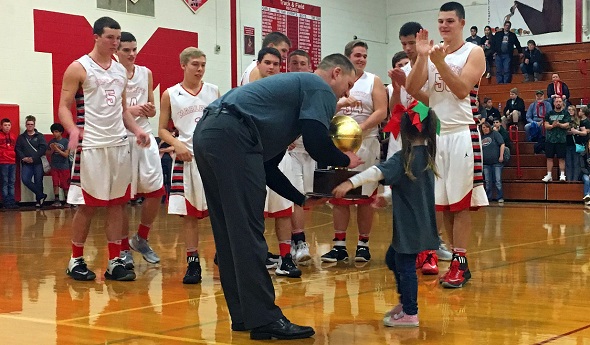
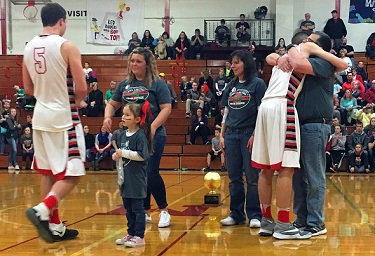
That was apparent in the latest edition, as Connor’s family – his father, his mother Sue, and his sisters Lindsey and Annie – were given a signed basketball from the Brown City community, and a bouquet of flowers and a blanket tiled with memories from all eight Team Connor Classics from the Marlette community. After the game, the family handed out medals to each player on both teams, receiving from them many long, heartfelt hugs.
It’s not easy for the family, especially in a year when Connor would have been the one on the court with his classmates enjoying a season that has seen the Red Raiders go 18-1 and clinch the GTC East title.
“This is only the second game I’ve watched the Marlette boys play (this season),” Jay Burton said. “I can’t watch them. I see Hunter Kelly; the kid stands a foot taller than me. What would Connor have been? He’s the 10-year-old in front of me and all of his friends are 18 getting ready to graduate high school.
 “Caleb Muxlow, his cousin who plays for Brown City, I can go watch simply because he’s family. But this is only the second time I’ve seen (Marlette) play. It just hurts too much.”
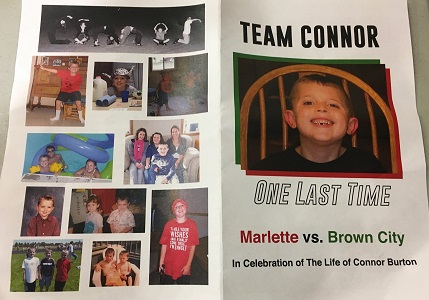
Each team came out for warm-ups in the same Team Connor shirts, which combined the green of Brown City and the red of Marlette, and read “One Last Time.” They sat on the court before the game to watch the presentations and a slideshow of photos from Connor’s life and Team Connor Classics past, and stood with one another during the national anthem.
“I think this one was a special night mainly because these were his classmates,” Marlette coach Chris Storm said. “The rivalry has gotten stronger and stronger between us. It was there because of the league before, but it adds a lot of pressure to both teams and you could see that in the game.
“But it means a lot to see how many people come out for the event. The pastor comes back; he’s been out of the area for three years. It’s a great environment for kids to play high school basketball. It’s a District or a Regional feel almost on a regular-season night.”
As the game tipped off, Marlette took the court with four players. It’s a newer, but impactful tradition that was added in the years Connor would have been playing in the game.
“It was quite a surprise (the first year),” Jay Burton said.
It’s a sign that Connor is certainly not forgotten, and while the Team Connor Classic may be going away, anyone who played in one, coached one or simply attended one, will never forget it.
“It means that we’re remembering a great kid that would have given a lot more to his community if he had more time,” Kelly said. “It shows that us as a senior class, the way we represent ourselves as a team and a community, is reflecting who he was. It means a lot because he would have been a senior this year, he probably would have been playing with us. He was better than me, he was better than a lot of these kids, so he probably would have been starting, too.
“So it means a lot to play in remembrance of him, because he’s missing out on all these memories.”
 Paul Costanzo served as a sportswriter at The Port Huron Times Herald from 2006-15, including three years as lead sportswriter, and prior to that as sports editor at the Hillsdale Daily News from 2005-06. He can be reached at [email protected] with story ideas for Genesee, Lapeer, St. Clair, Sanilac, Huron, Tuscola, Saginaw, Bay, Arenac, Midland and Gladwin counties.
PHOTOS: (Top) Annie Burton, Connor Burton’s younger sister, presents Marlette boys basketball coach Chris Storm with the “Team Connor Classic” trophy after Friday’s game. (Middle) Hunter Kelly hugs Connor’s father Jay Burton as the family welcomes both teams' players. (Below) The game program from the night celebrated Connor Burton’s life and legacy. (Photos by Paul Costanzo.)
Cass Tech 'Gamers' Force OT, Finish Surge to Reach 1st Final Since 1974
By
Dean Holzwarth
Special for MHSAA.com
March 24, 2023
EAST LANSING – Detroit Cass Tech’s Darius Acuff was held in check for a majority of the second half Friday by Grand Blanc’s defense.
The talented sophomore, however, came up clutch in a pivotal moment.
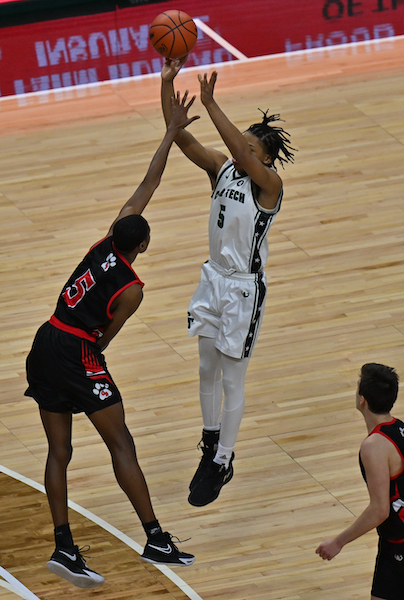
The 6-foot-2 guard forced overtime with a 3-pointer and then scored four points in the extra period to help lift the Technicians to a thrilling 62-56 win in a Division 1 Semifinal at Breslin Center.
Cass Tech (27-1) will play Muskegon in Saturday’s Division 1 Final.
After Grand Blanc senior Robert Williams made two free throws with 9.1 seconds left in regulation to put his team ahead 54-51, Acuff banked in a 3-pointer in the waning seconds.
It was only his second field goal of the second half after tallying 10 first-half points.
“Once I got open, I called for the ball and I knew I was going to shoot it,” said Acuff, who finished with a game-high 19 points, five assists and three steals. “I knew it was going in.”
The Technicians took control in the extra session.
A breakaway layup by Acuff pushed the Cass Tech lead to 59-56 with 55 seconds to play. He followed with a pair of free throws to make it 61-56.
“We have some gamers on this team, and he doesn’t practice to my liking a lot of times, but when those lights come on I can count on him,” Technicians coach Steven Hall said of his standout sophomore. “The last play out of the timeout that we got a 3 on, they executed it to the T.”
Cass Tech was making its first Semifinal appearance since 1993, and will play in its first Final since 1974, when it finished Class A runner-up.
Hall guided Detroit Rogers to three straight Class D titles (2003-05) and returned to his alma mater in 2015-16.
“It’s a wide range of emotions right now,” Hall said. “I’m happy to still be living to fight another day.
“For me, it’s my sixth time here but the first time with my school, and it's a dream of mine. It was a dream of mine for these guys. We came so close last year, and sitting here last year and watching the Semifinals was painful, but I’ve been dreaming of getting here with my school.”
Cass Tech ended a 22-game winning streak by Grand Blanc, which was denied a third-straight appearance in the Division 1 Final.
The Bobcats (25-3) rallied from an early deficit, but committed 18 turnovers for the game and were held to one field goal in overtime.
“We didn’t handle the pressure, and one of the keys of our offensive game plan was limiting turnovers,” first-year Grand Blanc coach Tory Jackson said. “You can't beat great teams like that with 18 turnovers, and we just didn’t handle the pressure like we were supposed to.
“Hats off to Acuff. He’s a tough player and by far one of the best players we've played all year. We got undisciplined at the end, and it’s frustrating because this was supposed to be ours. We left money on the table.”
Cass Tech jumped out to an early 11-4 lead as Acuff scored six quick points.
The Bobcats, however, trimmed the deficit to 17-15 in the second quarter with a 3-pointer in the corner from sophomore Donnie Huddleston.
The Technicians took a slim 26-25 lead into halftime.
Grand Blanc took its first lead, 35-34, midway through the third quarter on an offensive rebound and put-back by junior Anthony Perdue.
Cass Tech has become accustomed to close games.
“That’s us being tough and scrappy,” Acuff said. “It’s always going to come down to one possession, and it came down to that. Once we went to overtime we knew we were going to win, but we knew we had to fight for it.”
Senior Tae Boyd led the Bobcats with 16 points and 10 rebounds, while senior RJ Taylor had nine points.
Senior Kenneth Robertson added 15 points for Cass Tech, and freshman Corey Sadler Jr. added 14 points.
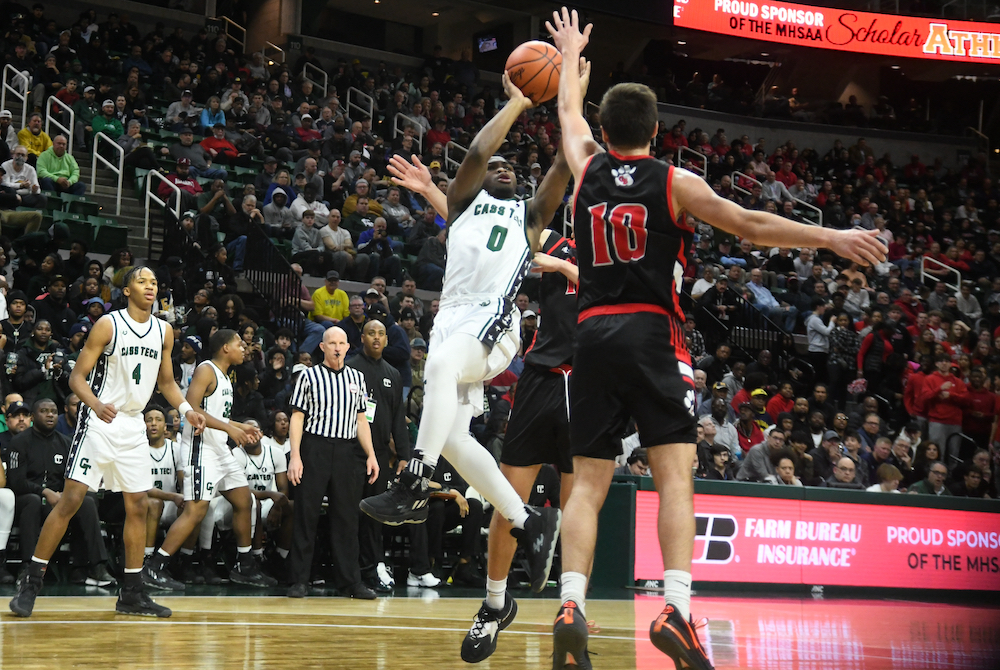
PHOTOS (Top) Detroit Cass Tech’s Corey Sadler Jr. (0) gets up a shot during his team’s Division 1 Semifinal overtime win Friday. (Middle) The Technicians’ Darius Acuff shoots the game-tying 3-pointer at the end of regulation despite the defense of Grand Blanc’s Anthony Perdue (5).