

Thumb Rivals Honor Connor 'One Last Time'
By
Paul Costanzo
Special for MHSAA.com
February 28, 2017
Jay Burton said one of his biggest fears after his son Connor passed away in 2009 was that he would be forgotten.
 But eight years after his death, the memory of Connor Burton is as strong as ever in Marlette and Brown City, the two communities he managed to make a big impact on during his 10 years on Earth.
“Any parent that’s lost a child, one of the biggest fears is that your child will be forgotten,” Jay Burton said. “They never are, but that’s any parent’s fear. But he’ll be a part of this community for the rest of our lives.”
This past Friday, the two schools met in Marlette for the eighth and final Team Connor Classic, a game that has celebrated Connor’s life since the year after it ended. On this night, Marlette came away with a 49-40 victory, winning the game for the eighth straight time in what would have been Connor’s senior year.
“It’s a good time to call it quits,” Jay Burton said.
Connor’s life
On Thursday, April 16, 2009, Connor went to his gymnastics and baseball practices before shooting baskets outside his house until the sun set and he could no longer see the hoop.
It was a typical day for the energetic 10-year-old, who was described by many as a gym rat and a lover of all sports.
“Whatever sport was in season, he would be ready to play,” said Connor’s uncle Tony Burton, Brown City’s athletic director and former boys basketball coach. “During the winter, basketball was something that was a high priority with him. Obviously, he got taken from us too soon, but he sure loved sports.”
He was good at them, too. His friend Hunter Kelly, now a senior on Marlette’s boys basketball team, said Connor was a better basketball player than most of their friends when they were young.
 In the Thumb, Burtons and basketball are synonymous, and Connor seemed poised to be the next in that line – even if he was coming through the Marlette program and not the Brown City one his uncle was leading and for which his cousins had starred. Connor was even a manager, along with his cousin Caleb Muxlow (who is a senior on this year’s Brown City team), for his uncle’s team.
On Friday, April 17, 2009, Connor, who it would be found suffered from Long QT – a heart rhythm disorder – passed away less than 24 hours after shooting his last shot.
“Basically the electrical system in the heart, which tells it to beat, his wasn’t running correctly,” Jay Burton said. “The thing about it was, you would have never known. … I went (into Connor’s room that morning) and the only weird thing he said to me was, ‘Dad, why did you open the door so fast?’
“I didn’t think anything of it, I flicked his light on, and when I came back he hadn’t made it out of bed. He had cardiac arrest.”
A tradition is born
The following basketball season, the Team Connor Classic was born, and the two communities that Connor loved showed their love for him. There were tributes and tears, and a great basketball rivalry was all of a sudden elevated to another level.
“It’s always been a good game between Brown City and Marlette,” Tony Burton said. “We border each other, we’re in the same county, so it’s usually a pretty good game when we play, regardless of records. It means a lot, and for both teams when we play each other, we want to win. But when the game’s over we still have our friendships and our associations with each other.”
While they compete for bragging rights, and often for Greater Thumb Conference East championships, Marlette and Brown City actually have a long history of coming together for good causes.
“Us and Marlette, we have a great relationship,” Brown City High School principal Neil Kohler said. “We do the pink out game in football every other year at our place, we do the Team Connor game. We did a basketball game last year where both teams gathered water for the Flint crisis. So, it’s probably our biggest rival, but also our biggest partnership. When they came to our place about three weeks ago our local rotary did a pancake dinner and had about 400 people come in from Marlette hospice to raise money. The two communities really come together.”
The Team Connor game has a different feeling than most tribute games because of its unique connection of the family to two tight-knit communities.
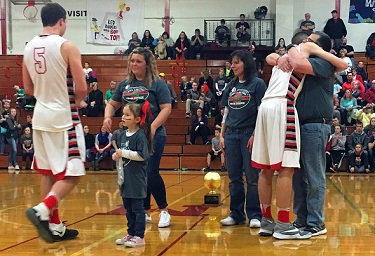
That was apparent in the latest edition, as Connor’s family – his father, his mother Sue, and his sisters Lindsey and Annie – were given a signed basketball from the Brown City community, and a bouquet of flowers and a blanket tiled with memories from all eight Team Connor Classics from the Marlette community. After the game, the family handed out medals to each player on both teams, receiving from them many long, heartfelt hugs.
It’s not easy for the family, especially in a year when Connor would have been the one on the court with his classmates enjoying a season that has seen the Red Raiders go 18-1 and clinch the GTC East title.
“This is only the second game I’ve watched the Marlette boys play (this season),” Jay Burton said. “I can’t watch them. I see Hunter Kelly; the kid stands a foot taller than me. What would Connor have been? He’s the 10-year-old in front of me and all of his friends are 18 getting ready to graduate high school.
 “Caleb Muxlow, his cousin who plays for Brown City, I can go watch simply because he’s family. But this is only the second time I’ve seen (Marlette) play. It just hurts too much.”
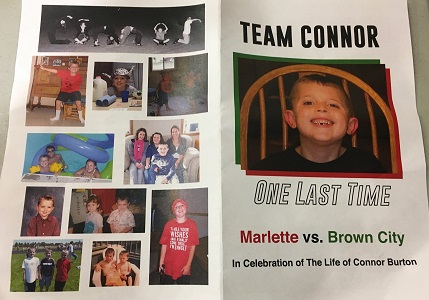
Each team came out for warm-ups in the same Team Connor shirts, which combined the green of Brown City and the red of Marlette, and read “One Last Time.” They sat on the court before the game to watch the presentations and a slideshow of photos from Connor’s life and Team Connor Classics past, and stood with one another during the national anthem.
“I think this one was a special night mainly because these were his classmates,” Marlette coach Chris Storm said. “The rivalry has gotten stronger and stronger between us. It was there because of the league before, but it adds a lot of pressure to both teams and you could see that in the game.
“But it means a lot to see how many people come out for the event. The pastor comes back; he’s been out of the area for three years. It’s a great environment for kids to play high school basketball. It’s a District or a Regional feel almost on a regular-season night.”
As the game tipped off, Marlette took the court with four players. It’s a newer, but impactful tradition that was added in the years Connor would have been playing in the game.
“It was quite a surprise (the first year),” Jay Burton said.
It’s a sign that Connor is certainly not forgotten, and while the Team Connor Classic may be going away, anyone who played in one, coached one or simply attended one, will never forget it.
“It means that we’re remembering a great kid that would have given a lot more to his community if he had more time,” Kelly said. “It shows that us as a senior class, the way we represent ourselves as a team and a community, is reflecting who he was. It means a lot because he would have been a senior this year, he probably would have been playing with us. He was better than me, he was better than a lot of these kids, so he probably would have been starting, too.
“So it means a lot to play in remembrance of him, because he’s missing out on all these memories.”
 Paul Costanzo served as a sportswriter at The Port Huron Times Herald from 2006-15, including three years as lead sportswriter, and prior to that as sports editor at the Hillsdale Daily News from 2005-06. He can be reached at [email protected] with story ideas for Genesee, Lapeer, St. Clair, Sanilac, Huron, Tuscola, Saginaw, Bay, Arenac, Midland and Gladwin counties.
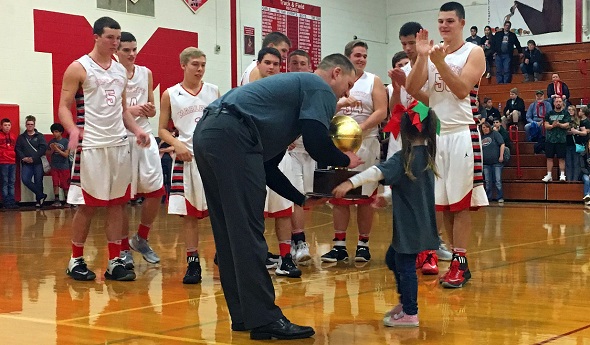
PHOTOS: (Top) Annie Burton, Connor Burton’s younger sister, presents Marlette boys basketball coach Chris Storm with the “Team Connor Classic” trophy after Friday’s game. (Middle) Hunter Kelly hugs Connor’s father Jay Burton as the family welcomes both teams' players. (Below) The game program from the night celebrated Connor Burton’s life and legacy. (Photos by Paul Costanzo.)
Breslin Bound: Boys Report Week 7
January 27, 2020
By Geoff Kimmerly
Second Half editor
Michigan’s high school boys basketball teams are this week reaching the regular-season’s midpoint and the heart of league play from the Ohio and Indiana borders to the top tip of the Upper Peninsula.
 You’ll see that move toward emphasizing conference play reflected in much of this week’s Breslin Bound report – although it’s tough to not be most excited about another showcase coming up this weekend that will match up championship contenders from two of the MHSAA’s four divisions.
“Breslin Bound” is powered by MI Student Aid and based on results and schedules posted for each school at MHSAA.com. Send corrections or missing scores to [email protected].
Week in Review
The countdown of last week’s five most intriguing results:
1. Flint Beecher 70, Orchard Lake St. Mary’s 61 – The Bucs moved up to No. 2 in Division 3 MPR with a major win over the No. 2 team in Division 2 at the Horatio Williams Freedom Classic.
2. Clarkston 55, Detroit King 41 – The Wolves also made Freedom Classic headlines with arguably their best of a solid set of wins this winter.
3. Gaylord St. Mary 59, Pellston 54 – The Snowbirds pushed back into the Ski Valley Conference mix by handing the first loss this season to Pellston.
4. Grand Blanc 80, Kalamazoo Central 73 – The Bobcats are now 9-3 against one of the toughest schedules in the state, and followed up this Friday win with another seven-point over Ferndale on Saturday.
5. Traverse City West 47, Cadillac 46 – The Titans are only 5-6 overall but could make a move in the Big North Conference after handing co-leader Cadillac its first loss this season.
Watch List
With an eye toward March, here are two teams in each division making sparks:
DIVISION 1
Hamtramck (9-2) The Cosmos have flown a bit under the radar, but sit second in the Michigan Metro Athletic Conference Blue with an opportunity to make a loud statement. Hamtramck fell to league leader River Rouge 54-49 on Jan. 10, but a win in the rematch Tuesday arguably would be one of the program’s best in some time. The Cosmos’ only other defeat this season came to Warren De La Salle Collegiate, 65-62 in overtime Dec. 20.
Mount Pleasant (10-0) Reigning Saginaw Valley League Red champion Mount Pleasant is off to another fantastic start after winning its first 18 games last season. A 66-58 win over SVL Blue co-leader Flint Carman-Ainsworth a week ago was particularly impressive, even as the only single-digit victory surrounded by much larger margins in the Oilers’ other nine games.
DIVISION 2
Croswell-Lexington (10-1) A three point December loss to 9-1 Flint Southwestern is all that has kept Croswell-Lexington from perfection this winter – and only a few others have come close to breaking up the success. The Pioneers have nine double-digit wins and Friday against Almont can finish an unbeaten first half in the Blue Water Area Conference.
Fremont (10-0) The Packers’ 102 points last week against Howard City Tri County likely caught even casual fans’ attentions. But it was just a highlight from a greater body of work that is setting Fremont up for a run at a third straight Central State Activities Association Gold title. The Packers are perfect through the first run of the league schedule, thanks in part to a three-point win over Newaygo and four-pointer over Grant. Fremont also downed Lakes 8 Activities Conference co-leader Ludington.
DIVISION 3
Hanover-Horton (7-1) The Comets face Napoleon on Wednesday for first place in the Cascades Conference as they continue to pursue a third-straight league championship. All seven wins so far have been by 10 points or more, and the one defeat looks pretty good too – 68-66 to Division 1 one-loss Grand Rapids Union. A Feb. 10 matchup with Ypsilanti Arbor Prep could be telling of the team’s possibilities come tournament time.
Ravenna (10-0) The Bulldogs have climbed from six to 11 to 15 wins, respectively, over the last three seasons, and seem likely to continue the rise after a flawless first half. Ravenna leads the West Michigan Conference by a game over Muskegon Oakridge, which gave the Bulldogs their closest game so far – a six-point battle Jan. 16.
DIVISION 4
Alanson (8-1) Alanson improved from five wins in 2017-18 to 10 last season and could equal that latter total before the end of January. The Vikings are undefeated since falling to Bellaire 61-54 in their season opener, and they’ve hung tough in tight times with three wins by three points or fewer. That success has sent Alanson into a tie for first place in the Northern Lakes Conference with Ellsworth, which hosts the Vikings on Friday.
Hillsdale Academy (8-1) After playing in the 2018 Class D Semifinals but falling back to 9-13 last season, the Colts rank No. 5 in Division 4 MPR and sit tied for first in the Southern Central Athletic Association East despite losing Dec. 19 to co-leader Camden-Frontier. Hillsdale Academy will get another chance at C-F on Feb. 11 and also can boast a win over SCAA West co-leader Bellevue.
Can't-Miss Contests
Be on the lookout for results of these games coming up:
Tuesday – Hudsonville (9-0) at Holland West Ottawa (8-2) – The reigning Ottawa-Kent Conference Red champion Eagles will try to hold off second-place West Ottawa in the first of their two meetings.
Tuesday – Iron Mountain (9-0) at Negaunee (10-0) – The Mountaineers took three wins from the Miners last season, outpacing them to win the Western Peninsula Athletic Conference Iron and then eliminating Negaunee in a Regional Semifinal.
Friday – Oscoda (9-0) at Mio (8-1) – The two top teams in the North Star League Big Dipper again, Mio is just behind reigning champion Oscoda after the Owls won the first matchup Dec. 12.
Friday – Stevensville Lakeshore (9-0) at Portage Central (8-0) – This matchup for first place winds up the first half of the Southwestern Michigan Athletic Conference West schedule.
Saturday – Ypsilanti Lincoln (7-1) vs. Benton Harbor (9-1) at Grand Rapids City – The headlining matchup of the Redhawk Showcase Classic might be one of the most entertaining regular-season games of this entire season.
Second Half’s weekly “Breslin Bound” reports are powered by MI Student Aid, a part of the Office of Postsecondary Financial Planning located within the Michigan Department of Treasury. MI Student Aid encourages students to pursue postsecondary education by providing access to student financial resources and information. MI Student Aid administers the state’s 529 college savings programs (MET/MESP), as well as scholarship and grant programs that help make college Accessible, Affordable and Attainable for you. Connect with MI Student Aid at www.michigan.gov/mistudentaid and find more information on Facebook and Twitter @mistudentaid.
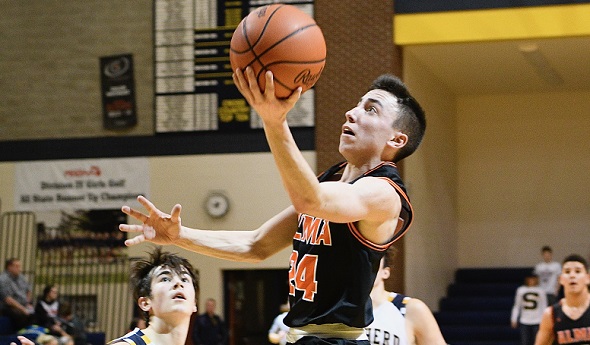
PHOTO: Alma improved to 7-3 last week with wins over Shepherd and Frankenmuth. (Click to see more from HighSchoolSportsScene.com.)