


'Who Will Cheer for the Nimrods?' Peterson IV, Watersmeet Found Fans Worldwide
By
Jason Juno
Special for MHSAA.com
July 15, 2025
WATERSMEET — George Peterson IV talks to a lot of people through his job as a police officer in the Green Bay, Wis., area. When some of those folks are headed up north for the weekend, he tells them he’s from the Upper Peninsula.
 Many are expecting to hear about one of the bigger towns located a couple of hours drive from Green Bay, like Iron Mountain or Escanaba. But they usually know his hometown, too.
“There’s more people than I would have thought know exactly – ‘Oh Watersmeet, the Nimrods,’” Peterson said.
Some surely know the tiny town because it’s not light years away from Green Bay – only about three hours. But Watersmeet’s dot on the map got a little bigger when Peterson was in school two decades ago, thanks to a run of media exposure that all started with an ESPN commercial that wondered: Without sports, who would cheer for the Nimrods?
Peterson and his teammates can look back on a high school sports experience unlike pretty much anyone else’s, which included the popular ESPN commercial, an appearance on “The Tonight Show” with Jay Leno, and an eight-part miniseries and media exposure from print and television outlets throughout the country. All because of their quirky nickname that has come to be an insult but was chosen because the biblical figure Nimrod was a mighty hunter, and hunting is a big deal in the U.P.
That era also coincided with the best basketball Watersmeet has ever seen. The 2004-05 team, with Peterson was a junior, won its only MHSAA Regional championship and only U.P. small-school team of the year award.
“Great memories from that year,” Peterson said.
The first moments he mentions from his time in high school sports as a aren’t of going to Hollywood – although that certainly came up later – or of being on ESPN. He instead recalled the camaraderie with his teammates, the bus rides, and proving people wrong even in elementary school that Watersmeet could be good.
“The Watersmeet Nimrods weren't supposed to be good,” he said. “We weren’t supposed to win elementary tournaments; we were supposed to fall apart.”
They definitely didn’t do that, as one of the smallest high schools in the state enjoyed instead an unforgettable three-year run.
The cameras first showed up when Peterson was a sophomore. ESPN staff came to get footage early that season, during a December 2003 game against rival Bessemer. The cameras didn’t faze the Nimrods, who upset the rival Speedboys that night; Peterson remembers Bessemer putting 100 on them later that season.
No one told the Nimrods when the commercials were going to air. Then one came on one night when Peterson was watching ESPN.
“That was really cool, just little surprises you weren’t expecting,” Peterson said.
Watersmeet was featured in major newspapers, “CBS Sunday Morning” came to town, and Nimrods merchandise flew off the shelves.
They were even on “The Tonight Show.”
“I would say Jay Leno was probably the coolest experience,” Peterson said. “A small-town kid from Watersmeet, all of us that went, getting treated like we were important, something that a lot of people don’t get to experience. They flew us out, we had limos, we had a hotel right down the road – I think it was a Hilton.”
After the national attention died down during their very successful 2004-05 year – which included the run to the Class D Quarterfinals – the cameras were back for Peterson’s senior year. This time it was the Sundance Channel for an eight-part miniseries about life in his team’s small town.
Those cameras were around that entire season. But if something came up along the way – and it did – the team could just ask the filmmakers to go away while they hashed it out privately. Peterson said they didn’t pressure him to do anything, and the staff members were great to he and his teammates, while doing what they could to make them feel comfortable.
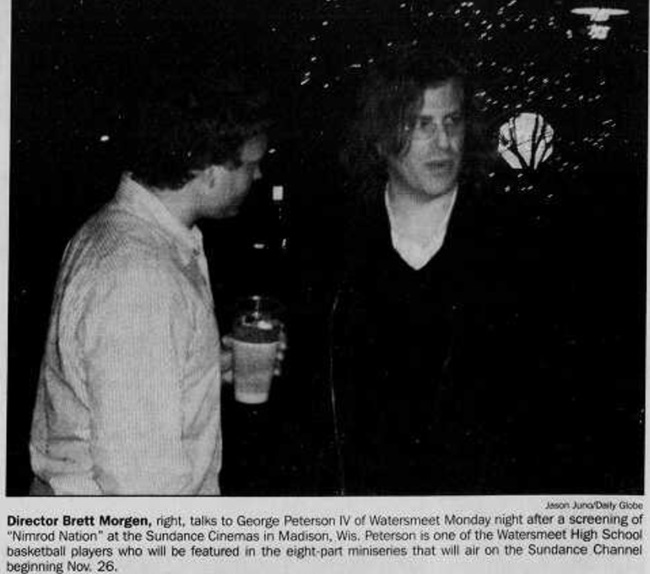
The buzz for the miniseries wasn’t quite the same as for the commercials. But Peterson enjoyed going to a screening ahead of its debut in Madison, Wis. And he can look back on scenes with his late grandfather.
“Now I can show my kids when they get older,” he said.
The basketball part of Peterson’s high school days was a pretty big deal as well.
Growing up, Peterson’s dad George Peterson III took him to the Regionals in Marquette each year. Rooting for area teams like Ewen-Trout Creek kept the fire going.
“I’d go back home, I’d shoot hoops and play ball,” Peterson IV said.
As he and his teammates entered in high school, the Nimrods finished well under .500 his freshman year. The next year, they flipped their regular-season record to 14-6, which included the early season upset of rival Bessemer with ESPN’s cameras recording commercial material.
“And then we were kind of like, ‘OK, we got something here,’” Peterson said.
They went to Michigan Tech’s basketball camp the following summer and won pretty much every game, including against the U.P.’s big schools like Marquette and Iron Mountain.
 The Nimrods also won constantly early in the 2004-05 season – until Baraga gave them another piece of humble pie. But that proved to be a quick bump in the road. They won their District tournament at home and then both Regional games by double figures.
Watersmeet then lost a heartbreaker in overtime in the Quarterfinal against Posen, but it didn’t diminish what they had accomplished.
For Peterson, he got to do it with his dad coaching, his brother Jordan playing with him and the whole community cheering for them. He still remembers the bus ride home and the reception they got going through Bruce Crossing, part of the E-TC school district.
“We got to experience something we never got to experience before,” Peterson said. “That was probably one of, if not my favorite, moments from my junior year.”
He learned a lot of lessons from that time in his life — just from playing sports but also from playing for his dad and with the kind of spotlight most small-school athletes don’t see.
“Being an athlete and working in law enforcement, a lot of the lessons learned go hand-in-hand with my profession, because you have to be teachable, you have to be coachable and you have to take the losses,” Peterson said. “Obviously in sports, every time you step foot on the court, we didn’t win. There’s some things in life that you don’t get what you want, but you just learn you gotta work harder for it and strive to be better. That helps me in my profession.”
His dad, who recently retired from coaching boys basketball after walking the sideline for more than three decades, taught his son many things like humility, how to be respectful, patience, and how to respond when things don’t work out.
“That doesn’t mean the door’s closed; you just gotta find a whole different way to get what you want,” Peterson IV said. “I remind myself of that every day when I’m at work.”
As for being in the spotlight, he took valuable lessons from that as well.
“It’s helped me learn to take a step back and not get too excited about certain things,” he said. “Like when I’m around a crowd or when I have stuff going on, like board meetings, or we just have a crowd where people could be mad or people could be in support. It’s helped me to learn to take a step back and mentally just prepare, take that deep breath and everything seems to run smooth.”
2025 Made In Michigan
July 10: Feeding 'Drive to Win,' Loy Norrix Grad Morgan Impresses with Strong USBC Showing - Report
July 9: After Blazing Multiple Volleyball Trails, Bastianelli Charting Next Career Path - Report
PHOTOS (Top) At left, George Peterson IV (12) puts up a jumper playing for Watersmeet in 2004. At right, Peterson holds his son George V while pictured with wife Elise and daughter Braelynn. (Middle) This Ironwood Daily Globe photo from 2007 shows Peterson talking with “Nimrod Nation” director Brett Morgan. (Past photos by Jason Juno; current photos courtesy of the Peterson family.)
Ribel's Return Sets Up TC Central for 2nd-Half Rebound, Postseason Push
By
Tom Spencer
Special for MHSAA.com
January 19, 2024
Best of three.
 That’s the perspective Traverse City Central’s varsity basketball team has as the Trojans travel to play undefeated Cadillac tonight. And really, they have the same vision for most of their Big North Conference opponents as they reach midseason.
Central has hopes of getting in two or more wins against those rivals with a third meeting likely coming during the postseason. Central also is hopeful of getting to play those conference and postseason games with their leading scorer Anthony Ribel healthy and in the line-up.
Ribel missed the first seven games this season with a foot injury, including an opening day 68-33 route by the Vikings on the Trojans’ court. He will be in the line-up this time – and the Trojans are a much more confident and experienced team than they were in the first meeting.
Cadillac is entering tonight 10-0 overall and 5-0 in the Big North. Central, 2-8 but coming off its highest-scoring game in 15 years (a 94-50 victory over Alpena), owns a 2-3 league record. But the Trojans haven’t given up winning the conference title just yet. Ribel’s injury occurred at practice just three days before the season opener, and since returning he has averaged 30 points per game.
“Cadillac beat us pretty bad,” second-year coach Ben Fischer acknowledged. “The guys are very motivated to show them how we play Trojans basketball.
“Anthony is a big addition – it goes without saying,” he continued. “We’re a much different team offensively and defensively than we were before.”
Last year, the 6-foot-3 Ribel broke the junior-season scoring record at Traverse City Central previously owned by Dan Majerle, who played 14 seasons in the NBA, made three all-star teams and helped the U.S. Olympic team to a bronze medal in 1988. Ribel scored more than 600 points and also eclipsed the 1,000-point career mark during his junior campaign.
Despite missing the first third of this season, Ribel has a shot at Majerle’s career scoring record of 1,388 points. He started this winter with 1,133 career points after joining the varsity as a freshman.
 Ribel recalled how he struggled through Cadillac’s lopsided win in the season opener while sitting the bench. Cadillac dominated the inside game, and Ribel is confident that will change tonight.
“When you lose at home by that much, it is embarrassing,” Ribel noted. “We have a lot of extra motivation.
“We’re less worried about what they can get from outside — we’re more worried about what they can do inside,” he continued. “We just have to take over the paint the best we can.”
Ribel led the way with 25 points in the Alpena win. The Trojans also got contributions from Owen Ribel (20 points), Brendan Slack (12 points), EJ Maitland (10 points), Jaden Clark (10 points, five assists), Jack Potgieter (nine points, eight rebounds) and Ethan Rademacher (five assists).
“We’re starting to find our stride.” Fischer pointed out. “Guys are getting a lot more dialed into their roles. We have relied on a lot of guys who didn’t have much experience coming into the season. Now they know they can go out there and compete having played some really good teams already.”
Slack is averaging 11.2 points per game and Maitland is contributing 10.1. Potgieter and Anthony Ribel are collecting six rebounds per game. Maitland and Potgieter kick in more than two assists.
Owen Ribel, only a sophomore, is also making a big mark for the Trojans. He’s thrown down a few dunks and had the 20-point effort against Alpena.
Owen and Anthony are the sons of past Trojans standout Ryan Ribel, a key team member of the last Central team to win a Regional, back in 1996. As a junior that year, Ryan Ribel averaged 17.5 points per game.
This season’s potential District opener opponents include the Big North’s Gaylord, Alpena, Petoskey and Traverse City West. Marquette also is in the District. The Trojans have wins over Alpena and Petoskey and lost to Gaylord and West the first time around. Anthony Ribel’s second game back was against West. He scored 19 points, but the Titans prevailed 64-59 with some strong free throw shooting down the stretch. Cadillac is a possible Regional opponent.
Regardless of tonight’s outcome, the Trojans will look forward to every rematch that comes their way as they hope to win all of their best-of-three series – of even sweep them.
“We’ve got a really good group of young men who are hungry to compete,” Fischer said. “Our biggest goal is to win Districts and hopefully Regionals. We’re getting a little bit better every single day.”
Anthony Ribel agreed.
“My teammates were put in some uncomfortable positions to start the year,” he said. “I think it will benefit us for the rest of the season.
“Getting the chemistry back with each other is going to be important,” he continued. “We need to string some big games together with all of us healthy, and make a good run.”
 Tom Spencer is a longtime MHSAA-registered basketball and soccer official, and former softball and baseball official, and he also has coached in the northern Lower Peninsula area. He previously has written for the Saginaw News, Bay County Sports Page and Midland Daily News. He can be reached at [email protected] with story ideas for Manistee, Wexford, Missaukee, Roscommon, Ogemaw, Iosco, Alcona, Oscoda, Crawford, Kalkaska, Grand Traverse, Benzie, Leelanau, Antrim, Otsego, Montmorency, Alpena, Presque Isle, Cheboygan, Charlevoix and Emmet counties.
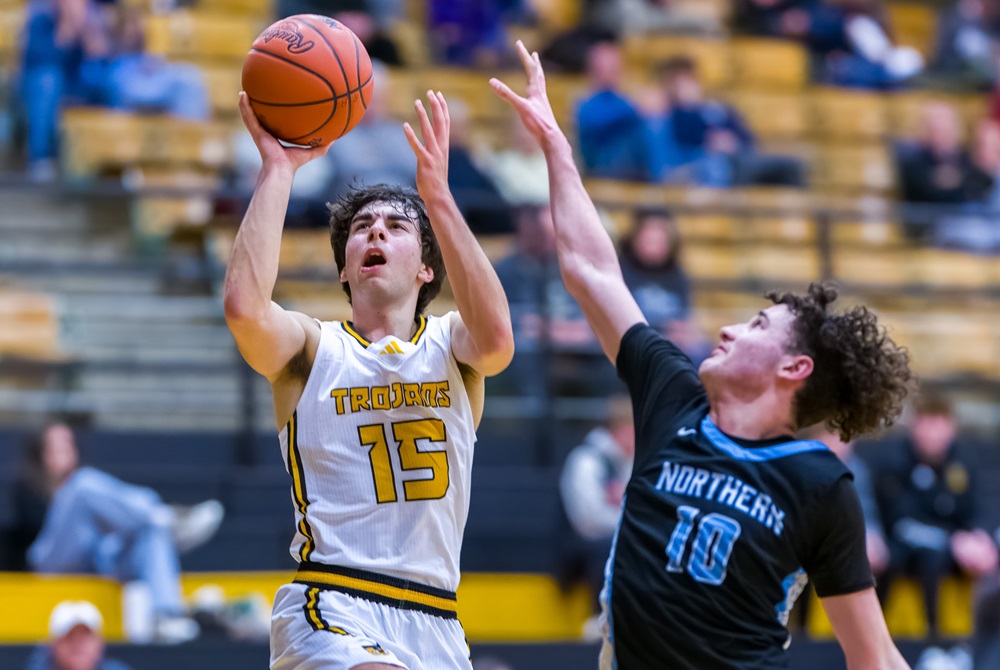
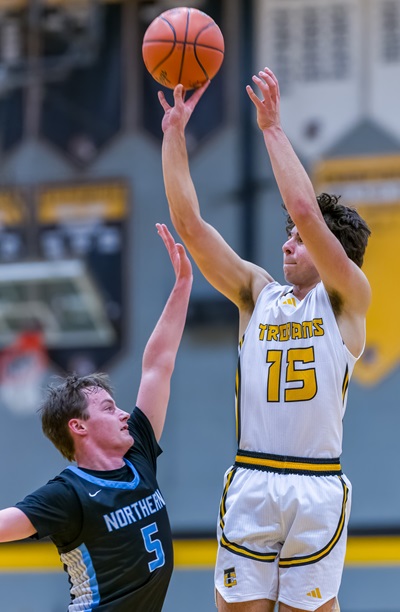
PHOTOS (Top) Traverse City Central’s Anthony Ribel, left, gets to the basket during his first game this season, against Grand Rapids Forest Hills Northern on Jan. 2. (Middle) Ribel elevates for a jumper. (Photos by Rick Sack, TC Rick Photo.)