

Youngest Salenbien Sibling Making Name as Family's Latest 1,000-Point Scorer
By
Doug Donnelly
Special for MHSAA.com
January 28, 2025
When Jaxon Salenbien was getting close to reaching the 1,000-point milestone for his career, he had some pretty good people to turn to for advice.
 Salenbien is the third member of his family to reach 1,000 points. Both of sisters scored more than 1,000 points while also playing for Adrian Lenawee Christian and his father, Jamie Salenbien, is a state-championship winning coach.
“My dad has coached ever since I can remember,” said Jaxon, a junior. “My sisters were always playing. I just kind of flowed right into it. I’ve just always been around it. I’ve watched a ton of basketball. I think that’s helped.”
The talent certainly runs deep in the family.
Jamie Salenbien played high school basketball for Hudson and set the school’s single-game scoring record. His wife, Deborah, played in college.
Jaxon’s older sisters Dani and Bree both were all-state players at Lenawee Christian and led the team to back-to-back Class D/Division 4 championships. Dani scored more than 1,000 points before playing at Hillsdale College. Bree scored more than 2,000 points, won four straight Associated Press Class D/Division 4 Player of the Year honors and is now playing at Gonzaga. Jaxon’s older brother Tyler was all-state in football.
“I used to watch them; now they are watching me and cheering me on,” Jaxon said. “We always have supported one another. It’s harder for Bree since she’s so far away, but when she’s home, she comes to my games.”
Salenbien was an instant starter on the LCS varsity team as a freshman, scoring nearly 450 points. He had a knack for getting to the free throw line and was a dangerous 3-point shooter.
Last year he teamed with senior Brandon Summer – a 1,000-point scorer himself – to light up the scoreboard but was also a top-notch playmaker, dishing out more than six assists a game.
 This winter, as a junior, Salenbien has been even more assertive with the basketball, shooting from the outside more often and driving with authority. He’s twice scored more than 30 points in a game, including 37 in an overtime win over Springport. It was during that game that he surpassed the 1,000-point milestone.
"Jaxon is not only super talented but also one the most dedicated gym rats I've ever coached,” Cougars coach Matt Summer said. “He is a great leader and a phenomenal teammate. His passion for the game is second to none. I'm super happy for him to hit this scoring milestone in his career."
That Springport win also was his first back in the lineup after an ankle injury forced him to miss two games.
“(The milestone point) had a weird timing to it because the game was so close,” he said. “They never said it over the PA system or anything because the game ended up going into overtime. I didn’t know exactly when I got it, but my coach told me.
“It’s a cool milestone to get as a high school player,” he added. “It was on my radar, but we just want to win as a team.”
Salenbien said there has been no magic formula to being more assertive on the basketball floor – he’s just playing the role on the team that an upperclassman should.
“Being an upperclassman, that’s what you are always going to do,” he said. “Taking control down the stretch is important for the junior and senior guards.”
The Cougars are off to a 12-2 start with a key stretch of Tri-County Conference games coming up. They lost their first TCC game recently to Petersburg Summerfield, which is 13-0.
The Cougars have excelled at 3-point shooting – averaging nearly 10 made triples a game.
“It’s so much fun,” Salenbien said. “Teams can’t key on one person. If they do, we have shooters everywhere.”
Jaxon is the youngest of the Salenbiens, who are all two years apart. He was in third grade when Dani started on the varsity. In fifth grade, his dad – who won 104 games in five seasons as the LCS girls varsity coach – coached him. Since then, his dad has been an assistant coach on several of his teams, including this year.
“When I was younger, he coached me in maybe fifth grade, but he’s never been my head coach, but always an assistant,” Jaxon said. “He’s always coaching me even if he’s not my coach.”
His sisters were definite basketball role models.
“Watching them has helped and just conversations we get to have,” he said. “Dani comes to pretty much every game now. Right before I reached 1,000 points, Bree and I had an hour-long conversation about things I need to work on and being coachable. It’s helpful to have those two to look up to on and off the court.”
Bree’s advice: Be coachable, be a leader and never think you can win a game by yourself.
His mom, who keeps the scorebook for LCS, offers her own advice – sometimes during games when he reaches the scorer’s table and checks in.
“We always say she’s the emotional support, and my dad is the basketball support,” Jaxon said. “She keeps me in line. She tells me to not complain to the referee and keep my head.”
 Doug Donnelly has served as a sports and news reporter and city editor over 25 years, writing for the Daily Chief-Union in Upper Sandusky, Ohio from 1992-1995, the Monroe Evening News from 1995-2012 and the Adrian Daily Telegram since 2013. He's also written a book on high school basketball in Monroe County and compiles record books for various schools in southeast Michigan. E-mail him at [email protected] with story ideas for Jackson, Washtenaw, Hillsdale, Lenawee and Monroe counties.
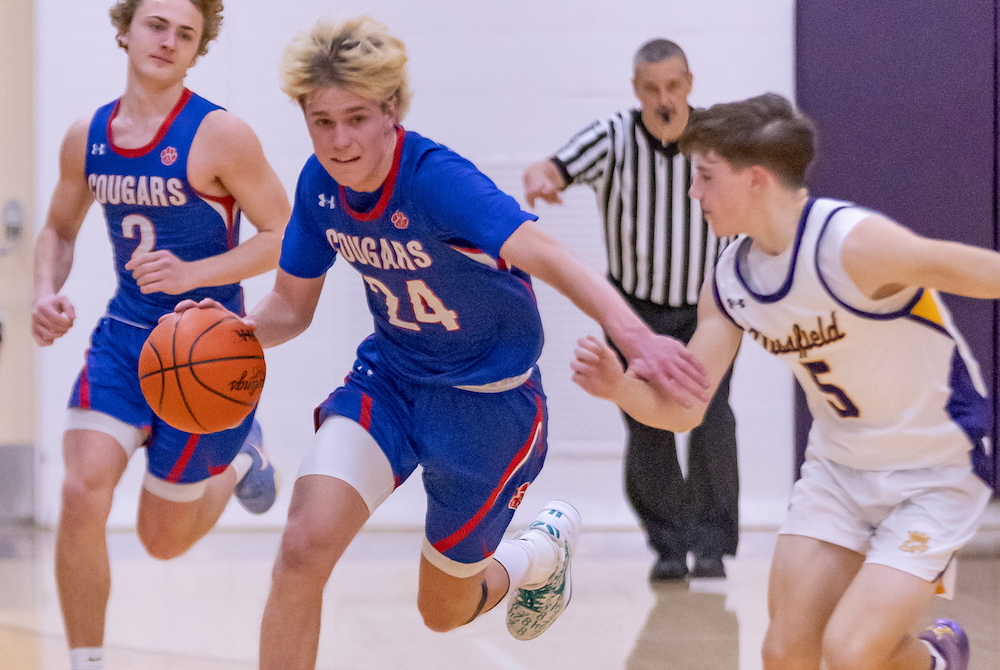
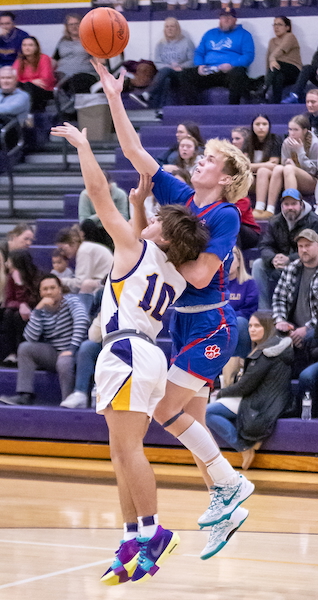
PHOTOS (Top) Adrian Lenawee Christian’s Jaxon Salenbien (24) pushes the pace bringing the ball upcourt against Blissfield. (Middle) Salenbien elevates to get a hand on a loose ball. (Photos by Michelle Sullivan.)

Jets' Streak Withstands Mightiest Challenge
March 23, 2017
By Geoff Kimmerly
Second Half editor
EAST LANSING – Seth Polfus might still be giggling and shaking his head. He couldn’t believe it either.
Southfield Christian was going to be the greatest threat so far to Powers North Central’s nation-leading 81-game winning streak. Anyone closely following the Jets’ record-setting run knew it.
But no one would’ve guessed Polfus – a 5-foot-9 senior guard, the team’s fifth-leading scorer, coming off three missed jumpers – would be the one to finish victory 82.
With four seconds to play in Thursday’s first Class D Semifinal, the team’s Mr. Basketball finalist double covered, and history seemingly hanging in the Breslin Center air, North Central’s Dawson Bilski sent a halfcourt pass deep to Polfus, who bobbled the ball at the baseline. Recovering, he somehow got up a shot around outstretched arms with one tenth of a second on the clock – and it dropped to give the Jets an 84-83 double overtime victory that could well be remembered as the game of this Finals weekend, even though no title was awarded for winning it.
Regardless, it surely will be remembered as the defining game of North Central’s winning streak, however long it lasts. Southfield Christian won three straight Class D titles from 2012-14, and then played in Class C the last two seasons while the Jets built their legacy. After last season’s Finals, this school year’s classifications were released showing the Eagles headed back to Class D.
“We knew if we made it to this point, they’d be there,” said Jets senior Jason Whitens, that Mr. Basketball finalist. “So everything from that point was getting better each day, preparing for that but not overlooking any opponent because you never know when something’s going to slip up, and teams are after you. We’ve got a big target on our back, and we got the job done.”
North Central (27-0) will next face Buckley in Saturday’s 10 a.m. Class D Final.
Polfus will have a busy weekend. A 4.0 student, he’ll later that afternoon accept one of 32 MHSAA/Farm Bureau Insurance Scholar-Athlete Awards for his achievements as an all-around athlete and student.
But he wrote his legend with that most improbable shot, the basket of a lifetime for a player who tore a knee ligament two seasons ago and spent last year’s Breslin run mostly holding down the bench.
“I didn’t know how much time was on the clock. I didn’t even know I shot it,” Polfus said. “We set up that play and Dawson was going to be coming down the court, and I knew I was going to be in that position because they were going to go double (Whitens down the sideline), and the ball was coming and I was ‘Oh man, it’s actually coming at me right now.’ And then I lost (the ball) … and I didn’t really know where I was. And then I saw the 6-4 kid coming at me, pump-faked him like I always do when I’m really scared. And then just launched it, and I saw it hit off the rim, thought it was an air ball, and then I just didn’t know what happened.”
 “I saw him go wide open,” Bilski added, “and I have enough trust in Seth – I grew up with him – I knew he was going to get the job done.”
Needless to say, none of what happened past halfcourt was coach Adam Mercier’s plan.
“I think one thing that summarizes these guys, and they’ve always been this way, is that they’re good at adapting,” Mercier said. “You run sets and plays, and sometimes you get in the way coaching. (But) sometimes you let kids make mistakes, and you let kids make plays.”
The Jets had to make a few. Southfield Christian led by 10 with two minutes to go in the third quarter, only to see the Jets tie it back up with a 14-4 run to end the period.
The two teams went back and fourth during the fourth, with the Eagles pushing the game to overtime on sophomore Harlond Beverly’s free throw with six seconds to go in regulation.
“We had a couple chances, they had a couple chances to put it away,” Southfield Christian coach Josh Baker said. “That’s kinda what we’re used to with these guys and the work ethic they put in.”
Southfield Christian got up by three at the end of the first overtime, but Whitens drained a 3-pointer with 17 seconds left to push the game to a second extra period. As that one wound down, the Jets led 82-80 with 20 seconds to go after a Bilski blocked shot and free throw.
But Eagles senior Brock Washington fearlessly drilled a 3-pointer with 10 seconds to play, pushing his team ahead by one and setting up Polfus’ dramatic moment.
“That’s what you want in the playoffs, what you want in the final four – a great game, a great matchup,” Washington said. “We’ll all look back one day and we’ll all be proud of what we did, but we all wanted to get that win.
“Everybody was prepared. Everybody was ready for the challenge. We’ve just gotta make the extra play.”
All five starters scored in double figures for the Eagles (21-6). Junior Bryce Washington had 23 points and Beverly had 22, seven assists and six steals, while Brock Washington added 12 points and 10 rebounds. Senior forward Trenton Temple had 10 points and 10 rebounds, and sophomore guard Caleb Hunter had 11 points and also seven assists.
Four other Jets average at least 10 points a game, and Polfus finished fifth in the points column again with seven (just above his 5.5 ppg average). Whitens had 31 points and 10 rebounds, Bilski added 23 points and 12 boards, and senior Bobby Kleiman had 14 points and eight rebounds. Polfus was the only starter who didn’t play the full 40 minutes, sitting for a mere three.
“I think win or lose tonight, they guys have already built their legacy. They didn’t need to win this game to prove anything,” Mercier said. “I’m just so happy for our guys to overcome. I know a lot of people have doubts about us, and deservedly so. We’re a small Class D school with 115 kids, so a lot of people discredit our 81-game winning streak up to this point, because who have you beat?
“That was a question mark coming in. So these kids played the underdog role. At the same time, we’re the two-time defending state champs, we’ve won that many games in a row and we deserve to be here as well. I was just so elated at pushback by our kids tonight … just that pushback, because how many games did we have single digits (during this streak)? So how are our kids going to respond? Those were the questions coming in. And these kids answered them tonight.”
PHOTOS: (Top) North Central teammates carry Seth Polfus down the court after his game-winning shot Thursday. (Middle) The Jets’ Jason Whitens works for an opening while the Eagles’ Brock Washington (left) and Harlond Beverly defend.