

One Mora Chance To Finish On Top
November 2, 2012
Mr. Competitive got the nickname from his fourth grade teacher, and he still loves to win.
He's enjoyed that feeling more times than most over the last three years. But Connor Mora nearly made a decision that would’ve deprived the state’s cross country community of its fastest runner this season.
Soccer was a serious contender for Mora’s talents as he contemplated what fall sport to play as a freshman. Not until the end of June that summer did the now-senior decide to join Cedar Springs’ cross country team instead.
“I’ve thought about it a lot, where my life would be if I chose to play soccer. I don’t know where I’d be right now,” he said.
And the rest is history. Or can become so today.
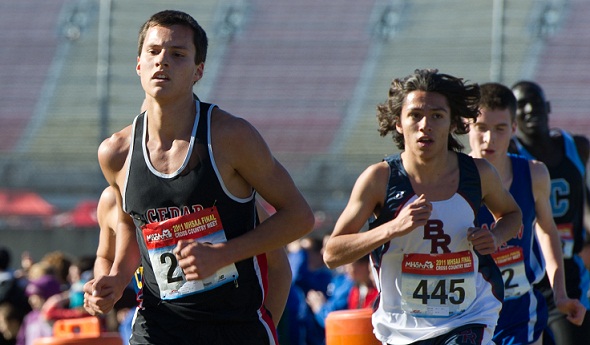
A Second Half High 5 recipient this week, Mora will run in his fourth and final MHSAA cross country championship race at Michigan International Speedway, and is expected to lead the pack.
To answer Mora’s question, had he chosen option two, he might have just finished patrolling the Redhawks’ midfield. He was “all right” at soccer and played it through middle school. But that’s when he also decided to run cross country with some friends who were joining the team.
Great call. Fast forward to Nov. 7, 2009, when he ran a 16:23.4 at MIS. He finished 15th at the Division 2 Final and was the fastest freshman in that race. Only Lake Orion’s T.J. Carey (16:18.2) was faster among freshmen from all four divisions.
In 2010, Mora cut his Finals time to 15:39. He finished fifth in Division 2 and was the fastest sophomore in any race by five seconds.
Last season he ran a 15:33.2 at MIS, good for third in Division 2 behind two seniors. And he was again second-fastest in his grade on the day, with only Carey in Division 1 edging him by a second.
So it makes sense that Mora enters his final high school cross country race with the fastest time in the state this fall by 11 seconds after breaking the 15-minute milestone with a 14:54 at his Regional a week ago.
That time broke his personal best by 20 seconds and the Cedar Springs school record by seven.
"The exciting thing for me as a coach was being able to call off his time with maybe 200 or 300 meters to go. That’s one of my styles; I’m not at the finish line, I’m away from the finish line letting them know where they’re at,” Cedar Springs coach Ted Sabinas said. “When I called out his time, I could see he instantly knew what that meant. He had put on an amazing 800 anyway to separate himself from Clark Ruiz (of Big Rapids). When he knew he had a chance to break into the 14s, that look on his face, that effort he put in, it was something to see.”
Breaking into the 14s for a high school runner is comparable to a running back rushing for 2,000 yards or a basketball player scoring 2,000 points in a career. It’s done on occasion, but only by the very best.
Sabinas has coached cross country at the school for 28 years. He’s watched the program emerge from its beginnings to an MHSAA team title contender, and he told Mora earlier this week that he remembers vividly when his all-time top runner broke into the 16s for the first time, and then the 15s too.
But he’s become memorable for more. Mora won MHSAA track championships in the 1,600 and 800 this spring, and owns the school 1,600 record of 4:09. He’s a 3.8 student and a leader who pulled in even his youngest teammates and helped them to feel included. Mora remembers the runners who pushed him when he was a freshman, and works to supply the same influence now.
“Certainly his times stick out. But it’s his nature and his personality,” Sabinas said. “He’s a leader on the team with his actions. He leads by the way he presents himself in practice. He doesn’t take an easy day. He leads in the classroom. We’ve got a close-knit group of kids here, and he leads the way.”
That will be the goal today. Mora has finished lower than first only once this season, nearly two months ago.
“My drive to win, that’s really what drives me. I don’t want to sound full of myself or anything, but I just want to be the best,” Mora said. “I want to set an example mostly for others coming up, who are in that position, and I want to give them someone to look up to.”
PHOTO: Cedar Springs' Connor Mora (left) rounds a turn during last season's Division 2 Final at Michigan International Speedway.
Match Race Makes for Intriguing Change, but Favorites Still Find Ways to Front
By
John Vrancic
Special for MHSAA.com
September 17, 2025
HOUGHTON — After following the traditional format for several years, organizers of the Bill Fezzey Memorial Invitational cross county meet decided to do something a little bit different for their races Sept. 4.
 They elected to host a match race, formerly known as fox and hounds, on the cloudy and cool day in the Copper Country.
“We decided to make it different this year,” Houghton coach Traci Welch said. “Our kids were really upset about it at first. Although they were apprehensive, I think this brought out the best in them. Some of them ran significantly better times.
"This was the first perfect score ever for our girls. I was a little worried about the boys because we knew (Painesdale) Jeffers was going to be tough.”
The Houghton girls grabbed the top five places in their race and scored 15 points, followed by L’Anse with 49 and Calumet at 74. Jeffers squeezed past the Gremlins 27-28 for the boys title, and third-place Dollar Bay scored 88 points.
Runners followed a 20-second stagger, starting with the No. 7 runners from each school and working their way toward the top. The first one to cross the finish line in each race was the winner regardless of starting position.
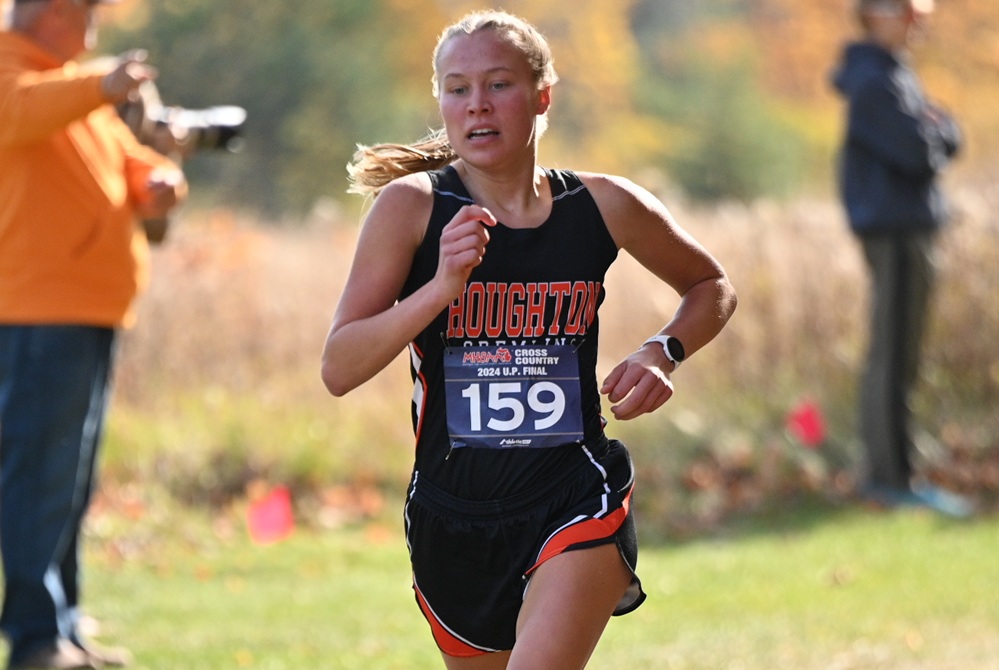
Houghton senior Tessa Rautiola was clocked at 22:14.1 in winning the girls race.
“I’ve never done a race like this before,” she said. “All varsity runners go out at once in other races. It’s just a matter of getting into a good mindset.
 “This is a learning curve for me. I should be happy I’m still running. I was just trying to catch other people during the race, which added to the intensity somewhat.”
Houghton sophomore Sela Niska was runner-up (22:23.4), and senior teammate Jovie Williams took third (22:38.8).
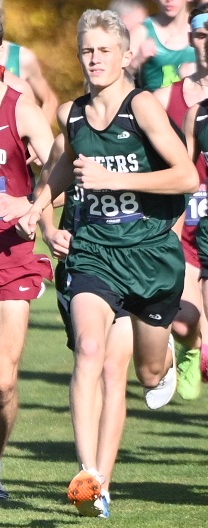
Jeffers senior Cameron Anderson was the boys winner at 18:33.4, followed by Houghton sophomore Xavier Hutchinson (19:08.3) and freshman Cole Ceane (19:08.8).
“Cam started last and came in first,” Jets coach Sam Kilpela said. “We had him timed at 16:31. It’s so easy to start out fast, which in a way is the hardest part. Once the guys settled in, they knew their job and got it done. This is a big win for us.”
Anderson said he didn’t mind the new format.
“It wasn’t bad,” he added. “I wouldn’t mind doing it again. It made me push myself and want to catch the other guys. You had to make sure you held your pace.”
Hancock senior Lydia Pelli took 18th (24:12.9) among the girls.
“(The match race format) gives the people who are usually first more of a challenge,” she said. “I think I like the regular races better because I’m more familiar with them. You have a better idea of what to expect.”
Ironwood senior Jaelyn Novasconi previously played volleyball but decided to go out for cross country this year. She finished 37th (27:48.8).
“This was a hard choice because I love volleyball,” she said. “I also love basketball, and this will get me in better shape.
“This was my (second) meet since middle school. This is also a great opportunity to compete with kids from other schools. The start was definitely different, but I ran faster than in my first meet.”
 John Vrancic has covered high school sports in the Upper Peninsula since joining the Escanaba Daily Press staff in 1985. He is known most prominently across the peninsula for his extensive coverage of cross country and track & field that frequently appears in newspapers from the Wisconsin border to Lake Huron. He received the James Trethewey Award for Distinguished Service in 2015 from the Upper Peninsula Sportswriters and Sportscasters Association.
PHOTOS (Top) Houghton senior Tessa Rautiola runs to the Upper Peninsula Division 2 Finals championship last season. (Middle) Painesdale Jeffers’ Cameron Anderson moves toward the front of the lead pack at last year’s UPD2 Final. (Photos by Cara Kamps.)