

From Athens to Alpena, Storch Makes Impact
September 7, 2018
By Chris Dobrowolski
Special for Second Half
ALPENA — Riding off into the sunset was never part of Tim Storch’s retirement plan.
 That’s why, seven years into retirement from teaching, Storch continues to do the same thing at Alpena that he did for 30 illustrious years at Troy Athens — coach high school soccer.
“I think anyone who coaches knows that coaching is an addiction,” said Storch. “You love it, and it’s hard to walk away from.”
Storch’s love for coaching has fueled one of the greatest careers in the history of Michigan boys and girls high school soccer. Storch entered this year with more than 1,000 wins, including a state-best 514 in girls soccer since 1982. He has the third-most wins all-time among boys soccer coaches. At the forefront of all those victories are nine MHSAA Finals championships, with five boys titles (1981, 1983, 1984, 1989 and 1997) and four girls crowns (1989, 1991, 1993 and 2000) to his credit.
Each of those titles came at Athens, where Storch was hired fresh out of college in 1981 and guided the Red Hawks from the inception of both programs.
“I was fortunate to win a lot at Athens,” said Storch. “The players I had really helped me do that. I still hold a soft spot in my heart for Troy Athens.”
Storch also has an affinity for the Alpena area, a place where his parents regularly vacationed while raising their family and Storch knew was his destination once he ended his teaching career in 2011. Still with the urge to coach soccer, Storch was hoping for an opportunity in some capacity when he moved to his house on Grand Lake, minutes north of Alpena. The timing proved to be perfect as the Wildcats were looking for boys and girls varsity head coaches. Storch stepped right in without missing a beat. He later added the role of athletic director four years ago.
In many ways though, coaching in Alpena has been a big contrast from Troy — perhaps the biggest being location. There are no other Division 1 schools within an hour of Alpena in the northeast part of the Lower Peninsula. In Troy there was always top competition throughout the metro Detroit area.
There also is a big difference in the number of athletes who enter high school with a lifetime of soccer experience.
“Unfortunately in Alpena, we’re an island over here in a big area,” said Storch. “So, it’s tough to find competition. When you’re downstate you’ve got Troy and Rochester and Birmingham and Bloomfield and Royal Oak and Shelby Township all within five to 10 miles of each other. Here we’ve got to go quite a ways to find an opponent that is somewhat near our size.”
Storch still has managed to make an impact in Alpena. His players find the credentials he’s brought to their community motivating, and they’re thankful for how he’s been able to cultivate their skills.
“It’s super fun playing for him because he makes practices fun, but he always makes practices hard and challenging so we can get better,” said senior Mollie Girard, who has played on the girls varsity for the past three years. “He expects a lot of us. He’s a good leader as a coach. He also looks at some of us to be leaders for our other teammates. He knows a lot about the game.”
Aidan Day, a senior on this year’s boys squad, said he has the utmost respect for his head coach for helping Day reach a high level of play on the pitch. Day set Alpena’s record with six goals in a game last season.
“He’s meant everything to my soccer career,” said Day. “I wouldn’t be the player I am today if it wasn’t for him.”
Day was an underclassman on possibly Storch’s best team since he arrived in Alpena. That 2016 squad won 15 games and competed well against the top teams in the Big North Conference. Traverse City West, the team that ended up ousting the Wildcats in the District, reached the Regional Finals.
 Storch sees potential in this year’s boys squad too, which reeled off five straight wins after two early losses to kick off the year.
“We’ve been very diversified in our attack,” said Storch. “We probably have four or five guys who I think can step up and score goals. I think we have multiple weapons, which makes us tough to defend and not so one-dimensional.”
Day, along with Grant Botha, Deven Saranen and Noah Carstens are the offensive threats that make the Wildcats go.
“I think it has the potential to be (one of my best teams in Alpena),” said Storch. “But as I said to the paper here locally, ultimately we’ll be judged by what we do with the league and the postseason play.”
Day talks excitedly about achieving postseason success. It’s not come easily for the Wildcats. Alpena’s boys team has not won a District title since 1997.
“That’s my dream,” said Day. “I’ve always wanted to (win a District title). Hopefully this is the year. I’ve got one more year left. It’s doable for sure this year. That would be phenomenal.”
Storch said creating a winning team remains important to him, but he has found over the years that the relationships he’s established have become the most satisfying aspect of coaching.
“This summer I had the goalie from my first team. He’s in his 50s, and he’s a minister in Atlanta, Georgia,” said Storch. “He and his wife and son came up and stayed with me. When you’ve got connections that go back 37 years and the kids who played for you then are not kids anymore (it’s special). Unfortunately, I just had to speak at one of my former players’ funerals. I’ve had seven former players pass. and that’s difficult. It’s nice to know you had an important influence on their lives where they still want you to be part of it, even the families when one of their loved ones pass. They keep you included.”
Storch said there is no timetable for how long he would like to coach. He enjoys impacting the student-athletes in Alpena, and he still loves teaching the game – that’s for sure.
“Eventually maybe the battery loses some of its charge, but I think every coach knows when it’s time to get out,” he said. “Certainly, I have the passion to keep doing it. When it is time, I think I’ll know that.”
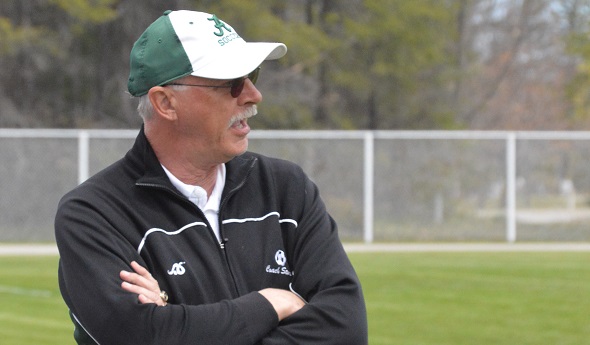
PHOTOS: (Top) Tim Storch coaches one of his Alpena soccer teams. (Middle) Far right, Storch celebrates Troy Athens’ 2000 girls Division 1 championship. (Top photo courtesy of the Alpena News.)
Performance of the Week: Howard City Tri County's Savanah Thompson
May 7, 2026
 Savanah Thompson ♦ Howard City Tri County
Senior ♦ Soccer
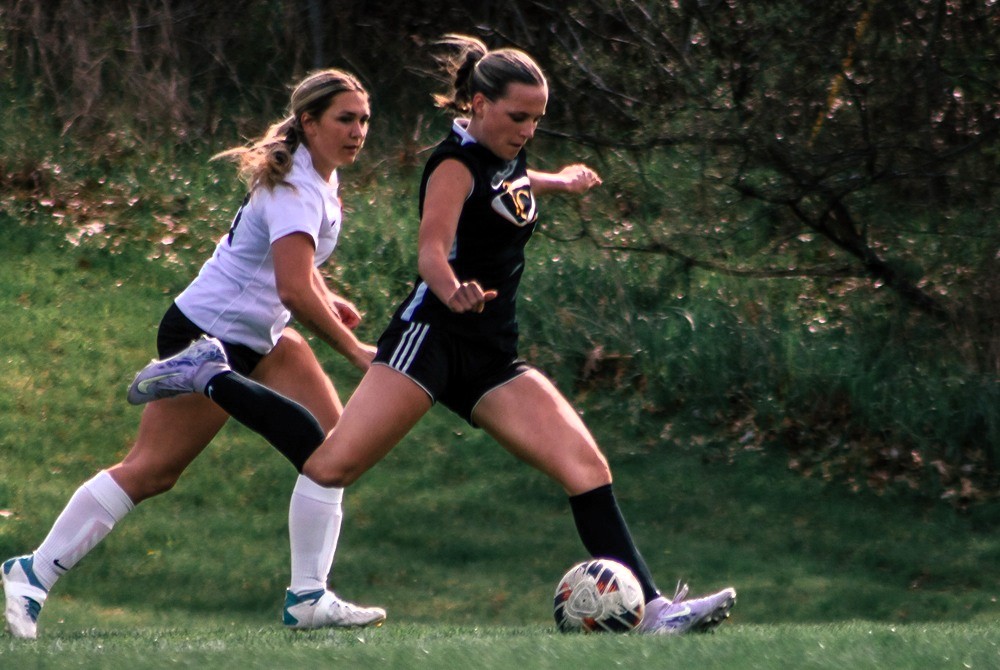
The four-year varsity standout, became just the fourth player in MHSAA girls soccer history to score 200 goals, reaching the milestone during a seven-goal performance against Lakeview on April 29. She reached 200 on her first goal of the evening and needs only 10 more to break the MHSAA career record of 228 set by Leland's Libby Munoz from 2013-16.
Thompson set her school's single-season goals record first as a sophomore and again as a junior, with her 67 goals last season ranking eighth and her 65 in 2024 tied for 10th on the MHSAA single-season goals list. A first-team all-stater as a sophomore and honorable mention last spring, Thompson has extended a family sports legacy at her school that includes her dad Mike, a Finals wrestling champion in 1994, and uncle Dan Thompson, who won three Finals titles on the mat. Savanah also played two seasons of basketball and ran two of track, and she'll continue her soccer career at Saginaw Valley State University where she'll study toward eventually becoming a nurse practitioner. Tri County is 10-3-1 this season and a combined 57-21-4 during her four on varsity.
@mhsaasports ⚽️POW: Savanah Thompson #tricounty #soccer #highschoolsports #performanceoftheweek #MHSAA ♬ Bright and fun upbeat pops, Kids, Animals, Pets, Fun, Cute, Happy, Playful, Upbeat(1465232) - SAKUMAMATATA
@mhsaasports ⚽️POW: Savanah Thompson #funfacts #tiktalk #performanceoftheweek #highschoolsports #MHSAA ♬ Girly and cute synth pop - SAKUMAMATATA
Follow the MHSAA on TikTok.
MHSAA.com's "Performance of the Week" features are powered by MI Student Aid, a division within the Department of Lifelong Education, Advancement, and Potential (MiLEAP). MI Student Aid encourages students to pursue postsecondary education by providing access to student financial resources and information. MI Student Aid administers the state’s 529 college savings programs (MET/MESP), as well as scholarship and grant programs that help make college Accessible, Affordable and Attainable for you. Connect with MI Student Aid at www.michigan.gov/mistudentaid and find more information on Facebook and X @mistudentaid.
Previous 2025-26 honorees
April 30: Eliza Schwass, Ludington track - Report
April 23: Emily Postema, Ravenna softball - Report
April 16: Katie Berkshire, Gaylord track - Report
March 26: Kayla Hairston, Goodrich basketball - Report
March 19: Liam Smith, Otsego swimming - Report
March 12: Jack Sayen, Houghton hockey - Report
March 5: Devin Patrick, St. Clair Shores Lake Shore - Report
Feb. 26: Madison Nieuwenhuis, Plainwell wrestling - Report
Feb. 20: Sophie Ramey, Allen Park competitive cheer - Report
Feb. 13: Cam Ryans, Grand Rapids Northview basketball - Report
Feb. 6: Melanie Kolnitys, Midland Dow basketball - Report
Jan. 29: Stella Musialowski, Huron Valley United gymnastics - Report
Jan. 22: Baylor Perkins, Grand Blanc swimming - Report
Jan. 15: Delaney Vanier, Flint Kearsley bowling - Report
Jan. 8: Stevie Hall, Detroit Cass Tech basketball - Report
Dec. 18: Ethan Martha, Ishpeming Westwood basketball - Report
Dec. 11: Louis Smith, Three Rivers wrestling - Report
Dec. 4: Traverse Moore, DeWitt football - Report
Nov. 28: Elizabeth Eichbrecht, West Bloomfield swimming - Report
Nov. 20: Brady Kieff, Blanchard Montabella football - Report
Nov. 13: Ella Laupp, Battle Creek Harper Creek swimming - Report
Nov. 7: Hunter Eaton, Charlevoix cross country - Report
Oct. 31: Stephen Gollapalli, Lansing Christian tennis - Report
Oct. 23: Talya Schreiber, Pickford cross country - Report
Oct. 16: Avery Manning, Dexter golf - Report
Oct. 9: Brady Van Laecke, Hudsonville football - Report
Oct. 2: Sarah Giroux, Flat Rock volleyball - Report
Sept. 25: Sam Schumacher, Portage Central tennis - Report
Sept. 18: Kaylee Mitzel, Saline field hockey - Report
Sept. 11: Natasza Dudek, Ann Arbor Pioneer cross country - Report
Sept. 4: Kate Posey, Big Rapids golf - Report
(Photos courtesy of the Tri County athletic department.)