

Little Leland Boasts Big Numbers, Success
By
Dennis Chase
Special for MHSAA.com
October 6, 2015
By Dennis Chase
Special for Second Half
LELAND – Small school, big aspirations.
Welcome to Leland, where the volleyball and soccer programs are once again celebrating success.
 Both teams are ranked No. 3 in state coaches polls in their respective sports and divisions.
And both are hoping to make deep runs in the MHSAA tournament.
That's been the norm in volleyball. The Comets – Class D champs in 1978 and 1980 (Lower Peninsula), 2002 and 2006 – reached the Class D Final last November before dropping a four-setter to perennial power Battle Creek St. Philip.
The soccer program is making noise, too, with three consecutive district titles, including an MHSAA Semifinal appearance in 2012.
"Obviously, the volleyball program has tradition," soccer coach Joe Burda said. "We've been around lately. We're trying to start our own (tradition)."
His Comets are 15-2, heading into Friday night's showdown at Muskegon Western Michigan Christian, the school that beat Leland in the regional final a year ago.
The volleyball team is 20-5-4. One of the losses was to St. Philip in a season-opening tournament. Another was to Class A Caledonia in the final of the Morley-Stanwood Invitational.
Some 60 students – almost half of Leland's 122 total – play soccer or volleyball.
"There's definitely momentum behind both programs," athletic director Ryan Knudsen said. "The kids are having fun, learning a lot about their sport, learning life lessons, and being successful, and that really draws kids to want to participate. It carries on from year to year and you can see it all the way down to our middle school and elementary programs. There's an excitement."
Leland is the smallest school in the Northwest Conference. Size, though, does not deter the spirit, and the Comets thrive on the challenge.
"Our coaches do an outstanding job," Knudsen said. "But we also have tremendous support from our school board, administration and community. They all understand that being the smallest school in the conference, and the fact we schedule as many challenging non-conference games as possible in all our sports, helps us prepare our student-athletes and teams to be able to have longstanding success. We're excited about the present and we're excited about the future."
That sentiment is readily apparent in volleyball. Coach Laurie Glass, who has won MHSAA titles as a player and coach at Leland, has an interesting blend in her starting lineup, ranging from two returning all-state seniors to two promising freshmen.
The team has grown considerably since that early-season loss to St. Philip.
"We have a very strong team," senior Maddie Trumbull, the team's floor captain, said. "We started off a little slow, but our freshmen are really stepping up and are a big part of our team. They have made such a difference. We are so much better than we were four weeks ago."
 Glass said playing St. Philip so early in the season was an advantage.
"You have to bring your best in order to compete with St. Phil," she said. "It sets the tone for what you've got to work on in order to get back there (Battle Creek is host site of the MHSAA Finals)."
Trumbull, an outside hitter, and Eva Grobbel, a middle hitter, are the returning all-state players. They lead the team in kills. Trumbull also tops the charts in hitting efficiency and Grobbel in blocks, according to Glass.
"Maddie's even better now than she was last year (when she led the team with 572 kills), and she's really developed her leadership skills," Glass said. "Eva played club in the spring, and she's varied her offense."
Glass said opponents often focus their gameplans on trying to stop Trumbull at the net – and that's a mistake.
"We have too many other weapons and we have the ability to move (Trumbull) around so they just can't camp out on her on the outside," Glass said.
Other key contributors are senior ViAnna Hennig, who battled shin splints last season, but is now physically tougher and stronger; freshman outside hitter Allie Martin; freshman setter Ella Siddall, junior libero Julie Bardenhagen; and junior Rachel Bechtel, a strong server, and sophomore Rowan Wilson, who split time. Martin leads the team in aces, Siddall in assists. Martin and Siddall were team managers last season.
Siddall has replaced graduated Jessica Fleis as the setter.
"That's the toughest position to replace," Glass said. "We run a pretty complicated offense, so to be able to call audibles on the fly, that's a lot for a freshman. That speaks to her talent."
Bardenhagen, who's replaced another spring graduate in Whitney Schaub, has helped solidify the defense and passing game at libero.
"In our first tournament we didn't have a libero," Glass said. "We didn't have anyone to replace Whitney. We really struggled passing and didn't have a good anchor on the back row."
Now it seems to be clicking.
"It's been going so much better because I didn't know what to expect," Grobbel admitted. "We lost our libero, our setter, and they were a huge part of our team. But we all want to win a state championship. We've worked so hard together to try to make that happen."
Trumbull agreed.
"Right after the state finals (last November) we were already looking forward to this season, making plans for what we can do better," she said. "We're always thinking about how we can get better, how we can win a state championship."
"I think this team wants to go deep again," Glass added. "They have certainly set their sights on that from the beginning. If it has anything to do with work ethic and team chemistry, they have all the pieces they need to make a run."
Leland's reached at least the quarterfinals in five of the last six years. Glass attributes the program's success to player development at the middle school level, where a higher priority is placed on learning the game and proper techniques as opposed to winning.
"It's about doing the right things for the right reasons at the right time," Glass said.
Burda, meanwhile, is in his sixth season leading the soccer program. And he has it rolling with 39 players out, which allows for a junior varsity team.
The Comets are tough up front with senior Mike Osorio and junior Noah Fetterolf. Clarke Morgan, a four-year varsity veteran, anchors the defense. Rick Roman is an experienced keeper.
 "They've all been different," Burda said of his teams. "I think I see more potential in this team, though. I think we're more balanced offensively and defensively. We've always been strong down the middle, but we're strong at all of our other positions, too."
Osorio and Fetterolf are the scoring leaders who keep opposing defenses honest. They are particularly dangerous when Leland counter attacks. Morgan, meanwhile, commands respect from his sweeper position.
"He chases down everybody and everything," Burda said.
Leland's only two losses came on the same day – setbacks to Harbor Springs and Elk Rapids in a tournament at Elk Rapids. The Comets were shorthanded that day, minus, among others, Fetterolf.
The Comets went through September without a loss, including a 4-1 victory over the Elks.
"We're just preparing every day for the next game because that's the only one that matters," Morgan said. "If we focus on one game at a time, focus on each opportunity, we can really do something in the post-season."
Morgan said the Comets are "super competitive" and that drives them in their quest to be the best.
"We're always trying to push each other to reach our full potential," the 17-year-old said.
Morgan, who also plays club soccer for the Midwest United FC travel team out of Grand Rapids, said the Comets have all "the key components," including chemistry.
"It's really cool," he said. "Our school is so small you see everyone in class, you see everyone around school and then you go to soccer practice and it's the same people. We have a good bond, a good connection."
Burda is hoping to parlay that into something special.
"We want to make another run," he said. "We want to get back to the Final Four."
 Dennis Chase worked 32 years as a sportswriter at the Traverse City Record-Eagle, including as sports editor from 2000-14. He can be reached at [email protected] with story ideas for Manistee, Wexford, Missaukee, Roscommon, Ogemaw, Iosco, Alcona, Oscoda, Crawford, Kalkaska, Grand Traverse, Benzie, Leelanau, Antrim, Otsego, Montmorency, Alpena, Presque Isle, Cheboygan, Charlevoix and Emmet counties.
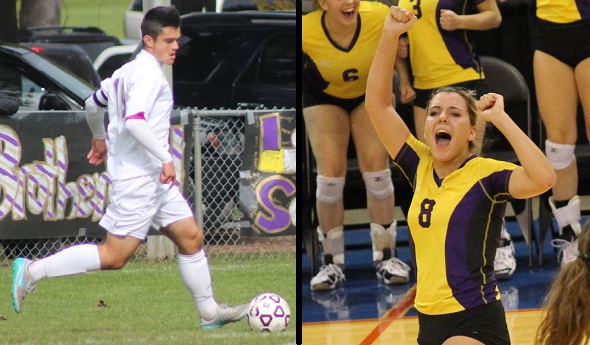
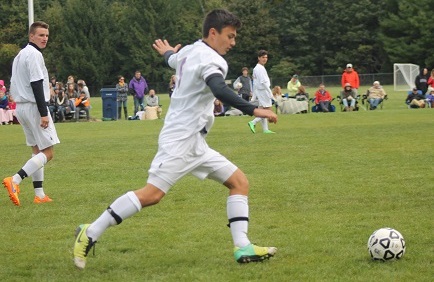
PHOTOS: (Top) Leland soccer senior Clarke Morgan, left, and volleyball senior Maddie Trumbull are among standouts for the school's standout teams this fall. (Middle) Senior Eva Grobbel unloads a serve during a match this week. (Below) Senior Mike Osorio lines up a kick during a game this season. (Soccer photos courtesy of Katia Skarupinski; volleyball photos by Gwen Martin.)
Dakota Hammers Home First MHSAA Title
November 17, 2012
By Geoff Kimmerly
Second Half editor
BATTLE CREEK – On one side of Saturday’s Class A Volleyball Final stood Temperance Bedford, with three MHSAA championships and led by the second-winningest coach in national high school volleyball history.
On the other sideline, Macomb Dakota prepared for its first championship game since the school opened in 1996, when most of the Cougars were just learning to walk.
That imbalance didn't end up deciding much on this day, but was certainly something Dakota considered before making its own history with a 25-22, 25-21, 26-24 win over the Kicking Mules.
It was truly a milestone run for the Cougars, who didn't give up a set during the entire tournament.
“We’d never played Bedford before. We'd never played (Semifinal opponent) Northville before. So I think it showed so much adaption for our team and so much depth that we could come in barely knowing anything about their teams, with 10 minutes of scouting video, and we can take them down in three,” Dakota junior hitter Carli Snyder said.
“It’s ideal for that to happen, but it doesn’t happen very often. Great teams drop games because they play badly, but we didn’t (through the tournament) because we kept playing tough the entire time. It’s incredible.”
Seemingly everyone in Battle Creek knew Snyder would be on the attack.
But that hasn’t helped opponents the University of Florida-bound standout all season. And it didn’t make much difference at Kellogg Arena.
Snyder, in just three sets, had 31 kills – third-most in an MHSAA Final since the beginning of the rally scoring era in 2004-05.
Bedford had survived the Semifinal against Grand Haven despite 20 kills by Miss Volleyball runner-up Abby Cole. But Snyder was unstoppable when it counted most.
She killed the final two points of the first game and the final point of the second. With Dakota trailing by three in the third, Snyder had three straight kills to make it 14-14. Her final attempt of the day was dug – but Bedford’s return went wide down the right side.
“We just had to adjust to her and learn from her and get better,” Bedford sophomore middle Nicole Rightnowar said. “She hit where we weren’t, and it was really hard to block her.”
 The Cougars have learned a lot in short time. Only three seasons ago, Dakota finished 19-27-3 in coach Tracie Ferguson’s second year.
But the former Clinton Township Chippewa Valley standout (who later played at Wayne State) led the Cougars to a near reverse of that record in 2010 before guiding them to the first of two straight Regional titles last fall.
Dakota entered the District this season ranked No. 3 and finished 59-5.
“When I played in high school, it was Bedford and Jodi (Manore) was still coaching. And honestly, coming into tonight, I knew she was the coach and knew they had a great team, a very technical team … and I gave the girls that input that, ‘Hey, they know how to play volleyball,’” Ferguson said. “Bedford is a big volleyball school. But at the same time, we’ve come a long way. What we’ve accomplished and built on, we were right there with them.”
Bedford’s run was equally exceptional considering that although the Kicking Mules were ranked as high as No. 6 this fall, they entered the tournament an honorable mention.
Bedford finished 65-13-3, with Manore now 1,679-283-48 over an incredible 28-year career – and with four of Saturday’s starters set to come back next season.
“If you look back and ask a lot of the teams we played this year if we were going to be state runners-up, I don’t think too many would’ve picked us,” Manore said. “We came up a little short once we got here, but we beat two really good teams to get to the Finals in Mercy and Grand Haven. I think we came up against not only a team with the best player we’ve played all year, but her supporting cast stepped up I think a lot bigger than we saw (Friday).
“Give her 31 (kills). But there were some other kids there that had quite a few, and that was our problem.”
Dakota junior setter Megan Manuerski had 43 assists, good to tie for 13th on the MHSAA Finals record list. Snyder also had 14 digs and senior outside hitter Megan Downey had 19.
Sophomore outside hitter Kayla Gwozdz had 14 kills to lead Bedford and Rightnowar had 10. Junior setter MacKenzie Andrews had 37 assists and senior libero Ellen Hays had 18 digs. Senior Lexie Curtis added 10.
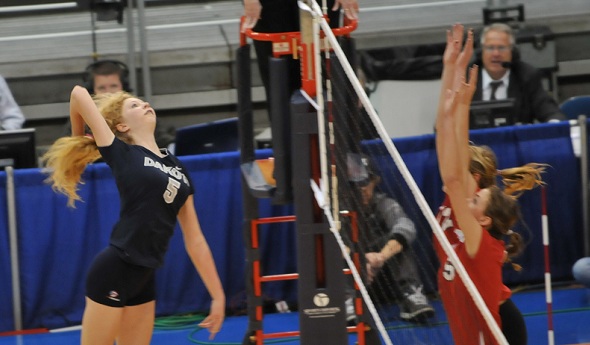
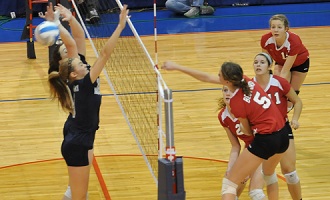
PHOTOS: (Top) Macomb Dakota junior Carli Snyder prepares to unload on a set during Saturday's Class A Final. (Middle) Temperance Bedford's Nicole Rightnowar puts down one of her 11 kills.