

Performance: Coldwater's Shuaib Aljabaly
October 7, 2016
 Shuaib Aljabaly
Coldwater junior - Cross Country
In a relatively short time, Aljabaly has made an incredible impression on the cross country course. He started running with Coldwater's high school team only midway through his sophomore season but finished last fall placing eighth at the Lower Peninsula Division 2 Final. Now a junior, Aljabaly is undefeated this season and earned the Michigan National Guard "Performance of the Week" by winning Saturday's Otsego Invitational Division 2 race in a school-record 15:34, finishing just ahead of two more 2015 all-staters in Grand Rapids Christian's Justin Varineau and Otsego's Alex Comerford.
Also a starting midfielder on Coldwater's No. 7-ranked soccer team, Aljabaly has led the Cardinals' cross country team to a No. 4 ranking in LP Division 2 – they finished second as a team at Otsego only to top-ranked Grand Rapids Christian. Varineau had finished one spot ahead of Aljabaly at last season's MHSAA Final – but Aljabaly was most familiar with Comerford (13th in LPD2 in 2015) as the two already had faced off this fall in a race of undefeated runners Sept. 24 at the Jackson Invitational. Aljabaly's time at Otsego also would've won that event's Division 1 race by 40 seconds.
 Aljabaly played junior varsity soccer and ran track as a freshman, qualifying for the MHSAA Finals in the 3,200-meter run. At the convincing of his cross country coaches, Aljabaly gave that sport a try last fall and should contend for the LPD2 title this season and next; his 15:34 would've finished third at last season's MHSAA Final and he also broke 16 minutes with a 15:46 at Jackson. He'll likely face his fastest challenge so far this fall at Saturday's Portage Invitational, where he finished seventh in the Division 2 race last season.
Cross Country coach Jim Bilsborrow said: “He is a real competitor who hates to lose. He also studies his opponents and knows what are their strong and weak points, which he tries to exploit. Now that he has made cross country his primary sport, he has been able and willing to do some more intense training, which of course has made him even better. He is also a real ‘team player’ who cares about his teammates and how well the team does. Of course, I must add that he is blessed with talent, as all great runners are endowed, but fortunately he is using his talent and not wasting it.”
Performance Point: “We raced the week before at Jackson and the course was pretty fast, and they said Otsego’s is even faster,” Aljabaly said. “I was 1.5 seconds away from the record at that (Jackson) race, so I had a good feeling about Otsego. … Usually I start kicking at the 2-mile mark; Coach is usually standing there telling me when to kick. But I waited until the 3-mile mark, the 2.9. I didn’t know if one of (Varineau and Comerford) would go or not. We just stayed together until I went, and I felt like they just dropped back. But (Varineau) was kicking strong; he was only four tenths of a second behind me. I was told he was six seconds behind me at the 3-mile mark. Everyone was just yelling so loud, it made me run faster.”
Doubling up: “(Playing two sports) is going better than last year. It’s pretty hard, but we’re 14-1-1 (now 15-1-1) in soccer and we just locked up the conference, so we’re doing pretty good there too. It’s really flexible, the schedule. The coaches talk it out before the season starts. Cross country is my primary so I go to cross country practice and I go to soccer practice unless there’s a meet the same day, and then I usually go to the cross country meet. I haven’t missed a soccer game, but this weekend (running) at Portage, I’m going to miss a soccer game.”
 Back for more: “Last year I wasn’t going to do cross country, but Coach Bilsborrow got me to do it. I started halfway through the season and at Portage last year I broke the school record but on a short court (just less than 5K), and that’s what motivated me to keep running.”
Born to run: “I like the competition. I like being nervous before the race, the feeling of knowing who you’re up against, the competition mainly. … We didn’t really have strong competition at the first few races. At Jackson I went against (Comerford) and I kinda realized how he races and starts off at the beginning. At Otsego I thought I’d get (Comerford) but I wasn’t sure about (Varineau). ... (Competition) pushes me. It motivates me. At Jackson, Coach told me (Comerford) was undefeated too. One of us was going to lose that day.”
Now I know: “Last year at the Portage meet, I went out too fast. I didn’t know who I was going against, and it was the top 10 kids in the state. I led for a mile, but I didn’t know how to race last year; I didn’t know how to start and how to finish and how to race. I raced this summer at 5Ks and (learned) strategies and talked to Coach about it. Grand Rapids Christian, Otsego and most of the rest of the good kids are going to be there (Saturday), and it’s going to show me what I can do at state.”
- Geoff Kimmerly, Second Half editor
Every week during the 2016-17 school year, Second Half and the Michigan National Guard will recognize a “Performance of the Week" from among the MHSAA's 750 member high schools.
The Michigan Army National Guard provides trained and ready forces in support of the National Military Strategy, and responds as needed to state, local, and regional emergencies to ensure peace, order, and public safety. The Guard adds value to our communities through continuous interaction. National Guard soldiers are part of the local community. Guardsmen typically train one weekend per month and two weeks in the summer. This training maintains readiness when needed, be it either to defend our nation's freedom or protect lives and property of Michigan citizens during a local natural disaster.
Previous 2016-17 honorees:
Sept. 29: Taylor Seaman, Brighton swimming & diving – Read
Sept. 22: Maggie Farrell, Battle Creek Lakeview cross country – Read
Sept. 15: Franki Strefling, Buchanan volleyball – Read
Sept. 8: Noah Jacobs, Corunna cross country – Read
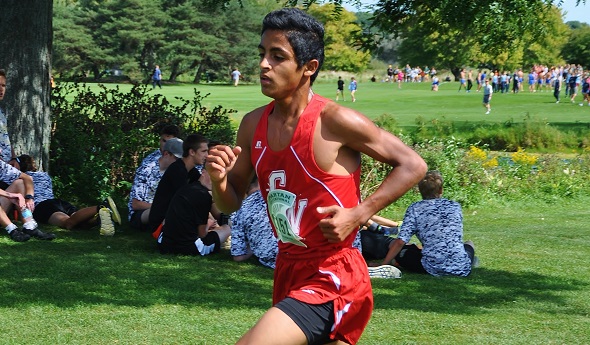
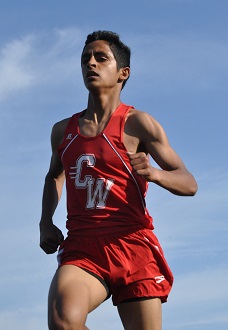
PHOTOS: (Top) Coldwater's Shuaib Aljabaly cruises through a course this season. (Middle) Aljabaly is undefeated in 2016 and will next race Saturday at the Portage Invitational. (Photos courtesy of the Coldwater boys cross country program.)
He's Got the Goal-den Touch
September 28, 2012
By Geoff Kimmerly
Second Half editor
Their games were fueled by typical sibling rivalry. To Lee Chatfield, the endings were humorous. To his two little brothers, more like cruel.
Sixth-grader Paul and fifth-grader Aaron regularly would take on their senior brother on a makeshift soccer field in the family’s back yard. They’d play games to 10, the two youngest brothers against a standout on the Burt Lake Northern Michigan Christian varsity.
Lee would let them score nine goals before dribbling circles around his siblings. Paul and Aaron would yell at each other to somehow block Lee’s path, but to no avail. Inevitably tears would fall.
“Maybe I was being a baby,” Aaron said. “He would let us get up and then come back and beat us, and he’s laughing while we would just cry.”
But on that backyard soccer field, Aaron Chatfield also learned how to compete. And there’s no question it paid off during one of the most accomplished careers in MHSAA soccer history.
Chatfield scored his 173rd career goal on Sept. 21 against Elk Rapids. He’s pushed that total to 178 heading into this weekend’s games against Fife Lake Forest Area and North Muskegon. A Second Half High 5 recipient this week, Chatfield has 45 goals this season after scoring a career-high 56 in 2011.
“Up until seventh grade, he couldn’t lose a game and not cry,” said Lee, also Northern Michigan Christian’s coach the last three seasons. “It built a little chip on his shoulder.
“But it’s always been God-given (talent). And Aaron has worked tremendously hard to hone the gifts God has given him.”
All in the family
To set the record, Chatfield passed 2009 Dearborn graduate Soony Saad, who went on to lead the NCAA with 19 goals as a freshman at the University of Michigan in 2010 and now plays for Sporting Kansas City of Major League Soccer.
Chatfield learned about Saad as he was pursuing the record, but admitted he isn’t familiar with most of the others on the MHSAA all-time goals list.
However, there are a few he knows better than anyone – there are five Chatfield brothers total, and three more also are among the most prolific scorers in MHSAA history.
Entering this season, Nathan Chatfield was second on the career goals list with 170, scored from 2001-04. Spencer was tied for 12th with 121 goals from 1998-01. Paul is tied for 19th with 109 goals during a career that ended last fall. Lee was a sweeper, so his game was stopping goals instead of scoring them – but he did a fine job at that as well.
Aaron, being the youngest, tried to pick up certain qualities from each. Nathan, the second-oldest, was “a natural goal-scorer, probably the fastest. He would just outrun people,” and holds the MHSAA record with 272 career points, although Aaron needs only five more to match him.
Oldest brother Spencer “could dribble like no other.” Paul was “built differently than all of us … but he could double scissor you up. He’s very physical.” Lee was “more like me; he was the best defender,” and Aaron played in the back from third through eighth grades.
“I would like to think I’m more of a mix of everybody,” Aaron concluded.
“Almost everything I do, I’ve learned from them. The way that they play, people say all the time that I remind them of my brothers.”
He can play with anyone
The best compliment – and a strong representation of how Chatfield matches up statewide – comes from Petoskey coach Zach Jonker.
The Northmen have made two recent trips to the MHSAA Finals and regularly load up their schedule with top-ranked teams from Divisions 1 and 2 including East Kentwood, Rochester Hills Stoney Creek, Warren DeLaSalle and Bloomfield Hills Lahser. Petoskey also regularly scrimmages Northern Michigan Christian.
“He’s the most dangerous individual we’ve faced all season. When he received the ball against us, we kinda held our breaths,” said Jonker, who also knows the Chatfields well through the club program. “He has a great combination of speed with the ball and power. He has great balance and he’s tough to knock off the ball. And he’s got another gear; he can explode by (defenders).
“We double teamed the guy, and we haven’t had to give any individual we’ve played all season that kind of attention.”
Chatfield joined an Eagles varsity in 2009 that had only three seniors. Not only did he start immediately, but he also was named a co-captain.
Last season’s team became an incredible story, advancing to the Regional Final on a 24-game winning streak before losing for the first and only time of the fall, 2-0 to eventual MHSAA runner-up Muskegon Western Michigan Christian. Chatfield scored in every game but that last one.
He also has cut his teeth playing for his club team, the Petoskey Lakers, and his teams are a combined 24-2-2 during their last three seasons playing in the Michigan State Premier Soccer Program. Chatfield scored 1.9 goals per game last club season, down from 2.5 the season before. There is interest from a number of colleges, and he is looking at options of all sizes, from Division I to NAIA.
Chatfield has logged plenty of miles to see strong competition, and one game as a sixth grader left Lee with the impression that big things were on the way.
“There was one moment when I was standing on the sideline, and he did a spin move and split two defenders with a scissor. At that moment, I thought this kid has got it,” Lee said.
“He’s always been tenacious. He’s a natural-born competitor. He’s anything but a prima donna. He just wants to win.”
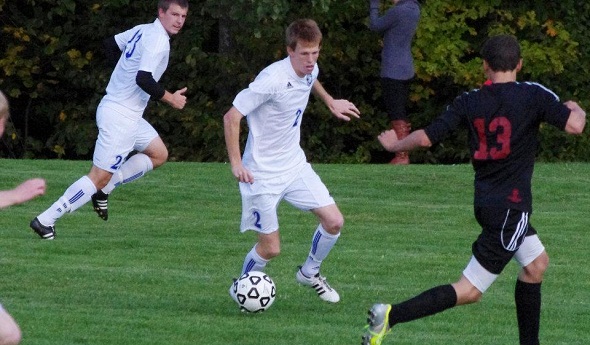
PHOTO: Burt Lake Northern Michigan Christian's Aaron Chatfield dribbles through defenders during a game earlier this season (Photo courtesy of the Petoskey High School soccer program.)