

Unranked Knights Finish No. 1 in D4
November 3, 2012
By Geoff Kimmerly
Second Half editor
TROY – It’s fair to say Hamtramck Frontier International was underestimated entering this fall’s MHSAA boys soccer tournament.
But Division 4 opponents will be wise to pay attention to the third-year program from this point forward.
The Knights entered the District tournament three weeks ago unranked, but beat five top-10 opponents and finished their first MHSAA title run by beating No. 8 Grand Rapids Covenant Christian 3-2 on Saturday at Troy Athens.
Frontier (18-2) also eliminated No. 1 Lansing Christian, No. 4 Birmingham Roeper, No. 5 Genesee Christian and No. 9 Ann Arbor Greenhills along the way.
“Some teams underestimated us, but we came through hard. We knew we could’ve (won) it, and we got this,” Frontier junior midfielder Mujeeb Nahshal said. “The first three years, we came (a long way). We don’t have much support, but thanks to our principals and thanks to our coaches.”
 The Knights had advanced to the Division 4 Semifinals in 2010 and made it back to the Regional last fall. Their regular season schedule was loaded with larger schools, and they entered the tournament after losing two of their final three games.
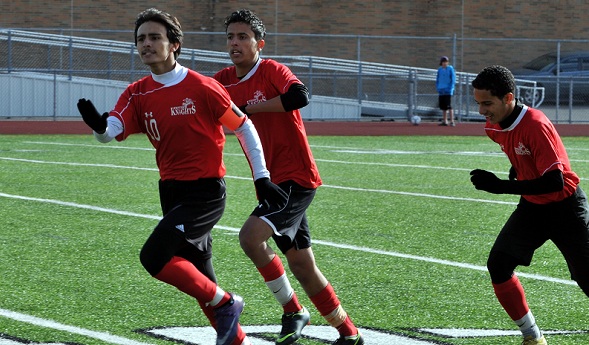
But Frontier outscored its seven postseason opponents by a combined 22-5 and got on the board quickly Saturday when Nahshal scored from about 20 yards out just 1 minute, 54 seconds in off a pass from senior forward Baleegh Algahim.
Although Covenant Christian did well to control the ball, the scoring opportunities during the rest of the first half belonged to Frontier. And midway through the second half, Algahim scored twice within two minutes to put the Knights up 3-0 with 20:25 to play.
“We used to practice day and night,” Algahim said. “We worked hard, so that's what we get.”
The Chargers, also playing in their first MHSAA Final, didn’t give up. Frontier loaded the box and turned away most of Covenant Christian’s increased attack. But Chargers senior Jordan Van Oostenbrugge finally broke through with 4:59 to play.
Van Oostenbrugge scored again with 55 seconds left, before Frontier held tight until the buzzer.
“I wanted to make the game interesting, I guess. Just put the ball in the back of the net, and I got it,” Van Oostenbrugge said. “It’s always difficult to come back from 3-nothing, but I think we got a couple goals there at the end and had a chance. The first half we played a little timid, but we came back in second half and took it to them.”
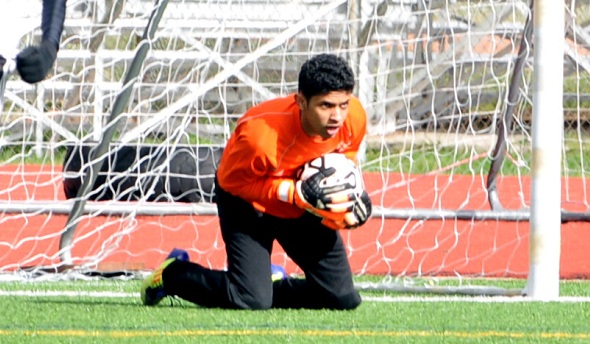
Nahsal also had an assist on Algahim’s first goal, and sophomore midfielder Habeb Ghaleb had the assist on Algahim’s second. Sophomore Ammar Abdullah had 12 saves. Covenant Christian junior Austin Brower had 10 saves.
The Chargers finished 19-5-1.
“We showed we could play with them. … we just ran out of time,” Covenant Christian coach Mike Noorman said. “I’m very proud of how hard they worked. We had great opportunities. But they finished.”
PHOTOS: (Top) Sophomore Ammar Abdullah makes one of his 12 saves during the Division 4 Final. (Middle) Mujeeb Nahshal (10) and his teammates celebrate after Nahshal scored the game's first goal.
Second Title Just as Sweet for Sailors
November 3, 2012
By Dean Holzwarth
Special to Second Half
KENTWOOD – Two years ago, Kevin Doornbos was a sophomore when the South Christian boys soccer team won the program's first MHSAA title.
Following Saturday afternoon's Lower Peninsula Division 3 championship game, Doornbos had reason to cherish this one even more.
He booted the lone goal of in a thrilling 1-0 double-overtime win against Williamston at Pat Patterson Athletic Field.
“This is the second time for me, and this one feels even better since I got the game-winning goal,” said Doornbos, whose twin brother, Kyle, also plays on the team.
“I knew we were going to be able to do this because we have a great team. We have such great depth, and I had confidence in my team that we were going to come out with the win.”
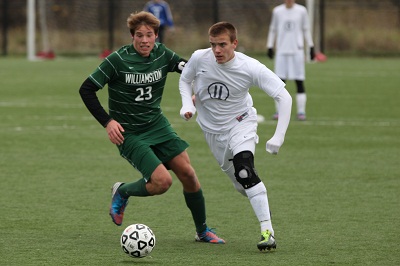
Amid a defensive struggle that resulted in a scoreless regulation and first overtime, Doornbos delivered a booming shot from 18 yards out that soared past Hornets' keeper Charlie Coon with less than six minutes remaining in the second overtime.
“I was trying to create space between myself and the defender,” Doornbos said. “I think I took my time a little too much, but I was waiting for the perfect shot, and I'm pretty sure I got the perfect shot there. It is the best thing that has ever happened to me.”
 South Christian coach Jason Boersma knew the potency of Doornbos' left foot, and became excited when he lined up for the shot with little pressure surrounding him.
“Kevin has a cannon of a shot, and when I saw them letting him set up to the left, I thought they were playing smart defense, but they don't realize that he is a lefty,” Boersma said. “When the ball hit the back of the net, the emotion was amazing. It was an amazing moment, and I just watched my guys go crazy.”
Boersma said his assistant coach, Ben Cook, predicted that Doornbos would be the hero.
“He actually told him before the second overtime that he thought he was going to get on here,” he said. “He has kind of been like Nostradamus all season, calling out whose going to get that opportunity.”
While South Christian (21-2-3) celebrated its second crown, it ruined the Finals debut of Williamston.
The Hornets (19-7-1) were making their first appearance in a title game after winning the program's first Regional title.
They defeated Elk Rapids 2-1 in a shootout to reach the Finals.
“This team made history,” Williamston coach Brent Sorg said. “Twenty-three years in the program, and this was the first time ever advancing to the state finals. That is something they will remember 10, 15, 20 years down the road.”
The Sailors' defense allowed few scoring chances, and posted their 18th shutout of the season. They blanked their third straight opponent in the tournament after also shutting out Otsego in the Regional Final and Grosse Ile in the Semi.
“Our defense has been hard to score on all season, and most of them are coming back next year,” Boersma said.
Coon, a senior, kept the Hornets in the game with stellar play in goal. He made eight stops, including a diving save in overtime on a shot in front of the net by South Christian's Cody Kok.
“He is an all-state goal keeper, and he had made some tremendous saves for us,” Sorg said. “He kept us in many games all year.”
The Sailors closed the season on an 11-game winning streak.
“What a fun opportunity for these guys,” Boersma said. “They played their hearts out, and Williamston played a fantastic game. I thought they had a few chances, and we had a few chances, and it was just a good battle between two good teams and we're blessed to be on top of this one.”
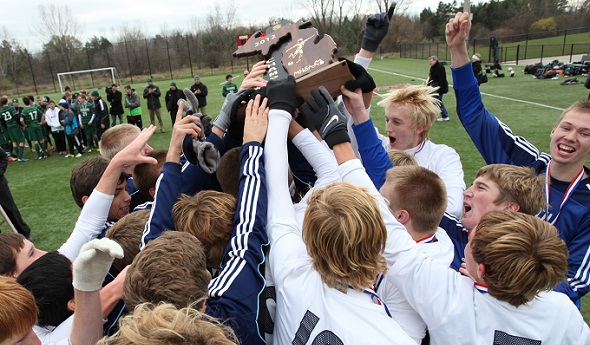
PHOTOS: (Top) Grand Rapids South Christian players hoist their second MHSAA championship trophy won over the last three seasons. (Middle) South Christian's Kevin Doornbos (11) charges ahead as Williamston's Phil Erickson gives chase moments before Doornbos scored the game's only goal.