

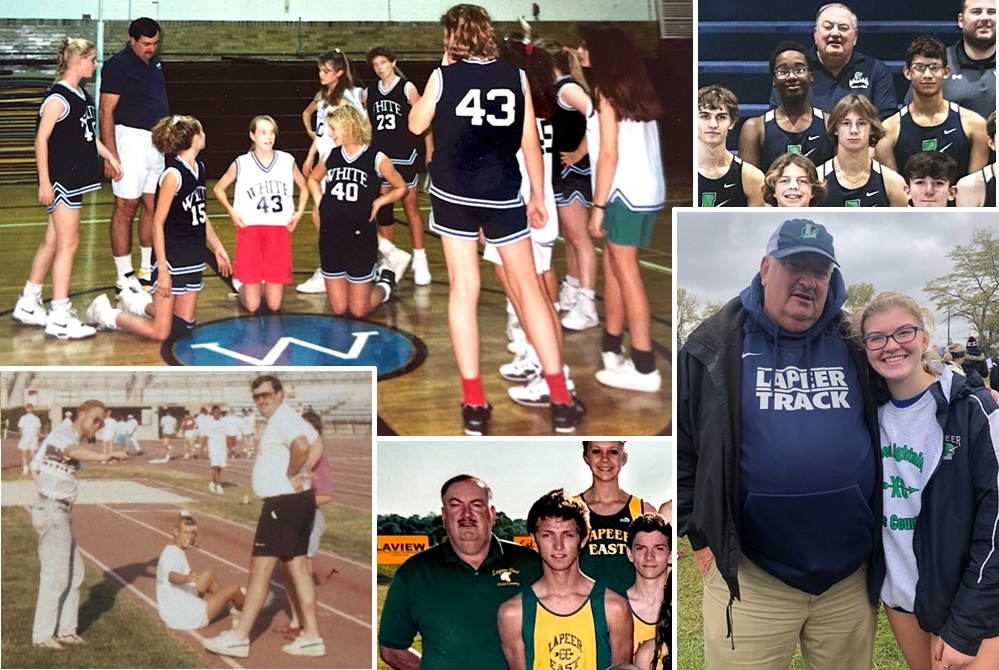
'Lapeer Through and Through,' Schmidt Surpasses Half-Century in Coaching
By
Paul Costanzo
Special for MHSAA.com
April 2, 2025
Manny Schmidt still wants to be at track practice.
 After 50-plus years coaching in Lapeer, the man they call Coach Manny has not lost his love for helping student-athletes – and at this rate, he might go another 50.
“I told my wife years ago that the first day I don’t feel like going to practice, that I’d rather be somewhere else, that’s the day I’m done,” Schmidt said. “And it hasn’t happened yet. Obviously, you have bad days and things like that. But track, and right now practice, it just keeps me going.”
Schmidt, who is the head boys track & field coach at Lapeer, began coaching track as an assistant in 1974, and has remained there – and Lapeer East, then back at Lapeer when the schools merged back together – ever since. On Friday, April 11, he will be honored at an event at Lightning Rounds in Lapeer for his years of service to Lapeer athletes. The event begins at 7:30 p.m., following the Lapeer Lightning Co-Ed Relays.
“Manny has been a staple of Lapeer Athletics through many different renditions over the years,” Lapeer athletic director Shad Spilski said. “His willingness to help student-athletes grow and achieve their goals is all he wants out of his athletes. Manny spends, and has spent, countless hours over several decades providing athletes multiple opportunities to hone their skills. He not only coaches, but he is one of Lapeer athletes’ biggest fans and supporters. You will always find him at other sporting events cheering on athletes and his coaching colleagues. He truly is Lapeer through and through.”
Schmidt came to Lapeer to teach English in December of 1972 after graduating from Western Michigan University. He had attended high school at St. Joseph Catholic, and was unfamiliar with Lapeer.
But it didn’t take long for him to fall in love with the school community after receiving the assignment.
“Almost immediately,” he said. “I started in December; the teacher had left and I got the job in December. Three days later, they had a staff Christmas party that I got invited to, and all of my close friends over the years, many of them, I guess, I met at that party.”
Coaching was always something Schmidt wanted to do. He played basketball and ran track in high school, and had a basketball coach who made a big impact on his life. He wanted to do the same for others.
In the spring of 1974, during his first full year of teaching English at Lapeer, he got that chance as the assistant track coach. He has since coached cross country – working to start the Lapeer East girls program in the 1990s – junior varsity football and middle school basketball. He also served as a basketball official for more than 30 years.
“I just liked being part of it,” he said.
 Throughout his five decades coaching track, Schmidt has worked with athletes in every event. While middle and long distance are what he’s long enjoyed coaching, he’s currently working with the Lapeer throwers and high jumpers, as head cross country coaches Russ Reitz and Bill Spruytte are also coaching track.
“In our program, we have four of us (Schmidt, Reitz, Spruytte and Anthony Merlo), and we all have equal voice, we all coach together,” Schmidt said. “On any given day, and that’s the nice thing, I could be with anything. I could be with the hurdlers.”
This past year, Schmidt returned to the Lapeer cross country staff as an assistant, saying he was honored that the current coaches respected him enough to call him back.
But for them, it was an honor to have him.
“Working with Manny is like having access to decades of knowledge,” said fellow cross country assistant Christine Cerny. “It is such a privilege to be able to draw from that and learn from that myself. It’s so awesome to be able to coach alongside him after he has coached my kids.”
During his time, Schmidt has coached multiple generations of Lapeer families, including his own. His children Corrinne and Jennifer both ran for him, as did his grandchildren Morgan, Mason and Colton.
And by his side the entire time has been his wife, Val, who worked as a scorekeeper during meets.
“When I started coaching, she would be the person at all our home cross country meets and all our home track meets who sat there and kept track by hand,” Schmidt said. “Probably the happiest person with this new technology is my wife – now she doesn’t have to do it. When we have invites, she’ll do medals and stuff like that.”
Technological changes have been abundant for high school athletes over the past five decades, not just in competition but outside of it. Schmidt recalls returning to Lapeer from away meets and having athletes line up at the school’s two payphones to call their parents.
“Now, when we get back, everyone has called home and their rides are there waiting,” Schmidt said.
Throughout his time, Schmidt has done plenty of winning and coached several athletes who have moved on to compete at the college level. But the relationships he’s created are what he values most.
“Nobody’s luckier than I am with where I taught and where I coached, and who I’ve coached with over the years,” Schmidt said. “You have to look forward to going to work, and I hate to use the word ‘work’ with coaching. It is, I guess. But there’s just so much good with it.”
 Paul Costanzo served as a sportswriter at The Port Huron Times Herald from 2006-15, including three years as lead sportswriter, and prior to that as sports editor at the Hillsdale Daily News from 2005-06. He can be reached at [email protected] with story ideas for Genesee, Lapeer, St. Clair, Sanilac, Huron, Tuscola, Saginaw, Bay, Arenac, Midland and Gladwin counties.
PHOTOS (Top) Clockwise from the top left: (1) Manny Schmidt (standing, second from left) coaches the Lapeer White Junior High girls basketball team. (2) Schmidt, top middle, takes a photo with Lapeer’s boys track & field team last spring. (3) Schmidt, left, has coached three of his grandchildren including Morgan Turk. (4) Schmidt, far left, takes a photo with the 2011 Lapeer East cross country teams. (5) Schmidt, standing far right, coaches Michelle Brundage during the 1991 Meet of Champions. (Middle) Schmidt looks on during an event. (Photos provided by the Lapeer athletic department.)

Williams Races to Place with All-Time Best
By
Paul Costanzo
Special for MHSAA.com
April 18, 2019
Bridgeport girls track coach Rick Popp said he believes his star sprinter Payten Williams has the potential to be a world champion.
 The high praise is something Williams appreciates, as she said it shows her coach has faith in her. But does the senior have that same faith in herself?
Williams was as quick to answer that as she is on the track: “Yes.”
“Payten is crazy fast,” Popp said. “She’s been the fastest girl in the state of Michigan the past two years. When you watch her run, her leg speed is insane. We don’t have a boy that can beat her in the 40 meters. The girl is just crazy lightspeed right now.”
While a world championship is a lofty goal, it’s hard to argue with Popp’s current assessment of Williams, the reigning MHSAA Lower Peninsula Division 2 champion in the 100 and 200 meters. During the past two years, she’s lost just two races, and both came at the MHSAA Finals her sophomore year. She placed fourth in both. She wasn’t unbeaten as a freshman, but she still finished first more than she didn’t and placed sixth at the Finals in the 200.
Her personal best in the 200 meters is 24.26 seconds, which she ran in July 2018 at the United States Track and Field Junior Olympics in North Carolina, placing 10th. That time would be an MHSAA Finals record in all but Division 1. Her personal best in the 100 is 12.06, which she ran at the 2018 MHSAA Finals, when she won by nearly half a second – second place came in at 12.55.
“Every state record should be gone,” Popp said, alluding to Williams breaking them. “Every all-time state record should be gone. When she’s dialed in, she’s lightspeed. She flies off her feet better than most anybody I’ve ever seen.”
Williams said she’s always been fast, but it took good coaching to help her reach these heights. That’s something she said she began to receive while in middle school from her AAU coaches, and that has continued into high school with them and Popp.
As things started to click, Williams started thinking big.
 “It felt great – it felt that I was going to become something,” Williams said. “I had a lot of people looking up to me, so I knew I had to keep going further. Making it all the way to the Olympics is something that’s big for me.”
She said she’s made a decision on which college she will be attending, but that she isn’t ready to make an announcement.
Her focus for now is on finishing her high school career strong. That includes breaking the 24-second and 12-second barriers in her respective races, although she was quick to note that the 100 isn’t really her race despite the fact she’s been dominant in it for two years.
“The 200 is my race,” she said. “I just like the race; it’s hard to explain it.”
She said that even after winning the 100 at last year’s Finals, she was more concerned with the 200 she still had to run. That doesn’t mean she wasn’t happy about the double.
“It felt great,” she said. “My mom was like, ‘You’re going to get this. You’re going to become a state champion.’ I was like, ‘No mom, don’t think that.’ But then she was right.”
The times are more important to Williams than winning races. With such lofty goals and recent championship results, focusing on racing the clock could be her best path to reaching them.
“I just focus on getting to the finish line and how I run,” she said. “I don’t think about anything else. I just think about myself and the track.”
Williams has yet to run an outdoor race this season, but she did win a pair of indoor races at Saginaw Valley State in late March, claiming the 60 meters in 7.74 seconds and the 200 in 25.41.
She said she’s been off to a slower start this season, as she’s had to devote more time to her family, specifically helping care for her grandfather. While she didn’t want to elaborate, she did say that she’s getting back to practicing full time and expects to have another strong season.
There’s plenty for her to work for, including repeat championships, state records, getting closer to her Olympic dreams, and her family.
“I’m pushing myself by using my strength as my motivation,” she said. “And I’m doing it for my granddad.”
 Paul Costanzo served as a sportswriter at The Port Huron Times Herald from 2006-15, including three years as lead sportswriter, and prior to that as sports editor at the Hillsdale Daily News from 2005-06. He can be reached at [email protected] with story ideas for Genesee, Lapeer, St. Clair, Sanilac, Huron, Tuscola, Saginaw, Bay, Arenac, Midland and Gladwin counties.
PHOTOS: (Top) Bridgeport's Payten Williams, far right, surges through the finish in winning the 200 meters at last year's Lower Peninsula Division 2 Finals. (Middle) Williams, middle, leads the 100 as contenders power through the final paces of that sprint. (Click to see more from RunMichigan.com.)