

1st & Goal: 2021 Playoff Week 1 Preview
By
Geoff Kimmerly
MHSAA.com senior editor
October 28, 2021
From an up-close point of view, at just more than half of Michigan’s football-playing high schools, three months of football season ended last weekend.
 But from a mile-high perspective, 20 teams have played just slightly more than half their games this fall – and 288 begin this weekend with the opportunity to add onto their seasons and finish among that fortunate few.
Playoffs begin Friday with District Semifinals in 11-player and Regional Semifinals in 8-Player – click here for the full schedule for each division. More than 100 of the 144 total playoff football games will be broadcast on MHSAA.tv, with Clinton Township Chippewa Valley at Troy appearing on the Bally Sports Detroit primary channel tonight – click for more on how to watch.
Below are glances at games that especially pop off the page in every division. (Games are Friday unless noted.)
11-Player Division 1
Howell (7-2) at Hartland (7-2)
The co-champions in the Kensington Lakes Activities Association West meet again, after Hartland won the regular-season matchup 29-7 on Oct. 1. Those remain the most points given up by a Highlanders defense allowing an average of 11.9 per game, while the Eagles’ defense finished the regular season giving up an average of just 9.6 (and only five per game not counting a 46-9 Week 9 loss to No. 6 Belleville). This time Howell will have running back August Johanningsmeier, a Western Michigan recruit, who didn’t play during the first meeting.
Keep an eye on these FRIDAY Clinton Township Chippewa Valley (6-3) at Troy (8-1), Ann Arbor Huron (8-1) at Belleville (8-1), Detroit Cass Tech (6-3) at Dearborn Fordson (7-2), Lapeer (7-2) at Rochester Adams (9-0).
11-Player Division 2
Muskegon Mona Shores (7-2) at Grand Rapids Forest Hills Central (8-1)
Two-time reigning Division 2 champion Mona Shores is facing a playoff road that may not include a home game. But while that adds to the challenge, the Sailors are plenty familiar with elite opponents – their losses this fall were to Division 3 top-ranked Detroit Martin Luther King and No. 5 Muskegon High. This week’s trip is especially intriguing, however – Forest Hills Central barely fell to Shores 28-25 during the last year’s playoffs and by just six points in a 2018 playoff matchup, and won their 2017 postseason meeting. The Rangers’ only loss this fall was early by four points to Division 1 No. 4 Grand Blanc.
Keep an eye on these FRIDAY Dexter (5-4) at Battle Creek Lakeview (6-3), Port Huron (6-3) at Port Huron Northern (7-2), Bay City Western (7-2) at Midland Dow (6-3), East Lansing (6-3) at Milford (7-2).
11-Player Division 3
River Rouge (6-2) at Harper Woods (7-2)
These are familiar opponents with this their eighth meeting over the last 14 seasons, including as members together of the Michigan Metro Athletic Conference Blue from 2017-19. River Rouge has won the last five of those matchups and is continuing to build on a decade as a Finals contender as it looks to return to Ford Field for the third-straight season. But Harper Woods has been climbing. Two of those losses to Rouge in the MMAC Blue were league title deciders, and the Pioneers have made the playoffs four straight seasons (including all-in 2020) with their lone defeats this fall to Division 2 top-ranked Warren De La Salle Collegiate and Division 3 qualifier Orchard Lake St. Mary’s.
Keep an eye on these FRIDAY Marquette (7-2) at Mount Pleasant (9-0), Orchard Lake St. Mary’s (5-4) at Flint Kearsley (6-3), Warren Fitzgerald (8-1) at Detroit Martin Luther King (8-1), Riverview (9-0) at Allen Park (7-2).
11-Player Division 4
Whitehall (7-2) at Sparta (7-2)
The Spartans somewhat quietly put together a fourth-straight winning season with their two defeats this fall coming over the first three weeks and by a combined eight points. The first of those losses was opening night to Muskegon Oakridge, 22-21, which went on to defeat and then share the West Michigan Conference championship with Whitehall. The Vikings are coming off a 10-point loss at 8-1 Reed City, but can boast wins over Montague and Kalamazoo United to go with their league title share.
Keep an eye on these FRIDAY Spring Lake (6-3) at Grand Rapids Christian (6-3), Goodrich (7-2) at Freeland (8-1), Pontiac Notre Dame Prep (7-2) at Croswell-Lexington (8-1). SATURDAY Detroit Country Day (5-3) at Redford Union (8-1).
11-Player Division 5
Comstock Park (9-0) at Grand Rapids West Catholic (8-1)
Houseman Field will host one of the most intriguing matchups statewide regardless of division. Both teams have four wins over others in these playoffs. Comstock Park bounced way back this fall from three straight one or two-win seasons to finish ahead of Sparta (see above) in winning the Ottawa-Kent Conference Silver title. The Panthers are plenty familiar with West Catholic after losing to the Falcons in last season’s playoffs and playing them either as part of the same league or nonconference the 12 seasons prior. West Catholic’s only loss this fall was to eventual O-K Blue champion Hudsonville Unity Christian, and the Falcons handed Division 7 contender Muskegon Catholic Central its lone loss.
Keep an eye on these FRIDAY Clare (6-3) at Gladwin (9-0), Kingsford (6-3) at Kingsley (8-1), Olivet (7-2) at Williamston (6-3), Corunna (5-4) at Flint Powers Catholic (3-6).
11-Player Division 6
Michigan Center (8-1) at Jonesville (9-0)
This is a rematch of last season’s District Final won by Michigan Center 28-22, and they just missed seeing each other in the Big 8/Cascades crossovers of this year’s Week 9. Jonesville won the Big 8 Conference this fall, and then edged Cascades champion Addison 20-14 last Saturday in the Comets’ only game this season closer than 16 points. Michigan Center was second in the Cascades after a one-point Week 4 loss to Addison, but since the Cardinals have shined in close games winning three by eight points of fewer.
Keep an eye on these FRIDAY Calumet (7-2) at Menominee (5-4), Boyne City (8-1) at Grayling (7-2), Erie Mason (5-4) at Ida (7-2), Detroit Pershing (5-4) at Detroit Southeastern (6-3).
11-Player Division 7
Elkton-Pigeon-Bay Port Laker (7-2) at Reese (8-1)
All three co-champions of the Greater Thumb Conference West play in the same District, and these two are meeting again after Reese won the Week 7 matchup 27-18. The Rockets are enjoying their first winning season since 2013, losing only to Bad Axe – the third co-champion in the GTC West. Laker has enjoyed more recent success, with this its sixth-straight playoff appearance. The Lakers edged Bad Axe by a point Week 8 to create the shared league title. Bad Axe travels to Hemlock on the other side of the District bracket.
Keep an eye on these FRIDAY New Lothrop (6-3) at Montrose (7-2), Lutheran Westland (8-1) at Monroe St. Mary Catholic Central (8-1), Bad Axe (7-2) at Hemlock (5-4). SATURDAY East Jordan (7-2) at Ishpeming Westwood (8-1).
11-Player Division 8
Centreville (7-2) at Addison (8-1)
Four of the top 14 teams in Division 8 playoff points are in the same District (Reading and Hudson are on the other side). Addison entered as the No. 3 team and Centreville is No. 10 and also the reigning Division 8 champion. As noted above, Addison’s lone loss came last week to Division 6 No. 11 Jonesville, and Centreville’s defeats came to a pair of Division 7 teams including No. 6 Muskegon Catholic Central. Both are league champions and have put up similar numbers overall this fall – but the difference may be found when Addison is on offense (averaging 43.8 points per game, but 48 not counting the Jonesville loss) and Centreville is on D (12 points allowed per game, but only 8.6 after opening night.)
Keep an eye on these FRIDAY Fowler (6-3) at Flint Beecher (4-5), Reading (6-3) at Hudson (9-0). SATURDAY Bark River-Harris (6-3) at Beal City (8-1), Frankfort (6-3) at Iron Mountain (6-3).
8-Player Division 1
Rogers City (8-1) at Indian River Inland Lakes (9-0)
Inland Lakes dove into 8-player last season with great success, and Rogers City is following the same path in its first season this fall while the Bulldogs have been even better in their encore. Inland Lakes reached the Division 1 Semifinals in 2020 and is coming off its closest game of this season, a 14-point win over Gaylord St. Mary. Rogers City is coming off its defeat – 44-36 to Newberry – but didn’t give up a point in September and won its first three games of October against teams sitting now at .500 or better.
Keep an eye on these FRIDAY Rudyard (7-2) at Munising (7-2), Tekonsha (7-2) at Martin (9-0). SATURDAY Britton Deerfield (8-1) at Deckerville (7-1).
8-Player Division 2
Colon (8-1) at Portland St. Patrick (9-0), Saturday
These have been two of the most dominating 8-player programs in the state over the last four years, with Portland St. Patrick defeating the Magi 44-34 last season in a Regional Final on the way to the Shamrocks finishing Division 2 runners-up for the third time in four seasons. Colon was the Division 1 champion in 2019, and its only other losses over the last two seasons were to reigning Division 1 champion and current favorite Adrian Lenawee Christian. Portland St. Patrick long has thrived offensively, scoring 43.6 points per game this fall, while Colon has established itself as a defensive juggernaut over the last three seasons and has given up 11 points per game with five shutouts.
Keep an eye on these FRIDAY Mio (6-3) at Hillman (6-3), Mount Pleasant Sacred Heart (7-2) at Kinde North Huron (9-0). SATURDAY Crystal Falls Forest Park (7-2) at Lake Linden-Hubbell (7-2).
Second Half’s weekly “1st & Goal” previews and reviews are powered by MI Student Aid, a part of the Office of Postsecondary Financial Planning located within the Michigan Department of Treasury. MI Student Aid encourages students to pursue postsecondary education by providing access to student financial resources and information. MI Student Aid administers the state’s 529 college savings programs (MET/MESP), as well as scholarship and grant programs that help make college Accessible, Affordable and Attainable for you. Connect with MI Student Aid at www.michigan.gov/mistudentaid and find more information on Facebook and Twitter @mistudentaid.
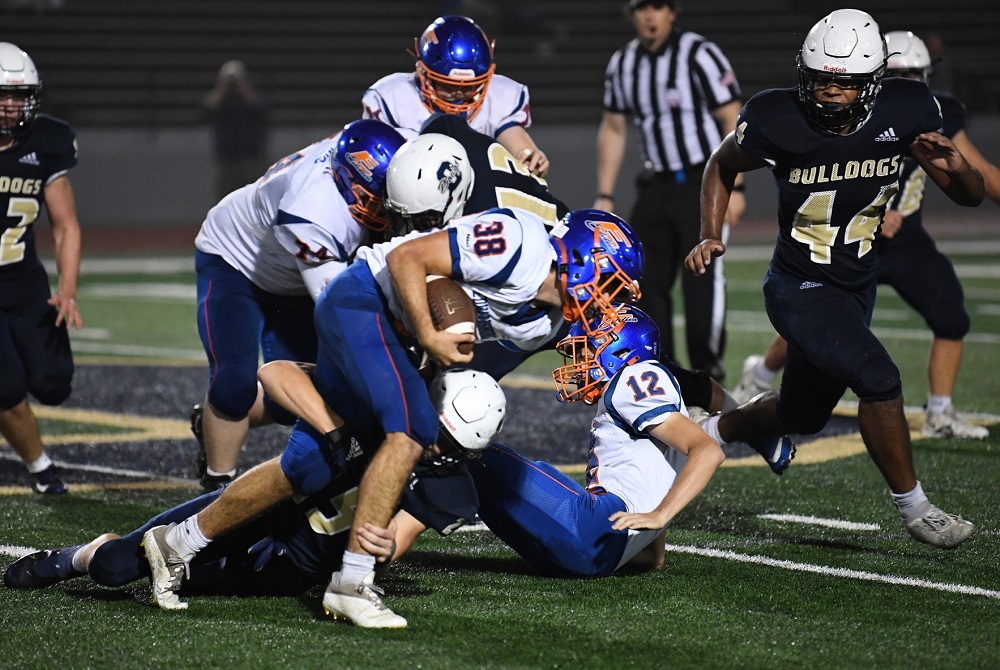
PHOTO Edwardsburg, here on offense against Otsego, brings a 9-0 record into the Division 4 playoffs. (Photo by Gary Shook.)
Drive for Detroit: Week 9 in Review
October 26, 2015
By Geoff Kimmerly
Second Half editor
Week 9 of the football regular season brings with it a Twitter feed full of gems like these:
Enjoy perfection? Northville finished 9-0 for the first time since 1961. Portland did so for the first time since 1969. Birmingham Groves posted its first flawless regular-season finish since 1978. For Buchanan, it was the first since 1988.
How about streaks? Rockford continued a 20-season playoff streak, and Stevensville Lakeshore clinched 18 years in a row heading to the postseason. And of course there was at least one stat line worth a double take – like Pewamo-Westphalia running back Jared Smith finishing the regular season with 2,065 rushing yards and 38 touchdowns for the undefeated Pirates.
Those are just highlights. As we begin to focus on the first week of the playoffs, let's not forget the rest of the best from the final week of the regular season.
Bay & Thumb
Fenton 30, Linden 27 (OT)
Fenton upped its Flint Metro League winning streak to 29 straight games and its league title streak to five seasons either sharing the championship or winning it outright thanks to this victory over second-place Linden. The Tigers ended the regular season at 8-1 while Linden is 7-2; Fenton’s lone loss came on opening night to Davison by three points. Click for more from the Flint Journal.
Also noted:
Freeland 42, Frankenmuth 7 – The Falcons (9-0) won the only matchup between undefeated teams in the state this weekend, but could see Frankenmuth (8-1) again in a Division 5 District Final.
Midland Dow 49, Midland 28 – The Chargers (8-1) won this crosstown rivalry game for the second straight season … and earned a rematch with the Chemics (7-2) in a Division 2 opener.
New Lothrop 41, Montrose 0 – The Hornets (9-0) completed their sixth straight undefeated regular season and in the process gave Montrose (5-4) a boost that helped the Rams into the playoffs as an at-large team.
Saginaw Swan Valley 28, Bay City John Glenn 21 – The Vikings (6-3) secured a fourth-straight playoff berth, but John Glenn (5-4) also made the postseason for a second straight season.
Greater Detroit
Detroit Martin Luther King 27, Detroit Cass Tech 25
It wouldn’t surprise many if both of these teams ended up back at Ford Field in five weeks playing for MHSAA titles in Division 2 and Division 1, respectively. This Detroit Public League Division I Final was their second matchup this season and both were decided by a field goal or less; King won the Sept. 25 meeting 31-28. The Crusaders (9-0) locked down Cass Tech’s passing game in this one, holding the Technicians (7-2) to their season low in points. Click for more from the Detroit Free Press.
Also noted:
Orchard Lake St. Mary's 38, Warren DeLaSalle 0 – The Eaglets (7-1) look like strong favorites in Division 3 after defeating reigning Division 2 champ DeLaSalle (6-3) big in the Prep Bowl to avenge their only loss this season.
Utica Eisenhower 17, Romeo 14 – The Eagles (6-3) are one of the state’s hottest teams, beating opponents the last three weeks that are a combined 21-6 including handing Romeo (8-1) its only loss.
Detroit Collegiate Prep 26, Detroit Central Collegiate 12 – The Colts (9-0) won the PSL Division II title game to register their first perfect regular season in at least 65 years; Central Collegiate (6-3) is headed to the playoffs for the second straight season after going 0-9 in 2013.
West Bloomfield 20, Farmington Hills Harrison 14 – The Lakers (9-0) tied their school record for wins set last season with their first perfect regular season since going 8-0 in 1960; Harrison (7-2) is headed back to the playoffs for the ninth time in 10 seasons.
Mid-Michigan
Lansing Catholic 35, Monroe St. Mary Catholic Central 10
Reigning Division 6 champion Monroe St. Mary (8-1) has looked ready for another run since putting up 62 points on Tecumseh on opening night, but Lansing Catholic (8-1) reminded the rest of Michigan it’s one of the dangerous teams in Division 5 by going on the road and handing the Falcons their first regular-season loss since 2013. The Cougars rattled off 28 unanswered points during the second half. Click for more from MLive-Lansing.
Also noted:
Portland 25, Marshall 16 – The Raiders finished 9-0 for the first time since 1969, which was a lot easier said than done considering Marshall (7-2) was one of five playoff teams on the schedule.
Harrison 40, Clare 20 – The Hornets (7-2) locked down second place in the Jack Pine Conference with their first win over Clare since 2010, and in the process kept the Pioneers (5-4) out of the playoffs for the first time since 2005.
Grand Ledge 42, Holt 0 – The Comets (9-0) completed their outright Capital Area Activities Conference Blue title, finished their third perfect regular season over the last eight and in the process kept rival Holt (5-4) from making the playoffs (although the Rams did improve from 3-6 a year ago).
Mount Pleasant Sacred Heart 13, Mendon 7 – The Irish (6-3) ran off six straight wins after opening 0-3 against teams that finished a combined 25-2 to return to the playoffs for the eighth straight season; Mendon (5-4) also earned its ninth straight postseason bid despite the loss and after starting 1-3.
Northern Lower Peninsula
Harbor Springs 22, Charlevoix 20
The winner was guaranteed a playoff spot. And Harbor Springs had plenty to celebrate with its move to 6-3 earning both the first playoff berth since 2000 but also its first winning record in 16 years. Senior Mitch Hoffman drilled a last-second field goal to put his team over the top – and keep the Red Rayders out of the playoffs as they did not end up with enough playoff points to qualify as an at-large team despite finishing 5-4. Click for more from the Petoskey News.
Also noted:
Boyne City 35, Grayling 20 – Boyne City may have finished behind Traverse City St. Francis in the Northern Michigan Football Conference Leaders standings, but beating third-place Grayling (6-3) helped the Vikings (8-1) secure up to two home playoff games – with St. Francis likely awaiting in the Regional Final.
Lake City 28, Newberry 21 – The Trojans made quite a bounce-back from last season’s 2-7 finish and beat two straight playoffs teams in Lincoln Alcona and Newberry (6-3) the last two weeks to get back to the playoffs at 5-4.
Oscoda 48, AuGres-Sims 22 – The Owls (6-3) also are back in the playoffs for the first time since 2000 after finishing the regular season with two straight wins.
Onekama 21, Frankfort 8 – Before last season, Onekama hadn’t beaten Frankfort since 1994; now, the Portagers (8-1) have won two straight over the Panthers (7-2) and could see them again in a Division 8 District Final.
Southeast & Border
Jackson 35, Jackson Lumen Christi 34 (OT)
This season just keeps getting better for Jackson. By moving to 7-2, the Vikings equaled their wins from 2010-2014 combined. And although they didn’t play most seasons in between, it’s worth noting this was Jackson’s first win over Lumen Christi since 1988 – and after 27, 29 and 34-point defeats to the Titans (6-3) the last three years. Click for more from the Jackson Citizen-Patriot.
Also noted:
Grass Lake 19, Union City 16 – The Warriors (5-4) survived a three-game losing streak midseason to earn an at-large playoff bid, and with this win knocked Union City (4-5) out of the running.
Clinton 36, Ottawa Lake Whiteford 18 – The Redskins (9-0) finished their fourth straight perfect regular season and fourth straight Tri-County Conference title by beating Whiteford (7-2), one of three other playoff teams from the league.
Manchester 45, Homer 38 – The Flying Dutchmen (8-1) claimed this meeting of first-place teams in the Cascades and Big 8 conferences for the second straight season, putting up a season high points total while also giving up their most this season to Homer (7-2).
Parma Western 28, Dexter 0 – After missing by a win twice over the last six seasons, Western (6-3) finally has its first MHSAA playoff berth thanks to two straight victories to close the regular season.
Southwest Corridor
Benton Harbor 29, Portage Northern 23 (OT)
Benton Harbor is one of the best stories of this season. The Tigers (5-4) didn’t win a game in 2013 or 2014 and went a combined 4-68 over the last eight seasons, but with a new coach and new athletic director posted their first winning season since 1989 – and earned their first playoff berth ever. It took this overtime win over Portage Northern (4-5), which hadn’t lost to Benton Harbor since 1996. Click for more from the St. Joseph Herald-Palladium.
Also noted:
Dowagiac 49, Paw Paw 46 – The Chieftains (6-3) reversed their record of a year ago but needed a second straight win by three points or fewer to return to the playoffs.
Constantine 21, Hartford 6 – The Falcons kept their playoff streak alive for a 17th straight season by bouncing back from a Week 8 loss to finish 5-4; Hartford also made the playoffs at 5-4.
St. Joseph 22, Portage Central 6 – The Bears (8-1) gained a share of the Southwestern Michigan Athletic Conference East title by breaking a three-year losing streak against the Mustangs (8-1).
Schoolcraft 41, Delton Kellogg 15 – The Eagles (9-0) finished a perfect regular season for the second time in four and won all but one of their games by at least 18 points; Delton (5-4) still made the playoffs for the first time since 2001 with its first winning record since 2009.
Upper Peninsula
Escanaba 18, Kingsford 14
Escanaba was riding high this fall after opening with two wins under a new coach. Then came four straight losses against a string of opponents that ended up including three playoff teams. But the Eskymos (5-4) didn’t fold, instead finishing with three wins including two over playoff teams to earn their first postseason berth since 2011. Kingsford (6-3) ended up with a home game this week despite the loss. Click for more from the Iron Mountain Daily News.
Also noted:
St. Ignace 14, Fowler 7 – The Saints (8-1) deserve a lot of credit for stacking their nonleague schedule with undefeated Ishpeming last week and annual Division 8 power Fowler (6-3).
Negaunee 35, Ishepming Westwood 0 – Westwood (5-4) claimed a playoff spot for a second straight season despite the loss, but Negaunee (7-2) hopes it regained some momentum after two straight defeats by a combined seven points.
Munising 41, L'Anse 8 – The reigning Division 8 runner-up Mustangs (7-2) bounced back from a Week 8 loss by ending the playoff hopes for L’Anse (5-4).
Lake Linden-Hubbell 34, Crystal Falls Forest Park 28 – The Lakes (9-0) broke a five-game losing streak against Forest Park (5-3) to finish perfect for the regular season for the first time since 2009 … and earn a rematch with Forest Park this week.
West Michigan
Rockford 28, Hudsonville 27
At stake Friday was a share of the Ottawa-Kent Conference Red title – four teams were tied for first place, guaranteeing multiple champions. But also at stake was Rockford’s 20-season playoff streak, the longest-running in Michigan and third-longest in MHSAA history. A blocked extra point by a back-up quarterback and a pair of field goals by the back-up kicker were among contributions that paid off nicely for the Rams (6-3), who could see Hudsonville (6-3) again in a Division 1 District Final. Click for more from the Grand Rapids Press.
Also noted:
Grandville 18, East Kentwood 8 – This decided the other half of the O-K Red title, with the Bulldogs (6-3) not only earning a share but posting a sixth win for the first time since 2006; East Kentwood also is 6-3 and gets also third-place Hudsonville in the playoffs.
Lowell 28, Grand Rapids Christian 14 – The Red Arrows (8-1) finished a perfect run in the O-K White for the second time in three seasons and won their fourth straight against the Eagles (5-4).
Grand Rapids Forest Hills Northern 26, Ada Forest Hills Eastern 24 – The Huskies (7-2) fell shy in the O-K Bronze after a 5-0 start, but forcing rival Forest Hills Eastern (8-1) to share the title probably lessened any lingering disappointment.
Big Rapids 20, Morley-Stanwood 10 – After seasons of three and one win over the last two, Big Rapids is back in the playoffs thanks to two straight wins, this one over a Mohawks team also 6-3.
8-Player
Battle Creek St. Philip 47, Lawrence 44
St. Philip (9-0) got the better of Lawrence for the first time in their last four meetings, handing those Tigers (7-2) their first in-state loss since 2013 and cementing the top spot overall in the 8-player tournament with the highest final playoff-point average. The two could meet again in a Regional Final next week. Click for more from the Battle Creek Enquirer.
Also noted:
Pickford 62, Onaway 28 – It was this simple: Pickford (6-3) won and got into the playoffs, and Onaway (5-4) fell out of the top 16 with the loss.
Morrice 58, Portland St. Patrick 42 – The Orioles (8-1) still aren't getting much mention as a contender, but they haven’t lost since falling to St. Philip on opening night and clinched the Central Michigan 8-Man League title with this win over the Shamrocks (6-3).
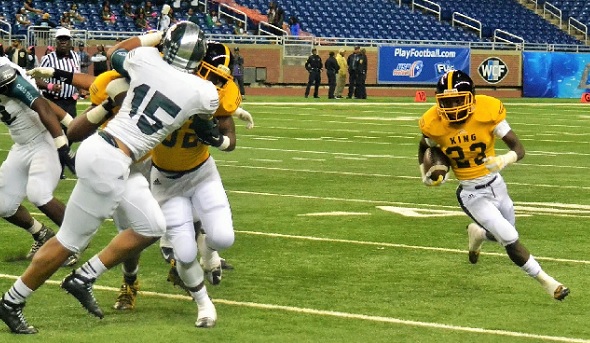
PHOTO: A Detroit Martin Luther King ball-carrier follows his blocker during the Crusaders' Detroit Public School League Division I championship win. (Photo courtesy of the Detroit Public School League.)