

'22 Game' Lasts 2 Plays, Lives on
By
Ron Pesch
MHSAA historian
October 26, 2015
What would you do with 22 seconds to right a wrong?
In Michigan, the longest football game in high school sports history was played on September 23, 1977 when Detroit Southeastern defeated Detroit Northeastern 42-36 in nine overtimes.
But what is the shortest?
On the evening of Thursday, Nov. 5, 1953, Eaton County foes Bellevue and Vermontville squared off in a Tri-C Conference battle. It was a home contest for Vermontville, but without illumination at its field, the game was staged just west beneath the lights at Nashville High School in Barry County.
The dominant team in Tri-C play over the previous three years, Bellevue’s Broncos had posted three consecutive undefeated seasons from 1950 and 1952. However, graduation took its toll and with only five returning veterans in the fall of 1953, Bellevue lost its nonconference season opener to Homer. The Broncos had also dropped a pair of league contests, to Lake Odessa and Olivet, just prior to the Vermontville game, and entered with a 4-3 record.
Vermontville brought a 4-2 mark into the contest, and was in a four-way tie with Bellevue, Nashville and Lake Odessa for second in the conference.
The Broncos and Wildcats were evenly matched and played to a scoreless tie in the first half. Vermontville opened up a 6-0 lead on a 20-yard end sweep by the Wildcats’ quarterback Pete Benton in the third quarter, but entered the final minutes of the game trailing 12-6 thanks to a TD run by Bellevue’s Jim Smith and an early-fourth quarter scoring pass from Smith to Bob Babbitt.
Coach Dave McDowell’s Wildcats mounted a long final drive, and fans strapped in for a thrilling finish. Pushing deep into Bellevue territory, Vermontville faced a fourth down and eight from the 16-yard line with under a minute to play when Benton launched a desperation pass to the end zone.
The pass fell incomplete, but Bellevue was flagged for pass interference. Officials stepped off the penalty and awarded Vermontville the ball at the one-yard line, but the Wildcats’ plunge into the line fell an inch short on what was called a repeated fourth down play. Vermontville took possession and ran out the clock.
Following the game, Coach McDowell protested the ruling to officials, correctly stating that his team should have been awarded an automatic first down and goal from the 1-yard-line on the penalty, according to high school rules. Appealing the call, the situation was brought to the attention of the league, MHSAA executive director Charles Forsythe and the MHSAA athletic board.
On Wednesday, Nov. 11, the state athletic board agreed an error had been made, but did not order a replay. Instead, they noted three possible solutions:
- Result left as it was.
- Called a no contest.
- Replay it at the point of infraction.
The board moved a final decision back to the league. Because of the possible impact on the final conference standings, and eventually, the awarding of the league’s all-sports trophy, the Tri-C Conference opted to replay the contest from the point of infraction – the 1-yard line – with 22 seconds placed on the clock.
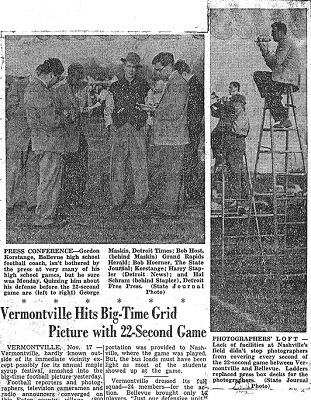 The news of the league’s decision was blasted out by the news services nationwide, and immediately, the pending replay of a small town contest captured the imagination of reporters and sports fans across the United States.
“Shortest ‘Game’ in History?” read the headline in the Lexington, Kentucky Herald. From Biloxi, Mississippi, to Boston, Massachusetts, from Rockford, Illinois to Omaha, Nebraska and Seattle Washington, sports aficionados read the news about the error. Best of all, details flowed forth on the plan to replay critical seconds that might alter the result, fulfilling every fan’s dream.
So began the longest huddle in history.
“What would you do?” was the question on the lips of coaches and followers in barber shops and factories. Detroit Free Press writer George Puscas asked that very question to some of Michigan’s top coaches.
Detroit Lions coach Buddy Parker offered his advice to Vermontville’s coach McDowell.
“The other team will be expecting a run,” noted Parker, “so I would fake a run off tackle then throw a pass in the other direction – with three receivers downfield.”
Michigan State’s legendary Biggie Munn stated the obvious:
“Call a scoring play.”
University of Michigan head coach Bennie Oosterbaan was tied up preparing for the Wolverines’ upcoming contest with MSU, so instead U-M end coach Bill Orwig weighed in with a tongue-in-cheek recommendation:
“Take the time out.”
Earl “Dutch” Clark, in charge at the University of Detroit, suggested that McDowell diagram “two of the most unusual offensive formations … anything to confuse the defense. The first play should be a running play and if it didn’t work, take time out then try again.”
Wayne University’s coach Lou Zarza was the most specific of them all.
“On a goal line stand, the defense usually drifts toward the middle. So I would fake the ball to the right halfback on a slant, then send the fullback with the ball wide to the right, outflanking the defense. It’s a good goal line play on the T formation.”
Suggestions came from all over. A gentleman in Syracuse, New York, even penned a personal letter to McDowell with a sure-fire suggestion.
Three days after the 1953 prep season had officially ended, on the afternoon of Monday, Nov. 16, the same officiating crew and the Vermontville and Bellevue squads emerged and again travelled to Nashville to line up for what can arguably be called the shortest – or perhaps the longest – game in high school football history.
Reporters from Detroit, Grand Rapids, Lansing and Battle Creek converged on the city for 22 seconds of football. High school reporting legends Hal Schram of the Detroit Free Press, Bob Hoerner of the Lansing State Journal, George Maskin of the Detroit Times, Harry Stapler of the Detroit News and writers from the Associated Press and United Press International all descended upon mid-Michigan, “almost as if the Rose Bowl was to be played.”
“That game brought more publicity to coach Gordon Korstange’s 6-3 squad then his teams received for posting three consecutive unbeaten seasons in 1950, 1951 and 1952,” recalled 80-year old Burton H. Brooks, who was the only reporter who had covered the original contest, and one of many covering the replay. A graduate of Bellevue, he was a freshman at Michigan State at the time, earning money as a sports stringer for the Bellevue Gazette and Charlotte Republican Tribune.
Beneath sunny skies, “a crowd of over 500 fans and curiosity seekers, most of them attired in shirt sleeves, lined the field on both sides near the east end of the Nashville gridiron,” wrote Brooks, many years later. “At 5:00 the shrill blast of an official’s whistle split the air, announcing time for the game.”
Attendance was way up from the original contest, and in an unusual move for the time, Kalamazoo television station WKZO announced that they would send a crew to Nashville and then televise the game – (all 22 seconds of it!) – Tuesday evening. In addition, 10 newspaper photographers were on site to capture images from the game.
While the size of the crowd was up, turnout on the football squads had decreased. Vermontville dressed its full squad of 24 for the showdown, but kept out two regular tackles and his first-string quarterback, as all had been on the injured list at the end of the first clash.
Meanwhile, Bellevue brought only 14 players.
“Just our defensive unit and enough to run back the kickoff,” Korstange told the Lansing State Journal, prepared for a situation that could arise if Vermontville scored.
“Three of the defensive starters had decided to go deer hunting instead,” said Brooks discussing the shortened game, “so Bellevue needed to call up some kids for the game from the junior varsity squad.”
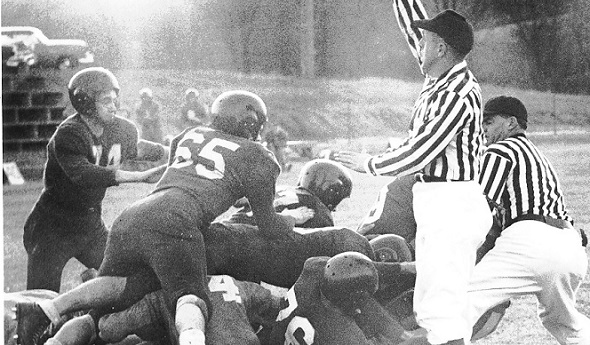
“Bellevue won its sixth game of the year, downing Vermontville in a sensational goal line stand in the famous ‘22’ Game” at Nashville last Monday,” wrote Brooks in the Bellevue Gazette. “Coach Dave McDowell’s Wildcats ran two plays against Bellevue, but couldn’t dent the solid Bronco defense. On the first play the Wildcats sent big Bob Steward up center, but he was driven back a yard by the entire center of the Bellevue line.”
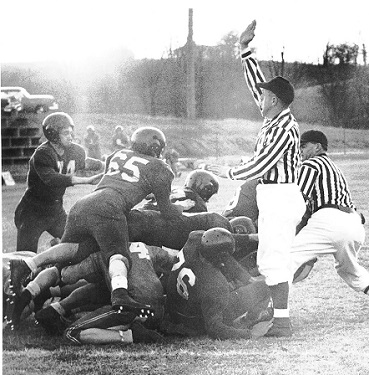 Following a timeout, the Green and White tried to sneak quarterback Pete Benton across the line to the left of center as the ball carrier on the second play, but the hole was quickly plugged by tackle Donald Rogers and guard Jerry Babbitt. Steward had been stopped by Bellevue guard Wayne Lesser. Dale Spotts, Bob Babbitt, Harold Messenger, Ralph Hales, Dick Moon, Jim Smith, Gordon Smith, and Ed Bessemer filled the other defensive spots and ensured the result of the first game went unchanged.
Once again, the wire services blasted their report from sea to shining sea.
“Officials Didn’t Rob Vermontville Team” screamed the headline in the Miami Daily News. Beneath an AP photo, residents of the Florida town were treated to a detailed account of the contest.
“Prep Grid Game Ends Same Way Following 11-Day Break” read the caption in the Dallas Morning News in football-crazed Texas.
“Replayed Grid Game Ends with the Same Result as Before,” read the headline in the Seattle, Washington, Daily Times.
As noted at the time, it certainly wasn’t the first, nor would it be the last, that a refereeing crew made a mistake in a game. Fans then, like now, were reminded officials are only human.
Bellevue ended the extended season in a tie for second with Lake Odessa, with 5-2 marks. For the first time in league history the Tri-C gridiron championship was awarded to Olivet, which, at 8-0, posted its first unbeaten season and, as it turned out, unseated Bellevue for the league’s 1953-54 all-sports trophy.
More than 60 years later, a forgotten showdown between high school football teams, played out before national attention in little Nashville, Michigan, still stands as one of the most entertaining and unusual sports moments in the history of America.
 Ron Pesch has taken an active role in researching the history of MHSAA events since 1985 and began writing for MHSAA Finals programs in 1986, adding additional features and "flashbacks" in 1992. He inherited the title of MHSAA historian from the late Dick Kishpaugh following the 1993-94 school year, and resides in Muskegon. Contact him at [email protected] with ideas for historical articles.
PHOTOS: (Top and below) What's believed to be a Battle Creek Enquirer photo shows one of the goal line stands by the Bellevue defense against Vermontville. (Middle) The Lansing State Journal reported on the nationwide reporting of the "22-second game."
Family Coaching Tree Grows to 3 Generations
By
Tom Markowski
Special for Second Half
September 13, 2018
Like father like son, like grandson.
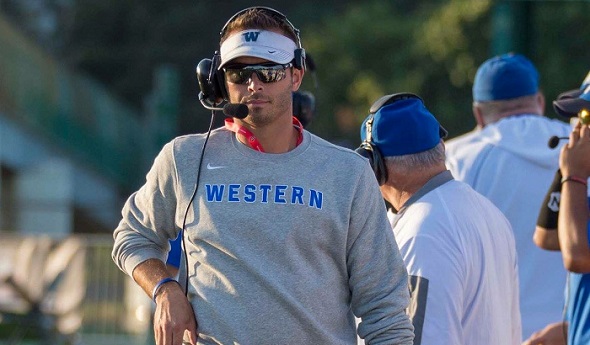
 The Grignon football family continued its progression in the coaching ranks this season when Alex Grignon got his shot at being a head coach. Grignon was hired in June as head coach at Walled Lake Western to replace Mike Zdebski, who resigned to take a coaching position in Arizona.
Alex Grignon, 31, represents the third generation from a family of past and present high school head football coaches. And one can’t talk football in Wayne County communities like Dearborn and Lincoln Park without mentioning the Grignon family.
Ted Grignon was the athletic director and head football coach at Lincoln Park in the 1980s. His two sons, Ted and Jamie, played football at Dearborn Edsel Ford and then in college – Ted, a quarterback at Western Michigan University and Jamie, a safety at Grand Valley State. Jamie Grignon is in his third stint as Lincoln Park’s head coach. He was hired in 1994 and stepped aside after the 1999 season, but never left the sport as he went to Dearborn High as an assistant under Dave Mifsud in 2000. Grignon went back to Lincoln Park in 2013 as the head coach and, after taking another brief hiatus, came back last season and remains in that position.
His two sons, Andrew and Alex, played for Mifsud at Dearborn; and in 2004, Alex’s senior season, Dearborn reached a Division 2 Semifinal before losing to Orchard Lake St. Mary’s, 6-0. It marked the first time the program advanced that far in the MHSAA Playoffs.
 Andrew switched sports and played lacrosse in college (at Grand Valley), but his younger brother stuck with football. After playing four years at Northern Michigan, Alex was a graduate assistant there working with the offense before joining his father’s staff at Lincoln Park.
The Railsplitters have had their struggles of late, starting this season 0-3 and last making the playoffs in 2015. But in 2013, with Jamie as the head coach and Alex as the defensive coordinator, Lincoln Park ended a 66-game losing streak by defeating Taylor Kennedy, 34-20.
After five seasons at Lincoln Park, Alex went to South Lyon last season as the offensive coordinator, and this season he made the big jump. Walled Lake Western is one of the top programs in the Detroit area and a member of the Lakes Valley Conference, and Grignon has the Warriors off to a 2-1 start.
“He was proud that he was the third generation (of head coaches),” Jamie Grignon said. “When he coached with me, it was a growing process for him. There isn’t anyone who works harder than Alex. Whether it’s watching film, working with the kids after practice or what. He’s full-go.”
Like father like son. Jamie is not one to toot his own horn, but when he was the defensive coordinator at Dearborn people in the Downriver area, and in other football strongholds in the county, knew Mifsud had one of the best coaches calling his defense.
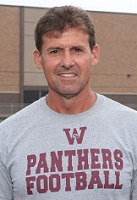
Mifsud is in his sixth season as the head coach at Parma Western after serving 16 in the same position at Dearborn. He was an assistant coach at Dearborn for four seasons before being named head coach in 1997.
 Remember those dates. Before Mifsud was able to hire Grignon, the two met as adversaries on the field. Lincoln Park defeated Dearborn, 14-0, during Dearborn’s homecoming, no less, in 1999. That was Grignon’s last season during his first stint at Lincoln Park.
Mifsud didn’t have to twist Grignon’s arm to join his staff at Dearborn. Grignon’s oldest son, Andrew, was set to play for Mifsud in 2000. Alex is two years younger, so Mifsud was secure knowing the Grignons had his back.
“I was in my fourth year when Andrew came through, I hired Jamie and Keith Christnagel, who’s the coach at Woodhaven now,” Mifsud said. “We grew up together, the three of us, as coaches. We racked our brains learning the ropes. I always coached the offense. Keith had the offensive and defensive lines and Jamie the defense. The working relationship with Jamie was excellent. We split up the special teams, though he probably did more there.
“People know of Jamie, and he worked his tail off. On Sundays I’d stop by, you know, just to drop some film off or just to touch base, and his entire dining room would be spread all around with notes on breaking down the other team’s offense and such. Jamie’s a high-energy guy. He’s always thinking.
“Looking at Alex, yeah, I think they are similar. They can’t sit still. They’re always looking for something better. What a great hire (for Walled Lake Western). Alex is so great with the kids. He’s young (31). He’s got great football intelligence. Jamie was like that. He would tweak things in practice. He’d never be satisfied. Alex has that. He’s Jamie but at a different level.”
Mifsud and Jamie Grignon both said that what makes Alex a cut above is his leadership. As good as Alex was athletically as a player, his father said it was his leadership qualities that set him apart.
 Mifsud recalled a story, a 2-3 week period, actually, during the 2004 season. The staff had yet to elect captains, and as preseason practices wore on Mifsud and his staff were taken aback by the actions of three seniors, Alex among them.
The coaches didn’t have to blow a whistle to start practice. Those three would have the players ready.
“I looked at my coaches,” Mifsud said. “And said those are our captains.”
Alex said he never thought about being a leader. It just came naturally. He grew up watching football from the sidelines, and later as a water boy, and then at home watching his father gather notes and dissect film footage.
“I was on the sidelines my entire life,” he said. “The leadership, you see it. You watch the players. You know what it takes to be a leader. I tell my players at Western, people want to be led.
“As a youth you don’t realize what level dad is coaching at, but you remember going to coffee shops exchanging film. I’d have my ninja toys with me, and the next minute I’d be holding dummies. Dad didn’t push us. He wanted us to do what we wanted to do. Heck, I was a big-time soccer player. I didn’t start playing football until middle school. For two years I did both.”
By his freshman year, Alex was all in for football. His was one of best classes the school has had for the sport, and Alex recalls that 40-50 of his classmates showed their dedication by increasing their work in the weight room.
Playing with his brother for two years and with his father for all four only made Alex more determined.
“I can’t talk football and family without getting emotional about it,” he said. “Watching your dad work 18 hours on the weekend, turning the pages of his legal pad, he was always doing something. I remember eating eggs for breakfast every day and peanut butter sandwiches for lunch to try and get as much protein in our bodies. I’d get up as a child, and he’d be on his third cup of coffee. He never stopped. He saw us wanting to be around the game, and he helped in any way he could to make us better.
“Everything I know, I’ve seen him do.”
 Tom Markowski is a columnist and directs website coverage for the State Champs! Sports Network. He previously covered primarily high school sports for the The Detroit News from 1984-2014, focusing on the Detroit area and contributing to statewide coverage of football and basketball. Contact him at [email protected] with story ideas for Oakland, Macomb and Wayne counties.
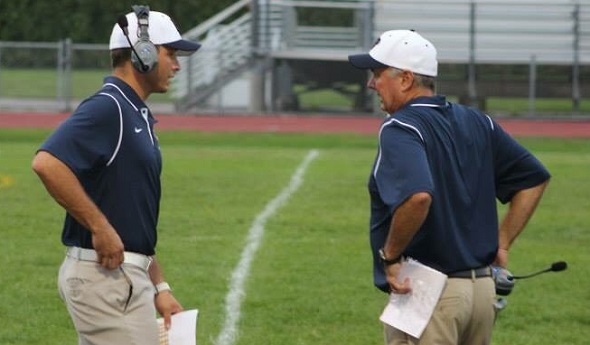
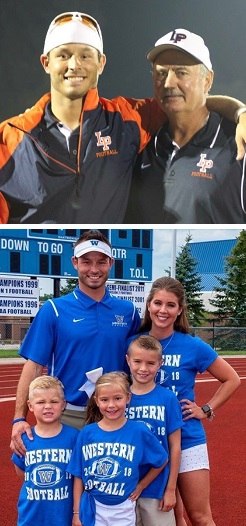
PHOTOS: (Top) Walled Lake Western coach Alex Grignon is in his first season as head coach at Walled Lake Western. (Top middle) Alex, left, and father Jamie Grignon when Alex was assisting Jamie at Lincoln Park. (Middle) Current Parma Western and former longtime Dearborn coach Dave Mifsud. (Below) Alex and Jamie Grignon, when both were coaching Lincoln Park, and Alex with his family now as coach at Walled Lake Western. (Photos courtesy of Grignon family; Walled Lake Western photos by Teresa Presty Photography.)