

'22 Game' Lasts 2 Plays, Lives on
By
Ron Pesch
MHSAA historian
October 26, 2015
What would you do with 22 seconds to right a wrong?
In Michigan, the longest football game in high school sports history was played on September 23, 1977 when Detroit Southeastern defeated Detroit Northeastern 42-36 in nine overtimes.
But what is the shortest?
On the evening of Thursday, Nov. 5, 1953, Eaton County foes Bellevue and Vermontville squared off in a Tri-C Conference battle. It was a home contest for Vermontville, but without illumination at its field, the game was staged just west beneath the lights at Nashville High School in Barry County.
The dominant team in Tri-C play over the previous three years, Bellevue’s Broncos had posted three consecutive undefeated seasons from 1950 and 1952. However, graduation took its toll and with only five returning veterans in the fall of 1953, Bellevue lost its nonconference season opener to Homer. The Broncos had also dropped a pair of league contests, to Lake Odessa and Olivet, just prior to the Vermontville game, and entered with a 4-3 record.
Vermontville brought a 4-2 mark into the contest, and was in a four-way tie with Bellevue, Nashville and Lake Odessa for second in the conference.
The Broncos and Wildcats were evenly matched and played to a scoreless tie in the first half. Vermontville opened up a 6-0 lead on a 20-yard end sweep by the Wildcats’ quarterback Pete Benton in the third quarter, but entered the final minutes of the game trailing 12-6 thanks to a TD run by Bellevue’s Jim Smith and an early-fourth quarter scoring pass from Smith to Bob Babbitt.
Coach Dave McDowell’s Wildcats mounted a long final drive, and fans strapped in for a thrilling finish. Pushing deep into Bellevue territory, Vermontville faced a fourth down and eight from the 16-yard line with under a minute to play when Benton launched a desperation pass to the end zone.
The pass fell incomplete, but Bellevue was flagged for pass interference. Officials stepped off the penalty and awarded Vermontville the ball at the one-yard line, but the Wildcats’ plunge into the line fell an inch short on what was called a repeated fourth down play. Vermontville took possession and ran out the clock.
Following the game, Coach McDowell protested the ruling to officials, correctly stating that his team should have been awarded an automatic first down and goal from the 1-yard-line on the penalty, according to high school rules. Appealing the call, the situation was brought to the attention of the league, MHSAA executive director Charles Forsythe and the MHSAA athletic board.
On Wednesday, Nov. 11, the state athletic board agreed an error had been made, but did not order a replay. Instead, they noted three possible solutions:
- Result left as it was.
- Called a no contest.
- Replay it at the point of infraction.
The board moved a final decision back to the league. Because of the possible impact on the final conference standings, and eventually, the awarding of the league’s all-sports trophy, the Tri-C Conference opted to replay the contest from the point of infraction – the 1-yard line – with 22 seconds placed on the clock.
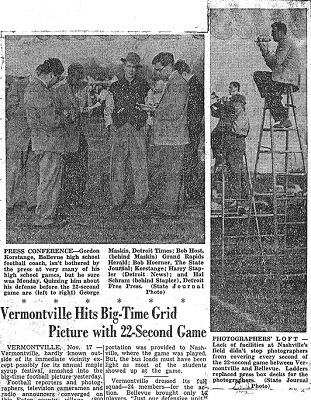 The news of the league’s decision was blasted out by the news services nationwide, and immediately, the pending replay of a small town contest captured the imagination of reporters and sports fans across the United States.
“Shortest ‘Game’ in History?” read the headline in the Lexington, Kentucky Herald. From Biloxi, Mississippi, to Boston, Massachusetts, from Rockford, Illinois to Omaha, Nebraska and Seattle Washington, sports aficionados read the news about the error. Best of all, details flowed forth on the plan to replay critical seconds that might alter the result, fulfilling every fan’s dream.
So began the longest huddle in history.
“What would you do?” was the question on the lips of coaches and followers in barber shops and factories. Detroit Free Press writer George Puscas asked that very question to some of Michigan’s top coaches.
Detroit Lions coach Buddy Parker offered his advice to Vermontville’s coach McDowell.
“The other team will be expecting a run,” noted Parker, “so I would fake a run off tackle then throw a pass in the other direction – with three receivers downfield.”
Michigan State’s legendary Biggie Munn stated the obvious:
“Call a scoring play.”
University of Michigan head coach Bennie Oosterbaan was tied up preparing for the Wolverines’ upcoming contest with MSU, so instead U-M end coach Bill Orwig weighed in with a tongue-in-cheek recommendation:
“Take the time out.”
Earl “Dutch” Clark, in charge at the University of Detroit, suggested that McDowell diagram “two of the most unusual offensive formations … anything to confuse the defense. The first play should be a running play and if it didn’t work, take time out then try again.”
Wayne University’s coach Lou Zarza was the most specific of them all.
“On a goal line stand, the defense usually drifts toward the middle. So I would fake the ball to the right halfback on a slant, then send the fullback with the ball wide to the right, outflanking the defense. It’s a good goal line play on the T formation.”
Suggestions came from all over. A gentleman in Syracuse, New York, even penned a personal letter to McDowell with a sure-fire suggestion.
Three days after the 1953 prep season had officially ended, on the afternoon of Monday, Nov. 16, the same officiating crew and the Vermontville and Bellevue squads emerged and again travelled to Nashville to line up for what can arguably be called the shortest – or perhaps the longest – game in high school football history.
Reporters from Detroit, Grand Rapids, Lansing and Battle Creek converged on the city for 22 seconds of football. High school reporting legends Hal Schram of the Detroit Free Press, Bob Hoerner of the Lansing State Journal, George Maskin of the Detroit Times, Harry Stapler of the Detroit News and writers from the Associated Press and United Press International all descended upon mid-Michigan, “almost as if the Rose Bowl was to be played.”
“That game brought more publicity to coach Gordon Korstange’s 6-3 squad then his teams received for posting three consecutive unbeaten seasons in 1950, 1951 and 1952,” recalled 80-year old Burton H. Brooks, who was the only reporter who had covered the original contest, and one of many covering the replay. A graduate of Bellevue, he was a freshman at Michigan State at the time, earning money as a sports stringer for the Bellevue Gazette and Charlotte Republican Tribune.
Beneath sunny skies, “a crowd of over 500 fans and curiosity seekers, most of them attired in shirt sleeves, lined the field on both sides near the east end of the Nashville gridiron,” wrote Brooks, many years later. “At 5:00 the shrill blast of an official’s whistle split the air, announcing time for the game.”
Attendance was way up from the original contest, and in an unusual move for the time, Kalamazoo television station WKZO announced that they would send a crew to Nashville and then televise the game – (all 22 seconds of it!) – Tuesday evening. In addition, 10 newspaper photographers were on site to capture images from the game.
While the size of the crowd was up, turnout on the football squads had decreased. Vermontville dressed its full squad of 24 for the showdown, but kept out two regular tackles and his first-string quarterback, as all had been on the injured list at the end of the first clash.
Meanwhile, Bellevue brought only 14 players.
“Just our defensive unit and enough to run back the kickoff,” Korstange told the Lansing State Journal, prepared for a situation that could arise if Vermontville scored.
“Three of the defensive starters had decided to go deer hunting instead,” said Brooks discussing the shortened game, “so Bellevue needed to call up some kids for the game from the junior varsity squad.”
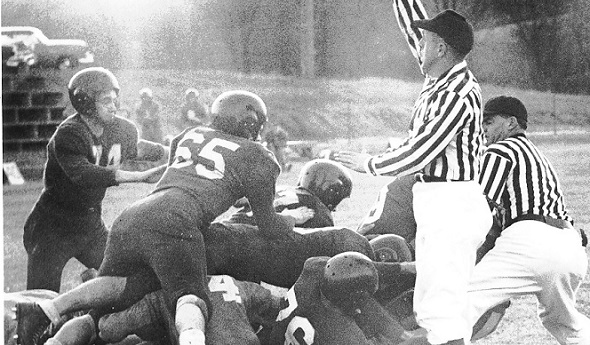
“Bellevue won its sixth game of the year, downing Vermontville in a sensational goal line stand in the famous ‘22’ Game” at Nashville last Monday,” wrote Brooks in the Bellevue Gazette. “Coach Dave McDowell’s Wildcats ran two plays against Bellevue, but couldn’t dent the solid Bronco defense. On the first play the Wildcats sent big Bob Steward up center, but he was driven back a yard by the entire center of the Bellevue line.”
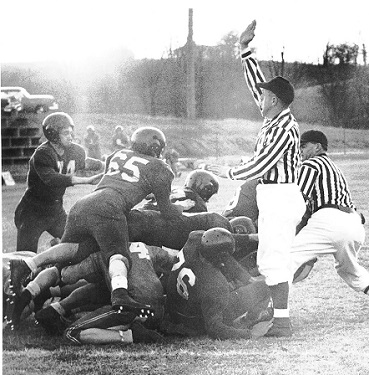 Following a timeout, the Green and White tried to sneak quarterback Pete Benton across the line to the left of center as the ball carrier on the second play, but the hole was quickly plugged by tackle Donald Rogers and guard Jerry Babbitt. Steward had been stopped by Bellevue guard Wayne Lesser. Dale Spotts, Bob Babbitt, Harold Messenger, Ralph Hales, Dick Moon, Jim Smith, Gordon Smith, and Ed Bessemer filled the other defensive spots and ensured the result of the first game went unchanged.
Once again, the wire services blasted their report from sea to shining sea.
“Officials Didn’t Rob Vermontville Team” screamed the headline in the Miami Daily News. Beneath an AP photo, residents of the Florida town were treated to a detailed account of the contest.
“Prep Grid Game Ends Same Way Following 11-Day Break” read the caption in the Dallas Morning News in football-crazed Texas.
“Replayed Grid Game Ends with the Same Result as Before,” read the headline in the Seattle, Washington, Daily Times.
As noted at the time, it certainly wasn’t the first, nor would it be the last, that a refereeing crew made a mistake in a game. Fans then, like now, were reminded officials are only human.
Bellevue ended the extended season in a tie for second with Lake Odessa, with 5-2 marks. For the first time in league history the Tri-C gridiron championship was awarded to Olivet, which, at 8-0, posted its first unbeaten season and, as it turned out, unseated Bellevue for the league’s 1953-54 all-sports trophy.
More than 60 years later, a forgotten showdown between high school football teams, played out before national attention in little Nashville, Michigan, still stands as one of the most entertaining and unusual sports moments in the history of America.
 Ron Pesch has taken an active role in researching the history of MHSAA events since 1985 and began writing for MHSAA Finals programs in 1986, adding additional features and "flashbacks" in 1992. He inherited the title of MHSAA historian from the late Dick Kishpaugh following the 1993-94 school year, and resides in Muskegon. Contact him at [email protected] with ideas for historical articles.
PHOTOS: (Top and below) What's believed to be a Battle Creek Enquirer photo shows one of the goal line stands by the Bellevue defense against Vermontville. (Middle) The Lansing State Journal reported on the nationwide reporting of the "22-second game."
Drive Complete: 2017 Finals in Review
November 27, 2017
By Geoff Kimmerly
Second Half editor
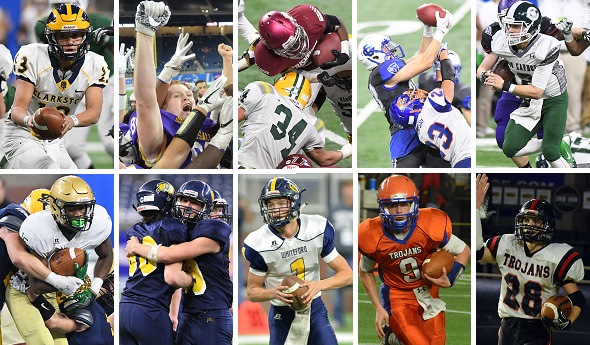
Every November, the MHSAA Football Finals give players, coaches and fans an opportunity to see what everyone else has been talking about.
 These last two weekends were no different. We saw powers restored and others emerging. We witnessed two first-time winners finish perfect seasons and another champion win for the fifth straight year. We enjoyed performances from some of the talented stars we’d only read about, and encores by others returning to the championship round – including the now-winningest coach in Michigan high school history.
Second Half covered all 10 championship games last weekend at Ford Field and two weekends ago at the Superior Dome, with quick recaps and links (click on the game scores) to those stories below followed by notations of performances entered into the MHSAA record book and a report on some of the biggest and best stories to emerge from the 2017 Finals.
Finals in Review
11-Player Division 1: Clarkston 3, West Bloomfield 2
This one had an intriguing circumstance from the start: West Bloomfield, playing its first Final, had tied for first and Clarkston finished third in the Oakland Activities Association Red during the regular season with the Lakers beating the Wolves 37-16 in Week 4. The rematch ended with the second fewest points scored in MHSAA Finals history.
11-Player Division 2: Warren DeLaSalle 41, Livonia Franklin 6
DeLaSalle took its lead 16 seconds into the game on a fumble return touchdown and never slowed down in winning its second championship in four seasons. Franklin, playing in its first title game since 1975, had turnovers on three of its first four possessions (and a turnover on downs to end the other one) and never got rolling again.
11-Player Division 3: Muskegon 28, Farmington Hills Harrison 10
Muskegon won its first championship since 2008 after finishing runner-up four of the last five seasons. The Big Reds finished one of the most impressive runs in recent playoff history, winning on average by 37 points over its five postseason victories. Harrison – led by all-time winningest coach John Herrington – did give Muskegon one of its toughest tests.
11-Player Division 4: Grand Rapids Catholic Central 42, Edwardsburg 31
After winning a 2016 Division 4 title game that saw only 17 points scored between the two teams, GRCC repeated in a game featuring 73. The Cougars came back from an early deficit as standout running back Nolan Fugate put together one of the top rushing performances in Finals history. The Eddies were playing in their first championship game and made this arguably the most entertaining of the weekend.
11-Player Division 5: Grand Rapids West Catholic 34, Saginaw Swan Valley 7
Grand Rapids West Catholic tied two more programs by winning its fifth straight MHSAA championship, jumping out to a 34-0 lead led by three-year quarterback Gaetano Vallone and a number of others who have contributed to multiple titles. Swan Valley was making its first Finals appearance, but will be a strong candidate to return next fall.
11-Player Division 6: Jackson Lumen Christi 40, Ithaca 34
What was expected to be one of the most competitive Finals didn’t disappoint, as the Titans came back from a 13-8 halftime deficit to repeat. They put up some of the biggest rushing numbers in championship game history to offset the dual danger posed by Ithaca quarterback Joey Bentley, who threw three touchdown passes in the fourth quarter as the Yellowjackets worked for a chance to win.
11-Player Division 7: Pewamo-Westphalia 21, Saugatuck 0
These teams met in the playoffs for the third straight season but first in a championship game. P-W, despite losing quarterback/defensive end Jimmy Lehman to a hand injury near the end of the second quarter, hung on through a scoreless second half to repeat as champion.
11-Player Division 8: Ottawa Lake Whiteford 42, Saginaw Nouvel 21
Whiteford returned after finishing runner-up in 2016 to claim its first MHSAA football championship. The Bobcats got on the board before the first minute was over and totaled 484 yards as quarterback Thomas Eitniear and running back Logan Murphy both ran for three touchdowns.
8-Player Division 1: Central Lake 32, Deckerville 30
Central Lake came back from 2-7 last season, its last in 11-player, and 10 points down during the second half of this game to win its first MHSAA football championship and first in any sport since 1980. The Trojans went ahead to stay with 2:49 to play.
8-Player Division 2: Crystal Falls Forest Park 54, Portland St. Patrick 12
The Trojans claimed their first championship since 2007 and first as an 8-player program, but in similar style as their 11-player winners. Forest Park ran for 481 yards and built a 30-point lead by halftime.
Record Report
Clarkston’s three points against West Bloomfield tied the record for fewest by a winning team (with Ann Arbor Pioneer’s 1987 team) and the five points scored between the teams ranked as the second fewest for a Final. The two also combined to tie the record for most punts, with 14, with Clarkston’s Jermaine Roemer tying the individual Finals record with eight.
 Brandan Madigan made the “quickest touchdown” list by returning a fumble return 13 yards for a touchdown 16 seconds into Warren DeLaSalle’s Division 2 win. Warren DeLaSalle also tied for the third-most points in a quarter, putting up 31 during the second in its win over Livonia Franklin.
Warren DeLaSalle’s Riley Garrison and Grand Rapids West Catholic’s Liam Putz both drilled two field goals, joining seven others who have done the same (two hold the record at three field goals). Garrison also made the extra points list with five on five tries.
Farmington Hills Harrison broke the record it previously held with Detroit Catholic Central by playing in an 18th MHSAA championship game, this its first since 2010. The MHSAA Football Playoffs began in 1975.
Muskegon sits 11th with 10 MHSAA Finals appearances and moved up to tied for 10th with six championships. La’Darius Jefferson earned multiple entries with his 245 yards and four touchdowns rushing, tying for fourth-most points (24) in one Final, third most total touchdowns and also rushing touchdowns in a game and eighth most rushing yards.
Harrison’s Ben Williams earned entries for his 91-yard opening kickoff touchdown, both among the longest kickoff returns and fastest touchdowns (16 seconds into the game) scored in a Final.
Nolan Fugate capped his career with one more jaw-dropping rushing performance. The Grand Rapids Catholic Central running back ran for 306 yards, one shy of tying the Finals record, and his 392 total yards ranked seventh all-time. He did tie Finals records with five touchdowns and 30 points and tied for third with four rushing scores. Kicker Alec Winden tied for the fourth-most extra points making all six of his tries.
Edwardsburg also took home two Finals records, as Nick Bradley tied the longest running play with a 90-yard touchdown dash; his run equaled Nick Williams’ for Farmington Hills Harrison in 1994. Caden Goggins tied the 2014 record set by Tommy Scott of Muskegon Catholic Central by bringing a kickoff back 99 yards for a touchdown.
Grand Rapids West Catholic moved up lists with its eighth MHSAA Finals appearance and sixth championship, and into a first-place tie with a fifth-straight title. Farmington Hills Harrison 1997-2001 and East Grand Rapids 2006-2010 also won five consecutive Finals. Grand Rapids Catholic Central also moved up the Finals appearances list with its seventh, while Jackson Lumen Christi is tied for eighth most with 12 and Ithaca added its seventh as well. Lumen Christi’s championship was its 10th, good to tie for the sixth-most titles.
Jackson Lumen Christi became the third team to rush for more than 500 yards in a Final, its 514 yards the third most and its 67 carries second. Sebastion Toland ran for 244 yards – ninth-most by one player – and teammate Kyle Minder made that list with 206 yards. The team’s 523 yards of total offense tied for fifth most, and its 24 first downs tied for eighth.
Ithaca’s Joey Bentley made his last game another great one, even in defeat. His four touchdown passes tied for fifth-most in a championship game, and his 329 total yards of offense – 89 rushing, 240 passing – also earned a record book entry.
Ottawa Lake Whiteford’s offense impressed to open Finals weekend, tying for third with six rushing touchdowns and becoming the latest of 24 teams that did not punt in a championship game.
Crystal Falls Forest Park set an 8-Player Finals record with 481 yards on the ground, rushing 52 times without throwing a pass. Peter Ropiak had the second-most yards in one game, 275 on 16 carries, while backfield mate Connor Bortolini was added for scoring 26 points on four rushing touchdowns and a two-point conversion. Ropiak’s total yards also qualified in the total offense category, and the team’s eight rushing touchdowns also set a record.
Central Lake made the rushing list with 316 yards in its 8-Player Division 1 win over Deckerville, and also the first downs list with 21.
Portland St. Patrick’s Colin Cook was added for seven punts in the 8-Player Division 2 game against Forest Park. Cook averaged 34.1 yards per punt with a long of 63.
Stories behind the scores
Repeat again: For the second straight season, there were four repeat champions at the 11-Player Finals – this time, as noted above, Grand Rapids Catholic Central in Division 4, Grand Rapids West Catholic in Division 5, Jackson Lumen Christi in Division 6 and Pewamo-Westphalia in Division 7. Also noted above, West Catholic next fall will attempt to become the first team in MHSAA football history to win six straight titles.
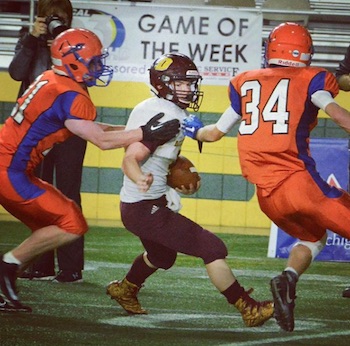 First-time celebrations: Ottawa Lake Whiteford in 11-Player Division 8 and Central Lake in 8-Player Division 1 claimed their first championships, showing off powerful running games against opponents who had won championships previously – Whiteford over Saginaw Nouvel and Central Lake over Deckerville.
Running ran the day(s): In an era of wide-open spread offenses, power running ruled the 2017 Finals. Start with Whiteford and Central Lake mentioned above; Crystal Falls Forest Park set an 8-Player Finals record for rushing while Jackson Lumen Christi put rushers on the all-time record book list for the second straight season. Muskegon threw two passes and didn’t complete any in running away in Division 3, and the Division 4 Final between GRCC and Edwardsburg featured a combined 675 rushing yards.
We may never see this again: Clarkston’s 3-2 win over West Bloomfield was the lowest-scoring Final in 30 years, but how the teams got to five total points might end up rarer. Clarkston’s points, of course, came on a field goal by Roemer from 30 yards out on the final play of the second quarter. But to that point, West Bloomfield led for 15 minutes thanks to a safety when a punt snap sailed through the end zone. For unrelated comparison’s sake, two of our four Baseball Finals in the spring were higher scoring, and only one was decided by the same close margin.
Hawks’ last stand: Farmington Hills Harrison finished something of an unexpected run by playing in its 18th MHSAA football championship game, capping the season that saw Herrington become the winningest coach in state history with a 435-108-1 record. The school will close in spring 2019, and Herrington will coach the final season next fall; he has served as coach since the school opened in 1970. Harrison’s enrollment likely will fall without the usual underclassmen next year – which could make the Hawks an interesting contender staying in Division 3 or moving into Division 4 or 5.
The MHSAA Playoffs are sponsored by the Michigan Army National Guard.