

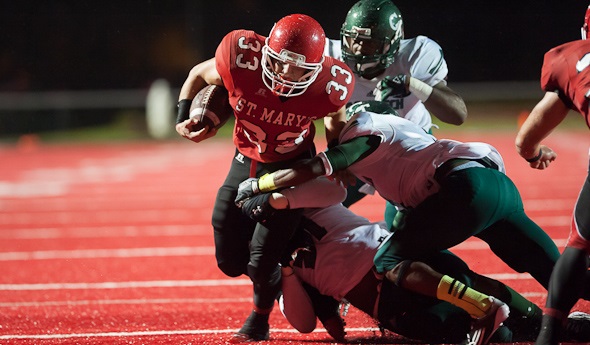
Behind Scenes, St Mary's Goes to Goddard
September 27, 2016
By Keith Dunlap
Special for Second Half
As a coach and athletic director at Orchard Lake St. Mary’s over nearly three decades, George Porritt has been asked plenty of times to recall details from his football program’s storied past.
 That comes with coaching a program that annually has a roster full of highly-touted high school players coveted by college recruiters and has seen the best not only shine for prominent college programs but also NFL organizations (see Allen Robinson of Jacksonville).
“When was the last time a player did that?”
“What is the school record in this category?”
“How often has your team done this in a season?”
“When was the last time you lost to this opponent?”
Porritt’s answer is usually quick and consistent.
“Ask Robin Goddard,” Porritt typically says.
For the past 40 years, turning to Goddard has been a frequent option for anyone around St. Mary’s, and for that matter, other schools around the state.
It is why there will be lots of people in the prep sports community thinking of him when he has surgery on Thursday to break up kidney stones that have been bothering him during recent weeks.
Goddard each year puts together media guides with records and teams at St. Mary’s that go all the way back to the early 1900s. (See "Michigan's Football Past: A Must Read")
He can easily point out the fact that St. Mary’s won a state basketball championship in 1933, lost in the state basketball semifinals in 1919 and won its first state baseball championship in 1913. (Note: The MHSAA was not formed until Dec. 1924; previous championship tournaments were hosted by various entities around the state.)
“If he doesn’t have it in something, he finds it right away,” Porritt said. “He goes to the library and he tries to dig it up. He calls the other school and has done it for years. He keeps a great history of our school.”
Surely though, there have to be times when people raise their eyebrows at Goddard and wonder how he can possibly get accurate information from a century ago, right?
Actually, not really.
Not around St. Mary’s, anyway, even if it is hard to fathom for many others that high school sports in Michigan actually did exist before the start of World War I.
“I won’t even challenge him,” Porritt said. “I know he found it somewhere. He’ll tell other schools what their records are historically, and they don’t even know what theirs is. He has fun doing it and will go anywhere and find any way to find out the history of whatever he is looking into.”
Goddard’s importance to the school isn’t limited to being arguably the Encyclopedia Britannica of prep sports in the state of Michigan.
Also a facilities coordinator and valuable fundraiser, Goddard has spearheaded projects to put a track and lights at the football field, and was the architect of one of the most ambitious and out-of-box ideas ever seen at the school – the red artificial playing surface now on the football field.
 During Labor Day weekend in 2011, Goddard flew to Cheney, Wash., to meet with officials at Eastern Washington University, which at the time had the only red-colored artificial football field in the country.
Goddard picked the brains of the folks at Eastern Washington, came home and started a fundraising effort to try and secure $600,000 to bring a red-colored artificial surface to St. Mary’s.
By the following spring, the funds were raised and construction began on the field that was ready by the start of the 2012 season.
At the time, it was the third red-colored field in the country in addition to Eastern Washington and a high school field at Canyon High School in Texas.
Goddard also helped start the annual Polish Country Fair that takes place on the St. Mary’s campus every Memorial Day weekend, which is one of the most regularly-attended festivals in the Detroit area.
Len Karschnia, an administrator and assistant coach for the both the football and basketball teams at St. Mary’s, said when Goddard gets in touch with alums who have the means to donate back to the school, there usually is no hesitation because of their respect for Goddard.
“They always trust Robin to do that,” Karschnia said. “Everything he does (is) for the kids and the school, and that is why nobody is really reticent to give back to any projects that he runs because if he tells you on Tuesday he wants $500 to put up a banner in the gym, on Thursday the banner is up and done and there is a plaque on the wall saying thanks to whoever gave it to him.”
A staple at the school since he arrived in 1976, there obviously will be a lot of prayers and well-wishes around the state for a speedy recovery from surgery.
“He is a guy that whatever St. Mary’s needs, he’ll do it and he doesn’t need any fanfare for his good deeds,” Karschnia said. “It’s all for the kids, for George and for the school. That is really his value.”
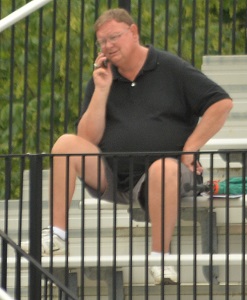
PHOTOS: (Top) Orchard Lake St. Mary's takes on Detroit Cass Tech on its home red turf in 2012. (Middle) Tucked away in the McLane Stadium bleachers, Robin Goddard watches the Eaglets' run to the 2015 Division 2 baseball championship. (Top photo by Terry McNamara.)
1st & Goal: 2024 Week 9 Review
By
Geoff Kimmerly
MHSAA.com senior editor
October 28, 2024
Wow. The 2024 football regular season did not go quietly.
 Between multiple matchups of undefeated teams, several league championships being decided, and final maneuvering to get into the field of the 50th MHSAA Football Playoffs, there was a lot to follow – with the final moves still being made late Saturday afternoon.
Below we glance at several of the highlights, and Friday we'll move into playoff mode as we preview the first round of this season's tournament.
Bay & Thumb
HEADLINER Midland 17, Midland Dow 6 Midland High (8-1) locked up one of the final league championships still in question, finishing an outright title run in the Saginaw Valley League Blue when a Dow win would have given the Chargers (5-4) a share. The Chemics also avenged two losses to Dow from 2023, from the regular-season finale and first week of the playoffs, and they could meet again this postseason as well if both win first-round games this week. Click for more from the Midland Daily News.
Watch list Almont 49, Detroit Edison 24 Almont (9-0) enters the playoffs as the No. 1 overall seed in Division 6, holding down the top spot for the third-straight week with this win over Edison (6-3), which entered Week 9 No. 6 on the Division 6 playoff list. The Raiders had last finished a regular season 9-0 in 2019.
On the move Davison 48, Lapeer 28 The Cardinals (7-2) cemented second place in the SVL Blue, but more importantly moved ahead of Oxford to earn a home game in their Division 1 matchup this week. Marine City 37, Detroit Central 15 The Mariners finished second in the Macomb Area Conference Silver this season but defeated a co-league champion in Central (6-3) to hold onto the No. 4 spot on the Division 6 playoff list. Frankenmuth 41, Gladwin 14 The Eagles (9-0) wrapped up a fourth perfect regular season over the last half-decade with a second-straight win over Gladwin (6-3).
Great Detroit
HEADLINER Detroit Catholic Central 23, Detroit Martin Luther King 7 DCC’s Jaden Pydyn starred in this Prep Bowl showcase game at Ford Field, running for two touchdowns and scoring a third on an interception return. The Shamrocks moved to 9-0, completing their first perfect regular season since COVID-shortened 2020 and first at 9-0 since 2016, and they sit second on the Division 1 playoff list. King finished 6-3 and moved down only one spot on the Division 3 list to No. 7. Click for more from Hometown Life.
It was the Jaden Pydyn show for Detroit Catholic Central against Detroit King. Two rushing touchdowns and a pick-6 in their 23-7 win on October 26th, 2024. Delivered by @hungryhowies.@jadenpydyn | @dccfootball | @detroitccad | @jcessante pic.twitter.com/2ANzcTKgNa
— STATE CHAMPS! Michigan (@statechampsmich) October 27, 2024
Watch list Romeo 14, Grand Blanc 13 This one was a stunner as Grand Blanc (7-2) had just clinched the SVL Red title the week before and Romeo (4-5) was six spots from falling out of the Division 1 playoff field. Instead, Romeo moved up to No. 19 and earned a rematch with Week 3 opponent Utica Eisenhower.
On the move Macomb Dakota 28, Oxford 0 Dakota (8-1) won a meeting of league champions, adding to its shared title in the MAC Red by shutting out the Oakland Activities Association Red-winning Wildcats (6-3). Clarkston 32, Utica Eisenhower 3 Clarkston (6-3) finished tied for second in the OAA Red and dominated its matchup with the other co-champion from the MAC Red, sending Eisenhower to 7-2. Macomb Lutheran North 17, Clarkston Everest Collegiate 14 (OT) Lutheran North (8-1) completed its most successful regular season since posting the same record in 2006, adding the Catholic High School League Cardinal championship by handing Everest (8-1) its only loss.
Mid-Michigan
HEADLINER Howell 30, Belleville 29 Howell finished 9-0, concluding its first perfect regular season since 1963 (according to Michigan-Football.com) and after going only 3-6 a year ago. The Highlanders retained the No. 1 position on the Division 1 playoff list for the third straight week. So to call this a shocker seems at least a little absurd, but Belleville (8-1) hadn’t lost a regular-season game since Week 3 of 2021 and has played in three straight Division 1 Finals and won the last two. Justin Jones’ touchdown grab from Preston Barb with eight seconds to play clinched the overall Kensington Lakes Activities Association championship and was called by the Howell Football’s X feed “the biggest play in the history of Howell football.” Click for more from the Livingston Daily Press & Argus.
ICYMI: Howell junior quarterback Preston Barb with the game-winning TD pass to senior Justin Jones with 8 seconds left as the Highlanders beat Belleville 30-29 in the KLAA Championship Game. @MHSAA | @FootballHowell | @HowellAthletics | @PRESTONBARB3 | @JT_Jones25 pic.twitter.com/G72xT4ZHaR
— STATE CHAMPS! Michigan (@statechampsmich) October 26, 2024
Watch list Leslie 35, Hanover-Horton 14 The Blackhawks (8-1) have gone from not posting a winning season since 2012 to claiming the overall Cascades Conference championship by handing Hanover-Horton (8-1) its only defeat.
On the move Belding 40, Hopkins 0 In a winner-take-all for the Ottawa-Kent Conference Silver title, Belding (8-1) did so for the third straight season, running its league winning streak to 17 games and sending the Vikings to 6-3. Fowler 35, McBain 28 The Eagles (9-0) completed their first perfect regular season since 2014 and are No. 3 on the Division 8 playoff list after handing Division 7 McBain (8-1) its only defeat. Mason 43, Fenton 0 Mason (7-2) won a matchup of league champions and moved up to No. 8 on the Division 3 playoff list as it begins a quest to reach Ford Field for the second-straight season.
Northern Lower Peninsula
HEADLINER Boyne City 23, Traverse City St. Francis 20 Ryan Spate’s 35-yard field goal with five seconds to play turned an outright league championship for St. Francis (6-3) into a three-team share that included the Ramblers (7-2) and Kingsley in the Northern Michigan Football League Legends. The win was Boyne’s first over the Gladiators since 2017. Click for more from the Petoskey News-Review.
Watch list Maple City Glen Lake 35, Mancelona 0 The Lakers (8-1) completed an outright championship in the NMFL Legacy and sit No. 8 on the Division 8 playoff list with their only loss this season to Division 6 Reed City.
On the move Traverse City West 23, Traverse City Central 7 The Titans (6-3) capped their best regular-season finish in three years with their second-straight win over rival Central (4-5). Petoskey 42, Clare 21 Petoskey won this matchup of league champions to finish 9-0 for the first time since 1974. Clare is 7-2 with its only losses to league title winners. Kingsley 47, Charlevoix 28 The Stags received a piece of the NMFL Legends title thanks to Boyne City’s win, and also moved up to No. 13 on the Division 6 playoff list for downing the Rayders (6-3).
Southeast & Border
HEADLINER Dexter 35, Chelsea 6 The Southeastern Conference Red-winning Dreadnaughts (9-0) claimed this matchup of league champions after jumping to a 21-0 first-quarter lead against the SEC White-clinching Bulldogs (7-2). In doing so, Dexter also avenged last season’s 31-21 loss to Chelsea. Click for more from the Ann Arbor News.
Watch list Pinckney 12, Ann Arbor Pioneer 7 Including the first four games of this season, Pinckney (5-4) had lost 13 straight before winning their last five games this fall with this one clinching a Division 4 playoff berth. The Pirates jumped six spots to No. 30 on that division’s playoff list.
On the move Jackson Lumen Christi 39, Kalamazoo United 21 Lumen (8-1) impressed in another CHSL Prep Bowl showcase game, handing another league champion in United (7-2) just its second defeat. Saline 8, Lake Orion 7 Saline (6-3) scored and added a two-point conversion during the final minutes of the fourth quarter to get past the Dragons (6-3). Ida 23, Clinton 14 Ida (8-1) secured second place in the Lenawee Country Athletic Association and sent Clinton (6-3) into third, and ended a three-game losing streak against the Redwolves.
Southwest Corridor
HEADLINER Kalamazoo Central 20, Kalamazoo Loy Norrix 10 The most consequential meeting of these rivals in some time went to Central (6-3), which not only clinched the Southwestern Michigan Athletic Conference East title outright but jumped five spots to No. 32 in Division 1 to secure a first playoff appearance since 2018 (not counting COVID-shortened 2020, when nearly all teams qualified). Loy Norrix missed the playoffs, but at 5-4 posted its best finish since 1998. Click for more from WWMT.
Watch list St. Joseph 15, Portage Central 0 Despite losing a Week 7 contest to Mattawan, St. Joseph (8-1) clawed back to shut out Portage Central and share the SMAC East championship with the Mustangs (6-3). The shutout was St. Joseph’s third over the last seven weeks and avenged last year’s loss to Central.
On the move Niles 21, Paw Paw 0 Niles (8-1) finished a second-straight perfect run through the Wolverine Conference, posting its second-straight shutout this month and fifth of the season in this winner-take-all matchup. Paw Paw also is 8-1 and will travel back to Niles this weekend for a Division 4 playoff opener. Stevensville Lakeshore 28, Portage Northern 13 Despite losing its first six games this season, Lakeshore (3-6) won its final three and will return to the playoffs after facing six opponents that finished with winning records including Northern (5-4). Buchanan 17, Union City 7 The Bucks (6-3) jumped from a precarious No. 31 spot on the Division 6 list all the way up to No. 22 with this win over a league champion in Union City (8-1).
Upper Peninsula
HEADLINER Kingsford 27, Marquette 17 Kingsford (9-0) defeated a longtime rival to finish a first perfect regular season since 2002, and by downing the Division 2 Sentinels moved all the way up to No. 4 on the Division 5 playoff list. The Flivvers have won three straight over Marquette, which finished 6-3. Click for more from the Iron Mountain Daily News.
Watch list Iron Mountain 35, Negaunee 21 The Mountaineers (9-0) completed their second-straight perfect regular season with a second-straight win over Negaunee (6-3), and in doing so moved up to No. 8 on the Division 8 playoff list and secured home games through the Regional Final should they continue to advance.
On the move Escanaba 50, Gladstone 7 Escanaba (5-4) won its final two games to finish this season with as many victories as the last three combined. Calumet 51, L’Anse 6 The Copper Kings (6-3) have fallen between Nos. 26-32 on the Division 6 playoff list the last four weeks but secured the No. 30 spot and a place in the bracket with this fourth-straight victory this season. Menominee 41, Bark River-Harris 0 The Maroons bounced back from a two-point loss to Kingsford in Week 8 to close out its best regular season since 2016 and move into the No. 2 spot on the Division 7 playoff list as they too work to get back to Ford Field for the second consecutive November.
West Michigan
HEADLINER Coopersville 35, Cedar Springs 21 The first-year River Cities Alliance put four of seven teams into the playoffs, making Coopersville’s shared league championship with Lowell even more impressive. The title was the Broncos’ first since 2007 and came as the program also has celebrated its 100th season. Coopersville is 6-3, and Cedar Springs (7-2) would have shared the title instead with a win. Click for more from the Grand Rapids Press.
Coopersville Claims Their First RCA Title With Their 35-21 Victory Over Cedar Springs!
🎥 : WXMI@MHSAA pic.twitter.com/MQAn6wCc50— STATE CHAMPS! Michigan (@statechampsmich) October 27, 2024
Watch list Hudsonville Unity Christian 43, Pontiac Notre Dame Prep 28 Unity Christian (9-0) has owned the No. 1 spot on the Division 4 playoff list the last five weeks and impressed yet again sending Notre Dame Prep (7-1) from No. 1 to No. 2 on the Division 5 list.
On the move Grandville 49, Caledonia 20 Grandville (5-4) plowed into the Division 1 playoffs with two straight wins to cap the regular season and kept Caledonia (4-5) from making a final move up the Division 2 list. Grand Rapids South Christian 26, Grand Rapids Catholic Central 20 The Sailors (5-4) were able to secure a place in the Division 4 field by avenging last year’s loss to the Cougars (5-4) to break a four-game losing streak. Zeeland West 34, Grand Rapids West Catholic 20 The Dux (8-1) will bound into the Division 3 playoffs coming off this win over the O-K White champion Falcons (6-3).
8-Player
HEADLINER Powers North Central 45, Crystal Falls Forest Park 34 The latest chapter in this rivalry saw the Jets claim the Great Lakes Eight Conference West championship outright via this winner-take-all matchup. North Central has won seven straight over the Trojans, this time scoring the most points Forest Park (8-1) has given up this season and holding the Trojans to their second-fewest. Click for more form the Iron Mountain Daily News.
Watch list Deckerville 50, Alcona 42 Deckerville (9-0) faced one of its few challenges this fall – and prevailed impressively once again to finish a regular season undefeated for the first time since 2019. The Eagles remained on top of the Division 1 playoff list as Alcona (8-1) fell one spot to No. 3 with its first defeat.
On the move Indian River Inland Lakes 50, Gaylord St. Mary 8 Inland Lakes (9-0) has never lost a league game in 8-player and wrapped up its fourth-straight Ski Valley Conference title in this winner-take-all with the Snowbirds (7-2). Climax-Scotts 63, Pittsford 14 Climax-Scotts also impressed again in this matchup of league champions, moving to a combined 18-1 over the last two seasons after losing only its opener this fall. Kingston 26, Marion 22 The Cardinals (7-2) showed more of the power of the Big Thumb Conference Blue. They finished third as Deckerville won the league and Brown City was runner-up this fall, but closed the regular season by handing Marion (8-1) its lone loss.
MHSAA.com's weekly “1st & Goal” previews and reviews are powered by MI Student Aid, a division within the Department of Lifelong Education, Advancement, and Potential (MiLEAP). MI Student Aid encourages students to pursue postsecondary education by providing access to student financial resources and information. MI Student Aid administers the state’s scholarship and grant programs that help make college Accessible, Affordable and Attainable for you. Click to connect with MI Student Aid and find more information on Facebook and Twitter @mistudentaid.
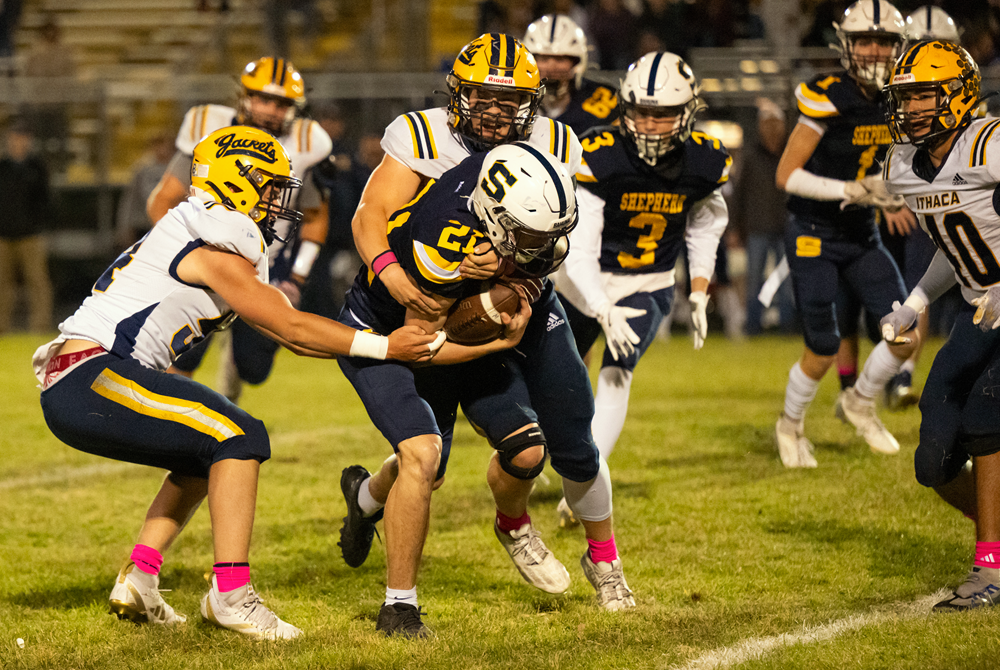
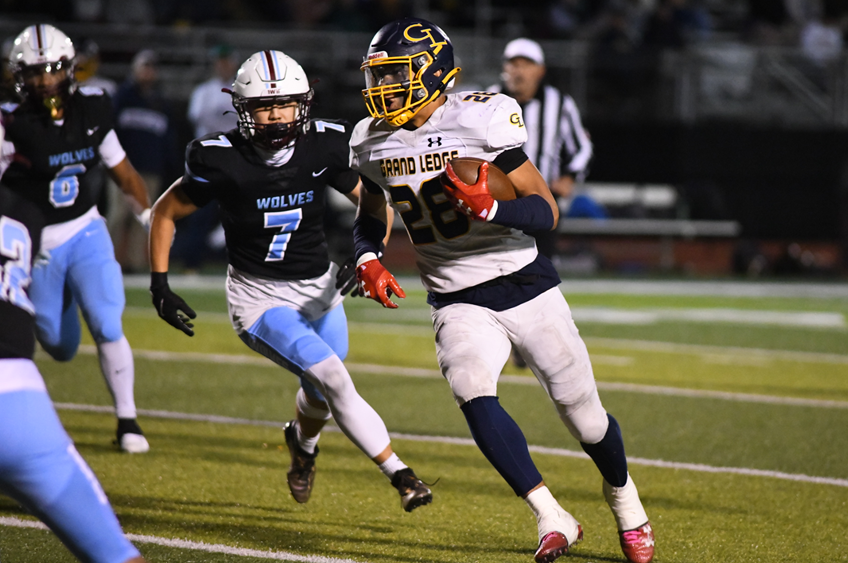
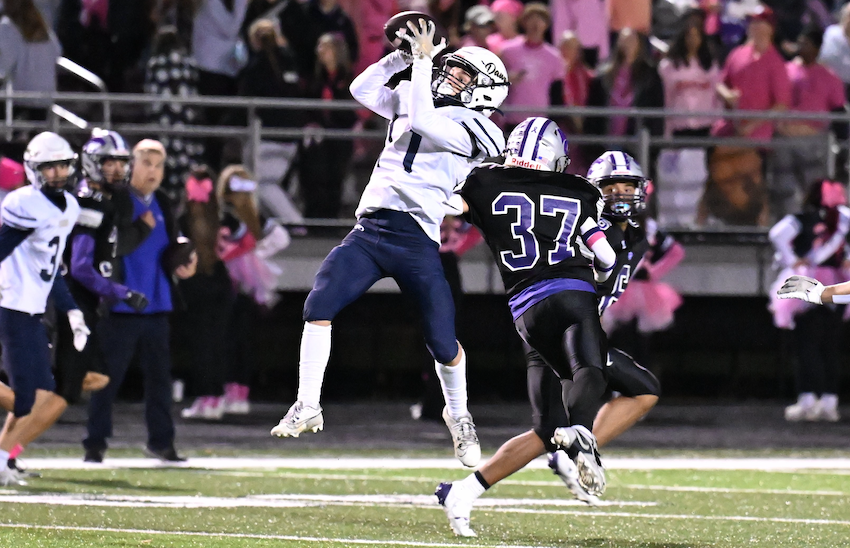
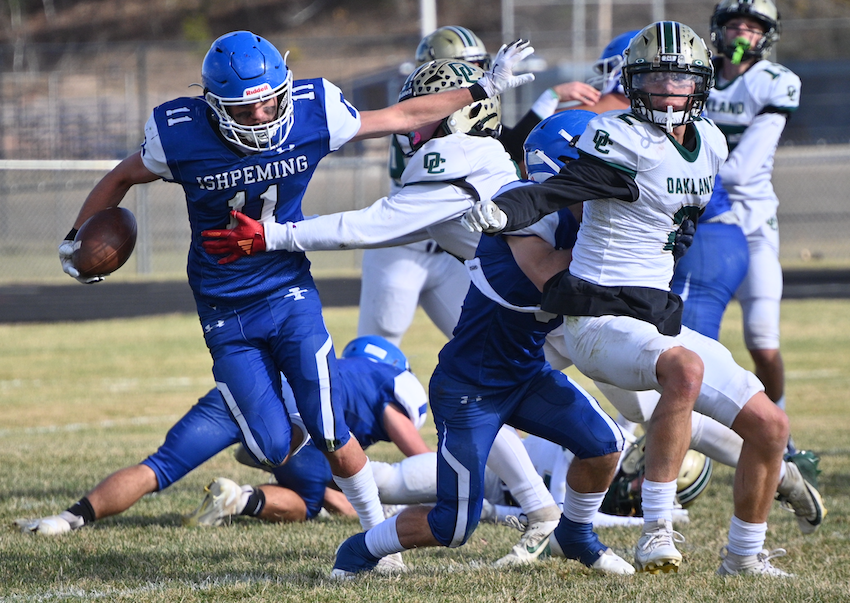
PHOTOS (Top) Ithaca defenders converge on a Shepherd ball carried during the Yellowjackets' 43-0 win Friday to finish 9-0. (2) Grand Ledge's Anthony Baker (28) finds a crease as Okemos' Sean Cho (7) pursues during the Comets' 46-10 win. (3) An Otsego player pulls in a pass during the Bulldogs' 17-7 win over Three Rivers. (4) Ishpeming's Ethan Corp works to get past an Auburn Hills Oakland Christian defender Saturday during the Hematites' 58-6 victory. (Top photo by High School Sports Scene. Grand Ledge/Okemos photo by John Johnson. Otsego/Three Rivers photo by Gary Shook. Ishpeming/Oakland Christian photo by Cara Kamps.)